2000 Les Forts de Latour & 2000 Clos du Marquis
After the Leoville Poyferre vertical, we adjourned to Jade Palace for a simple but sumptuous dinner. You can’t go wrong with this place; its Cantonese cuisine can hold its ground against any competition, service is prompt and attentive, and most importantly, the stemware (Riedel) and wine service are impeccable. Wines are decanted and labeled, no questions asked. 
Although both are so-called second wines, they are actually derived from plots of vines, respectively, that are separate from those that go into the making of the Grand Vin. Comparing these 2 estates in the same outstanding vintage is fascinating, as although one is St Julien and the other Pauillac, they are located immediately adjacent to each other. I still can’t get over the excitement of driving north along the D2 highway and, having passed Leoville Las Cases on the right, one reaches the top of a hill and immediately sees the clos of Las Cases merging imperceptibly with Chateau Latour and, just yonder, Chateax Pichon Baron on the left facing Pichon Lalande on the right. 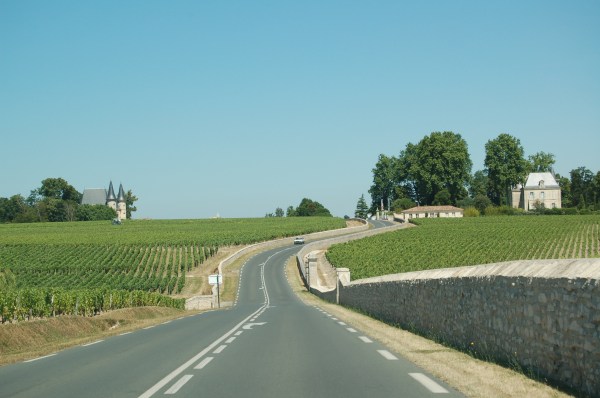
Both wines had a similar deep garnet red. Similarly both wines were quite shut, but one can catch a whiff of intense, rich dark fruits lurking beneath, with the 2000 Les Forts de Latour (courtesy Kieron) possessing a more powerful and luxurious bouquet. On the palate, the 2000 Clos du Marquis initially seemed to have the upper hand: full, powerful, intense, good grip, refined sophisticated tannins, with a touch of graphite that’s typical of St Julien. On the other hand, the Les Forts was less intense, but broader and more expansive, though similarly full-bodied. As it sat in the glass, the Les Forts took on more weight, becoming huge, dense and intense, whereas the Clos du Marquis appeared more willing to relax and soften.
This simple tasting had provided an absolutely fascinating insight into the importance of terroir: although both wines did share some common characteristics due to their close proximity with each other, they still retained the individual stamp of St Julien and Pauillac. Obviously, these wines should be left alone for at least another 10 years; pity I have none of the Clos du Marquis left. Most fitting end to a wonderful evening.
1982-2006 Chateau Leoville Poyferre
This wonderful Wednesday evening, 22 April 2009, began with a vertical tasting of Chateau Leoville Poyferre at St Regis, part of 2009 World Gourmet Summit, in the presence of M. Didier Cuvelier, co-chaired by Dr NK Yong and Ms Lisa Perotti-Brown, MW.
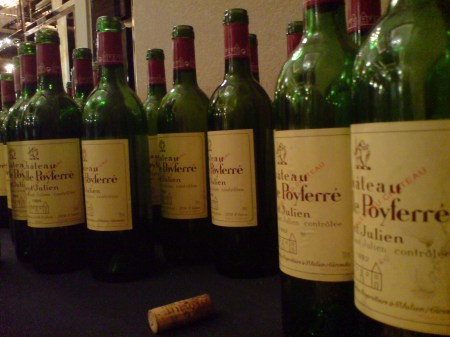 The 2006 that started the evening had a beautiful purple-ruby color, suggesting a lighter wine. True enough, it was light-medium, soft, with scents of plum and graphite. The finish was dry, lacking in weight and focus. Of course, it is young, but even then it doesn’t seem promising.
The 2004 that followed was altogether more preferable: deep purple, more open on the nose, revealing sweet aromas. Good grip on the palate, medium-bodied, very good focus, touch of tannins which did not threaten the overall balance. Tight. Classic in a very St Julien way. Moderately long. Very good.
The 2002 was deep red, with a less revealing nose compared to the 2004. Nevertheless, sweet aromas of dark fruits was evident. Medium-bodied, soft, low acidity, excellent balance with a linear finish. Quite harmonious. Somewhat hollow towards the end, but very approachable nonetheless. Drinking well. Very well, in fact, for a 2002.
The 2001 was already showing a hint of lightening at the rim. A beautiful, mellow St Julien nose of sweet fruits and plum. Classic, medium-bodied, good grip, low acidity, excellent tight balance, superb fruit quality. Lengthy. Quite complete. This is really excellent. NK commented that some wines of 2001 are actually better than the 2000. Really? M Cuvelier didn’t commit himself and, unfortunately, we didn’t have the 2000 to compare.
The 1998 that followed was already showing an evolved red with some lightening at the rim. The bouquet was noticeably bigger and more expressive, quite complex. Emerging secondary flavours engulfed the palate; the soft, medium-bodied wine had already merged into a harmonious whole. Moderate length. Excellent.
Some bottles of the 1995 were corked, but ours were alright. Nevertheless, this soft, low acid, medium-bodied wine was showing signs of fatigue. Rather short finish. The weakest wine of the night. The ’98 is definitely preferable. 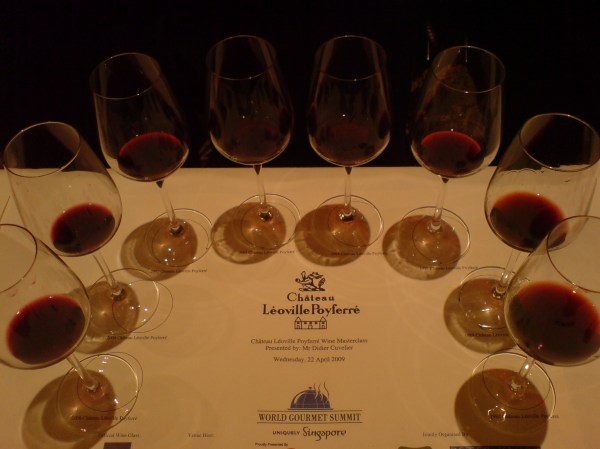
The 1989 revealed the sort of potential that Leoville Poyferre is capable of. Mature red, highly aromatic nose of sweet cherries that is typical of aged Bordeaux. Still relatively full-bodied, excellent grip and focus. Complex. Ends with a sophisticated lifted note of liquer. Long. Excellent.
The piece de resistance, undoubtedly, was the 1982, which had a beautiful red that was even deeper than the ’89! An open, multi-dimensional bouquet of sweet red fruits leapt out from the glass. Fully mature, but still full-bodied and relatively intense. Complex, excellent grip, showing utter sophistication and harmony. Clearly has a long life ahead. Superb!
This tasting amply demonstrated how highly consistent Leoville Poyferre is from year-to-year, and that it is perfectly capable of attaining nirvana. Simply quite outstanding.
An annual family function, 17th April 2009, at Imperial Treasure Crowne Plaza, Changi Airport. The customised menu was superb, as to be expected, since it was crafted by the boss Jimmy Leung himself.
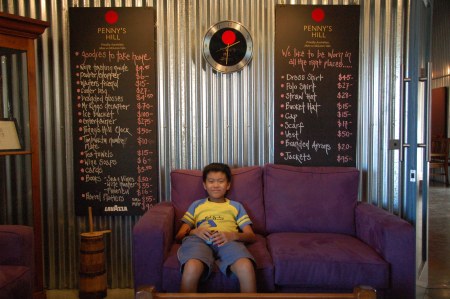 The 2006 Pikes “The Merle” Reserve riesling tasted fresh and crisp, with the right mix of fruit, minerality and acidity. Less dry than the 2002 I had previously at Dr Jaya’s housewarming a few years back, which is a welcome change. Went well with the roast duck & Alaskan crab with truffle egg white. I had initially thought of cellaring this for several years, but what’s the point? Drinking well.
The 2002 Penny’s Hill Footprint was the pioneering vintage of this flagship shiraz. I had carried it back personally from the cellar door in 2004. Ruby red core with some lightening at the rim. Characteristic bouquet of sweet plums and strawberries, which carried over to the palate – full-bodied yet soft, almost seductive, rich fruit but without the kind of glycerin overcoat or alcoholic heat that mar most Aussie shiraz. Silky tannins. No trace of wood. Quite lengthy. 2002, of course, was an outstanding cool vintage for South Australia. It’s good to know that McLaren Vale is capable of producing such sophisticated shiraz that’s quite different, and in some ways, preferable to so many other Barossian shiraz wines. Unfortunately that was my one and only bottle.
Rhone vs New World Rhone styles
I just managed to stagger home after this massive theme dinner at Asia Grand, 13th April, part of the official Bacchus dinners that started back in May 2006. I’m still drunk as I write.
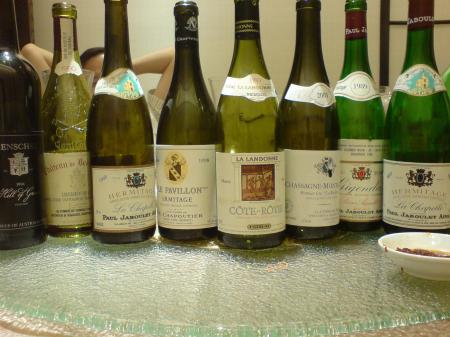
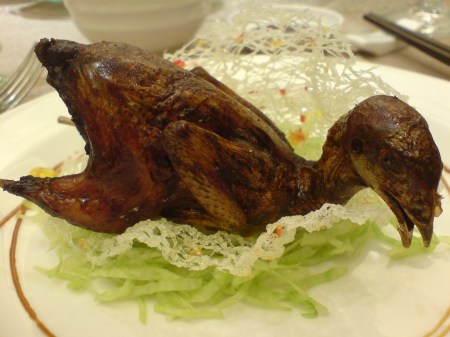
Kieron contributed a 2003 Dom. Ramonet Chassagne-Montrachet 1er Cru “Les Ruchottes” to start the evening’s proceedings: straw-yellow, light minerally nose, lean at beginning, light medium on palate, taking on a caramel note as it sat in the glass. Persistent finish. Went well especially with the giant prawn.
Next we had the 1998 Penfolds RWT that Fatty insisted on bringing, claiming that his original proferring of a 1998 Grange was way too young. The latter may be quite true, but the RWT was a poor substitute: from the impenetrable red arose a typically huge Barossian shiraz with notes of plum , sweet ripe fruit, surprisingly soft tannins, and a persistent medicinal/herbal finish. Entirely consistent with the Penfolds house style.
The 1998 Paul Jaboulet Hermitage La Chapelle (courtesy Fatty) that followed was quite the opposite: brownish-red evolved color with marked lightening at the rim, barely imperceptible nose of raspberry/cherries; soft, light-medium bodied, harmonious. Moderate length. Might have easily mistaken it for a Burgundy if blinded. Lots of sediment. Surprisingly evolved for a 10-year old Rhone from what was, supposedly, an excellent vintage. I had expected more. Perhaps the provenenace was suspect?
Next came the 1998 M Chapoutier Ermitage “Le Pavillon” (courtesy Vic). Nice red color with some lightening at the rim, a luxurious deep nose of red fruits, beautifully balanced sweet, ripe fruits with a vanillin coating. Sophisticated tannins. Long. Harmonious. Quite superb.
The 1989 Paul Jaboulet Gigondas that followed (courtesy Hiok) revealed an interesting nose of aniseed (what I’d call an Indian note) and hint of spice arising from a color that seemed fully evolved. The wine was open, medium-bodied, with sweet berries and a rather short finish. On its last legs, although still good at the moment. Reminded me of how the 1975 Ch Figeac carried itself when tasted last year.
Some confusion subsequently ensued as the waitresses plastered more than one color on the remaining decanters, but it was later resolved that the wine that followed was the 1990 Beaucastel (courtesy Li Fern): evolved color, medium-bodied, sweet cherries/raspberries, harmonious, still well-structured, moderate finish. Fleshed out further in the glass. Excellent stuff.
Then came the highly-anticipated 1994 Henschke Hill of Grace (courtesy Kieron). This contained a reddish core with some lightening at the rim. Nose of sweet, ripe, balanced fruit, medium-full bodied, harmonious, ending on a lifted note of ripe plums. Lengthy finish. Excellent. Many in the group felt Hill of Grace is preferable to Penfolds Grange anytime, which I concur. It must be something to do with the expression of Eden Valley fruit (elevated some 500 ft above sea-level) rather than the multi-district blend characteristic of Grange.
My personal offering, the 1993 E. Guigal La Landonne, was next: a fully evolved color with an open, complex yet delicate and balanced nose; the palate reveals pure expression of Syrah fruit that was absolutely harmonious with a hint of spice and mint. Long. Superb. Voted by most as Wine of the Night. This single vineyard is so different, and preferable, from what an Aussie single vineyard has to offer. I think only the Rockford Basket Press, or Torbreck Run Rig, come close with bottle age. Superb.
The 1992 Paul Jaboulet Hermitage La Chapelle (Hiok) rounded off the evening: deep red, with a restrained, yet luxuriant nose of sweet aromatic fruit amidst some trace of alcoholic heat. Finishes on a lifted note. Long. Excellent. Still surprisingly youthful, considering it has already spent so much time in bottle. Needs more time.
Altogether, an excellent evening of food and wine truly worthy of a Bacchus event. Goes to show that Aussie Rhone styles can never quite replicate the real McCoy. We should accord them their own distinctive attributes and enjoy the privilege of having tasted them amidst good food and company.
1998 Petaluma Coonawarra & 2002 Rockford Basket Press
The occasion, on 9th April 2009, was another one of those Ward 48 dinners hosted by the Consultants and Registrars for the MOs and HOs. This time we returned to KaSoh at the SMA Alumni. Poh Seng brought the Petaluma while I contributed the Rockford.
The Petaluma Coonawarra has always been one of my perenial favourites amongst Australian reds, as i) it’s a blend between cabernet sauvignon and merlot, rather than a straight varietal that’s so typical of New World reds; and ii) its expression remains faithful to the Coonawarra terroir, as evidenced by the fact that the region, rather than varietal, is listed on the label, another bit that’s atypical for a New World red. As 1998 was an outstanding vintage for Coonawarra (I still have fond memories of the ’98 Penley Reserve and ’98 Parker First Growth), my expectations were high.
The wine, poured straight from bottle, was deep purple right up to the rim. Tasted right after a horrible New Zealand red (a 2001 Herzog, also from P.S.) that opened the evening’s proceedings, the bouquet of fresh ripe blackcurrant and dark fruits was most welcome. The palate held up to the initial promise: medium to full-bodied, layered fruit, soft tannins that still lent good structure. There was none of the alcohol heat that tend to mar most Aussie reds, and the wood had long faded into obscurity, leaving behind purity of fruit. After an hour, the wine gelled further into a slightly sweet, harmonious finish. Interestingly, it doesn’t have the tell-tale plum-like character which the ’98 Penley possessed in abundance. No one will mistake this for a Pauillac; it’s proudly Coonawarra. This ’98 is much better than the 2001 vintage (unbalanced, with too much alcohol heat), and is likely what the excellent 2004 will eventually evolve into. Excellent.

But the wine of the evening undoubtedly was the 2002 Rockford Basket Press. I’ve had nothing but the highest expectations each time I taste Rockford Basket Press, ever since I first gained its acquaintance in 2004 while residing in Adelaide. Released every March (and sold out before June), the Basket Press needs plenty of time. Even weak vintages such as the 1997 eventually gained weight and fleshed out in bottle after 8-10 years, and when last tasted in Dec 2008, was still going strong. I had some reservations about opening the 2002, knowing that it’s actually way too early still, but since I’ve got 4 bottles in my Basket Press vertical (1997-2006, missing only the 2000), I decided to be generous.
Knowing that the wine would be huge (my wife and I couldn’t finish the 2001 over a 2-hour dinner couple of years back), I double-decanted it for 6 hours. By the time we drank it, the wine had been opened for 9 hours: deep red with slight lightening at the rim, beautiful bouquest of ripe sweet redcurrants and raisins, full-bodied, huge, layer upon layer of rich delicious fruit supported by judicious acid, wood and alcohol (without the heat!), and a sophisticated tannic backbone. Long, sweet finish. It is not the sort of alcoholic fruit-bomb that’s typical of so many Barossa reds. It’s got everything in abundance, but much more tightly wound and sophisticated. Complex. Superb. I’m not touching my remaining 3 bottles for the next 10 years. The later vintages of Basket Press (the 2005 comes to mind) are highly accessible right from the start, but common sense dictates that they must be put to sleep for at least 10 years.
 Ric's Wine Journal