1996 Bordeaux
Bacchus met, again after a long absence, on 28 January 2016 for a 1996 Bordeaux horizontal. Chris and Vincent had very kindly made available Lienville as the venue for fine dining, where we had the privilege of a private chef prepare for us a bespoke traditional French cuisine in its kitchen. As we awaited the arrival of all guests, Vincent served up a free flow of 1999 Salon S champagne that showed a fair degree of restraint on the nose although it was, expectedly, dry with a dominant tone of crisp citrus, toast and crème de la crème, very lively with plenty of verve, just a tad stern towards the finish with a graphite trace. As if this wasn’t enough, a 1996 Dom Perignon (courtesy of David Ong) was thrown in for good measure as well, displaying a slightly forward balance of green apples and melons underscored by a chromatic tone with a mild attractive pungency, subtle in both acidity and intensity on the palate, oozing with sweet citrus at its lengthy finish. Following on, the 2002 Bonneau du Martray Corton-Charlemagne Grand Cru (courtesy of Kieron), was characteristically oily with fluid textures, medium-bodied with attractive notes of incense and fig, open on the palate with a certain lightness and subtle intensity.

The reds were served in three flights, basically traversing the Haut Medoc in a northerly fashion from Margaux. The 1996 Ch Figeac (courtesy of Vincent), displayed perfumed aromas of rose petals in its wonderful bouquet, highly aromatic and feminine with lovely traces of camphor, appropriately soft and rounded with fine acidity on the palate though not quite plumbing the depths, finishing with good length. Next, the 1996 Ch Palmer (courtesy of Victor) was equally aromatic with attractive notes of pines, wild flowers and earth, medium-full, absolutely harmonious in its blend of red and dark fruits that glowed with an irresistible fragrance all the way to its long minty finish. Wonderful stuff.
In the second flight, the 1996 Ch Montrose (courtesy of Pipin) produced a powerful glow of heated stones, dense tea leaves and a soy-like character that reflected the ripe red fruits and dark berries that imparted fabulous intensity, richness and structure, unmistakably masculine and yet to peak.  Its neighbouring estate, the 1996 Ch Cos D’Estournel (courtesy of Chris), displayed intense aromas of roses and dark plums, very cedary on the nose though somewhat lean on the palate where it was open and relaxed, lacking the massive structure of the Montrose, tapering towards a stern minty finish. Traversing into Pauillac, the 1996 Ch Lynch-Bages had all the trappings of a classic claret, displaying a rich deep vein of ripe blueberries and dark berries that contrasted very well against dry textures of earth and snuff, open with subtle tannins, fleshing out very well, slightly minty at the finish.
The third flight pitted three estates in very close proximity. The 1996 Ch Leoville-Las-Cases (courtesy of Kieron) displayed powerful lifted aromas of complex tangerines and kumquat contrasted against red and dark currants, producing a perfumed fragrance unusual for the wines of this estate. On the palate, the wine was robust and structured, layered and fairly open at this stage although a mild tannic spine remained. It is always fascinating to compare the two Pichons (separated physically by just the two-lane D2 highway) from the same vintage. The 1996 Ch Pichon Longueville Comtesse de Lalande (courtesy of David Tan) offered a rose tinted bouquet of predominant red fruits that was well-replicated with excellent concentration and depth on the palate where it was open with supple tannins and just a slight vegetal hint that is typical of Pichon Lalande, unmistakably feminine, a touch minty at the finish. 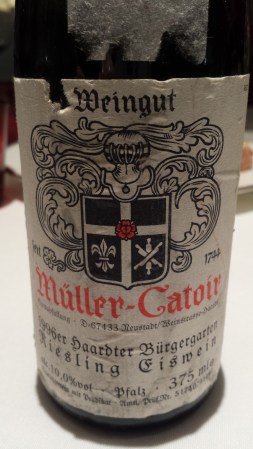 In contrast, the 1996 Ch Pichon Longueville Baron (courtesy of Daniel) opened with a mild bottle stink that dissipated soon enough, noticeably more masculine and deeper wine compared with Pichon Lalande, open with raspberries and blueberries of fabulous intensity along with overtones of tangerine.
Finally, a First Growth on its own to end the evening, served blind. Displaying a deep garnet red with just a trace of evolution at the rim, the wine was soft, rounded and distinctly feminine, offering red fruits and red roses of excellent concentration on the nose and palate with a hint of gravel, very correct in its balance, somewhat nonchalant and aloof in its demeanour. Most of us guessed a Mouton Rothschild, but it turned out to be the 1996 Ch Latour (courtesy of Li Fern). You just never know when a Latour will show up.
We concluded the evening with a 1996 Muller-Catoir Haardter-Burgergarten Riesling Eiswein (courtesy of Hiok) that offered great concentration and intensity of nectar, apricot, honey, pineapples and tropical fruits, displaying fine acidity and immense complexity. My sincere thanks to everyone for their kind generosity.
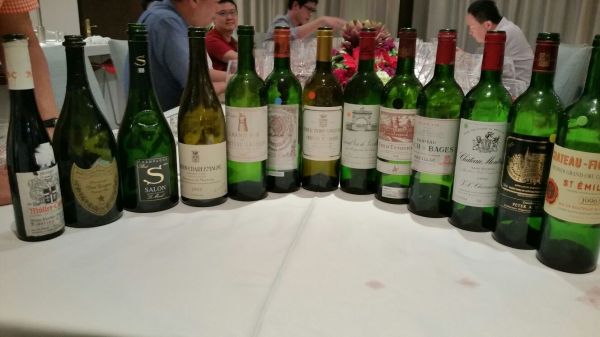
1990 Ch Montrose, 1982 Joseph Perrier, 1990 Les Forts de Latour
These are short notes from a dinner at Chef Kang’s on 26 Jan 2016 with all wines generously supplied by SKY (don’t we all aspire to be like him?), all aired in advance on-site, paired with Chef Kang’s unique creations plus another whole lot of crab beehoon and oyster omelette from Sin Huat.
1982 Joseph Perrier Brut. Poured from magnum. Second time within a year that I am privileged to have tasted this champagne that was served at William and Kate’s wedding. This wine carries an abundance of apricot, peaches and plums, fabulously intense on the palate with toasty characters, yeast and lime in a rich complex, yet lithe without any heaviness, displaying excellent acidity and definition, just a tad stern at the finish. Beautiful.
2003 Ch Brane Cantenac. Aromatic with attractive floral fragrance and red plums, medium-bodied, displaying cedary and raisiny characters that have turned slightly medicinal, rounded and soft, firming up very well on the palate although, like many 2003s of the Left Bank, a tad short. A classic example where the wine is better on the nose than on the palate.
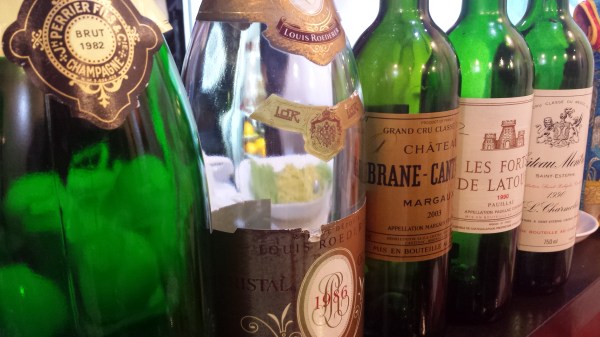
1986 Louis Roederer Cristal Brut. Poured from magnum. Restrained with notes of toast and pomelo that went very well with the ultra-fine gentle bubbles, seemingly dipping in acidity on the mid-body but redeeming itself very well after some time, establishing a certain richness coupled with excellent concentration of firm citrus and chalky minerality that led to a sweet finish. Excellent.
1990 Les Forts de Latour. This wine is beautifully evolved, exuding powerful aromas of red plums, red fruits, dates and cinnamon, rounded and absolutely harmonious, velvety in layering with overtones of camphor in its hallowed glow. More feminine compared with the grand vin but all the better as it exudes a distinct identity in its own right. Superb.
1990 Ch Montrose. Still deep garnet red with barely a vermilion rim after 25 years, this wine possesses an attractive earthy pungency well-matched with dry tobacco characters on the nose. A complex of ripe dark and red fruits saturates the palate, imparting a fabulous intensity and richness with an abundance of soy and concentrated tea leaves, voluptuous and alluring, yet still youthful and seemingly a long way from its peak. Outstanding, and no wonder why it’s labelled a 100-pointer. A complete wine.
My heartfelt thanks, once again, to SKY for the generous line-up.
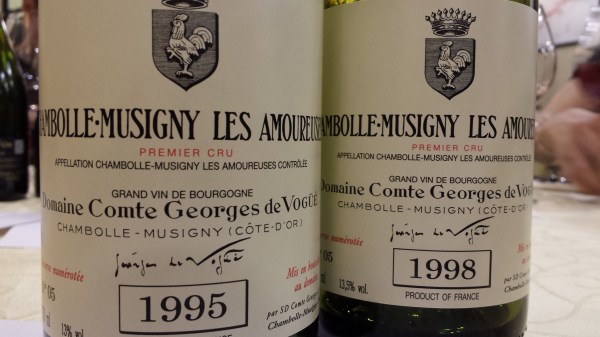
Domaine Comte Georges de Vogue is usually the first name that comes to mind when one mentions the wines of Chambolle-Musigny. Founded centuries ago in 1450, this estate has the largest holdings in Musigny Grand Cru (7.2 ha) and Bonnes-Mares Grand Cru (2.7 ha). Considering that many consider Musigny to be the finest of red burgundy after Romanee-Conti, this places the estate in the most enviable of pole positions. The vines of Comte Georges de Vogue in Musigny are located mostly over the south-eastern slopes, the ideal prime location, grown over eroded limestone soils overlooking Clos Vougeot further south and Amoureuses to the north-east. Fortunately for us, the estate’s sales director M. Jean-Luc Pepin enjoys coming to Singapore and, for some time now, Alvin Seah of Domaine Wines has been organising an annual dinner at Jade Palace featuring only the top cru of Comte de Vogue with Jean-Luc in attendance, where I was lucky enough to obtain a ticket for this year’s dinner on January 16. The wines were served in 3 flights – Les Amoureuses, Bonnes-Mares and Musigny – each flight pitting 1995 against 1998. While the latter may impress initially with its forward fruit balance and drive, it is the former that possesses consistently finer balance, structure and complexity.
2008 Michel Arnould et Fils Carte d’Or Grand Cru. Pinot noir and chardonnay in equal proportion. Notes of high-toned citrus with light touches of morning dew and toast, vibrant with fine acidity and definition, persistent at the finish. Very fine.
2008 Michel Arnould et Fils Blanc de Noirs Memoire de Vignes Grand Cru. Highly aromatic with a suggestion of depth from an abundance of lime and pomelo though, on the palate, this wine possesses more breadth than depth with transparent textures. Made from 100% pinot noir. Excellent.
1995 Domaine Comte Georges de Vogue Chambolle-Musigny Les Amoureuses 1er. Predominant notes of mint, spice and orange peel on the nose, displaying very good presence and concentration on the palate with overtones of cedar, smooth and feminine through its lack of tannic structure, eventually dominated by an attractive plummy note with trailing red fruits. I’d expected more complexity, but I guess Les Amoureuses at its best will always be a wine of understated elegance and purity.
1998 Domaine Comte Georges de Vogue Chambolle-Musigny Les Amoureuses 1er. Noticeably tighter, excellent in concentration of red fruits and dark berries, more cedary and structured though somewhat stern at the finish, characterised by a slight burliness that was absent from the 1995.
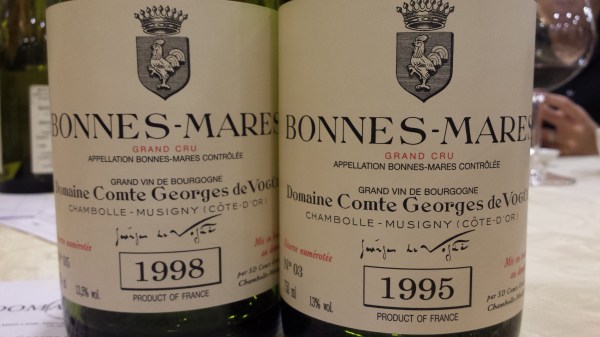
1995 Domaine Comte Georges de Vogue Bonnes-Mares Grand Cru. Beautifully evolved, this grand cru that extends seamlessly northwards into Morey-Saint-Denis and Chambertin features ripe dark plums, appropriately cedary on the palate where it is remarkably open and relaxed with a quiet intensity in spite of its massive structure and masculinity, still imbued with superb acidity and freshness. Those seeking absolute purity of fruit would be well-advised to lay the 1995 Bonnes-Mares for several more years. Outstanding.
1998 Domaine Comte Georges de Vogue Bonnes-Mares Grand Cru. Forward balance of red fruits, slightly austere initially, tight and spicy at the edges, gradually developing supple tannins that led to a lasting finish though still missing the finesse and elegance of the 1995.
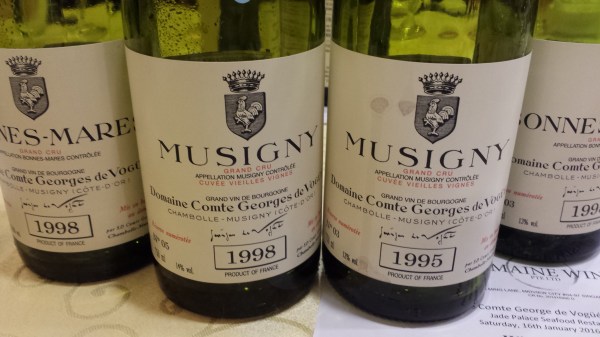
1995 Domaine Comte Georges de Vogue Musigny Grand Cru. Expectations are almost stratospheric for the pinnacle of Chambolle-Musigny and the 1995 does not disappoint. In spite of its restrained bouquet, this wine is absolutely beautiful on the palate where it is smooth, satiny and opulent, structured with highly supple tannins, displaying great definition, harmony, layering and balance. Don’t expect any knockout punches. This Musigny grand cru is a an elegant beauty that draws you in with her great composure. A complete wine.
1998 Domaine Comte Georges de Vogue Musigny Grand Cru. Equally restrained as well, the 1998 displays more forward characters of red and dark berries amidst a cedary backdrop but clearly lacking in layering and complexity, only opening up after some time with a mild intensity that doesn’t quite evoke a visceral response.
Jan 2016: 1999 Rene Engel Clos Vougeot, 2001 Penfolds RWT, 2004 Rockford Basket Press
1997 Ch La Croix de Labrie, popped and poured at Glen after hours on 04 Jan 2016. This wine has a pleasant bouquet of dark roses with notes of raspberries and dark berries on the palate, somewhat dry with a character of wood dust and earth, slightly austere towards the finish, a reflection of the unflattering vintage.
2012 Joseph Faiveley Bourgogne, popped and poured over a simple dinner at home, 06 Jan 2016. Lovely aromas of peaches, melons and a dash of apricot, fairly ample on the palate where buttery notes and some chalky characters dominate but do not overwhelm, quite open, slightly racy towards the finish. Quite attractive.
2001 Penfolds RWT, decanted on-site at Imperial Treasure T3, 08 Jan 2016. You could say this is a cousin of Grange, a 100% shiraz aged in French oak. Deep dark impenetrable red, dominated by powerful medicinal overtones on the bouquet, almost hedonistic on the palate where it is rich, concentrated and smooth, saturated with notes of licorice, camphor, raisins and savoury characters, gaining some transparency in the mid-body only after 90 minutes. I’d prefer some suppleness and layering but this wine doesn’t look like it is developing in that direction. BTW, Imperial Treasure now charges SGD30++ for corkage, making it far less compelling for casual dining.
 1999 Domaine Rene Engel Clos-Vougeot Grand Cru, popped and poured at Otto Ristorante, 11 Jan 2016, to celebrate Monster’s wonderful success. I last tasted this wine back in 2009 where it was still intense and primal. Now defunct since the tragic demise of Philippe (grandson of Rene Engel) in 2005, the Clos Vougeot Grand Cru is the flagship of this domaine in Vosne-Romanee. The 1999 appears to have mellowed considerably with aromas of roses, bright cherries and camphor, much more gentle and open on the palate where raspberries are well-integrated with saline minerals and earthy characters, smooth, rounded and ample in body, slightly feminine, although it seemed to lack structure and opulence until the final pour almost two hours later where some hint of layering and excitement in the tannins came into the picture. Drinking well now and probably at its best, but needs time in the glass to unfurl its full potential. Back vintages of Rene Engel appears to be enjoying a mini-Renaissance of sorts nowadays with the 1999 Clos Vougeot Grand Cru retailing for almost SGD400.
2000 Robert Mondavi cabernet sauvignon, decanted on-site at a celebratory dinner hosted by Joan and Eberta at Gattopardo, 20 Jan 2016. Poured from magnum. This bottle was much better than a previous one tasted last year. Displaying a deep crimson with some evolution at the rim, this wine offers notes of red plums, ripe wild berries and blueberries, open, soft and ample with recessed tannins though a trace of hardness is discernible on the back palate with a hint of vanilla. Almost Old World in style. A bargain at SGD70 for a magnum.
Franciacorta ’61, a sparkling wine from Lombardia bought off the list of Gattopardo, 20 Jan 2016. Vibrant with a forward balance of zesty citrus and lime with a hint of toasty oak and smoke, generous in fruit to match the dryness on the palate. Serviceable.
2008 Leeuwin Art Series chardonnay, a bottle presented to me by Dr Wang KW several years ago, now shared with him at Imperial Treasure Super Duck on 27 Jan 2016. Popped and poured. This wine got off to a tentative start, appropriately creamy with an oily texture, minerally from the start and imbued with clear citrus and white flowers. However, it was rather lean and stern on the palate, taking time to gain some weight and sweetness, eventually ending in a crisp biting finish.
2004 Rockford Basket Press, popped and poured at Beng Thin, 30 Jan 2016. As expected, this Barossa shiraz is saturated with ripe blackberries and redcurrants that produced a powerful whiff of medicinal characters on the nose, dominated by licorice and warm spicy peppery notes on the palate, rich and highly concentrated with controlled tannins, opening up substantially after some time to reveal a savoury dimension, becoming smoother as well although it remained full-bodied and muscular. Strictly for aficionados of Aussie reds.
1947 Chateau La Mission Haut Brion
Probably a once-in-a-lifetime tasting experience (at least for an amateur oenophile like myself) came my way unexpectedly during dinner on 26 January 2016 at Chef Kang’s when a magnum bottling of 1947 Ch La Mission Haut Brion was proffered by a newly-acquainted wine collector just recently introduced to us. There was no prior announcement nor any leak down the grapevine amongst our inner circle that this would be happening. My limited experience with old Bordeaux only went as far back as a 1964 Ch Cheval Blanc and the very thought of a 1947 was absolutely mind-blowing. The bottle certainly looked the part, with its label stained and capsule worn although the ullage was surprisingly good, up to upper shoulder. The owner of this bottle had purchased it from Les Amis some time ago for a small fortune, enough to buy a brand new car in UK or Australia. Nobody dared to pop the cork for such a precious bottle, but Dr Ngoi rose to the occasion, gingerly inserting a pair of blades into the rim of the cork and gently coaxing it out of the bottle. Any possibility of finding a 1947 Bordeaux on the open market must be approached with caution, in case the likes of Rodenstock or Kurniawan have managed to conjure up something. To our relief, the cork held together very well, certainly appearing to be rather soft but genuine-looking.


We poured the wine, which was an opaque murky brown, without decanting for we didn’t know whether it would survive too much aeration. However, we probably needn’t have worried. How does a 1947 claret taste like 69 years after its vintage? The wine was highly perfumed on the nose with notes of sweet incense, smoke and characters of dried plums. On the palate, it displayed the distilled essence of glorious berries past that still retained very good levels of concentration and fine acidity, not at all hollow nor medicinal nor burly, but smooth, rounded and gentle, linear all the way to its extended finish where an afternote of ash still lingered. I wouldn’t pretend that this is still a great wine at this stage (the 1990 Ch Montrose that preceded immediately would fit that definition). Rather, the 1947 La Mission Haut Brion is now absolutely unique and, to our surprise, it stayed that way till the end of dinner without fading off. What a great privilege this has been for me. Thank you very much Sir K….You have been most generous.


1990 Cos D’Estournel, 1990 La Conseillante, 1986 Haut-Brion, 1982 Leoville-Las-Cases…
Wining and dining in 2016 took off with quite a bang on 12 Jan 2016 where we had the honour and privilege of wishing Dr Ngoi many happy returns at Chef Kang’s. No specific wine theme was set apart from a common understanding that it would be Old World and that the wines would be blinded. Li Fern took great pains to ensure that we would be sampling Chef Kang’s signature creations while Kheng Yu (a.k.a. SKY) went the extra mile to procure crab beehoon and meepok from Sin Huat.
We began the evening with a 2006 Louis Roederer Cristal (unblinded, courtesy of Miah Hiang) that offered lifted aromas of clear zesty citrus, generous in body but rather dry, high-toned and steely on the palate along with characters of smoke and a subtle trace of yeast. This was followed by a magnum bottling of 2011 Domaine Leflaive Batard-Bienvenue-Montrachet Grand Cru (unblinded, courtesy of Vic) that opened with notes of melons, peaches and a dash of tropical fruits with a suggestion of great depth on the nose that was met on the palate, vibrant and lively with fine acidity. We drank half of it and revisited the other half at the end of dinner, where it had become far more relaxed and open, blossoming with subtle buttery characters and crème de la crème.
The reds got off to an ignominious start with an old bottle of 1986 Domaine Henri Rebourseau Chambertin Clos de Beze Grand Cru (blinded, courtesy of Miah Hiang) that was dark murky brown, producing considerable bottle stink though it was definitely not corked, almost resembling port in character, replete with medicinal overtones. On the palate, the fruit had clearly receded significantly, leaving a shell of prunes and astringent tangerine, awkward and disjointed. Clearly, no one could tell what sort of burgundy it was. We also quickly dispensed with a 2009 Croix de Beaucaillou (unblinded, courtesy of Gleneagles management). Poured from magnum, this wine was dominated by a funky pungency on the nose, marked by a forward balance of plums, dark currants and soy, medium-full, the vanilla note imparting a glossy sheen without any semblance of its Saint Julien origin.
The 1990 Ch Cos D’Estournel (unblinded, courtesy of SKY) displayed distilled aromas of ripe dark berries, distinctly medium-bodied and completely open on the palate, dry with tertiary characters of dried mushrooms and some cedary notes, lacking the concentration and opulence of the best clarets of 1990 and in danger of thinning out. It seemed to be just hanging on and unlikely to improve. On the other hand, this bottle may not be representative and so I’ll reserve judgement.
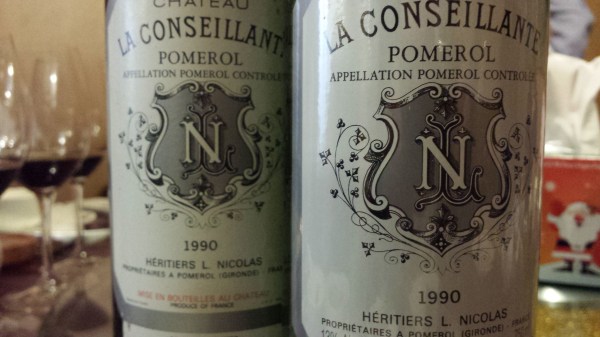
Then came an interesting turn of events. Two blinded Bordeaux bottles were tasted side-by-side. Both were deep dark purple, almost black, proffering notes of ash and intense black fruits marked by plummy notes, soy, wonderful ripeness and excellent depth, seemingly youthful and yet to develop further layering. Of the two, one was just slightly lighter in texture while the other was slightly fuller with a bit of biting intensity. Both exhibited velvety supply tannins that hinted at substantial proportions of merlot. There were wild guesses around the table but when the wraps came off, both turned out to be the 1990 Ch La Conseillante (courtesy of LF and Sanjay)!! It is extremely rare in a blinded line-up to feature two identical wines, especially when no theme has been specified. This little surprise also goes to show the extent of bias that open labels conjure up in drinkers’ minds.
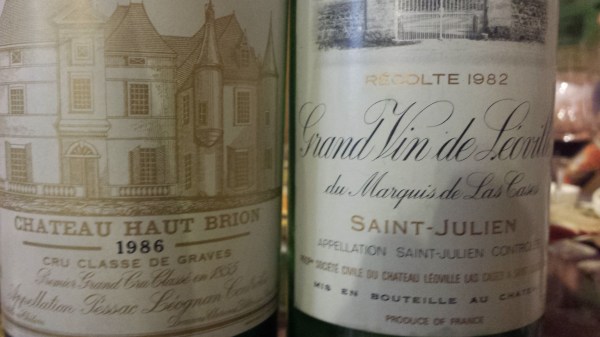
The final pair of reds proved to be outstanding. The 1986 Ch Haut-Brion, tasted blind, still displayed an abundance of glorious black fruits and dark currants with a dash of spice, replete with a tinge of tangerines (as always with Haut-Brion), earth and soy, proving to be a wine of great concentration, depth and complexity, brimming with supple intensity. I would say it has yet to peak, given how youthful it still is on the palate but, alas, that was my final bottle. Next to this, the 1982 Ch Leoville-Las-Cases (blinded, courtesy of Hsiang Sui), still possessed great balance and concentration of black fruits and dark berries, complex with tertiary characters of old leather, cedar and cinnamon, highly structured and “correct”, soft at the edges with a touch of austerity, seemingly aloof and somewhat stern.
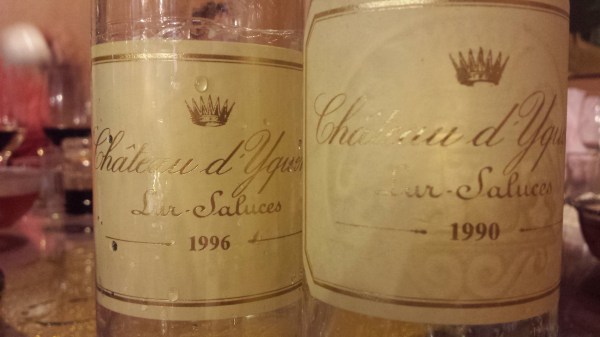
A couple of half-bottles of dessert wine, blinded, rounded off the evening of excesses. Both displayed an Old World complex of apricot, nectarine, peaches and melons with restrained acidity, still fresh, one lighter while the other considerably heavier in texture. The whole table was unanimous in deciding that both were Ch D’Yquem and was spot-on as well in pin-pointing the vintages: 1990 (more transparent in texture, courtesy of Hsiang Sui) and 1996 (slightly heavier, courtesy of Sanjay). My sincere thanks to everyone for their generous contributions.
Jean-Michel Guillon
These are notes from a dinner hosted by Fatty and Robin Soh at Chef Kang’s on 04 Dec 2015, featuring the wines of Domaine Jean-Michel Guillon which is based in Gevrey-Chambertin, with Jean-Michel himself having been apprentice to George Roumier at one time. This trait showed up across the entire line-up, wines that are very well-crafted but which tend to exhibit a certain house style subconsciously. The wines are listed following the tasting order.
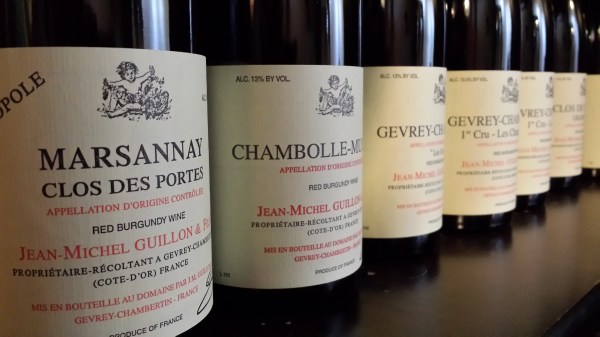
2013 Jean-Michel Guillon Marsannay Blanc Les Champ Perdrix. Notes of morning dew, pears, ripe zesty citrus and the aromas of white flowers, featuring fine acidity with overtones of crème coming on later. Most refreshing.
2013 Jean-Michel Guillon Marsannay Clos des Portes monopole. Dark berries, soy and red fruits, displaying good intensity, structure and concentration on the palate with a spicy trace, gelling together very well. A sturdy wine.
2013 Jean-Michel Guillon Gevrey-Chambertin Les Crais. A village wine, somewhat muted on the nose although there is a good concentration of roses and bright red fruits on the palate, brimming with fair intensity, not quite as structured for a Gevrey-Chambertin, slightly dour at the finish.
2013 Jean-Michel Guillon Chambolle-Musigny. Lovely bouquet, featuring a complex of raspberries and strawberries of excellent depth and length on the palate, coupled with an attractive sweetness. Harmonious and structured. Excellent.
2013 Jean-Michel Guillon Gevrey-Chambertin Les Champonnets 1er. Discernibly a notch up from the Les Crais, proving to be robust, masculine and structured, featuring excellent ripeness that is rich and fairly luxuriant.
2013 Jean-Michel Guillon Gevrey-Chambertin La Perriere 1er. Plummy with fair intensity and linearity, oozing with sweet tannins. Harmonious but lacking in complexity and structure.
2013 Jean-Michel Guillon Clos de Vougeot Grand Cru. Seemingly complex on the nose, marked by plums, redcurrants and earth but lacking complexity, which seems to be the case for a lot of wine produced from this second-division grand cru.
2013 Jean-Michel Guillon Mazis-Chambertin Grand Cru. The evening ended well with this wine ticking all the right boxes. Plummy and bright with attractive tangerine within a glossy sheen, possessing power and elegance in equal measure. Harmonious, layered and structured. Solidly crafted.
Dec 2015: 2006 Fleury Cepages, 2011 Alion, 2011 La Colombina Rosso di Montalcino, 2012 La Grave-a-Pomerol…
2012 Claude Dugat Bourgogne rouge, popped and poured with FICOFI’s Chee Wei at Glen, 03 Dec 2015. We couldn’t help finishing the entire bottle in 30 minutes, for the wine was imbued with lovely aromas of fresh pink and red roses, its fragrance complementing the predominant red cherries, raspberries and saline minerals on the palate that held a certain richness and concentration above most regional Bourgogne with tannins that are sweet, rounded and smooth.
2007 Saintsbury Carneros pinot noir (courtesy of Li Fern), popped and poured after hours at S S ENT, 04 Dec 2015. Considerably darker in tone for a pinot with an earthy bouquet complemented by dark roses, bramble, briar and cedar, medium-bodied, somewhat unresolved on the mid-palate with a metallic finish.
2006 Domaine Ponsot Nuits-Saint-Georges Cuvee des Alouttes 1er (courtesy of Vic), popped and poured after hours at S S ENT, 04 Dec 2015. Having had the 2011 recently, I had high hopes for this wine, opening with notes of earth, nutmeg and sunflowers, medium-bodied, warm and fleshy with fair intensity but missing in layering and sophistication, ending with a vegetal trace. Somewhat disjointed and certainly a disappointment.
2011 Domaine des Heritiers du Comte Lafon Macon-Uchizy Les Maranches at Vinum’s 20th Anniversary tasting, 08 Dec 2015. Grassy elements, minerally, good presence with generous proportions, as always from this producer, brimming with quiet intensity. Good.
2011 Jean Marie Fourrier Chambolle-Musigny Aux Exchanges 1er Vieilles Vignes, at Vinum’s 20th Anniversary tasting, 08 Dec 2015. Floral fragrance of red roses and red cherries, gentle on the palate with understated saline minerality, a tad short at the finish. Good.
2013 Jean Marie Fourrier Vosne-Romanee Aux Reas Vieilles Vignes, at Vinum’s 20th Anniversary tasting, 08 Dec 2015. Dominated by a funky pungency, dry and backward on the palate. Where’s the fruit?
2013 Jean Jacques Confuron Nuits-Saint-Georges Les Fleurieres at Vinum’s 20th Anniversary tasting, 08 Dec 2015. Red fruits with traces of dark cherries, harmonious but lean, with a firm attack on the palate. Not quite balanced.
2012 Follin-Arbelet Corton-Charlemagne Grand Cru at Vinum’s 20th Anniversary tasting, 08 Dec 2015. Notes of recessed citrus, sweet incense, morning dew and yellow melons. Medium-bodied with a trace of steeliness at the edges. Gentle finish, but lacking intensity and richness.
2012 Follin Arbelet Aloxe-Corton Les Vercots 1er at Vinum’s 20th Anniversary tasting, 08 Dec 2015. An abundance of dark red fruits veiled by vegetal notes and forest floor. Disjointed and unconvincing.
2012 Follin Arbelet Pernand-Verglesses Les Bichots 1er at Vinum’s 20th Anniversary tasting, 08 Dec 2015. Promising nose of red fruits and strawberries, radiant with attractive aromatics. Medium-bodied, dominated by saline minerality equally matched by plummy fruit to the fore. Just a tad short.
2005 William Fevre Bougrots les Bougerots Grand Cru (courtesy of WCY) at Jade Palace, 08 Dec 2015. Full-bodied with an abundance of crème and buttery notes supported by chalky minerality, supple with good intensity, turning slightly austere towards the finish. Needs more time.
2006 Ch Carbonnieux rouge (courtesy of F) at Jade Palace, 08 Dec 2015. Deep garnet red with nuances of mocha, dark currants and a graphite tone, excellent in concentration but becoming lean after some time. Still primal.
1996 Ch Pape Clement (courtesy of Hiok) at Jade Palace, 08 Dec 2015. Open and relaxed, full of secondary nuances amidst raspberries and redcurrants with a hint of dried mushrooms in its texture. Somewhat too predictable.
1990 Ch Leoville Poyferre (courtesy of John) at Jade Palace, 08 Dec 2015. Substantial bottle stink here, almost bordering on being corked, obscuring underlying notes of soy, peaches, plums and cedar. A pity.
2011 La Colombina Rosso di Montalcino, two identical bottles decanted on-site at Marini’s on 57, Malaysia’s highest rooftop bar and restaurant at the peak of Menara Petronas, Kuala Lumpur, 11 Dec 2015. Beautiful clear red with aromas of smoke, sweet incense, red plums and tangerine. Soft, rounded and open, medium-bodied, very good concentration and layered, yet gentle with lithe tannins, finishing with good length. Priced below MYR300 from the restaurant list, which means it ought to be even cheaper from retail. Excellent value.
2006 Fleury Cepages Blancs (courtesy of Dr Wang), popped and poured at the newly relocated Otto Ristorante (Maxwell Chambers, just a stone’s throw from its previous location at Red Dot Building), 15 Dec 2015. Known amongst insiders as a grower’s champagne and farmed biodynamically, this wine features accentuated notes of lime, fresh citrus and yeasty overtones, lightly oaked on the palate where it was open with further notes of pomelo, displaying excellent balance, intensity and depth of fruit, slightly minty at the finish. Excellent.
2012 Ch La Grave-a-Pomerol Trigant de Boisset, popped and poured from magnum after airing for 45 minutes and drunk over the next 4 hours at Otto Ristorante, 15 Dec 2015. Bright purplish, this wine opened with an attractive earthy pungency amidst dominant red fruits and cherries, surprisingly soft and highly accessible for such a youthful wine bottled in large format, medium-bodied, still shrouded with overtones of enamel from new oak but open with emerging plums of good intensity, oozing with sweet tannins. An excellent buy at SGD90 from the recent Caveau sale.
2012 Rivers Marie Sonoma Coast Silver Eagle vineyard (courtesy of Li Fern), popped and poured at Glen after hours, 16 Dec 2015. Powerful aromas of plums, cherries and olives with added notes of camphor on the palate, medium-bodied, well-balanced and linear, ticking all the right boxes for pinot noir though missing in layering and real complexity.
2005 Lan Rioja Gran Reserva (courtesy Li Fern), popped and poured at Glen after hours, 16 Dec 2015. Highly promising on the nose where sweet incense and dark currants dominate, slightly pruny with early nuances of cedar, surprisingly lean and distinctly medium-bodied with traces of vanilla amidst its dry finish.
1996 Maison Roche de Bellene Chambolle-Musigny 1er Derriere La Grange (courtesy of CJ), popped and poured at Glen after hours, 16 Dec 2015. Open and well-evolved with significant sweetness swelling from the quality fruit, imbued with other characters of roasted nuts and sandalwood, medium-full with good intensity and bright saline. Unlikely to improve further.
2004 Ch Leoville-Poyferre (courtesy of Hsiang Sui), popped and poured at Glen after hours, 16 Dec 2015. A reliable workhorse that is maturing faster compared with more outstanding vintages, now displaying notes of cedar, fig and sweet pines with graphite undertones, medium-bodied but vibrant and fleshy.
2010 Wolf Blass Grey Label, popped and poured at Ben’s BBQ, 18 Dec 2015. A 50-50 blend of cabernet sauvignon and shiraz, this Barossa red is bold and big, dominated by medicinal overtones, huge doses of licorice and savoury characters of cooked meat and dark plums with marked tannins on the mid-palate.
Louis Roederer Premier Brut NV, popped and poured over dimsum at Imperial Treasure T3, 20 Dec 2015. Forward notes of lime and citrus zest, excellent in concentration and depth to match the dryness on the palate, buzzing with great intensity, supported by flinty minerality, balanced and attractive.
2009 Le Carillon de L’Angelus, popped and poured at Bedrock Bar & Grill, 21 Dec 2015. Forward balance of fruit with notes of raisins, prunes and early nuances of cedar with an attractive spine of intense red fruits and currants that is still quite unresolved on the mid-palate, soft, fairly rounded and slightly lean towards the finish. Not really distinctive but will not offend any palate.
2011 Alion, popped and poured from the restaurant list of La Taperia, 22 Dec 2015. Surprisingly accessible, medium-bodied and rounded with good concentration of red fruits and raspberries of reasonable depth and fragrance without any jarring edges, finishing with recessed tannins and understated minerality. Quite lovely.
2004 Ch Latour-a-Pomerol, decanted on-site at Otto Ristorante (still maintaining the same prices in spite of its upmarket makeover at its new premises at Maxwell Chambers), 30 Dec 2015. This staple wine of mine has softened considerably, its fruit of raspberries and blueberries having gained some secondary nuances of cedar, sandalwood and briar with recessed sweet tannins. Very fine.
Billecart-Salmon Brut Rose NV, popped and poured after hours at S S ENT on New Year’s Eve, 31 Dec 2015. Highly attractive with forward notes of plums and peaches with overtones of toast and yeast to match the dryness on the palate, rounded and generous in body with a smooth finish, ending the year on a high.
FICOFI: Château de Meursault & Château de Marsannay
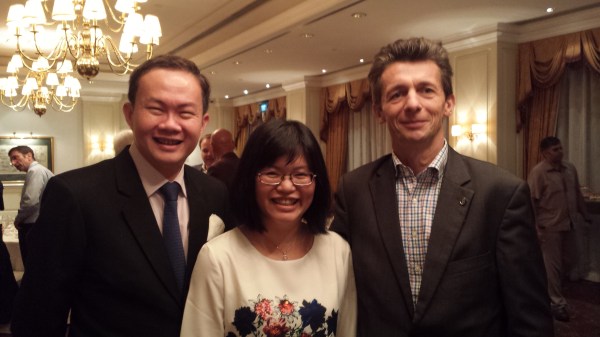
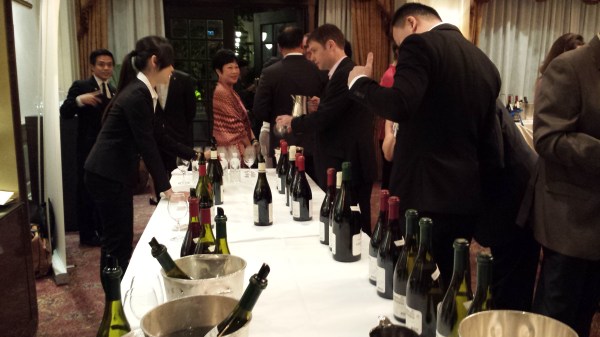
These notes come from a traditional Burgundy “La Paulée-style” dinner organised by FICOFI at the East India Room of the Raffles Hotel, Singapore, on 18 November 2015. Originally created in 1923 for winemakers and their workers in Burgundy to celebrate the end of the grape harvest at Château de Meursault, the La Paulée is a dinner where everyone brings their own bottles to share around the table, very much in the BYO spirit strongly espoused by yours truly. For this event, preceding the dinner was a Promenade featuring the top premier cru and grand cru of Château de Meursault and Château de Marsannay with their respective owners in attendance, M. Olivier Halley and M. Stephane Follin-Arbelet (photo below, whose brother directs the well-known domaine bearing the same family name).
Château de Meursault is a richly-endowed estate with 60 hectares of vines situated around the Côte de Beaune that can be traced back to the 11th century, while Château de Marsannay is situated within the Côte de Nuits, encompassing plots from Fixin to Vosne-Romanée. Hence, in a way, the offerings from these two estates cover the entire Côte d’Or. Lest you may think that the wines from these seemingly less familiar estates are second-rate, don’t let the names fool you, for the wines I tasted were nothing less than excellent and may represent real value for money. In the true spirit of FICOFI, the wines come first, evident by the abundant free-flow while dinner itself was just a simple 3-course affair.
2013 Château de Meursault Les Charmes-Dessus. Minerally with generous aromas of white flowers, excellent richness and intensity with a lengthy finish. Very lovely.
2013 Château de Meursault Clos Epeneaux Pommard 1er. Lovely deep ruby with an abundance of rose petals, red and dark cherries of great purity. Surprisingly gentle on the palate, well-structured and not at all overwhelming. Excellent.
2013 Château de Marsannay Ruchottes-Chambertin Grand Cru. Wonderfully perfumed with the generous fragrance of camphor and fresh roses, well-integrated on the palate where the minerality is seamless, displaying excellent balance and length. Quite superb.
2008 Château de Marsannay Chambertin Grand Cru. Notes of sweet incense, camphor and dark roses. Layered with understated minerality. Open and rounded with a soft finish. Perhaps not quite as profound as a top-tier Chambertin but this is a beautiful wine.
2013 Château de Marsannay Chambertin Grand Cru. Showing some restraint on the nose although there is an abundance of bright roses and cherries on the palate, rounded and soft, beautifully balanced. Could do with a more robust structure but the acidity is excellent.
2013 Château de Meursault Corton-Vergennes Grand Cru. Generous in white flowers, icing and crème, supported by great minerality and depth with further notes of nutmeg, though short at the finish. One wouldn’t have realised that the wine came from young vines planted only in 2007. Quite excellent.
 2011 Hautes-Côtes de Nuits Bourgogne. You really need to scrutinise the small print on the label to realise that this wine is specially bottled for FICOFI by Domaine de la Romanée-Conti. D.R.C. makes only three whites: a Montrachet Grand Cru, a Bâtard-Montrachet Grand Cru that’s only available for tasting within its cellars (yours truly was privileged enough to have had that experience…see Sept 2015) and this one which, of course, is not available on the open market. In spite of its Bourgogne classification, this white possesses great acidity, balance and depth, minerally yet restraint with excellent depth of fruit amidst some early complexity. Superb potential here. What a privilege!
1967 Remoissenet Pere et Fils Vosne-Romanée (courtesy of Dr Liang Te Shan). Still displaying great color with powerful medicinal aromas, almost port-like, yet open and soft with salty earthy notes and decent fruit quality, slightly short at the finish.
2009 Château de Meursault Volnay Clos des Chenes 1er. Sexy and feminine, displaying great harmony between superb notes of ripe strawberries, dark cherries and subtle minerality with excellent linearity and lithe supple tannins, not quite as structured and a tad short.
2012 Château de Marsannay Ruchottes-Chambertin Grand Cru. Great color with powerful aromas of dark red fruits of excellent depth, stern and tight at the finish. Still primal.
1999 Rapet Pere et Fils Corton Grand Cru. Deep in color with ripe fruit of brilliant intensity, only beginning to exhibit early secondary development at this stage with other notes of cedar. Great stuff.
2012 Claude Dugat Bourgogne. Forward balance of ripe red fruits and cherries supported by subtle minerality, a tad short.
2005 Faiveley Mazis-Chambertin Grand Cru. Dominant bouquet of menthol, surprisingly still tight and stern on the palate, underscored by intense graphite characters, gradually opening up after some time, superbly balanced. Excellent.
1990 Domaine Anne Gros. It’s a pity I failed to record which wine this was but it was beautifully open, medium-full with lovely depth of red fruits and dark berries, displaying great harmony and complexity.
1996 Domaine du Clos des Tart Clos des Tart Grand Cru (courtesy of Philippe). Some folks are wary of 1996 red burgundy, but there is absolutely nothing wrong here, this Morey-Saint-Denis stalwart showing plenty of bright red cherries, plums and orange peel characters, excellent in intensity and complexity with a broad finish. Excellent.
2009 Joseph Drouhin Clos des Mouches 1er (courtesy of Peter Tan), displaying notes of white flowers in full bloom with a hint of nectarine, crème de la crème and chalky minerality, caressing the palate with sweet intensity. Lovely.
2011 Bouchard Pere et Fils Corton-Charlemagne Grand Cru, poured from magnum. Unmistakable grassy elements with attractive notes of white flowers, gentle on the palate with subtle density though not quite as full as a Bonneau du Martray.
Blind tasting is always a humbling experience but also one of the most effective ways to appreciate the character of a particular wine and its expression of terroir without the bias of open labels. A small dinner between myself, Hiok, Chee Wee and Philippe of FICOFI was organised on 07 Dec 2015 at Gattopardo where it turned out that we had the entire upper floor dining room to ourselves. The theme was Left Bank blind tasting without any further specification. All wines were decanted on-site and served in two flights to go along with some delectable antipasto and Irish ribeye which was the restaurant’s special for the evening, rounding off with a cheese platter.
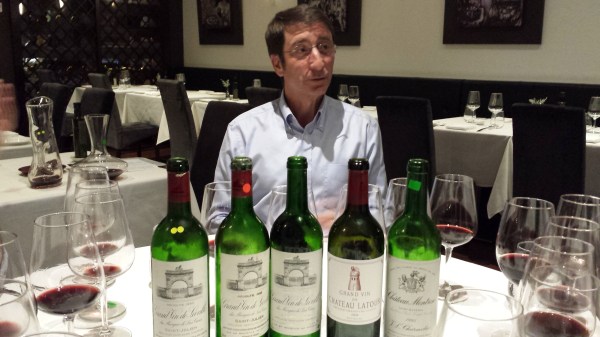
The first wine (courtesy of Hiok) had a peculiar medicinal note on the nose that became truly dominant throughout the evening, becoming almost port-like. Hiok was worried that the bottle may be corked but there was actually none of the dank staleness. On the palate, the wine was only medium-bodied, lacking the fullness promised on the nose, with notes of enamel, cedar and dense wild flowers with characteristic dryness, missing in voluptuousness and seemingly short at the finish. I deduced a Saint-Julien, which Philippe concurred, simply through the process of elimination although the overwhelming bouquet really obscured just about everything. When the wine was revealed to be 1995 Ch Leoville Las-Cases, I was surprised that it was so different from my previous impression of this wine nine years ago, which I recalled to be a tannic monster. Was it a flawed bottle? Will reserve judgement.
Tasted simultaneously, the second wine was a classic claret straight out of the box, dark with aromas of black fruits and a nose of snuff, cigar box and dark currants, open with an attractive dry quality on the palate, sappy and structured, displaying excellent linearity and concentration throughout its length, finishing with great persistence. As the evening wore on, it seemed to undergo some sort of reduction, becoming leaner in the mid-body and sharper at the finish. Philippe was ready to commit that this was a Pauillac, and I must say I would have concurred if I hadn’t brought this wine, with everyone agreeing that it was a mid-90s vintage. It was a 1995 Ch Montrose, not far from the soils of Pauillac, without much of the character of clay soils although, on hindsight, a Pauillac would have been even drier.
Within the same flight, the third wine displayed a deep garnet red with just a trace of vermillon at the rim, producing fragrant aromas of ripe dark fruits and blackcurrants, carrying excellent concentration and richness on the palate with supple velvety tannins that seemed to lack structure, fleshy yet soft, superbly integrated with just a vegetal or graphite trace at the finish. I thought this may be a Pichon Lalande with its higher balance of merlot and petit verdot, but it turned out to be the glorious 1986 Ch Leoville Las-Cases (courtesy of Chee Wee), a wine that I’ve always loved and treasured and, on this occasion, yet to truly hit its peak.
The second flight consisted of two wines contributed by Philippe that were sourced directly from the respective chateau. The first showed an impenetrable dark purple with fragrant aromas and notes of ripe dark fruits, currants and blueberries along with early secondary nuances and notes of cedar and graphite, soft and rounded, possessing richness, balance, sophistication, grandeur and structure with a certain aloofness. I thought it may be a 1999 Palmer, given its arresting fragrance and elegance. We were all floored when the wraps were removed: a 2004 Ch Latour. Outstanding!
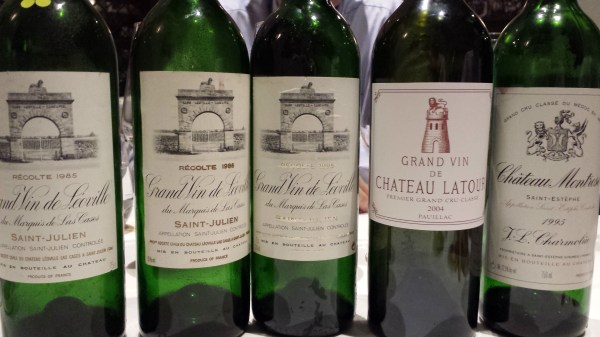
The second red was evidently an aged claret, displaying a certain evolution in color, dry with smoky characters, open on the palate with more red fruits in its balance, ripe but slightly austere, not in any danger of drying out, still fresh with a certain beguiling gentleness. We guessed a Pauillac, perhaps even a Lafite given the balance and mildly feminine character. A 1985 Ch Leoville Las-Cases it was, and what a beauty. As I have said, blind tasting is always humbling and this evening’s experience was no exception. But that’s I way to go, I feel. My thanks to everyone for their generosity.
 Ric's Wine Journal