2001 Ch Gazin
I was lamenting about the paucity of tasting opportunities over the last few weeks when an offer of lunching with some ex-colleagues at Les Amis came along that I immediately took, knowing full well that my liver would welcome some fresh input from the restaurant’s excellent wine list. 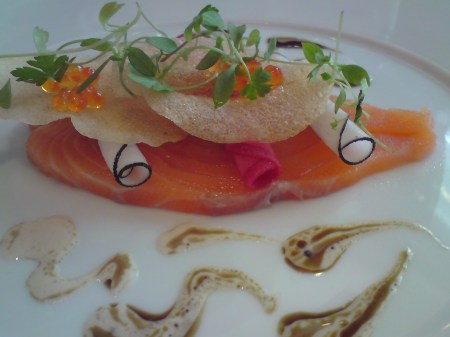 The lunch menu has been refreshed, and I happily settled down to a meal of Atlantic salmon and lamb shank, washed down with two half bottles, a white and an obligatory red.
The 2005 Saint-Veron from Maison Verget, dull golden in color, that began the meal exuded quite an expansive bouquet of orangey citrus with moderate minerality and a faint yeasty note. It was rather flat at the initial sip and somewhat hollow towards the finish, but it expanded rapidly within minutes, filling the palate with a broad swathe of smooth minerality interspersed with pockets of delightful acidity, medium-full, nicely weighted and balanced, but it hasn’t developed much complexity in spite its apparent depth. Nevertheless, this wine is remarkably truthful to its terroir (extreme south of the Maconnais region, just north of Beaujolais), accurately filling the gap between some of the greeness of Macon-Villages and the lean chalkiness of Pouilly-Fuisse. An excellent drop, going for SGD78 on the restaurant list, probably much less on retailers’ shelves. Highly recommended.
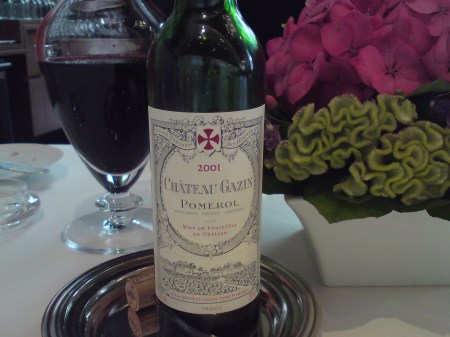 The 2001 Ch Gazin, deep red with a crimson hint, had quite a bit of bottle stink that took about 30 minutes to blow off, coupled with pungent earthy notes that could have passed as Pessac-Leognan. It settled into its stride thereafter, the ripe cool fruit of predominantly dark berries producing a lush, grippy, medium-bodied wine of understated elegance with excellent depth and concentration on the verge of developing its secondary textures. It’s difficult to pin down a Pomerol, the master masquerader, on blind tasting and this bottle was consistent with my experience. Nevertheless, I just felt that this particular bottle was somehow under-performing, for I recalled a standard bottle in 2008 hitting all the right notes from the start, possessing greater opulence and lift.
1999 Ch Pape Clement
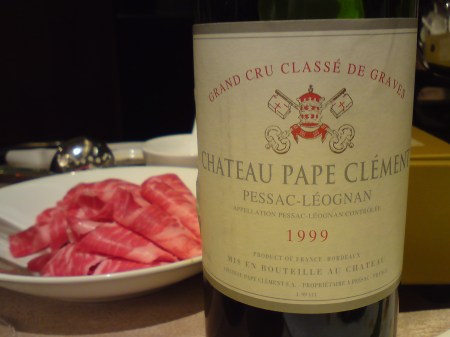 1999 Ch Pape Clement (purchased for only SGD100 a few years back) over Peking duck and wagyu beef at Asia Grand to celebrate Monster’s success in the pool and his 11th birthday. This is showing much better than a similar bottle drunk 3-4 years ago. Crimson with a deep garnet core, from which arose a very inviting nose of predominantly red fruits, scorched earth, cedar and charred wood, matched to a strong but attractive barnyard note. Recognisably Pessac-Leognan. Medium-full, smooth and rounded, fleshy and succulent, discernibly structured, gaining in weight and intensity with further airing, producing good depth and grip with just a tinge of sweet tannins on the finish. 1999, supposedly a wet year (but actually not, apart from a single day of particularly heavy rain on 20th September just before the cabernet was harvested), was a vintage where Bernard Magrez’s preference for higher extraction worked in its favour, unlike an example of the 2000 where his style turned out to be far too extracted and tannic for my taste. This is drinking very very well now.
Notes in brief…(March 2010)
 2006 Jacob’s Creek Cabernet Shiraz, the perfect quaffer over a BBQ at Changi chalet on a sweaty evening. Various people keep giving me bottles of this during the year-end season. Deep red, slightly dusty. Soft, rounded, medium-full, drinking very well without any hard edges nor traces of wood or alcoholic heat. Excellent levels of fruit, some licorice and plum, not over-driven yet carries weight, well-balanced. An unmistakable shiraz, but it’s good enough that if I’d been blinded, I wouldn’t have thought it’s a Jacob’s Creek.
2004 Ch Lagrange, at Imperial Treasure T3. I thought this might still be rather tannic, but to my surprise, its character had changed so much from an initial bottle tasted in 2007 (woody and one-dimensional) when this vintage first hit the shelves. Deep ruby red. A bouquet of predominantly red fruits and raspberry, its youthfulness given away by the primary fruit flavours. Surprisingly soft and fairly rounded on the palate, showing good levels of concentration, excellent structure, good grip, well-integrated, finishing with a tad of firm austere tannins with hardly any trace of wood. Quite similar in character to a 2004 Ch Grand-Puy-Lacoste, if not for the austere finish. This is really developing very well, and I wouldn’t hesitate to purchase a case as house pour if a good offer comes along.
2007 J J Christoffel Erben Uziger Wurzgarten Kabinett Riesling (courtesy PS), at Imperial Treasure T3. This must be the third time I’ve had this wine within a year, and it impresses more and more with each tasting. Pale golden. My initial impression was that of an auslese – a good one – for it was as superb on the nose as it was on the palate: highly complex, lifted aromas of nectar, apricot, pineapple, sophisticated citrus mix, dash of lime, honey and minerals, absolutely fragrant. Lived up to its promise in every way on the palate, the wine full, rich, concentrated yet supple, lively without too much acidity getting in the way, leading to a persistent finish with lingering flavours of tropical fruits. The only drawback, I felt, was that the level of sweetness was just a notch too much for its own good. But it’s excellent, really.
1996 Ch Rol Valentin, over a lovely lunch of dimsum and wagyu beef at Asia Grand. I spotted this bottle just 2 days ago at Le Benaton (now relocated to Bukit Timah next to Coronation Plaza) going for only SGD73. Popped and poured, showing a mature red with a brownish tinge, revealing a fairly complex bouquet of mature dark fruits, dates and plum that led to a soft, rounded, yet relatively full-bodied wine with excellent density, loads of soy and earthy notes and the last remnants of oak barriques, the supple merlot fruit gaining in intensity and sophistication after an hour, ending in a harmonious persistent finish with melted tannins. I believe 1996 was the inaugural vintage for this chateau, and I certainly prefer this than the 2001. Excellent.
 1995 Ch Lagrange, over an impromptu lunch with Hiok & KP at Imperial Treasure, ION Orchard. Aired for an hour in bottle. An evolving red with some bricking at the rim. The nose was initially rather muted, the wine austere with the fruit seemingly drying out. However, things improved significantly after an hour – the healthy glow of the Saint Julien cabernet much more to the fore with its unmistakbly dry and slightly metallic character, the so-called graphite note. Actually I find that much of the Bordeaux character on the Left Bank defies accurate description, and comments about “graphite” or “pencil lead” or – from certain persons – “cockcroaches” (God forbid!) are poor substitutes. Medium-bodied, soft, rounded, quite mellow, a wine of low acidity without noticeable tannins, the fruit of very decent quality and deep, but slightly hollow towards its austere finish. I remembered buying 6 bottles of these for only SGD75 each from Ben Foods at Fishery Port Road a few years ago. This wine is drinking well now, and will probably be even better if given 2-3 hours of airing, but it’s a severe governess that doesn’t put on a smile. Only 1 more bottle remaining.
2007 Joh Jos Prum Wehlenur Sonnenuhr Spatlese, over Alex’s famous Geylang Lorong 29 fried hokkien noodles, now located at Telok Kurau. Pale golden, but the hallmark of a JJ Prum is unmistakable: rich flavours of nectarine, apricot and ripe tropical fruits arising from a full yet supple body, appropriately concentrated, the fresh acidity in perfect counterbalance, never overwhelming, finishing with understated sweetness and just a glimpse of the deep potential that will most certainly develop in years to come. Superb!
Business Class, Singapore Airlines
Probably the best way to enjoy all the trappings of Singapore Airlines’ new Business Class is to hop onto the longest possible flight, none other than the all Business Class direct Singapore-New York return route on an Airbus A345, especially if someone else is footing the bill.
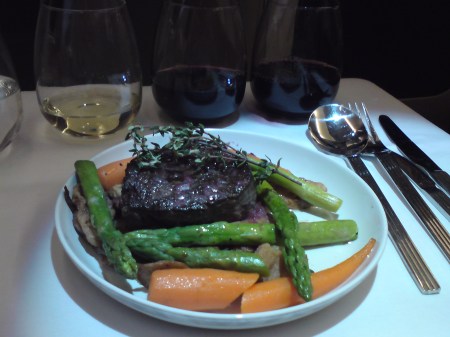 Charles Hiedsieck Brut Reserve, on board SQ22 all Business Class direct to New York. Pale golden. Highly pungent nose (really!). Almost shitty. Medium-bodied, lively on the palate, but too dry for my liking. Faint yeasty finish. I much prefer Bollinger.
2007 Geyser Peak Chardonnay (Alexander Valley), on board SQ22 all Business Class direct to New York. Pale golden. Quite expressive on the nose – good level of minerality, vanilla of sweet American oak, white flowers. Rather sharp on the palate initially due to its cutting acidity, lending it a crisp finish, but it opened up very nicely after a short while, becoming much smoother with substantial body. Very good. I enjoyed it.
2007 August Kesseler Kabinett Riesling, on board SQ22 all Business Class direct to New York. Light clear golden. Very attractive aromatics – some nectarine supported by citrus, lime, and chalky minerality with a floral lift. Medium-bodied, great acidity ensuring fresh and lively finish. Has more substance than a Dr Loosen, I imagine. Very good.
 2006 Rive Barbera d’Asti Il Cascinone Araldica Piedmont, on board SQ22 all Business Class direct to New York. Deep red, with a highly aromatic nose of mature dark fruits and blackcurrant, quite lifted and complex. Medium-full with great grip and density on the palate, the concentration of the nebbiolo fruit coming through easily, though it hasn’t acquired any significant complexity. Slightly spicy on the finish. Awarded 5-stars by Decanter, and I can see why. Quite excellent.
2005 Ch Baret, on board SQ22 all Business Class direct to New York. This grand cru classe from Pessac-Leognan is surprisingly good. Deep garnet red. Bouquet of dark berries, cool ripe fruit, shot through with earthy notes and a faint pungence. Medium-bodied, good grip and density, fresh, slightly spicy finish with well-managed tannins. Very similar in character to L’arrivet Haut Brion and Carbonnieux of the same vintage, though lagging somewhat in depth and intensity. A very good table wine, nonetheless.
Notes from America
2005 Podere Tramanti Innocento, a Tuscany, over veal cappellini pasta at the Ristorante Volare of Gaylord Opryland Hotel & Convention Center, Nashville, Tennessee. Dark red. Powerful bouquet of dark fruits and licorice, although the palate registered mainly plummy sangiovese against a background of scorched earth. Medium-bodied with dusty tannins leading to a long spicy finish. A fairly good table wine but I could have mistaken it for a New World.
2006 Shafer Merlot, over a fillet mignon at The Stock Yard in Nashville, Tennessee, supposedly one of the top 10 steakhouses in USA, but I’m not quite convinced. A deep dusty red. Typically big wine, predominantly ripe dark fruits, highly extracted, copious notes of burnt toast, smoke and licorice, spicy, ending in a tannic finish with minty herbal overtones. Doesn’t possess the suppleness of Old World merlot. Not cheap at USD125, but other stuff on the restaurant list was almost exhorbitant. A current vintage Cakebread cabernet was listed at USD255, whereas I remembered it going for only USD125 at an upmarket restaurant in Chicago in 2007.
2005 Bert Simon Serrig Herrenberg Kabinett Riesling, at the same dinner at The Stock Yard (above). Its pale colour belies a lovely powerful bouquet of apricot and nectar. Full-bodied, very fresh and lively, the terrific acidity lending it a crisp finish but never over-the-top. Has substantial fat in the middle though not quite the unique petroleum character. Sweeter than what I’d expect from a kabinett; behaves more like a spatlese. Quite excellent, really. Only USD56. And what happened was the waiter dropped the bottle while uncorking, resulting in considerable spillage. He replaced it with another bottle and knocked USD10 off the cost, and still gave me a full glass of what remained in the first bottle for free.
2007 Red Diamond Merlot, served during a reception at ACGME Conference at Gaylord Opryland Hotel & Convention Center, Nashville, Tennessee. Dark red. Simple and straightforward quaffer without pretension. Red and dark berries, weighty, with a finish of sweet licorice.
2008 Coppola Shiraz, at the SAS Business Class lounge (with its Ikea furnishing that’s decidedly low class) that SIA utilises in Newark Liberty airport, New York. A very deep red. Medium-full. Very clean notes of unmistakable warm shiraz fruit, generous with good density, a hint of undergrowth, peppered with a bit of spice, moderate finish. A very decent effort from the moviemaker.
2007 Penfolds Thomas Hyland Adelaide Hills Chardonnay at the SAS Business Class lounge (above) in Newark Liberty airport, New York. Absolutely pale and, predictably, offers only a dash of citrus and lemon without any substantial body. Short. But it, nevertheless, went well with the very decent fried rice that finally appeared.
Bordeaux 2000
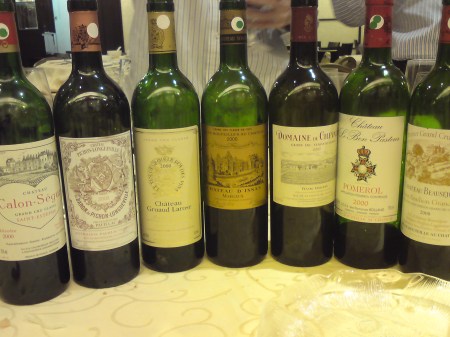
We had an excellent dinner on 23 Feb 2010 at Jade Palace featuring the Bordeaux wines of vintage 2000, with a representation from each commune (except Sauternes). As much as we know that Bordeaux wines only begin to enter their peak drinking period some 15-20 years after vintage, particularly if it was especially outstanding, it can be highly educational to chart the wines’ evolution at an earlier time point, even more so when the order of wines drunk follow the geography of the region, moving northwards, thus allowing one to appreciate the subtleties and nuances of differing terroir.
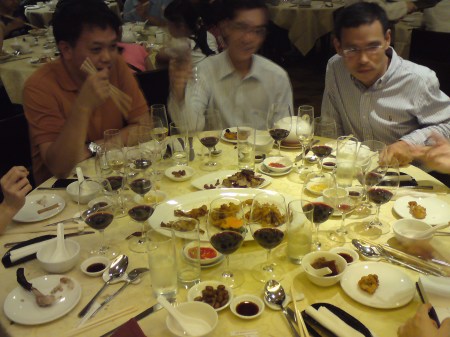 The vintage of 2000 is, of course, legendary by now, and so it seemed logical to assess these wines at the 10 year mark. The original intention was to drink a horizontal of Second Growths (or the equivalent) across the different communes, but it quickly became clear that the 1855 classification is not quite applicable. Firstly, the Right Bank and Graves do not follow the same classification. Secondly, quality has shot up across almost all estates. Thirdly, the old classification is something of a joke for the commune of Margaux: how could Rauzan-Gassies be a Deuxieme cru while Palmer continues to languish as Troisieme? Lastly, the wines of Graves and Margaux offer quality often at prices that are substantially lower than their counterparts in St Julien and Pauillac. Without the means to assemble a Hardy Rodenstock kind of tasting, we decided on a more modest line-up around the SGD200 mark. But it seemed we’re not the only ones with the same idea, for the usual retailers were extremely low in their stock of 2000 Bordeaux, save for Premier cru which are obviously out of reach. In the end, my friends had to resort to buying the wines off me at cost price (dammit), but we still managed to assemble a highly respectable lineup that represented the kind of wines we’re more likely to purchase.
 We kicked off with a Bollinger Grand Cuvee NV as an overture, purchased at the lowest price of SGD79 from Bob Rees of WEA, which was pale-golden, fresh and lively with mild notes of citrus, yeast and peat, not too dry, revealing good body, fairly rounded, ending with a slightly sweet finish. Preferable than a Billecart-Salmon Brut Reserve NV. Very good indeed.
The first Bordeaux to be poured was 2000 Domaine de Chevalier (courtesy LW), a perenial favourite. Often described as the connoiseur’s claret, but on this occasion, it seemed rather dull and uninteresting. Dark red, the nose very muted and restrained. Medium-bodied, soft, finishing with some sweet tannins with a hint of potential depth and greatness beneath, but one can’t escape the dour and austere impression. It’s obviously going through a very awkward phase right now. A bottle tasted last July, popped and poured, was absolutely on song. I’m confident it’ll show its full colours after this pubertal phase. Will rest my remaining 13 bottles for now.
 We then swung over to the Right Bank, pairing the 2000 Ch Bon Pasteur (courtesy Kieron) with the 2000 Ch Beausejour Duffau Lagrosse (courtesy KP, and not to be confused with Beausejour Becot). The former exhibited all the hallmarks of a Michel Rolland wine (this being his personal estate): deep purple, substantially more extracted than a “traditional” claret, intense, yielding notes of soy with traces of alcohol still discernible, giving it a New World feel. Nevertheless, in spite of the density, it was expertly balanced, the fruit never allowed to dominate. It opened up further after a couple of hours, becoming very well integrated, broad and lush, finishing with superbly-managed velvety tannins and a note of sweet licorice. My first encounter with this label, and I must say I’m impressed. It’d have been difficult to place if tasted blind, but that in itself is a hallmark of a Pomerol. In comparison, the Beausejour was actually more impressive initially – deep, ripe and lush right off the starting block, offering sweet dark berries with an alcoholic trace. But it failed to develop further and, in fact, became somewhat flat and disjointed on the mid-palate, whereas the Bon Pasteur, by then, had begun to sing.
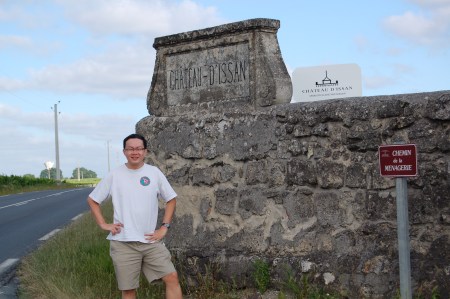 We moved back again to the Left Bank, pairing wines from Margaux and Saint Julien, the 2 communes that you come to as one moves up north on the D2 highway away from Bordeaux city. One of the first estates to be encountered in Margaux is Ch d’Issan (courtesy Vic), a Troisieme cru which lies adjacent to the main road, enclosed by its clos. The wine made in 2000 is deep dark red, restrained, but nevertheless exhibits more than a hint of a perfumed nose, with lifted notes of fig, dark berries and dried herbs, instantly recognisable as a Left Bank. Medium-full, smooth and well-integrated, lush with lovely ripe fruit, not at all assertive. It opened up further as the evening wore on, yet to develop secondary flavours but the potential is huge. This is a wine that’s unmistakably true to its Margaux roots, and the one that’s drinking best right now amongst the evening’s line-up. Excellent. Drunk alongside, the 2000 Ch Gruaud Larose, a Deuxieme cru showing a deep purple, was absolutely glorious, deeply inviting and seductive, offering loads of deep dark fruit and notes of tobacco and graphite. Broad and expansive on the palate, lush, suitably complex at this stage, full of subtle nuances, finishing with luxurious tannins. Brings back memories of the 1986 and 1990, although I’d say the 2000 surpasses both. Gets my nod for the Wine Of The Night. The reason this wine was showing so well could partly be due to the fact that it was the only one in the line-up that was decanted, as its cork had disintegrated.
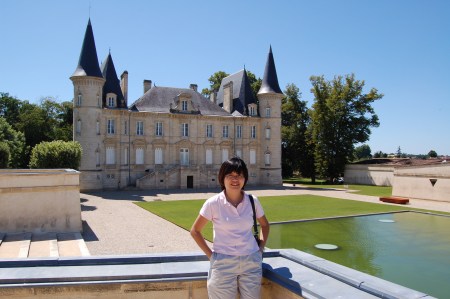 The final pairing saw us moving further up north, through Pauillac and finally Saint Estephe. One can’t ask for a more quintessential Pauillac than the 2000 Ch Pichon Baron Longueville (courtesy Hiok). Deep purple, throwing off a classic Pauillac nose of dried leaves, tobacco snuff, lead pencil shavings amidst its glorious fruit. Rightly masculine, rich and opulent, lush yet elegant within its superb cabernet frame. Great density and concentration. This Deuxieme cru is within touching distance of a Premier cru. It has all the trappings of a great wine in development and eventually will achieve greatness, just as the 1989 and 1990 did. In contrast, the 2000 Ch Calon Segur (courtesy HPP), dark red with a slightly rusty edge, was a tad more rustic and gravelly, betraying its northerly origins. But there is no mistaking its top drawer quality – the excellent density, richness and concentration. Posseses good depth, beginning to develop layers of secondary flavours, ending in a long finish. Has a certain “warmth” and charm that I attribute to the fact that it’s so well integrated and harmonious, with a real feel of the terroir. I always feel that Calon Segur, together with Montrose, is more true to its Saint Estephe roots than Cos D’Estournel, which tend to be more extracted and “international” in feel.
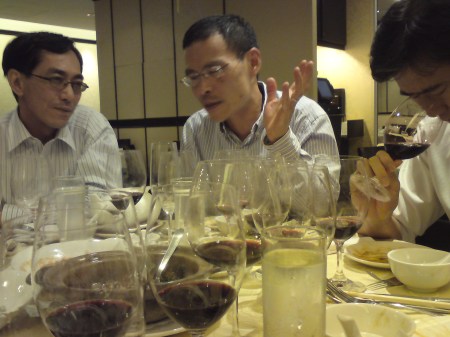 This tasting has been highly educational. Terroir does really matter, and it really does communicate with you through the wines that come from the vines. And the wines of 2000 seem to say that everything clicked together beautifully that year. I found myself repeating the same superlatives for almost each of these wines of 2000, perhaps with the exception of Domaine de Chevalier that seemed shut, proving that one doesn’t need to bust the bank in search of excellent wines even within such a stellar vintage. All are characterised by the right degree of ripeness in the fruit, matched with excellent concentration, depth and weight, yet effortless in retaining a wonderful balance and sense of lightness. No wonder there remains precious little of these on the shelves. I feel the Left Bank has the edge even within such an uniformly outstanding vintage, or perhaps we weren’t drinking the correct wines from the Right. But no matter. Just buy any 2000 you come across that’s friendly to your bank account.
1995 Ch Lynch-Bages & 2005 Stag’s Leap Cask 23, with Kobe beef
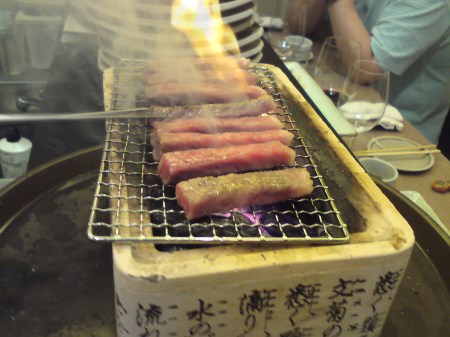
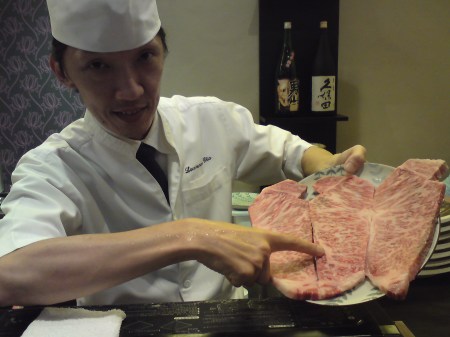
 It’s good to know that I’ve not been forgotten as a honorary cardiologist. And so when the Tall Man invited me to partake in some fresh Kobe beef that he’d hand-carried back from Kobe, to be washed down with some Cask 23 at Kome, it was an offer that I couldn’t refuse, and the least I could do was show up with a ’95 Lynch. More about that later.
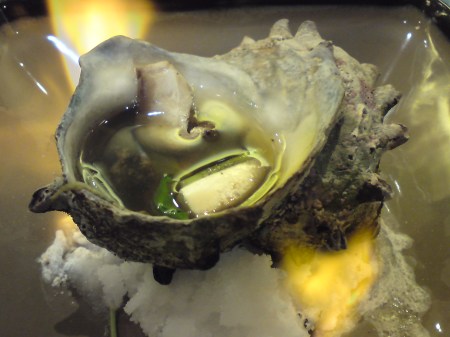
To his credit, Lawrence had also come up with some new creations (snails, some exotic soup contained inside a seashell), and so while he busied himself preparing the Kobe beef, we began drinking. The 2006 Dr Loosen Wehlenur-Sonnenuhr Auslese, light golden in color, was deeply fragrant, rich in notes of apricot, peach, and that petroleum character (some described it as “diesel”…good luck to those who’ve tasted diesel) so readily apparent in German rieslings. Medium-bodied, with undertones of malt and rye, and just the right amount of sweetness without being over-saturated nor overwhelming. Excellent. But a bottle of wine spread over 9 persons (including Lawrence) meant there wasn’t much to spare. Hence, we needed another white. The 2005 Domaine Patrick Javillier Mersault Les Clous was, perhaps, at a disadvantage coming right after the auslese. This producer, however, is a household name in Mersault and it shows. Straw colored, slightly yeasty with, again, a bit of malt and very little citrus notes. But, true to its roots, it offered loads of chalk and gravelly minerality. Somewhat thin initially, but it gained weight and intensity nicely after an hour, the hollowness on the mid-palate replaced by rich vanilla and caramel flavours, open and expansive, ending on a slightly grassy note. Now I remembered why I bought it from Le Benaton some time back, but that was my last bottle.
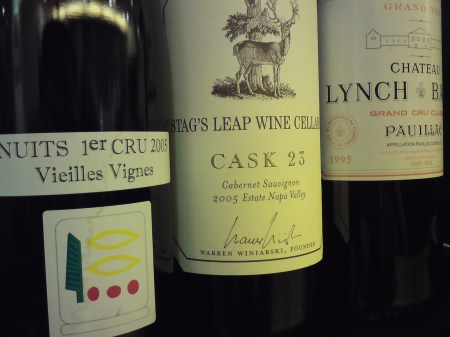 The 2005 Domaine Prieure Roch Nuits-Saint-Georges 1er Cru is somewhat of a curiosity. Purportedly owned by somebody who has a share in Domaine de la Romanee-Conti (don’t quote me…I may be wrong), it sports a weird-looking tiny modern label and a nose that suggests more of chemicals than red fruis and cherries. Minty, dense, and rather undifferentiated on the palate, with some sour plums and pickled cherries. It gained greater focus and definition with time, but never developed any real depth nor complexity. It certainly doesn’t taste anything like a SGD200-300 wine. Gimme a Armand Rousseau anytime.
 Another oddity cropped up in the form of a 2000 Ch Mouton, minus the Rothschild. Sounds impressive, and it even had the right level of deep garnet red, complete with a decent bouquet of dark fruits, dank undergrowth and a touch of banyard pungency. But it was a letdown on the palate – bland, austere, resinous, monolithic and undifferentiated, topped with a significant degree of alcoholic heat even after 10 years. Drinkable, I suppose, but I preferred not to waste my hepatocytes on it.
And so finally, we arrived at the two quality reds. The 1995 Ch Lynch-Bages, displaying an evolving red, was simply gorgeous, offering deep notes of red and dark fruits, and sweet berries against a background of dried herbs and tobacco. Soft, rounded with unobtrusive acidity, but still rather full-bodied in spite of its 15 years, superbly integrated with wonderful grip, focus and delineation across the palate. Perhaps not as complex nor deep as its bouquet had hinted, but this didn’t detract from its innate elegance that’s consistent with most of the Left Bank clarets of 1995. A wonderful wine.
In contrast, the 2005 Stag’s Leap Cask 23 cabernet sauvignon, an impenetrable red, was undeniably attractive with plenty of dense ripe fruit packed into a powerful wine of fierce intensity, obviously tannic with leafy undertones, producing a structured but austere and monolithic wine, toasty and resinous on the finish. To be honest, though, I’d have great difficulty identifying this as one of Napa’s pillars, for it lacked adequate distinction to set it apart other Napa reds, and I daresay that a Heitz Martha’s Vineyard is probably better and preferable. Nevertheless, I am grateful to have had the opportunity tasting it.
Notes in brief… (February 2010)
2006 Domaines Leflaive Macon-Verze, at the in-laws. Pale lemon color. Flavours lean towards light citrus, lime, green apples and grassy notes. Light-bodied, lacking in weight, density and depth. I daresay a Leflaive bourgone blanc is better. Not buying any more of this.
2000 Parker Estate Terra Rossa First Growth, at the EMSS AGM at Trader’s Hotel. Impenetrable crimson, a huge wine with undifferentiated flavours of licorice and dark berries of undeniably high extraction, very ripe with spicy notes, ending in a substantial trail of alcholic heat even after 10 years. Lacking in depth and complexity. Not my idea of a Coonawarra cabernet sauvignon. I thought I’d been drinking a Mclaren Vale shiraz until I saw the label. Certainly very different from a previous bottle tasted in June 2009 at Ed’s wedding, which was more accessible with some layering and complexity. My last bottle, but will not be missed. The 1998, and even the 1999, is much more preferable, and I have high hopes for one last bottle of the 1996.
I happened to bump into HK at Moomba (below) and, coincidentally, he poured me a 2001 Ch Langoa-Barton which provided a great opportunity for comparison with the Lagrange side-by-side. Although I’ve long admired this estate, I feel that Lagrange is the better buy, given that they both sell at similar price points, and this comparison proves it. Very similar in color and bouquet, but the Langoa-Barton is just a tad more rustic and lighter in texture, missing the opulence that Lagrange is sometimes capable of. Nevertheless, I’m happy to drink the former anytime.
2001 Ch Lagrange, over dinner at Moomba. This is my fifth bottle from a case bought cheaply for only SGD58/bottle a few years back. I have a soft spot for Lagrange for the fact that it still sells at realistic prices even though quality has improved by leaps and bounds ever since Suntory bought over in 1983, and this evening’s showing proved just how good it is. Dark red, imparting a sweet nose of dark fruits, blackcurrants, soy and that unmistakable metallic note of graphite that spells Saint Julien, with a hint of sizzling intensity. Medium-full, with excellent levels of richness and density producing a firm grip on the palate, the fruit beginning to develop secondary flavours, ending in a savoury finish with fairly sophisticated fine tannins without any hint of wood. To hell with label drinkers; connoiseurs of claret recognise a good drop when they taste one, and Lagrange is a great example.
2007 Heritiers du Comte Lafon Macon-Milly-Lamartine, my second and last bottle over yusheng. I regretted buying this. I’d mistaken it for the “clos du four” which hails from the same producer, but this isn’t, and it shows. Very dry, crisp and tight. Short on flavour and length, tasting more like a New World riesling than a white burgundy. Not good.
2007 JJ Christoffel Erben Uziger Wurzgarten Riesling Auslese, probably one of the best wines to drink in the sweltering heat of Lunar New Year. Light golden-green. A wine of low acidity, smooth, producing solid notes of nectarine, apricot, mangoes, lychees and a touch of honey underscored by a level of sweetness (not overwhelming at all for an auslese) that lingered on and on, making you long for sip after sip. Excellent.
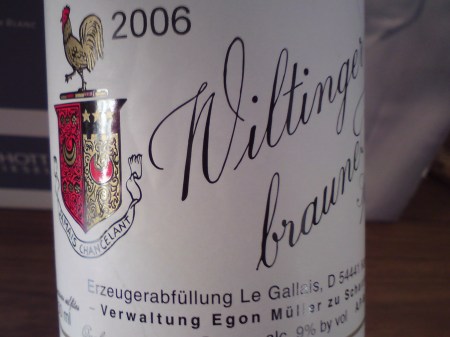 2006 Egon Muller Wiltinger Braune Kupp Riesling Spatlese (difficult-to-find; purchased from Vinum’s warehouse sale), at the Reunion Dinner on 13 Feb 2010 over steamboat delicacies. Beautiful clear yellow. An abundance of nectarine and apricot on the nose, highly perfumed, living up to its promise with a generous expression of tropical fruits, immediately leading to a deeper vein of exotic flavours that danced persistently across the palate, vibrant and vivacious without the acidity being overly crisp. Simply quite sublime.
2006 Dog Point Section 94 sauvignon blanc, at Imperial Treasure T3 on the occasion of Ben Ng’s visit. Pale, but exuding a lovely bouquet of floral fragrance with a hint of jackfruit and longans. Full-bodied, vivacious, showing great presence, dovetailing to a slightly grassy note at the finish. Excellent.
2004 Pahlmeyer merlot (courtesy Hiok), during an after-work happy hour with bak kwa, foie gras and smoked duck. Dark red.Very fruity and rich. Gentle on the entry, leading to a relatively soft wine with unobtrusive acidty. Quite resinous though, with a smoky note pervading the whole wine. Lacks the mouth-puckering suppleness of Old World merlot, but this is drinking well, I must say.
2003 Ch D’Aiguilhe, a half bottle over a tenderloin steak at Foo House. A big wine, but it’s better integrated now than 6 months before. Laden with very ripe dark berries and plums, highly extracted, warm, meaty, very full but it is becoming more seamless, ending with savoury chewy tannins, though the 14.0% alcohol is still quite apparent beneath. A good casual drop, but I don’t think I can take too much of this monster.
Rockford Black Shiraz (2009 disgorgement)
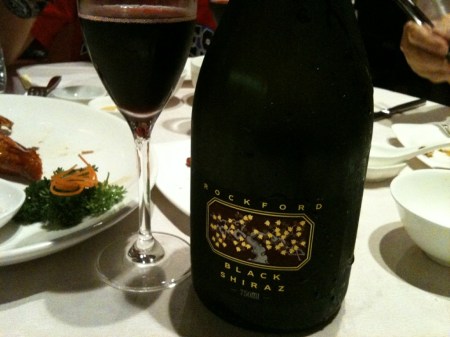 Only the land from Down Under has this penchant for producing sparkling reds, and of all these, only the Rockford Black Shiraz reigns supreme, the rest being either too sweet, too bland or too simple. What exactly is this Black Shiraz?? It is actually disgorged annually from a solera that is derived from the renowned Rockford Basket Press shiraz. Every year, some 30% of the current vintage of Basket Press is added to the solera which, of course, contains back vintages of Basket Press that had been added in previous years. Part of that is disgorged and matured in seasoned oak for three years before being bottle fermented and left on lees for another year. Only some 2500 cases of the Black Shiraz is disgorged and sold only at the cellar door at Krondorf Road in the Barossa every December (loyal fans on its mailing list – known as the “Stonewallers” – get the first cut in October), the whole lot being completely sold out before Christmas. Each customer is only allowed a measly carton of 3 bottles, max. Priced originally at AUD56, it is usually sold for well over AUD100 by the time you see it in retailers and restaurants. I have made it a point to obtain some every year, since 2003, directly from the cellar door either in person or by proxy. For the 2009, I’m absolutely indebted to AW for procuring 12 bottles. Fantastic effort!!
Popped and poured at Imperial Treasure T3. Bright purple, offering a bouquet of raspberries and brandied cherries. Medium-bodied. Slightly thin initially, but it rapidly gained weight with notes of redcurrants, strawberries and a hint of licorice underscored with liquered herbs. This is not the most complex nor layered of Black Shiraz that I’ve had, of course, for these things need time and another 5-8 years of careful cellaring can be extremely rewarding. No…I’m not in any hurry to drink up my stash of Black Shiraz.
1983 Ch Lynch-Bages @ Wild Rocket
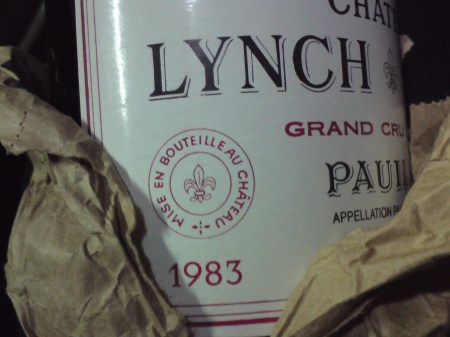 Vic finally made good his promise to buy his illegitimate sister dinner, and so we met over a 6-course set dinner at Wild Rocket. However, the portions threatened to rival those served at Les Artistes Bistrot, such that we had to add another half portion of pasta each.
We began with a 2006 Gaja Alteni Di Brassica that Vic had carried back from Italy. Very pale, but the bouquet was lovely – very fresh, floral, creamy and buttery, laced with a tinge of sweetness. It had a nice zesty zing on the palate without being over-exuberant, remaining well-balanced with understated acidity, the sauvignon blanc producing a complex body of lime, minerals, melons and lemongrass, ending wth traces of longans and pomelo, all contained within a body of excellent depth and concentration. Supremely effortless compared to its usual counterparts from New Zealand. Quite outstanding.
Great wines are meant to be shared with great company, and I definitely had no hesitation in offering a 1983 Ch Lynch-Bages, purchasd last month from Bob Rees of WEA who, in turn, had sourced it from a collection in California. The capsule definitely appeared worn, the ullage sat at high shoulder and the wine was a dusty red. But I needn’t have worried. The bouquet was unmistakably that of a beautiful mature Pauillac, offering an abundance of cedar, dried herbs, tobacco snuff, a touch of cinnamon and, of course, that note of pencil shavings with an afternote of licorice. Medium-full, soft, rounded, absolutely harmonious with infinite complexity, the glorious fruit still tasting very fresh, gripping the palate right to its savoury finish. It reminded me very much of the 1988 Pichon Lalande, for these wonderful Pauillac wines, when fully matured, are simply irresistible. Superb!! In return, I have been promised an ’89 Lynch-Bages at The White Rabbit at Dempsey over wagyu beef in the near future. I can’t wait.
 Ric's Wine Journal