Business Class with Singapore Airlines, September 2010.
The Business Class experience begins first, of course, at the Silver Kris Business Class lounge at Changi Terminal 3. The range of wines is nothing to shout about, really, but nonetheless, they mandate routine assessment. The 2007 Yalumba unwooded chardonnay is not unfamiliar, being the solitary white at the lounge for quite some time. Pale lemon color, showing some decent fragrance on the nose with steely minerality on the palate, simple and straightforward, ending in a slightly peppery finish. I didn’t bother with the Chilean red, going straight for a small pour of the 2008 Rubio San Polo Montalcino, showing a fairly deep red but not revealing much on the nose. Medium-bodied, soft, obviously made in an easy drinking style with just enough fruit to cover the alcohol without any lasting intensity.
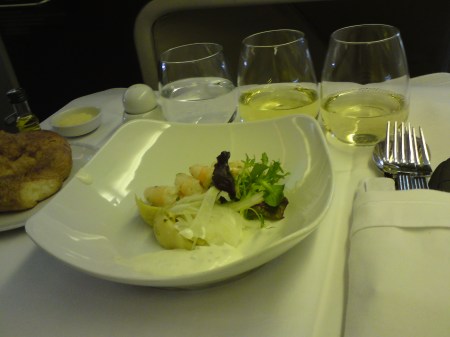 On board SQ352/351 (Boeing 777-200, which doesn’t carry the ER Business Class seats) return trip to Copenhagen, there was a choice of champagne between the ubiquitous Charles Hiedsieck (which I avoided) and the Bollinger Special Cuvee NV, which I took. Light golden. Enticing nose of malt, rye, vanilla, maple and toasty oak, rich in minerality, conveying a sense of depth. Almost has a creamy texture. But it was disjointed on the palate, being too dry. A letdown. Next, I had the 2007 Clos Philippe Le Hardi Bourgogne Hautes Cotes De Beaune Monopole to go with the scallops. Pale yellow. Highly promising on the nose, suggesting a medium-bodied wine with vibrant acidity and substantial minerality, but it was rather slender on the palate. No doubt quite elegant, but it could do with more fullness on the fruit, coming across as rather one-dimensional. The alternative white, a 2008 Dr Loosen riesling, was rather restrained on the nose, a light-weight wine with just adequate levels of fruit with tropical notes and just a hint of sweetness. This wine could certainly do with more body, I feel.
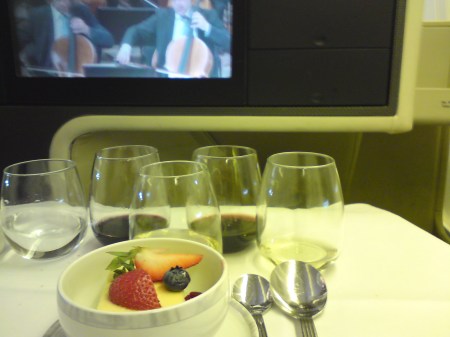 I had both reds to go with the beef short-rib (and the penne pasta on the return trip). The beef was nice, but you wouldn’t have known that it was conjured specially for SIA by Gordon Ramsay. The 2005 Ch Lacombe-Noaillac, from the Medoc, was dark red, showing lovely fruit, ripe dark berries laced with a tinge of sweetness and layered with cassis and cedar, carrying reasonable weight. Surprisingly good. No doubt the outstanding vintage accounted for much of the quality. It seems the lesser growths of 2005 are beginning to enter their drinking windows. The 2007 Allegrini Valpolicelia Superiore, from Verona, very deep red, was substantially heavier than the Bordeaux, fairly dense with a gravelly quality, with elements of earth, licorice and plums. Lacking in real depth, and not quite interesting enough, I’m afraid. The 2005 Offley LBV Port that concluded the wine selection, deep purple in color, contained a strong medicinal quality with some hollowness towards the finish. It could do with more stuffing and certainly cannot be compared with a Warre. What happened to the good ol’ Dow?
Notes from Stockholm
Greetings, from the land famous for ABBA, Volvo, Ikea and Bjorn Borg, amongst others, but not wine. Ikea does carry some Swedish wines next to its hot-dog counter, but you don’t see any Swedish wines on any wine list in the reputable Swedish restaurants, which says a lot. So, in the end, I had to drink non-Swedish wines in Sweden.
 2007 Domaine Saint-Gayan Cote du Rhone, over a huge Black Angus tenderloin at Restaurang Prinsen, Stockholm. Dull ruby red. A huge note of red fruits and plum dominated over the entire wine, without any meaningful depth nor texture. A cheap drink, overpriced at SEK105 (about SGD21) for a glass.
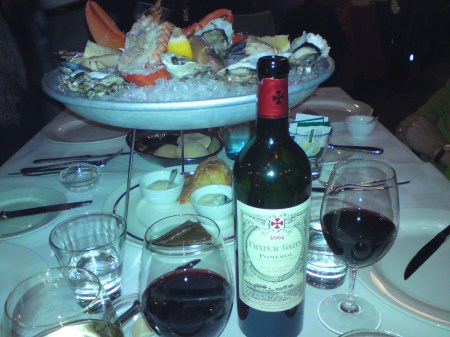
2008 Domaine William Fevre Chablis, just a glass to go with the seafood platter at Pontus By The Sea, in Stockholm. Light golden in color, but it packs a punch. Very open on the nose with the fragrance of white flowers, almost perfumed and sweet, living up to its promise on the palate, much fuller than expected for a village wine, overflowing with rich minerality, not quite as flinty as a Chablis Grand Cru, developing a creamy texture with a long glowing finish. Excellent.
 2004 Ch Gazin, a full bottle to go with the steak at Pontus By The Sea, in Stockholm. Popped and poured. Deep red. Very pleasant bouquet of blueberries and raspberries, leaping out from the glass with a hint of sweetness. There’s plenty of cool ripe fruit on the palate, very lovely, fairly rounded even at this stage with well-integrated and unobtrusive tannins, well-balanced, elegant and poised. With time, it expanded further, becoming broader, developing notes of toffee and dried leaves, leading to an extended minty finish. This is an excellent Pomerol, not at all overpriced at SEK950 (SGD180) off the restaurant list.
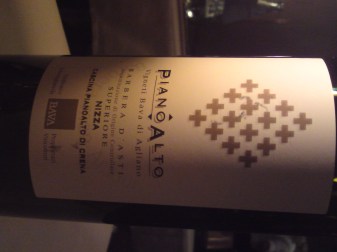
2000 Piano Alto Barbera d’Asti, shared with Ben over a fantastic steak at Teatergrillen in Stockholm. Decanted in the restaurant. Still showing a deep red with the slightest signs of tinting. Lovely nose of ripe fruit full of plum and licorice supported by a mild herbal, medicinal lift. Medium-full on the palate, rounded at the edges, fairly soft, the secondary characteristics emerged after some time, developing notes of cassis, cinnamon and dried herbs, fairly complex in the middle with just the right degree of intensity, remarkably harmonious. 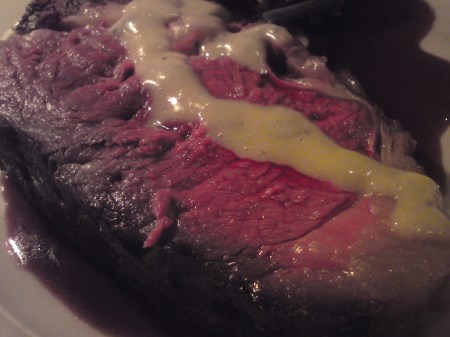 At SEK695 (SGD135) from the expensive restaurant list, this Piedmont certainly exceeded all expectations. Excellent. Testergrillen is a small charming restaurant that combines wonderful food with casual but discreet and friendly service. I chanced upon it in an editorial that I happened to read in an in-flight magazine on my way to Stockholm. The writer was absolutely right about its steak – huge, juicy, and tender, threatens to wear down lesser eaters but guaranteed to put a smile on everyone’s faces.
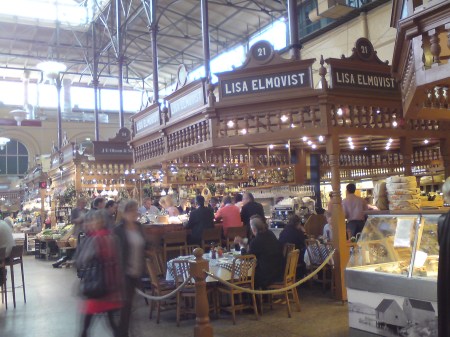
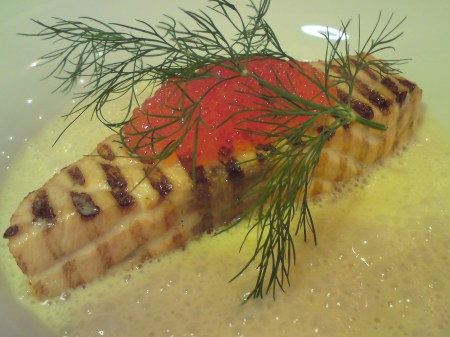 Another superb eatery in Stockholm is Lisa Elmqvist, located smack within a busy marketplace at Ostermalms Saluhall. A firm favourite with the locals, Lisa Elmqvist serves seafood freshly plucked from the Baltic Sea. Like any restaurant in Stockholm, the wait staff is friendly and highly-efficient, and it is always packed, necessitating advance booking. The grilled salmon with trout roe was absolutely the best I’ve ever had, easily the equal served at any top restaurant, with a price tag to match at SEK258 (SGD50), even pricier than any main course offered at Mathias Dahlgren! In fact, if not for the fact that it is located within a marketplace, Lisa Elmqvist would easily qualify for a Michelin star.
  I had a glass of Pol Roger Brut Reserve NV (SEK120 [SGD23]) to go with it. Light golden in color, the Pol Roger offered notes of toasty nuts, vanilla, cream and butter that was well matched on both the nose and palate, superbly balanced, smooth and rounded with the dryness well-contained. I preferred this to the Bollinger served on board Singapore Airlines. Excellent.
I also had a 2008 Italian cabernet-merlot from San Siro (the maker’s name escaped me) by the glass at Ciao-Ciao, an enormously popular Italian restaurant in Stockholm, but this wine tasted cheap throughout, the superficial plumminess failing to hide the indifferent fruit quality.
Monster tasting at The American Club
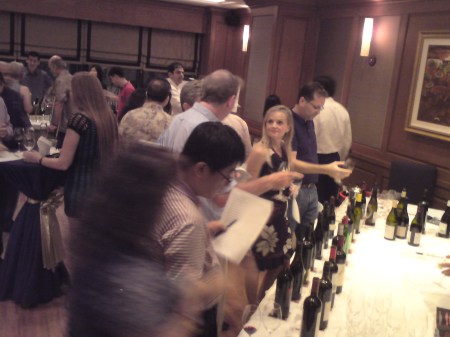 The American Club in Singapore, yet again, organised a massive tasting on 4th Sept 2010 where a good number of retailers and importers were present to showcase their wines, coupled with a super-sumptious buffet spread that’s absolutely irresistible. It was a great time to catch up with Liong, Robin Soh, Boon (from Wein & Vin, proudly espousing the virtues of Pierre Peters, Guy Charlemagne, Donnhoff and Kesselstatt), Jo Hung, and others in the F&B industry, not to mention the galore of tits and asses that filled the Presidential Room, including this leggy and knowledgable babe that Rev Distribution Network never fails to provide. And so, here are the 33 wines that tested my palate…
The Whites: Baron de Rothschild Brut NV (very good weight and concentration for a NV champagne without being too dry, but lacking in secondary toasty notes); Guy Charlemagne Rose NV (very lovely tint, bit shy on the nose, good body, rounded and smooth, perfect for summer); 2002 Guy Charlemagne Rose Cuvee Mesnillesime Grand Cru Blanc de Blancs (toasty, roasted nuts, yeast, fairly deep at this stage, rounded and not too dry, needs plenty of time for development…very good but not exactly a bargain at SGD165); Billecart-Salmon Brut Rose NV (lightly rose-scented with a bit of sweetness coming through, a tad drier than the Guy Charlemagne Rose NV); 2008 Vigneti Le Monde pinot grigio (rather leafy, could do with more fruit); 2007 Malat Gruner Veltiner Suse Reserve troknbeerenauslese (lovely mix of honey, nectarine and apricot with understated sweetness, a superb drop, only bettered by the 1989 Kesselstatt beerenauslese [below]); 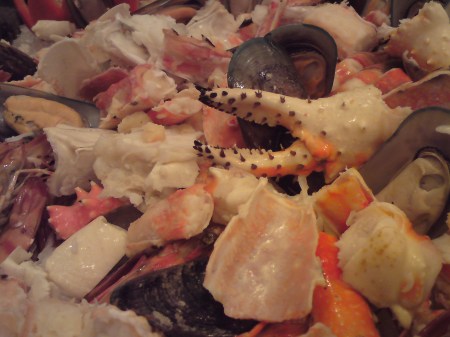 2007 Dog Point Section 94 sauvignon blanc (very different from the 2006, more nutty with coconut and caramel flavours that seem to add an extra dimension, less overt minerality with the acidty reined in…a bargain at SGD42…we bought a case); 2006 Domaine Louis Moreau Chablis “Valmur” Grand Cru (attractively priced at SGD67, but it seemed to lack concentration and character compared to the same bottle I had at Absinthe in July 2010); 2005 Vincent Girardin Puligny-Montrachet 1er Cru “Les Folatieres” (again lacking in the distinctive minerality of this famous terroir, rather soulless and dull…I’d expected more from this negociant winehouse); 2008 Donnhoff Tonschiefer riesling trocken (dry German riesling supported by excellent minerality and acidity); 2007 Donnhoff Hermannshohle GG (another dry German riesling, similar to the Tonschiefer but even better, showing perfect balance between the rich minerality and crisp acidity…not for ladies…costs almost thrice as much); 2007 Wittmann Westhofener riesling trocken “S” (dry German riesling made biodynamically…has a very clean feel with excellent purity); 2007 Kesselstatt Josephshofer riesling auslese Gold Cap #6 (very understated for an auslese...has it shut down?); 2001 Kesselstatt Scharzhofberger riesling eiswein (ooohhh…apricot, peaches, aged honey, richly layered…wonderful, if you’re prepared to pay SGD200 [375 ml]); 1989 Kesselstatt Scharzhofberger riesling beerenauslese (similar to the eiswein, showing more of the distilled essence with a burnished tone…SGD280 [375 ml]).
The Reds: 2005 Mount Mary pinot noir (lovely pinot hue, quite correct on the nose but unfortunately doesn’t quite deliver on the palate, lacking in depth and layering, to nondescript); 2005 Mount Mary Quintet (deep red, showing excellent weight, concentration and balance with a long finish, offered at a great price of only SGD119…easily the best red of the evening); 2004 Sergio Alighieri Vaio Amarne Valpolicella Classico (very deep red, full-bodied, luscious, threatens to coat one’s palate, doesn’t suit my preference but I can imagine others will like it); 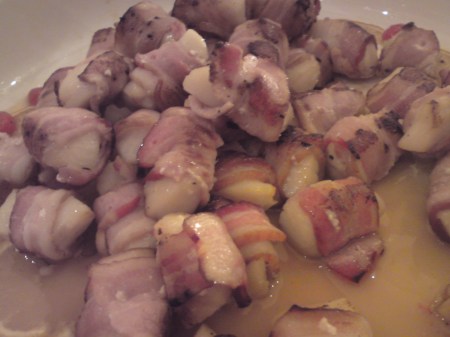 2007 Rockford Rifle Range cabernet sauvignon (very deep red, predictably full-bodied and rich with the warm Barossa character quite apparent); 2007 Vina Almaviva “Epu” (second wine of Vina Almaviva, clear red, medium-bodied, of blueberries and jam); 2006 Shafer One Point Five cabernet sauvignon (from the Stags Leap district, very dark red with an attractive mixture of sweet plums and concentrated dark berries without being jammy); 2006 Charles Melton Nine Popes (weighty, dense with a medicinal lift); 1987 Penfolds Grange (decanted for some time, I managed to pour myself a good dollop from a tiny bit that was remaining without the ang moh proprietor even realising…exuberant and open on the nose, still very concentrated and rich on the palate, structured, just beginning to develop layering and depth…an excellent wine but not distinctive enough if tasted blind, and certainly not worth SGD576); 2005 Cesare Pavese Barolo DOCG (pleasant, but lacking in weight and plumminess); 2006 Cesare Pavese Barbaresco DOCG (beautiful ruby red, showing real quality fruit, has superb concentration, intensity and sophisticated tannins to last in the cellar…superb value at SGD63…we bought half a case); 2007 Gibbston Highgate pinot noir (correct pinot hue, but it is too nondescript, lacking in verve, as if the winemaker was afraid of making a mistake, falling apart as it traversed the palate); 2007 Vynfields Reserve pinot noir (beautiful pinot color with a bold lovely bouquet that promised so much but failed to carry through on the palate, being too one-dimensional); 2006 Au Bon Climat Sanford and Benedict pinot noir (too brazen, I’m afraid…pinot is one damn fussy berry); 2006 Peter Michael Les Esprit de Pavots (rounded, grippy, quite harmonious even at this stage, excellent stuff but pricey at SGD139); De Stefani 1624 Marzimino (an Italian red, seemingly NV, big wine, velvety with luscious fruit, almost unctuous…not my preference);
  2001 Ch Cos D’Estournel (tasted this fairly early in the evening, dark red, quite harmonious and seamless, but this is not the setting to appreciate subtleties of a fine Second Growth, overwhelmed by the big reds, overpriced at SGD199); 2006 Ch Malescot St Exupery (more forward than usual for a Margaux, very good fruit concentration but yet to develop the characteristics of its terroir); 2000 Ch L’Arrosee (soft, developing very lovely secondary flavours, fragrant, not exactly a bargain at SGD109).
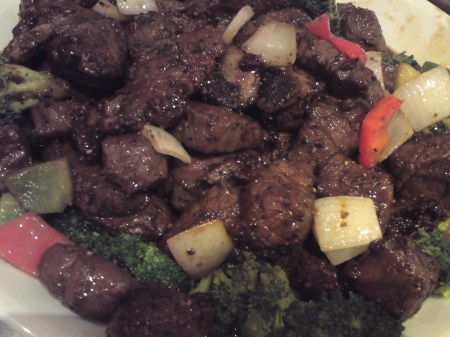
Well, I didn’t throw up, even after gorging on all that seafood and an entire plate of chunky black pepper beef cubes. As long as The American Club keeps organising this, I’ll be back.
1986 Ch Ducru Beaucaillou
Popped and decanted over dinner at Prive restaurant on 7 Sep 2010 with Angelina of Bordeaux Index. Along with the trio of 1988-90 from this estate, the 1986 is also known to be afflicted by serious cork taint that plagued the cellars of Ch Ducru Beaucaillou, and I’d certainly experienced this once before. As such, I was relieved when this sample seemed to taste alright just before the sommelier proceeded to decant it.
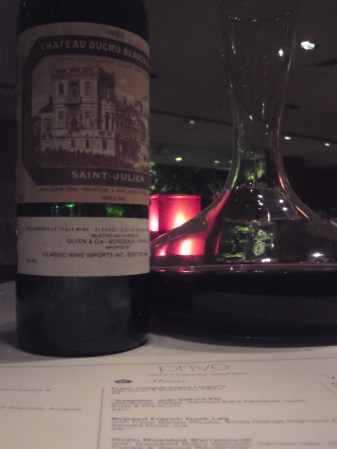 Still a dark semi-transluscent red. But I wasn’t quite entirely correct earlier, for I managed to detect a faint cork taint from the more substantial quantity that was poured into my glass. However, it didn’t detract from the positive vibes that greeted the palate, the wine mellow, soft and medium-bodied, imbued with complex notes of dried leaves, earth, tobacco and, most importantly, vibrant flavours of blue- and blackberries indicating that the wine was far from over the hill. It began evolving quite rapidly, the cork taint eventually disappearing after almost an hour to morph into an intense weighty wine of immense depth and complexity, more full-bodied with more fruit to the fore, with velvety sweet tannins caressing the palate in broad strokes, bathed in a harmonious glow, gaining in power yet maintaining superb focus and balance all the way to its lengthy finish. This is the third time I’ve tasted the 1986 Ch Ducru Beaucaillou, and certainly the best experience. Superb but, alas, none left.
I was away for a short conference in Melbourne, followed by a quick side-trip to Adelaide to visit the pandas as well as some friends. And in Australia, one can’t help but taste a range of Aussie wines while there.
1998 Scarpantoni Ironscarf Cabernet-Shiraz-Merlot (courtesy of Andrew), over a lovely dinner with Karen & Michael Horowitz at their manor in Adelaide on 31 Aug 2010. Popped and poured. This is the first time I’ve had a well-aged McLaren Vale shiraz. Dark red core with a slight vermillion rim. Lovely nose of ripe shiraz fruit that gained immeasurably in complexity after 30 minutes. Seamless, very well integrated with sweet plum and licorice and a very attractive glow, layered with mint and spice on the finish without any hint of rusticity nor alcoholic trace. I never realized McLaren Vale was capable of such sublimity. Excellent.
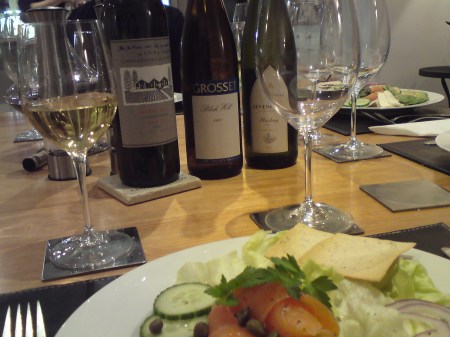 1997 Wynns Michael Shiraz (courtesy of Karen) over a lovely dinner with Karen & Michael Horowitz at their manor in Adelaide on 31 Aug 2010. Decanted well over an hour. Still showing a very deep red with a deep garnet core, from which arose a complex, seamless bouquet of mature shiraz fruit, deeply layered yet transparent in texture, with the feel of Old World northern Rhone, revealing superb depth and complexity. Highly seductive, keeps drawing you sip after sip. A wonderful example of a cool-climate shiraz, in this case Coonawarra. A stark contrast to the tannic John Riddoch cabernet of the same vintage. Wonderful .
2005 Sevenhill Riesling (courtesy of Karen), over a lovely dinner with Karen & Michael Horowitz at their manor in Adelaide on 31 Aug 2010. I remember visiting this estate in Clare Valley in 2003, previously run by Jesuit monks. Light lemon green in color, revealing ripe levels of fruit with great intensity and acidity, which is undoubtedly responsible for the fresh lively personality. Gained further intensity and weight with time, almost rivaling a Grosset Polish Hill in quality. Excellent.
1997 Grosset Polish Hill Riesling (courtesy of Karen). Clear golden in color, promising so much but badly corked, unfortunately.
2005 Starvedog Lane cabernet merlot, over dinner at the Greek restaurant Kouzina in Melbourne. Deep red with forward flavours of licorice, dark berries and plum, but without any meaningful depth nor complexity. A fairly good table wine.
2008 Ninth Island pinot noir, over dinner at the Greek restaurant Kouzina in Melbourne. Suitably appropriate fresh pinot hue. Nobody would mistake this for an Old World burgundy. Restrained on the nose initially, gaining in weight after some time, giving off a highly intense, biting intensity on the mid-palate, opening up to reveal some rose-scented flavours. Not bad at all from this cool-climate Tasmanian wine.
2008 Brokenwood McLaren Vale shiraz, at Becco restaurant in Melbourne. Dark opague red, rich in sweet licorice and very ripe shiraz fruit with more than a tint of medicinal note, framed by surprisingly smooth tannins, littered with spice and pepper. Very good indeed.
Notes in brief (August 2010): 98 Vieux Telegraphe, 08 Felton Rd, 09 Grosset Polish Hill, 05 Moss Wood & more…
2004 L’Hospitalet de Gazin, poured from magnum at the Departmental posting-out dinner at Azur, Crowne Plaza Hotel T3. A more transluscent red. Restrained on the nose and slightly thin initially, but it rapidly gained weight, adding more biting intensity on the mid-palate 30 minutes later, revealing very good fruit quality. Perhaps just lacking in layering and depth, but this is a very decent effort that I’d gladly drink. Only SGD70 at the mid-year Caveau sale.
2004 Ch Kirwan, at the Departmental posting-out dinner at Azur, Crowne Plaza Hotel T3 (courtesy of F). Popped and poured. Bright red at the rim. Medium-bodied, soft on the entry but showing more intensity on the mid-palate than a typical Margaux, with less feminity and fragrance. But it is drinking very well, poised and elegant. Very fine indeed.
2008 (?) Vina Maipo chardonnay, at the Departmental posting-out dinner at Azur, Crowne Plaza Hotel T3 (courtesy of F). Pale lemon color, but this was surprisingly very drinkable. Fruit forward with loads of citrus and lime, backed by a very substantial body underlined by a trace of minerality and a fairly long finish. I enjoyed it.
2005 L’Hospitalet de Gazin, bought cheaply from Caveau and drunk over a simple dinner at Imperial Treasure ION. Second wine of Ch Gazin. Dark red with a deep garnet core, this Pomerol has an attractive bouquet of soy and sweet dark berries with considerable salty minerality on the mid-palate, framed by smooth tannins without any hint of astringency. Just lacking in the layering and depth, but it is a good drop, nonetheless.
2005 Moss Wood cabernet sauvignon, at the combined ward 48/49 dinner at Big Eater. Lovely nose of dark fruits and black- and blueberries. More fruit forward than the Ch Bernadotte that was drunk alongside. Medium-full, elegant, well-balanced with a bit of tannic backbone showing when the ambient temperature became warmer. Leaning very much towards the Old World in style and feel. You could drink this now with a good steak, but I think I’ll keep my remaining 6 bottles.
2001 Ch Bernardotte (courtesy of Poh Yen), at the combined wards 48/49 dinner at Big Eater. I wish I could be more enthusiastic about this, but it came across as rather leafy and green, with a rather austere alcoholic finish. I believe I had a much better example sometime ago. Perhaps it hasn’t been stored well?
2008 Muller-Catoir riesling (courtesy of PS), at the combined wards 48/49 dinner at Big Eater on 18 Aug. This is a generic riesling from Muller-Catoir, sporting a very modern looking label. Very pale, with flavours that lean very much towards a leafy, citrusy style with a huge twang of zesty lime, rather one-dimensional and stern on the finish with hardly any of the sweetness normally associated with German rieslings. I’d rather go for the kabinett, at least.
2009 Grosset Polish Hill riesling, supposedly the best dry riesling from Australia, over Ming Kee’s signature beehoon crab with PS. Light lemon yellow. Very vibrant on the nose and palate, full of stony minerality and bitter citrus lending it an austere touch, with the full-bodied acidity adding to the lively crisp finish. Expectedly, rather one-dimensional at present. I’ve not had an aged riesling from Grosset. Will try my best to stash away these things for a few years. Only SGD46 from WEA.
2005 Ch Carbonnieux rouge, over takeaway fried rice and noodles. Dark red. Rather stern initially, with some herbaceous notes and a fair degree of mustiness from the wood, tasting not unlike a New World straight cabernet sauvignon varietal. It opened up somewhat after 30 minutes, developing more minerality and earthiness on the mid-palate with a trace of vanilla, but still rather one-dimensional, finishing with dusty tannins. I suspect this wine is beginning to shut down.
2007 Egon Muller Scharzhofberger kabinett riesling, a half-bottle over dinner at Asia Grand. This is the fourth time I’ve had this lovely wine over the past three months, and probably the best experience. Rich, ripe, with just the right level of sweetness amidst the smooth citrus and the relatively intense minerality, finishing long with the lovely floral fragrance lingering on and on. Wonderful.
2008 Felton Road Central Otago pinot noir, over dinner at Asia Grand. Double-decanted for 3 hours prior. A darker shade of pinot, primarily fruit-forward with loads of cherries, raspberries and other red fruits, with a coating of ripe peaches and the faintest trace of alcohol within its body. Already quite accessible at this stage.
1998 Vieux Telegraphe Chateauneuf-du-Pape (courtesy of PS), at Prive. Double decanted for almost 3 hours prior. Dull rusty red, exuding a complex powerful bouquet of licorice, strong herbal overtones, sweet meat, game, leather and toffee. Full-bodied, gripping the palate with a concentrated tannic attack, still rather dense, revealing a prominent streak of minerality, ending in a minty finish. However, this is not a monolithic monster. With time and food, it became more open and rounded. This is a wine that has yet to develop but it’s full potential is enormous. Excellent, but should not be touched for another 10 years.
2005 Domaine Bruno Desauney-Bissey Chambolle-Musigny Combe d’Orbeaux. This small producer is a favourite recommendation of Patrick Sauze of Le Benaton, but I find its Chambolle-Musigny less successful. This village wine has a heavy dusty pinot tint, which correlates with a weightier, rustic style that misses the rich deep character of the Musigny terroir, robbing the wine of much of its potential charm suggested by the relatively fragrant bouquet of red cherries, raspberries and redcurrant. Finishes with dusty tannins. Stick to the producer’s Gevrey-Chambertin, which is more true to character.
Not the professorial dinner: 2002/2004 Faiveley Clos de Beze, 2001 Louis Lequin Batard-Montrachet, 1990 Batailley & more…
Following a most successful dinner a month earlier, the breakaway faction re-grouped again on 27 July 2010 at Absinthe, with KP managing to arrange an excellent chef’s menu for SGD150, all in. A theme of Burgundy had been specified, even though most of the members of this group have little experience with this compared to Bordeaux. However, I must say we managed to do pretty well. I’d promised to bring for Li Wei a Ramonet Chassagne-Montrachet, but in my excitment, it completely slipped my mind. Instead, we had to make do with a 2006 Louis Moreau Valmur Chablis Grand Cru (courtesy of Li Wei) from the restaurant list, which was reasonable enough at SGD135++. This was light golden, clear, full of delicacy and the fragrance of white flowers, with a rich mixture of flint, citrus and minerals on the palate. Light-medium, yet yielding excellent concentration and complexity, the minerality expanding on the palate with an explosion of colors whilst retaining its delicate poise, the wine becoming more weighty as it sat in the glass. Excellent, really.
 PS generously supplied a 2001 Louis Lequin Batard-Montrachet Grand Cru, which I was grateful to have the chance to taste, for this negociant is represented by one of the major retailer chains locally at an affordable level. A nice golden hue, but the wine was very muted on the nose initially, light-medium on the palate but rather austere and stern, with hardly any minerality and certainly containing less stuffing than expected for a Grand Cru. Some degree of sweetness and caramel began emerging, together with notes of vanilla, slightly toasty, eventually it developed an intense body, becoming more luxuriant and richer, but it certainly took a long time coming and the nose still remained reluctant.
We kicked off the reds from the south of the Cote d’Or with a 2005 Comte Armand Pommard Clos des Epeneaux 1er Cru (courtesy of GPP), a monopole in the Cote de Beaune, although it quickly became clear this is not what one would normally expect of a Pommard. Very deep violet in color, matched by a wine that’s almost New World in character, a powerful musty bouquet reminiscent of nail varnish, huge dense and full-bodied on the palate, extracted to the hilt. It mellowed after two hours, becoming softer, but it still couldn’t shake off the immense density and concentration, not opening much at all. Rather wasteful to have opened it at this stage, but it is certainly not my style of preference for a Burgundy.
Kieron then offered a blinded pair. The first displayed a classic pinot hue with lifted aromas of red fruits amidst a considerable amount of complex minerality even though it didn’t quite have the depth nor layering. But what was most striking was the perfect integration between the excellent fruit, tannins and wood within the overall structure, all coming through quite effortlessly. Very lovely – a 2000 Louis Jadot Gevrey-Chambertin Clos St-Jacques 1er Cru. I should have guessed a Chambertin, at least, given the remarkable expression and purity of the fruit. In contrast, the other pinot had a much subdued tone, minty on the nose, soft, quite harmonious, slightly musty, definitely had an aged quality to it but, at the same time, a rustic feel as well, less layered and rather short on the finish. Somewhat one-dimensional. It was difficult to place. A New World pinot? It turned out to be a 1995 Comte Senard Corton Clos des Meix Grand Cru monopole. A fine wine in its own right, but a Clos St-Jacques Chambertin would always come out tops.
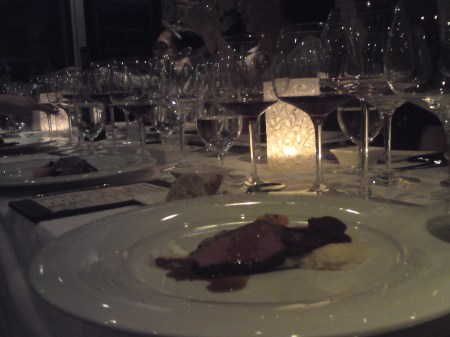 The following pair was also the focus of a fascinating comparison. Culina happened to hold its Faiveley clear-out sale during that week, where Chris managed to secure a 2004 Domaine Faiveley Chambertin Clos de Beze Grand Cru. This prompted me to bring along a 2002 of the same wine for comparison. The 2004 was more opague and less intense on nose. Medium-bodied, soft and radiant, quite harmonious, but the intensity and opulence was a notch lower although it is drinking well, whereas the 2002 Domaine Faiveley Chambertin Clos de Beze Grand Cru displayed a deeper ruby glow with a lovely fragrance of fresh red fruits. A big wine, but beautifully balanced, cohesive and structured, revealing wonderful depth and focus with a great deal of minerality in the body. Excellent. I should have bought more previously, but that was my last bottle.
The final pair were Bordeaux reds, of which the 1990 Ch Batailley (courtesy of Hiok) turned out to be a great surprise. Normally a perenial under-achiever, the 1990 proved to be a worthy exception. Dense on the mid-palate, displaying a classic Pauillac signature, harmonious and well-integrated, with excellent depth, structure and power. We’d thought it was a 1990 Lynch-Bages. Still a youthful red with the legs to last another 20 years, easily. By the time the final red, a 1994 Ch L’Eglise Clinet (courtesy of Vic) was poured, my jaded palate had just enough life left to appreciate the extracted richness emanating from the deep purplish red, loaded with glycerin, aided by more than a touch of modern winemaking from an ancient commune, with layers of flavours unfolding towards the finish. Amazing results from a wet vintage, perhaps justifying the use of interventional techniques to churn out good-tasting wines regardless of vintage conditions, at the expense of retaining its identity.
Final blowout at Iggy’s
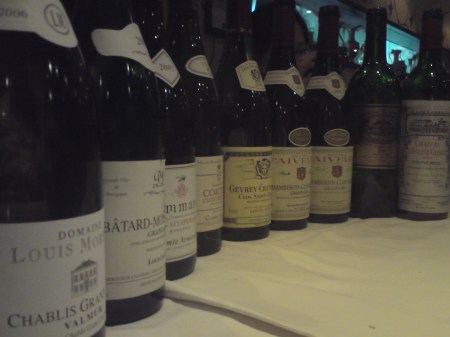
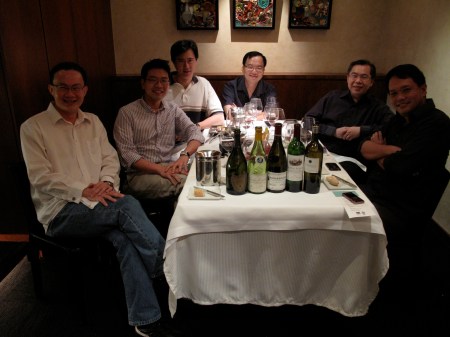 How does one move on after two highly successful dinners at Iggy’s, the best restaurant in Singapore and rated amongst the world’s best, especially as the last dinner had been hailed as well-nigh perfect? (see entries in Sept 2009 & Dec 2009). But there was unfinished business at hand, for Danny and I have yet to take our turn in providing the wines for dinner. And so, as incontrovertible as the night that follows day, we knew that a third dinner at Iggy’s was inevitable, which eventually took place on 7 July 2010. The question was: what could we drink after having had Petrus, DRC Grands Echezeaux, Le Pin, Harlan, Armand Rousseau Chambertin and various Montrachet Grand Cru? The answer was obvious after some reflection. Something highly desirable, but untried before. That would be the theme. The lineup was planned independently. We’d go for quality, not quantity. Ouch…I’ve never spent that much on just a couple of bottles of wine, but once that boundary had been crossed, all my other past purchases seemed cheap. Terrible. I knew not what Danny would bring and, save for the champagne and sticky, everything was blinded.
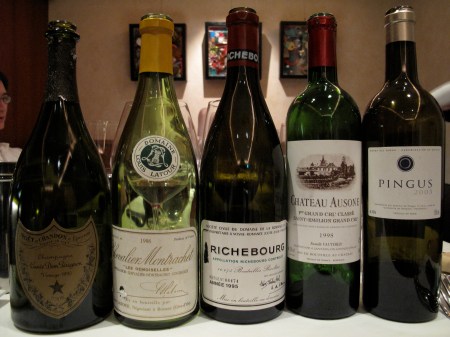
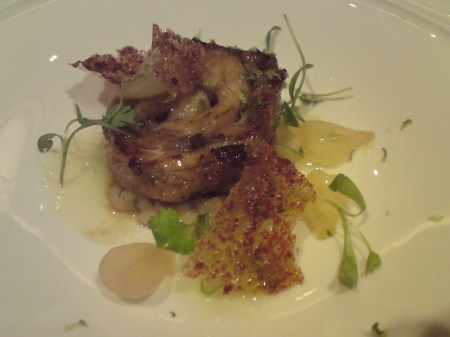 We started with a 1990 Dom Perignon (courtesy of Daniel). Pure liquid gold, displaying a deep twang of lovely citrus and minerality with a toasty character, stuffed with smoke, ash, and tobacco. Deeply complex with a burnished tone, weighty, possessing dry biscuity notes rather than the usual yeasty overtone, developing great acidity with time with emerging notes of caramel. Just lasts and lasts. A superb start.
The blinded white burgundy that was poured (courtesy of Daniel) was clearly a well-aged wine, judging by the fabulous liquid gold, yet remaining crystal clear in spite of the years. There was a hint of lemongrass, fig and grapefruit with a faint aroma of orange peel (from Uncle Hsu…I agree). Medium-bodied, deep, almost honeyed, remarkably transparent on the palate without much fat, the acidity already threatening to dip. However, it gained greater minerality with time, almost veering towards a Sauternes on the nose, with an emerging note of apricot, growing in stature with each sip. Great stuff. Clearly a Burgundian Grand Cru, but from where, and by whom? Thoughts of an aged Chablis were also briefly entertained, but Kieron ventured aloud the possibility of a Chevalier-Montrachet, which we’ve never had. And on hindsight, the signature grassy overtone was a giveaway on the producer: Domaine Louis Latour, Chevalier-Montrachet Grand Cru from 1986.
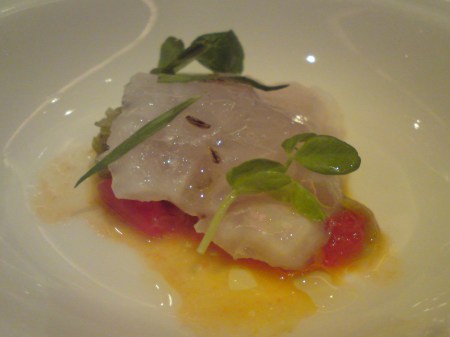 We moved on to the first red (courtesy of Daniel), undoubtedly a Burgundy. A very pure pinot tone, with immediate suggestion of power, finesse and elegance amidst the wonderful bouquet of cherries, redcurrant and raspberries at just the right level of ripeness, possessing a broad sweep across the palate, slightly salty in the middle with plenty of depth, leading to a highly complex finish, maintaining great balance and poise effortlessly. It gained more power with each pour, exuding wild exuberance, yet never out of control at any time, like a supreme driver in an F1 car. Not even Armand Rousseau can attain such heights. Surely, such sublimity must mean DRC, with every hallmark in place. A ’96 Richebourg? We were almost spot-on: 1995 Domaine de la Romanee-Conti Richebourg Grand Cru. C’est magnifique!
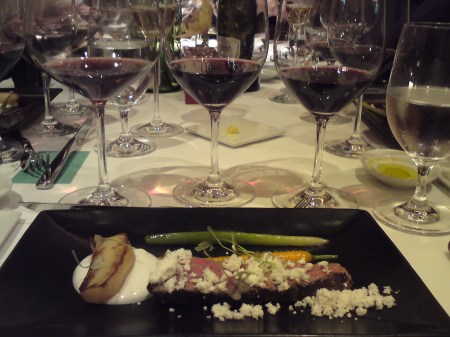 The next two reds were double-decanted inside the fridge for close to 4 hours to maintain temperature integrity, with further airing in bottle at the restaurant. The first was deep red, almost dark, revealing a dense mixture of dark and red fruits, beautifully intertwined with rich intense minerality and a touch of earth. The initial impression was that it was more developed on the nose than palate, where it was appreciably soft, with just the right level of extraction, the predominant merlot component already beginning to develop secondary characteristics. Less of structure, but totally seamless and complex, showing perfect delineation from start to finish, ending with sexy velvety tannins, becoming quite mellow with time. Clearly a Bordeaux, but nobody could quite place it, being an early modern-era style of Ch Ausone from 1998, a stellar Right Bank vintage.
The final red, showing a deep dense inky purple, was still rather muted in spite of all that decanting and airing, revealing only a glimpse of blackberries with emerging sweet oak. A huge wine of immense concentration, yet quite soft, not the monolithic sort of monster that knocks your palate out. Almost hedonistic but in a tightly controlled manner, medium-full with notes of plum and glycerin, finishing with a bit of menthol. Doesn’t strike one as outright New World in style. Most concluded a Californian cult wine…Araujo? Heitz Martha’s Vineyard? It took everyone by surprise when it was revealed to be a 2003 Pingus, the actual thing.
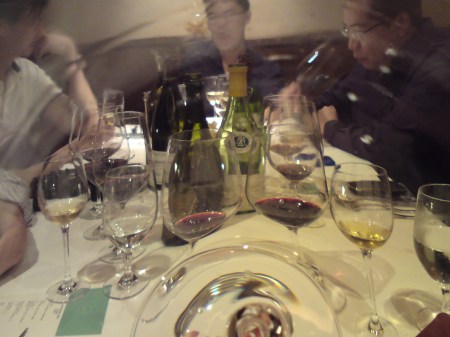 We concluded with a 2006 Kracher No. 10 chardonnay trocken beerenauslese that I’d hand-carried back from Vienna last year. Clear golden. Rather resinous with concentrated flavours of apricot, revealing excellent depth and intensity without any overbearing sweetness. That also brought our trilogy of terribly expensive blowout dinners at Iggy’s, spanning more than nine months, to a most satisfying conclusion. I don’t suppose I could possibly say which one of the three was the best. They were all wonderful but, most importantly, I enjoyed every minute of the company, without which the wines wouldn’t have tasted so good.
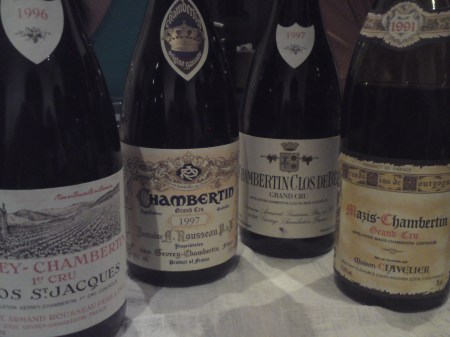
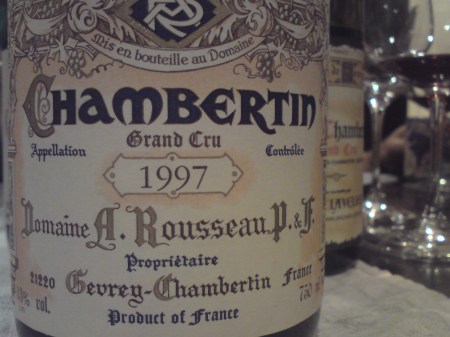 It certainly pays to have friends who are really generous, for I found myself staring at a top flight of Domaine Armand Rousseau Pere et Fils when I responded to See Lim’s idle SMS to show up at his place for a casual meet-up after dinner on 24 July 2010. All wines were aired in bottle for three hours prior, and so with the drama of Verdi’s La Traviata wafting in the background (Sutherland and Pavarotti) through a pair of Sonus Faber Amati, we went straight into the tasting. But first, we began with a 1991 Maison Clavelier Mazis-Chambertin, showing a mature rosy pinot hue and notes of cherries, red berries and sancha with understated fragrance, quite lovely. However, this turned out to be a wine that promises more on the nose than on the palate, where the concentration of the fruit, although seamless with excellent purity, didn’t quite live up to expectations of a Grand Cru from Chambertin, backward and lacking in the middle layers with a short finish. It only improved marginally over the next two hours, and certainly couldn’t match up to the next three wines.
I moved on to the 1996 Armand Rousseau Gevrey-Chambertin 1er Cru Clos St-Jacques, which had a pale mature pinot hue with an orangey tint, noticeably deeper on the nose with notes of red dates, raspberries and sweet citrus. Medium-bodied, soft, quite lush, displaying great focus and excellent concentration on the mid-palate. It developed into a truly gorgeous wine over the next couple of hours, gaining in power, complexity and layering that was clearly missing from the Maison Clavelier, highly complex in its finish. How would the Clos St Jacques, often regarded as befitting of Grand Cru status, compare against the 1997 Armand Rousseau Chambertin Clos de Beze, a wine that’s supposedly only second to Le Chambertin in the pecking order? The Clos de Beze was significantly deeper in color, more opague and more complex on the nose with a mixture of red and dark berries, evidently of superb quality, and that classic salty note representing the minerality of the the terroir. Medium-full, yielding excellent richness and intensity culminating in a slightly sharper attack on the mid-palate, superbly seamless, eventually developing even greater power with a note of menthol in its lingering finish. This is still a remarkably youthful wine that defies the problems of 1997. But, in a head-to-head comparison, the Clos St-Jacques held the edge by the end of the evening, indicating that vintage is a more important consideration than vineyard location, even between rival Grand Cru terroirs.
Finally, with great reverence, we poured the 1997 Armand Rousseau Chambertin. Outstanding right from the start, a beautiful pure transparent pinot glow, highly complex on the rose-scented nose, featuring rich mature red fruits, sherbet and vanilla, perfectly integrated. Soft on the entry with velvety textures gently caressing the palate, revealing very good concentration of fruit, perfectly seamless and sharply delineated from start to finish, gaining power with time, developing a sacharine-rich coating, ending on a slightly spicy note. Certainly the problematic vintage did manifest itself, the wine not as opulent nor intense as the 2003 example that I’ve had (see “Dec 2009: Perfect dinner at Iggy’s”), missing the layering and depth that an Armand Rousseau easily commands. Nevertheless, it is still a thing of beauty and soul, the effortless finesse, elegance and subtle power all hallmarks of Armand Rousseau, the wonderful craftsmenship of this great producer without resorting to vulgar means appreciated even more in this difficult vintage.
We closed the evening with a rarity, a 1991 Clos Jebsal Turkheim Tokay pinot gris. Very deep rose gold with very pure flavours of apricot and honey. Extremely rich, revealing great viscosity and weight on the mid-palate amidst lowish acidity, with understated sweetness that served to enhance the integrity of the wine, making up for the relative lack of complexity. Quite the perfect way to end a very lovely evening, and I shall, again, remain indebted to my generous host.
1998 Penfolds Bin 28 Kalimna shiraz, over lunch at Imperial Treasure T3. I remembered splitting a case with KP for only SGD40 per bottle, purchased from Auric Pacific Fine Wines some years back. Very deep dark red. Strong hint of ripe, exotic Barossa shiraz on the nose, delivering a full-bodied knockout (almost, in spite of its 12 years) on the palate, with notes of plum, licorice, dark currants and raisins, supported by lively acidity and alcohol and a prominent herbaceous medicinal lift. Still has plenty of youthful exuberance. The balance is there, but the parts are only just beginning to gel together. I’d say this has legs to last another 10-15 years, but alas, that was my last bottle.
1996 Clos du Marquis, over lunch at Prive with Kieron. Bright evolved red with notes of cedar, pencil-box, mature dark berries imbued with sur-maturite and minerality. Medium-bodied, soft, very well integrated and harmonious, the wine shedding some of the backwardness this vintage is known for. Quite excellent, but that was my last bottle.
1995 Ch Lagrange, an impromptu choice at an impromptu dinner at Asia Grand with the wifey. Bought for only SGD75 from Ben Foods some years back. Popped and poured. Dull red, a nose predominantly of some metallic minerality (the so-called “graphite” note of St-Julien), coupled with a mild bottle stink which blew off after a few minutes. It morphed very quickly into a low acidity, harmonious wine, easy on the palate with just enough fruit to avoid any sense of hollowness. I doubt it will improve much further and I was happy to drink up my last bottle of this.
2006 Felton Road Central Otago pinot noir (courtesy of Kieron), at Asia Grand. Deep pinot hue. Very open on the nose right from the outset – sweet red cherries, full of perfumed fragrance, violets and ripe red fruits that carried well onto the palate. Full-bodied, displaying excellent concentration and focus at just the right level of extraction, with glorious rich fruit running deep.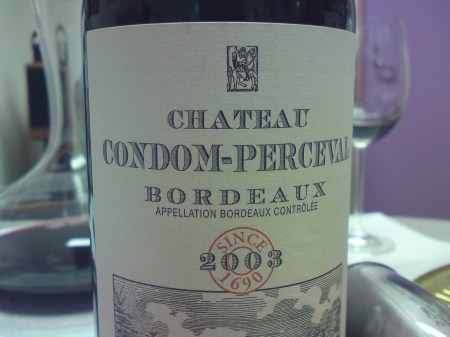 The only thing missing is the sense of place – terroir – otherwise this wine checks all the boxes correctly.
2003 Ch Condom-Perceval (courtesy of Hiok) at an after-hours drinks session. A Bordeaux table wine. How is a wine with this sort of name supposed to taste? Dusty dull red. The fruit is there but it doesn’t taste right – upfront, plummy, notes of orange peel with a sour aftertaste, clumsy, the fruit, acid and alcohol all over the place, restless, ending abruptly with absolutely no sense of place. No better than a supermarket wine. We poured it away. Damn cock.
1996 Ch Cantermerle (courtesy of PS), drunk with the Condom above. Coming after that, the Cantermerle (decanted for 3 hours) seemed like a breath of fresh air, even though this wine isn’t great, by any stretch of imagination. An evolving red, the mature cabernet producing some secondary notes of cedar, grapefruit and cinnamon, but there is already a fair bit of dryness creeping in around the edges, the fruit still remaining quite backward, as expected of this vintage, the oak still making its presence felt.
2006 Dog Point Section 94 sauvignon blanc, over some fabulous mussels and signature beehoon crab at Ming Kee Live Seafood. Upfront with loads of zesty citrus, jackfruit, tropical fruits and a hint of nectar. Medium-full on the palate with flinty minerality, the keen acidity ensuring plenty of vibrancy and freshness. But like all New World wines, it can wear your palate down quite quickly, and the lack of a signature terroir robs the wine of potential greatness.
2003 Ch D’Aigulhe, a half-bottle at Jade Palace. Deep crimson. Dense, evidently with a high level of extraction, producing very deep notes of dark berries, soy and plum, structured with silky smooth tannins, the vanilla from the new oak still quite discernible. Very well-crafted, bordering on the New World in style, if not for the homogeneity and minerality in equal measure to the fruit that is only possible from the Old World.
2003 Wente Riva Ranch chardonnay (courtesy of PS) over dinner at Starz Restaurant, Hard Rock Hotel, Sentosa. Pale yellow, very pleasing with fragrant citrus and melons, imbued with good levels of minerality, medium-bodied, easy on the palate. Nothing very cerebral, of course, but it served its function well.
2004 Ch Corbin, poured from a magnum that was bought at the mid-year Caveau sale, over dinner at Starz Restaurant, Hard Rock Hotel, Sentosa. Dense red with an opague core. Quite open on the nose, with minerals, soy and some plum that expanded with further aeration, revealing excellent fruit quality, medium-full, well-balanced with relatively tame tannins. A grossly under-rated wine. An excellent buy at only SGD65.
1994 Ch Cos D’Estournel (courtesy of TEK), popped and poured over dinner at Starz Restaurant, Hard Rock Hotel, Sentosa, drunk alongside the 2004 Corbin (above). An evolving red revealing flavours of plum, casis and cinnamon with a lovely aromatic lift, supported by excellent fruit without any sign of drying out. Remarkably well-integrated, structured and soft, without any harshness shown bysome wines from this particular vintage. Perhaps the depth and complexity isn’t quite there, but I much prefer this style of Cos than the present-day highly-extracted “international” style. Very good.

