1996 & 1999 Burgundy Grand Cru
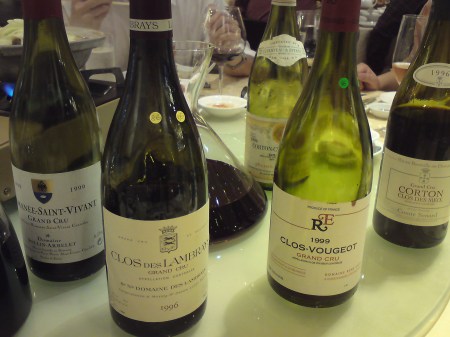 The Burgundian group met again at the superb Jade Palace on the occasion of YW’s return, and again it was KG who mooted the above wine theme. But before all that, we began with a Champagne Verve Clicquot Ponsardin Rose NV (courtesy KG), which was pleasant with some mild yeasty flavours, but on the whole it was simple and straightforward, hollow towards the finish. Very agreeable, nonetheless.
The solitary white was a 1996 Domaine Tollot-Beaut Corton-Charlemagne Grand Cru, brought all the way from Los Angeles by YW. The initial note from this pale yellow wine wasn’t encouraging, being quite lively on the nose with predominant citrus and lime, backed by a significant degree of acidity, but it lacked richness and concentration, as if the fruit was drying out, finishing short. However, it began to flesh out most impressively in the glass, becoming fuller, eventually putting on layers of nutty flavours, attaining greater weight and minerality. It’s a good drop, but it certainly took a long time getting into its stride.
We moved on to a pair of 1996 reds, a Domaine Comte Senard Corton Clos des Meix Grand Cru (which JJ had found in a dusty corner of Denise at Turf City) and a Domaine des Lambrays Clos des Lambrays Grand Cru (courtesy See Lim). Amazingly, the former was still very full and robust, still showing a deep red (for a pinot) and giving off a very attractive fragrance. I’m reminded of roses in full bloom. Very harmonious and even, with quite a bit of fat in the middle, ending with a rather slick finish. This wine has yet to reach full maturity in spite of its years. Quite a find, really. But as much as this was excellent, the Clos des Lambrays was even more impressive – fully mature and lighter in color and texture, offering notes of sweet cherries, soft, supple, totally seamless and harmonious. It got even better in the glass, developing great depth and definition, with aromas even more lifted, showing off wonderful richness and concentration in the middle, very slick, persistent in its finish. I get the impression that it still has plenty of life remaining. Fabulous. A great pairing.
 It was interesting to compare against the 1999 pairing of Domaine Follin Arbelet Romanée-Saint-Vivant Grand Cru (courtesy KG) and a Domaine Rene Engel Clos Vougeot Grand Cru. Both were huge, concentrated, deep in color and full on the palate, almost hedonistic, the latter being the heavier of the two, with a nose that was still closed. The Follin Arbelet, smooth and luxurious, had begun to develop delicious secondary flavours around its deep red fruit, producing good levels of complexity. A wine still very much on the ascent, entering its drinking window. The Rene Engel preferred to express itself on the palate – open, revealing rich flavours of sweet raspberry and brandied cherries with excellent definition and depth, even though its bouquet was quite restrained, ending in a long finish. On the whole, it was rather intense and tight, still primal, but there’s no doubt it has everything it needs to become a great grand cru in another 10 years. This has been a wonderful and highly educational tasting. Clearly, one needs to think twice about opening the grand crus of 1999 at this stage, but one doesn’t need to think twice about acquiring more to lay down.
Tasting at Auric Pacific
Auric Pacific Fine Wines held its year-end mega sale and tasting at its cellars, where I had the opportunity to taste the following wines…2006 Ch Cos D’Estournel (brought by one of Eugene’s customers) – deep purplish red, dominant nose of cashews and toasty oak, giving way after 20 minutes to ripe dark fruits and berries, deeply saturated but not over-extracted, smooth, finishing with well-managed tannins without any trace of heat. Very good, but I feel Cos is becoming too “international”. 2005 Domaine de Chevalier – a perenial favourite, deep red, lots of dark currants, full-bodied, intense, not quite well integrated yet, bit of a tannic finish. Needs lots of time, but I imagine this will be delectable after it has sorted itself out. 2004 Philip Togni cabernet sauvignon – deep purple, saturated with ripe red and dark fruits, well-extracted, full, with great mouthfeel. Correct in every way but not cerebral, nor seductive. 2005 Clos du Marquis, my first chance at tasting this – beautiful deep purple, slightly restrained but obviously has loads of quality fruit underneath, meaty, savoury. Surprisingly accessible on the palate, revealing excellent transparency than thickness, finishing with a deep rich vein of liquer. Excellent stuff, but the price is creeping up. 2006 La Fleur de Bouard – deep purple, full-bodied, yet really smooth, bit of toast and vanilla, excellent fruit quality, finishing long. 2006 Ch Calon Segur – the editors of Decanter rated St Estephe poorly for this vintage, but I found it quite agreeable – deep red, trace of gravel, toast, generous fruit and body, but like Cos, its terroir is not apparent. Prices for 2006 Bordeaux are declining, but I don’t see any compeling reason to buy.
1996/1998 Dom Perignon, 1999 Cheval Blanc & 1985/1999 Haut Brion
 I started the first day of December with a bang at Saint-Pierre, my fourth visit in as many months. K, still flushed over his recent success, was hosting an extravagant dinner, planned to the last detail. The decent thing to do was to offer him a Premier Grand Cru Classe en 1855; why hog these treasures?
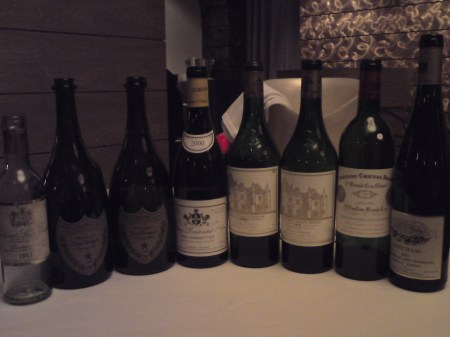
I was the last to arrive, and wasted no time plunging into the opening aperitif, a 1998 Dom Perignon (courtesy K). This was loaded with citrus and lime, light-medium, with excellent body, expansive yet delicate, offering good transparency, very deep, with a fragrance of longans and just the right level of acidity, ensuring a lively finish. It doesn’t have the yeasty note of a Krug, but this was great stuff, preferable than the 2000 vintage. But as good as the 1998 was, the 1996 Dom Perignon (courtesy D), drunk alongside, showed up the former’s deficiencies. One could immediately appreciate that the 1996 was a finer champagne – slightly deeper in color, richer, brimming with lifted aromas of lime and citrus, topped off with a creamy biscuity flavour, weighty and dry (but not to the extent of Salon), yielding greater complexity and depth, yet remaining smooth, even and delicate, avoiding any heaviness, ending on a note of pomelo and exotic tropical fruits, leading to a lingering, bitter-sweet finish. Going back, the 1998 seemed uneven in places, whereas the 1996 was a complete wine, beautifully proportioned. It is only through such side-by-side comparison that one can understand why the 1996 vintage is held in such high esteem. I am truly grateful to have had this great opportunity to taste both. Fantastique!
The solitary white, a 2000 Domaine Leflaive Puligny-Montrachet “Les Combettes” 1er Cru (courtesy K), almost seemed an oddity after such a marvelous start. This was not as deep in color as the 2003 example tasted in August, corresponding to its light-medium feel, with predominant notes of pear, pineapples and green apples (not to be confused with greeness), not quite as minerally or chalky as a Les Pucelles. It took on greater weight in the glass, developing a layer of vanilla and caramel, but the wine began to fade after 2 hours, never really getting into proper stride. Perhaps it had moved out of its temperature window, or because the subsequent auslese had altered my perception irreversibly.
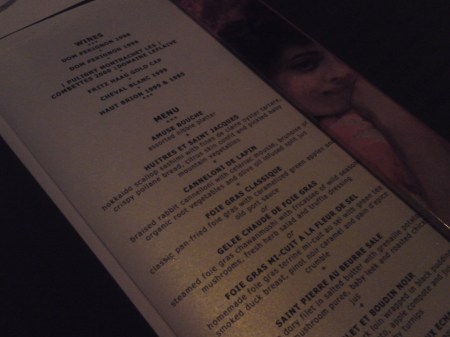
Next, the obligatory foie gras classique came along, paired astutely by K to go with a 2004 Fritz Haag Auslese Gold Cap, earning even the sommelier’s approval that this was more appropriate than a Sauternes, which would have been too cloying, whereas one could never direct such an allegation against an auslese. Pale yellow, conveying a wonderful body of pure nectar and honey with understated acidity, beautifully balanced, very smooth and even across the palate. Amazingly detailed, revealing very deep notes of lychees but it never ever threatened to dominate the food, neither did all the richness come across as being too thick on the mid-palate. It complemented the foie gras perfectly, and I simply can’t imagine how else the pairing should have been. I have to remind myself to keep my 2 bottles for at least 10 years.
 Then came the highly anticipated trio of First Growths, starting with a 1999 Ch Cheval Blanc (courtesy PS). I remembered missing out on this when it was offered for only slightly above SGD300 a few years back. The color was an unattractive dusty red, but it gave off a bold, almost acerbic, bouquet of deep red fruits, plums, olives and wild mushrooms, giving an initial impression of fruit that was drying out, but it dawned upon me later that this was, of course, the predominant cabernet franc, an unique majority in Cheval Blanc, that was speaking. Quite intense and full-bodied, finishing strongly on a note of sweet cherries and raspberries, but the wine lacked the power, opulence and depth of the great vintages, even though it fleshed out more in the glass, becoming more seamless. Strangely though, I recalled having tasted another example at a 1999 horizontal at See Lim’s last year, where it had a level of richness and depth that was missing here, and certainly nowhere near the 1964, plush and pure, tasted two years ago at Iggy’s.
In comparison, the 1999 Ch Haut Brion, sourced from Bob Rees of WEA, showed a deeper red, which translated into a fuller and deeper wine, fruitier, more svelte, with loads of deep dark berries and earthy notes amidst a trace of sweet vanilla. It fleshed out further in the glass, displaying very good levels of richness and concentration combined with quite a bit of verve, well balanced, finishing with fine tannins. A solid wine, perhaps even a tad four-square, but it stayed firm throughout the entire evening. Excellent. However, like the Cheval Blanc, it never achieved the opulence and lushness of a great Haut Brion, as exemplified by the 1985 Ch Haut Brion (courtesy K) that was drunk alongside. Clearly the wine of the night with an evolved red, the 1985 displayed a very open, inviting bouquet of classic aged Bordeaux, consisting of a very unique mixture of predominant red fruits and dry, exotic herbal overtones, yielding a wine that was still considerably bold and deep, yet absolutely seamless and harmonious, bringing out the cliche that “’85s are drinking best now”. It certainly had an antique chic quality that is quite different from an ’85 Medoc – more evolved, more pure. Wonderful.
I’m a sucker for Saint-Pierre’s excellent cheese platter, and K generously obliged with a 1983 Ch Suduiraut from the restaurant’s list. The acidity was beginning to fade in this quasi-liquid gold, losing some freshness, but it still had a deep, rich vein of apricot and nectar, leading to a bit of an austere finish. We probably caught it at the tail end of its drinking plateau, as I recalled a 1983 Rieussec as being considerably more complex and livelier.
We finally staggered out past midnight (no…I felt fine, really). This had been a great dinner, and again I must express my gratitude for the generous opportunity to taste all these wonderful wines, not forgetting to congratulate K for finally exiting the dark tunnel.
A simple dinner
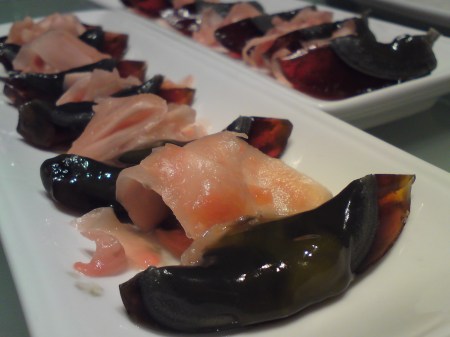 As I was faced with a most unpleasant week ahead, I decided the only solution was to make sure I ate and drank well. Happily, the usual suspects happened to be in the same boat, and so we adjourned right after a bad Monday to Imperial Treasure T3 for dinner. What was supposed to be a simple affair, predictably, turned out to be somewhat more elaborate, but no one’s complaining.
We started off nicely with a 2004 Jean-Noel Gagnard Chassagne-Montrachet “Blanchot-Dessus” 1er Cru (courtesy K). Light clear golden, it was immediately deep and complex on the nose, dominated by chalky, flinty minerals rather than outright citrus notes. It gave the impression of a very “clean” wine, complete with a strong scent of “Dettol”, which added, rather than detract, to its aristocratic aura. A rich, buttery, creamy note took over after some time, the wine continuing to show good intensity with great concentration and excellent focus right till the end. Quite superb, and obviously a great match with the buttered lobster, oysters and the obligatory century egg (nicely rich and runny).
The 2004 Domaine des Lambrays Clos des Lambrays Grand Cru, decanted for an hour, proved to be the perfect red to follow on. The initial nose that emerged from the beautiful deep ruby red seemed rather restrained to me, but it quickly opened up to reveal loads of red cherries and raspberries, deeply-layered with the right degree of fullness and intensity. It developed further complexity with time, taking on a “san-cha-like” coating with a trace of liqourice, developing even deeper fragrance, giving off intense notes of sweet cherries and strawberries with a persistent finish, yet remaining refined and elegant throughout with effortless grace. An excellent burgundy, and would be quite sublime, I’d imagine, if given several more years in bottle.
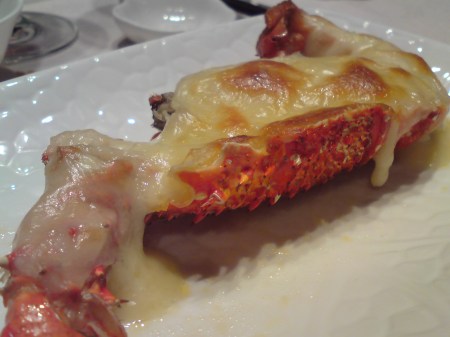 Unfortunately, the same couldn’t really be said of the final red, courtesy of David, a 2005 Kay Brothers Block 6 shiraz. A very deep, impenetrable red, revealing a highly-extracted wine of unctuous quality with a whacking dose of alcoholic heat, monster raisins, and liquorice in a disjointed heap, ending in a medicinal finish. Sure, it was smooth and svelte in places, but it proved difficult to drink, delivering a massive knock-out to the palate with the first sip. It reminded me of my visit to its cellar door at McLaren Vale in 2004, where I remembered the 2001 Amery Hillside shiraz tasted similarly bold and bruising. I was informed by K that the 2002 vintage of the Block 6 is altogether different, but I think I’ll still leave my 4 bottles of that alone for a few more years, at least.
Ch D’Aiguilhe @ Asia Grand: 2003 & 2005
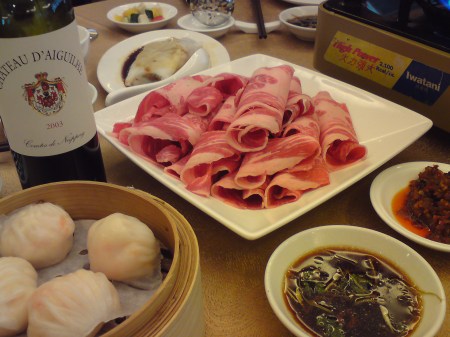 By coincidence, I happened to lunch at Asia Grand twice within a month, each occasion with a generous supply of beautiful wagyu beef, bamboo clams and some delectable dim sum dishes, all washed down with a bottle of Chateau D’Aiguilhe. This may only be an ancient estate in the Cotes de Castillon, on the outskirts of Bordeaux, but once it has been given the Midas touch by Stephan von Neipperg, you can’t go wrong, especially when a half bottle of the 2003 vintage is going for only SGD26 (incl GST). Popped and poured, it showed a very deep garnet red with a purplish rim. The initial bouquet was heavy with liquorice and soy that carried onto the palate, revealing high levels of extraction and thick textures, finishing on a slightly plummy note with tight, firm tannins. Much of its character is related, I’m sure, to the extreme heat of this vintage. After some aeration in the glass, the wine softened somewhat, but it was still essentially an unashamedly modern, young wine that’s happy to stain your tongue, teeth as well as the glass. I recalled a previous tasting at Les Amis couple of years back, also from a half bottle, that seemed a bit softer. No matter. This looks set to last the distance. Will let it sleep next couple of years.
About 3 weeks later, I was back again with Vic, this time with a 2005 over an identical menu. I much prefer this, a beautiful deep dark purple exuding rich ripe flavours of blackberries and blueberries, matched with a gentle entry, great body and mouthfeel, wonderful extraction, quite hedonistic without going over the top, finishing with sophisticated tannins. Still very primal, of course, but there was none of the heaviness or heat taint that marked the 2003, offering a glimpse at the potential depth after it had softened an hour later. Very classy, easily outperforming many other grand cru classe. Some would say it’s almost New World, but I disagree. No one could mistake that wonderful lushness and transparent texture for anything other than a superb Bordeaux. Having tasted quite a range of 2005 Bordeaux, I still maintain that Ch D’Aiguilhe offers the best value for this outstanding vintage.
We finished off with a 2002 Ch De Fargues, an estate under the venerable Lur Saluces of Ch D’Yquem. Light-golden, offering all the right notes of nectar, peach and apricot with a refreshing light touch, underscored by a deeper vein of tropical fruits. Excellent.
1996 Ch Ducru Beaucaillou
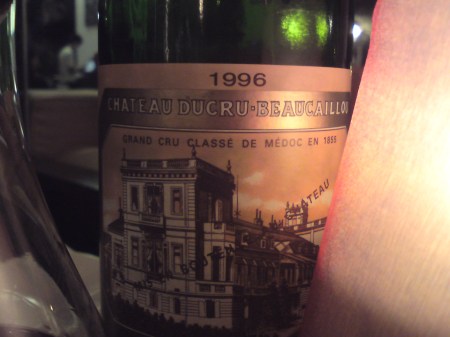 I’d not planned on opening this, but when Wan Cheng wanted to meet up with me over business, it struck me that we should mix it with pleasure. And since I’d be dining at Brasserie Wolf, a French bistro, with someone so knowledgeable about everything French, I decided to mark the occasion with a 1996 Ch Ducru Beaucaillou, decanted at the restaurant and served in Osterreich stemware.
The initial impression of this wine, a deep garnet red, wasn’t exactly encouraging. There wasn’t much on the nose, rather muted, just a whiff of soy and marmite (it’s that graphite again) intermixed with dark flavours, but the overall impression was a wine that was still quite shut. This carried onto the palate, where the full-bodied wine was still rather tight and backward, underscored by unresolved firm tannins, finishing on an austere note. It loosened up after about 60-90 minutes, imparting more depth, with flavours of rich dark berries emerging whilst the tannins softened considerably, holding the palate in a velvety grip. It never quite reached the level of lushness a Ducru can achieve, however, perhaps due to the pecularities of the vintage but more, I feel, because of the suboptimal ambient temperature in the restaurant. I have noticed that Ducru Beaucaillou tends to evolve quickly into a difficult, dense plummy wine if it is left too long in the glass at ambient temperatures that aren’t cool enough. This was certainly the case here, and I found myself unable to finish the last pour. Pity. This wine, clearly, has a long life ahead, and it’d be wise not to touch it again for the next 5 years. But it served its function well this evening, and I think this is the beginning of a beautiful working relationship with WC.
Fine dining
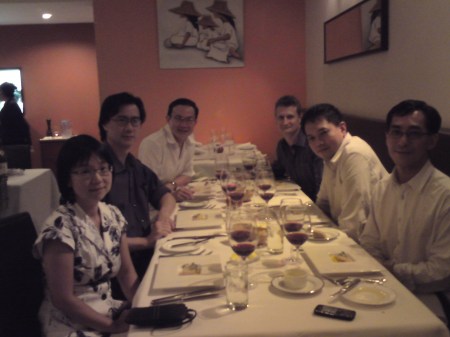 What a hilarious night. The ex-professorial group gathered enthusiastically, at short notice, at Les Artistes Bistrot (by Nicolas) for a regular meet-up. As nothing about wine had been planned, it was interesting to see what everyone would bring.
Interestingly, a pair of pinot noirs showed up. The 1990 Domaine Faiveley Echezeaux Grand Cru (courtesy KP) was drunk alongside a 1997 Giaconda pinot noir (courtesy Hiok). The Faiveley displayed the typical dusty red, giving off a very deep fabulous bouquet that was superbly fragrant, hinting strongly of rich red fruits and sweet cherries and raspberry. On the palate, however, the wine seemed curiously under-developed for a 1990, still remaining quite full and monolithic. Sure enough, it had great presence and a very correct “salty” pinot character, but there was none of the layers of richness, depth, and concentration – breed – that I had expected from this source. It loosened up after some time, but that was it.
In contrast, the Giaconda, a tad lighter in color, had a huge nose of red berries with sharper definition, but sacrificing depth and complexity. Full-bodied, much more extracted with thick textures, and again rather monolithic, yet to develop further, ending with a long salty finish. It opened up a little after an hour, revealing some notes of banana (I can’t think of anything else), but again not much else. A definite New World pinot. Neither of these two wines seemed entirely satisfactory, their relative deficiencies highlighted by the superb 2002 Nicolas Potel Vosne-Romanee”Les Suchots” 1er Cru that I had that same afternoon (see November Notes in Brief).
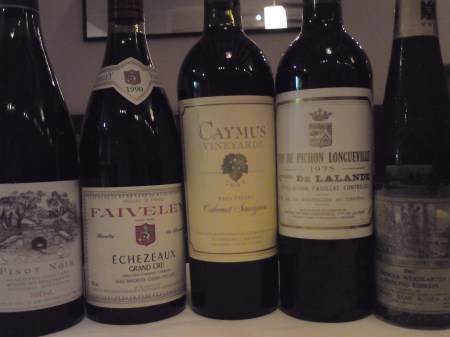 We moved on to more familiar stuff: a 1975 Ch Pichon Longueville Comtesse de Lalande paired with a 2000 Caymus Special Selection (courtesy Ed). The Comtesse has an interesting history. I remembered buying a couple from Oaks Cellars for under SGD300 couple of years back. What had struck me then was that the fill level was unbelievably full, the label appeared totally pristine, and it sported the words Vin de Pichon Longueville de Lalande, which is different from the usual. Fearing that it may be a fake, I’d emailed the chateau directly, which replied back after some considerable delay saying that a significant number of bottles of that vintage had been recorked at the chateau in 1993, with a change in label. Indeed this was true, as a closer examination showed that the cork bore a tiny inscription indicating that re-corking had taken place. This was my last bottle, which was also the best of 3 that I had tasted over the past 2 years. Obviously showing an evolved mature dusky red, it offered a fully developed bouquet of mature dark fruits that was surprisingly deep yet mellow. Still quite full-bodied on the palate, yet retaining very good levels of freshness, exotic notes of aged Bordeaux, very rounded and smooth, dominated by plum and raisins, chocolate, and tobacco. This is definitely the best showing of a ’75 Comtesse, coming across as fresher and more lively than before, and likely to hang on for a while more. The re-corking definitely had a part to play. But at 34 years of age, it’ll clearly not improve any further, and I’m glad to have shared this with wonderful company.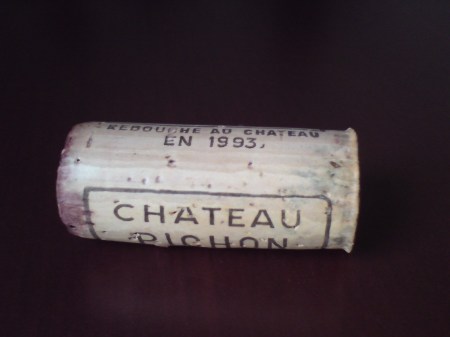
The Caymus was, predictably, the complete opposite, but it was very attractive nonetheless. Deep red, exuding a powerful bouquet of fresh vanilla oak, not excessive though, full of gorgeous ripe fruit, revealing great depth. Huge and dense, but surprisingly soft on the entry, very open and accessible, not monolithic, great mouthfeel with loads of liquorice and menthol laced with sweet tropical fruit, finishing long without any trace of heat. Delicious. A superb Napa wine. We rounded off with a 2002 J J Christoffel Erben Urziger Wurzgarten riesling eiswein (courtesy Vic), which was very lovely – lifted aromas of honey, nectar, peach, pineapple and apricot held in delicate balance with just the right level of acidity and freshness, with a bit of sizzling intensity beneath all that.
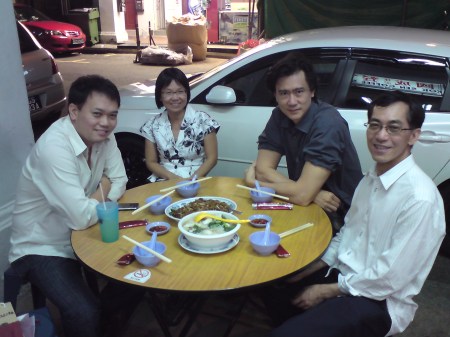
But that wasn’t the end. When we’d opted for the SGD70++ 5-course set menu that included a 200-day grain-fed beef tenderloin, we thought that would fill our tummies nicely. But the portions all turned out to be miniscule (the beef tenderloin only one-third the size of the kurobuta pork that Jade Palace serves as appetiser), plus one course that turned out to be just a tiny cupful of soup – actually more to cleanse our palates before the beef. True, the food was really excellent, it was truly fine dining, with fine portions. We’re still hungry. Hence, for the first time ever, we trooped across the road to Kok Sen Coffee Shop, ordered a huge plate of dry beef horfun and a huge bowl of sliced-fish noodles, and wolfed it all down in less than 10 minutes. I swear that was one of the most satisfying suppers ever. In fact, the beef horfun would have gone very nicely with a red. Five stars to Kok Sen coffee shop.

1994: Moss Wood & Ch Leoville-Las-Cases
The occasion was a casual dinner at Kome, with the missus and Monster. But as I don’t really visit Kome as regularly as some of my friends, and furthermore this is one of the few occasions where the missus tags along, I decided to drink a wine from our anniversary year of 1994. Coincidentally, K happened to be dining there that same evening, and so we turned it into a mini tasting, happily swapping wines.
 I started off with a 2007 Moss Wood chardonnay, dull, light-golden in color. This was quite a full-bodied white, with good levels of citrus and minerals without going over-the-top, showing excellent balance, with a trace of vanilla beneath. The fruit quality was excellent, ripe and peachy, with enough acidity to avoid heaviness, maintaining a delicate, lively balance with a fair level of complexity. It quickly took on a huge caramel and buttery note, eventually with notes of persimmon emerging as well – all very desirable, of course. However, it began to fade after about 2 hours, and I seemed to remember this happening the previous time I had it back in June (at Ming Kee), whereas a Leeuwin Estate chardonnay would hang on to its unfolding layers of complexity, and simply become better and better. I’ll probably refrain from opening my other 2 bottles till, perhaps, couple of years later.
I had the opportunity to taste, side-by-side, a 2006 Domaines Leflaive Macon Verze (courtesy K), a luminous gold, which was immediately much more complex on the nose, with lifted aromas of limestone, minerals and chalk – more of these rather than outright citrus flavours – along with some honey, pear and nectar. However, this complexity didn’t carry immediately onto the palate, the first entry being soft, smooth and even, ending on a grassy note. The intensity arrived later, matching much of the flavours on the bouquet. Eventually this wine was preferable than the Moss Wood, although it lacks the depth and stunning complexity of a Puligny-Montrachet.
It has been 4 years since I last tasted the 1994 Ch Leoville-Las-Cases, now 15 years old, which is timely for a reassessment. Clear dark but evolving red, giving off a highly complex and deep bouquet of sweet plums, dried herbs, saddle and leather – in short, the classic nose of aged Bordeaux, but this is quite aristocratic and cerebral, yet mellow and transparent. There’s always something special about the nose of an aged Bordeaux that defies description, an element of sensousness, beauty and attraction that would seem vulgar if words can be found to describe these senses. You won’t be able to tell that this came from an “off” vintage on the nose alone, although it was apparent on the palate that the wine lacked the opulence and bottomless depth of the great vintages, even though it still exhibited a very good level of richness and concentration and integration, avoiding any astringency, with excellent handling of oak which has largely faded. Went very well with the delicate Japanese cuisine. Compared to my previous experience where the wine had seemed a bit uneven and hollow in places, this is at its peak drinking period now, and will probably hold for a while. Very good stuff.
Compared to this, the 1994 Moss Wood cabernet sauvignon (courtesy K) was unashamedly New World through and through – a very deep impenetrable red, with a powerful intense bouquet of liquorice and herbs, rather thick textures, still quite monolithic even after 15 years, yet to develop tertiary flavours (will it ever??), ending with a trace of alcoholic heat. This is very different from examples of this wine from more recent vintages, for instance 2000 onward. It’s as if the estate was still on a learning curve back then. Certainly, based on this tasting alone, one wouldn’t have hailed this as the quintessential cabernet of Australia. It’s a very undifferentiated cabernet that doesn’t say where it’s from. In this aspect, the Coonawarra cabernets are far superior, showing real terroir characteristics. As I have alluded to in other posts, one shouldn’t even try to compare this against the Bordeaux. It’s like apples against oranges. At any rate, though, I’d expect an Australian cabernet to reveal its own unique character, but I don’t think this sample we had was the ideal cabernet Moss Wood had in mind.
Notes in brief (November 2009)…
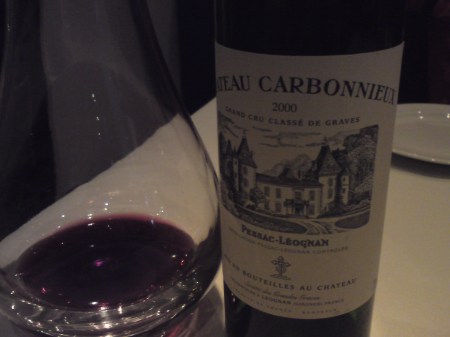 2000 Ch Carbonnieux rouge, all to myself at Moomba (well not really…a couple of generous pours going to Jeremy and Leonard, the chef). This is, by far, the best showing of this wine after having tasted it on 3 different occasions over the past year. The nose was quite forward right from the first pour, offering loads of cool ripe black berries intermixed with some soy and earthy tones, fairly deep and inviting. The entry was soft, the wine medium-full with a bit of hollowness on the mid-palate initially, finishing with some unresolved tannins. Things changed by the second glass, however, the wine becoming more open, gaining greater weight and intensity, the hollowness replaced by a fresh layer of richness and depth hitherto not encountered, leading to more sophisticated tannins at the finish. On the verge of developing secondary characteristics. Very good. At SGD88, it’s worth getting more should you chance upon it at Carrefour.
2003 Maison Louis Latour Puligny-Montrachet, my second (and last) bottle in as many months, at the in-laws. Not a good one. Too little fruit, lacking in minerality, too low in acidity, with too much leafy greeness, producing a dominant barley note. Not at all like a Puligny-Montrachet. Good thing it only cost SGD20.
2003 Ch Lascombes, after hours. I’d originally opened this bottle 10 days earlier in a restaurant, thinking that I’d share it with some people. But upon seeing that nobody could really drink, and that the bottle had been left untouched for about 30 minutes, I’d re-corked it very tightly (managed to push the cork almost entirely back into the neck) and left it reclining in my cool office. Surprisingly, it still tasted very fresh without any trace of oxidation. This is quite an atypical Margaux – big, full-bodied, toasty, dry, of cedar and dried leaves, not at all feminine or fragrant, but still unmistakably Bordeaux in character, managing to remain quite transparent in spite of its relative heaviness, becoming a bit softer and sweeter after some time. We drank it neat, but it would show even better with food. Would be an excellent table wine, but definitely not for purists.
2007 Krugscherhof spatsburgunder eiswein, bought cheaply for 22 Euros at Frankfurt duty-free, tasted right after the Ormes de Pez below at Ming Kee. Rather dull off yellow, but it hit all the right notes on the palate – heavier notes of peach, lychee and apricot, rather than the usual honey and nectar. Very fresh, not over-bearing at all. Took on a slightly more lifted and lighter note after some time, with pineapples creeping in.
2000 Ch Les Ormes de Pez, from the same winemaker as Ch Lynch Bages, over dinner at Ming Kee. Dark red. The initial pour was dominated by wood all over, with the wine coming cross as thin, not helped by rather acerbic tannins on the finish. It took on quite a dramatic transformation after about 45 minutes: the wood was gone, and one could then appreciate the classic Medoc character of dark fruits, with a trace of raspberry, and dried leaves and tobacco on the nose. The wine also began to flesh out considerably – medium-bodied, soft, packed with good fruit quality offering some depth, underscored by well-integrated tannins. Last tasted at Imperial Treasure T3 a year ago, where I thought it tasted better, being more evolved and mature, whereas it seemed somewhat out of sorts this evening. That’s the last of my standard bottles, but I still have a magnum of this same vintage, which I’ll probably keep for another 10 years.
2006 Oddfellows Langhorne Creek shiraz, at The Pod on the 16th floor of the National Library on the occasion of the ASM’s official dinner. I must say this is quite a good shiraz – deep purple, heavily scented with ripe plums, raisins and liquorice, full-bodied but not unctuous, tinge of sweetness with a moderately long finish without any trace of heat. Does its job as a good table wine, but don’t expect any serious complexity.

 1999 Domaine Leflaive Puligny-Montrachet 1er Cr “Les Clavoillon”, courtesy of D, over a 4-course impromptu lunch at Les Amis, consisting mainly of salmon, cod and pork. Beautiful clear light golden. As expected of Leflaive, lovely lifted aromas of chalk, minerals, less of citrus and lime, more of butter, almonds, cream crackers. “Les Clavoillon” is rated lower than “Les Pucelles”, and it shows on the palate, prefering to remain smooth, slick, and even, missing some of the depth and complexity that comes so easily with “Les Pucelles”, even though it was quite dense, only gaining some intensity after 2 hours. Probably worth keeping longer. I enjoyed it.
 2002 Domaine Nicolas Potel Vosne-Romanee 1er Cru “Les Suchots”, over lunch back again at Saint-Pierre, with Ben. This bottle was actually purchased at a steep discount from this restaurant’s list during its pre-renovation sale. Clear dusky red. A highly perfumed bouquet, full of fragrant sweet red fruits and cherries. Medium-bodied, soft, mellow, with low acidity, already quite fully developed and mature, revealing good depth but, of course, not the most profound of burgundies. It doesn’t possess the heaviness and extraction that can be found in a number of young premier cru from this producer, all for the better. This wine is entering its peak drinking period, and will probably hang in there for several years. I enjoyed it very much.
2005 Winemakers’ Collection Cuvee No.1, over a minuscule beef tenderloin at Otto. This is the sixth tasting of this wine, and the best so far, since I took delivery of 2 cases in 2008. It has developed beautifully, the color now a more luminous ruby red, clear yet deep, from which arose flavours of both dark and red fruits coated with glycerin, fairly intense and rich, nicely ripe without being over-extracted. The entry is soft but, revealing notes of chocolate and raisins, excellent presence and receding tannins that led to a moderately long finish without any sign of the fruit drying out, nor the austere greeness that marked the first few bottles last year. This is coming together very well, much more cohesive and seamless, on the verge of developing its secondary flavours. This project to allow a celebrated winemaker each year carte blanche to grow and make wine from a parcel of Ch D’Arsac had initially seemed gimmickry, especially as the bottling and labeling (completely in English) appear very un-Bordeaux, with a clear commercial slant. The vineyard, one of the first to be encountered south of the Margaux commune as one drives up north into the Medoc, certainly didn’t appeal to me at all when I passed it several times, lying on the “wrong” side of the D2 highway and appearing unkempt. It’s amazing what Michel Rolland has achieved for the inaugural vintage, no doubt assisted by the perfect weather in 2005. I shall have to carefully space out the remaining half-dozen lying in my office, and keep that un-opened case in cold storage even longer. Excellent.
2004 Ch Talbot, a half-bottle at Crystal Jade T2. Deep impenetrable red. A rather muted nose for a good 45 minutes, save for the obvious graphite note amidst the typical dark flavours of Left Bank Bordeaux. Full-bodied, steely and austere, backed by very firm tannins, imparting a very serious and business-like feel. Only after an hour did the wine begin to settle, revealing a lovely plummy note and softer tannins. The Brits would call this a classic claret, but it certainly will not put on a smile during its youth. I believe this is only the second time I’ve had a Talbot, the other being a 2000 couple of years back, which also left a similar impression. It’s a very good wine, but requires plenty of time.
2005 Les Hauts de Smith, at Imperial Treasure T3. Second time I’m having this in 3 months, also at the same venue. Deep crimson, imparting deep dark flavours with a hint of bottle stink that blew off after 20 minutes, revealing a full-bodied wine with firm tannins, with a bit of an austere, uneven finish. However, with food and time, it became much more savoury, developing velvety supple tannins that provided excellent mouthfeel and great grip on the palate, ending on a succulent raspberry note. This showing is even better than my previous experience, which was already positive. I’ll bet this second wine is cut very much from the same cloth as the Grand Vin. A great bargain at SGD58.
2004 Ch Gloria, a half bottle (SGD39), over a hamburger steak at Foo House. This cru bourgeois from St Julien has a bit of a cult following, but this effort is nothing to shout about. Dark purplish red, and very muted on the nose, with a faint hint of plums. One can tell from the colour this is not a saturated wine, which correlated accurately with the experience on the palate – light-medium, dry, a bit thin, lacking in richness, not even the rusticity of a St-Pierre (4th growth), ending in a slightly austere finish, missing very much the joie de vivre which a very good unclassified growth can sometimes surprise with. Not that it’s a bad wine…just that it’s perfectly nondescript. Drink up.
2001: Napa “First Growths” vs Bordeaux Seconds
 The occasion was a combined dinner for wards 48 & 49 on 29 October 2009, something unprecedented, back at the reliable Ming Kee, where we occupied 3 tables, setting new standards as well was the attention paid to the obligatory wines. This time, we opted for a 2001 theme, pitting a pair of top-flight Napa wines against a pair of St Julien, and we even brought our own decanters!
As usual though, we began with a couple of whites to go with the excellent seafood, particularly the signature beehoon crab. The 2006 Dog Point Section 94 Sauvignon Blanc (courtesy K), made by the former winemaker of Cloudy Bay, was light straw colored, displaying an initial note of lime and citrus that was fairly deep, but with a twist – more grassy but lifted, not unlike the hue of fresh morning dew, without any of that “sweaty armpit” nonsense associated with sauvignon blanc. With time, it expanded on the palate, becoming broader and full bodied, thicker in texture, developing even greater intensity and saturation, with distinctive notes of ripe pear, peach, lychees and, ultimately, jackfruit appearing, full of liveliness, ending in a long and satisfying finish. This is really quite excellent. Let’s just hope that with too much success it doesn’t screw up like Cloudy Bay did.
Next to this, the 2006 Beringer Private Reserve Chardonnay (courtesy PS) seemed rather sedate and four-square. Beautiful luminous yellow. The bouquet appeared to be dominated by a strong detergent note (I was reminded of “Fab”) that gave the wine a very clean feel, robbing it of much of the classic chardonnay character. A hint of vanilla was discernible, but there was none of the usual minerality and limestone notes. Although the wine took on a broader feel, with more biting intensity and richness after the customary pairing with century egg, it failed to really excite the senses. Clearly not in the same cerebral fold as a Kistler or Talbott, not to mention Leflaive, the benchmark reference.
 Then came the highly-anticipated challenge, beginning with the Bordeaux pairing. The dullish-red 2001 Ch Ducru Beaucaillou, aired in bottle for almost 2 hours, gave off a classic Bordeaux bouquet of slightly sweet, plummy dark and red berries, laced with a trace of liquorice and a hint of menthol. Soft, but quite full-bodied nevertheless, with a rich, intense core gripping the palate with early secondary flavours, the supple tannins leading to a lingering finish with a persistent trace of menthol. The classic graphite note of St Julien was evident, but if blinded, I wouldn’t have been able to call this St Julien. Definitely still developing, and will probably be wonderful in another 5-8 years, but that was my last bottle. I’ll be looking out for this at the year-end sales.
In comparison, the 2001 Ch Leoville Barton (courtesy PS), decanted over 2 hours and showing quite a similar impenetrable red, was marked by a very dense, powerful nose, suggesting at once rich and luxurious textures, combined with deep notes of earth and soy. The weight, however, didn’t really come through on the palate; neither was it as deeply layered as hinted by the bouquet. The graphite character was similarly less evident and initially the finish seemed shorter as well. The overall impression was more rustic, whereas the Ducru bordered on aristocracy and refinement. After 3 hours though, it evolved to become more rounded, bigger and more tight-knit and intense, yet remaining very balanced. In fact, it managed to maintain its poise right up till the end of the meal, even after having tasted the New World wines, whereas one couldn’t quite go back to the Ducru after the powerful Napa wines. Excellent stuff. But between the two, the Ducru is still the more complete wine, I’d say.
We moved on to the two Napa wines late into the dinner. The 2001 Dominus, showing a deep dark red, still seemed rather muted in spite of having sat 3 hours in the decanter. Nevertheless, there was a great sense of depth, the warm dark fruit caressing the palate with a firm grip, finishing very long. Very lush and opulent, but in a quiet understated manner without any hint of over-extraction nor any hard edges at all, very much in keeping with what was to be expected from the same maker of Ch Petrus. It developed a bit of a saccharine quality towards the end. Still yet to develop real complexity, but that’s merely a matter of time, for its deep velvety tannins left a real lasting impression. It has power and elegance, without being showy, but it won’t be mistaken for a Bordeaux. A French on American soil, behaving impeccably. Excellent stuff. Pity it’s my last bottle, but I have absolutely no regrets sharing this with great company.
How does it compare with a 2001 Ridge Monte Bello (courtesy K), aired for 3 hours in bottle? Like an American to the manner born, there was nothing modest about the Ridge – deep dark red, giving off a loud bouquet showing off layers of deep dark fruit, very rich, very intense and multi-dimensional. There was an exotic touch to its flavour, a lifted aroma of spices that I can’t quite pinpoint, although I was reminded of the smell of antiseptic, but in the most positive way. The mid-palate had a nice velvety feel, but the texture was still rather thick and unresolved at this stage. Powerfully built but balanced, definitely for the long haul. Great stuff, but it was a pity we came to this wine so late into dinner, for by then, my palate was worn, and the sulpites were beginning to go to my head.
So, does the best of Napa measure up to Bordeaux? The latter will always be unique, so much so that it can never be replicated elsewhere. When one drinks a Bordeaux blend made in Napa Valley, one is drinking the terroir of Napa. To try to believe that it is Bordeaux-like is not quite right, as one must always respect the way the terroir maketh the wine. A Napa wine has its unique qualities as well, and one must accept that. This came through very clearly on the palate. You can tell them apart. So it all boils down to individual preference, and pricing. I like the good wines of both regions, but I feel a Bordeaux claret will always have the edge in complexity. At the release price of almost SGD300 (if not more) for a top Napa wine, I’d rather go for a Bordeaux Super Second anytime.
We rounded off with a 1989 Ch Rieussec, which was, surprisingly, showing much better than my two previous experiences with this wine, the last at the SMA dinner in May, which had led me to think that it was past its prime. The impression this time was vastly different: clear golden in color (rather than the evolved dark orange encountered previously), with notes of honey, nectar and apricot held in fine balance, still retaining its acidity and freshness after 20 years. Excellent.
We finally staggered out of the restaurant at 12.30 AM (unheard of at Ming Kee and severely delaying the departure of two waitresses), the 6+ bottles beginning to exact its toll on the 4 of us who were the main drinkers, culminating in quite a severe hangover the following day. Too much of a good thing, I guess, but I don’t think it’ll stop us from doing it all over again.

 Ric's Wine Journal