Notes in brief (December 2009)…
 1999 Ch Leoville Barton, which turned out to be my last wine of 2009, at New Year’s Eve dinner at Moomba. What a lovely choice…deep dark red, exuding a fairly intense nose of rich dark fruits, chocolate, smoke, and that elusive graphite note of St Julien. Medium-full on the palate, showing well the secondary flavours of a maturing claret – cedar, sweet liquorice, raisins. Great depth and concentration, finishing with sophisticated velvety tannins. After 90 minutes in the decanter, it morphed into a medium-bodied smooth seamless wine, without any rough edges. Who’d have guessed a ’99? This is entering its peak drinking window and will probably hold for several years more. Definitely much better than a Pichon Baron, and more accessible than a Leoville Las-Cases, of the same vintage. Excellent stuff. I remembered buying this from Carrefour for SGD133. Grab if you spot any for around SGD150.
2003 Ch Branaire-Ducru, at a New Year’s Eve happy hour in the office, with some finger food. Dark red. Quite a lovely nose of rich dark fruits and blackcurrants, with a discernible trace of alcoholic heat. Full-bodied, good concentration, slightly toasty, rather austere and tannic finish, consistent with an early St Julien, although the wine softened considerably after 90 minutes of decanting. Quite unlike a ’03 Lagrange which is more toasty but has a smoother finish. Leave this for another 5 years.
 1995 Ch Haut Bailly, decanted for 4 hours at the Dept dinner at Kome (see below), which unwittingly turned out to be a Graves theme. Deep red. Attractive bouquet of rich, dark fruits, with a gradual lift hinting at raspberries and cherries . Medium-full, the scorched earth quality producing good weight and intensity. Some complexity on the mid-palate, but it’s not terribly deep. Slightly rustic. The Bahans has a more sophisticated feel, but the Haut Bailly is drinking better. Good, but not memorable.
2000 Bahans Haut Brion, at Kome. Deep but bright red. Definitely sweet on the nose, of glycerin, cherries and red berries. Earthy. There’s more fruit to the fore now compared to a previous tasting in 2005, where it was rather dry. Good transparency. It lacked weight and power initially, coming across as a bit lean. However, it snapped into focus after 4 hours, becoming more well-integrated and richer, but never attaining power nor depth. F kept raving about it (even though he didn’t bring this wine), sounding like a broken record but I don’t think I’ll miss this wine.
2004 Domaine de Chevalier (courtesy F), at Kome. Deep red with a bright purplish rim. Oaky nose. Primarily fruit-driven at this stage – loads of blackcurrants and redcurrants, some earthy notes so typical of Graves, with a touch of undergrowth. Yet to integrate; rather wood-dominated. Best to leave untouched for another 3 years, at least.
2007 Dr Loosen Wehlenur-Sonnenuhr Riesling Spatlese (courtesy PS), at Kome. Straw colored, exuding citrus, lime, mandarin orange and apricot. Great acidity, imparting a wonderful freshness. Initially seemed to lack weight and intensity, but this corrected after some time, although the finish probably bordered almost on being cloyingly sweet. Very good.
2006 Domaines Leflaive Macon-Verze, at the Dept dinner at Kome. Light golden, very muted on the nose, barely a hint of minerality. Coming after a Hunter’s Marlborough sauvignon blanc (I can’t recall the vintage), this was disappointingly lacking in weight and body. Rather weedy. Didn’t improve even after sitting in the glass at the correct temperature.
2005 Selbach-Oster Zeltinger Schlossberg Riesling Spatlese, a gift from a German elective student some months ago, drunk at Long Beach Seafood. Mix of nectarine, apricot and peach, with a bit of green apples. Good body and acidity, imparting zesty feel, finishing with understated sweetness. Not as rich or concentrated as a Muller-Catoir or a JJ Christoffel Erben, but sometimes you can do without the over-the-top character of some of these German rieslings. I enjoyed it.
1996 Domaine Jean-Marc Boillot Volnay 1er Cru “Carelle Sous La Chapelle”, bought for only SGD21 at Auric Pacific’s megasale, where even the maitre’d of Gunther’s was also grabbing some for himself. Dark murky brown (urghh…), rather heavy on the nose and palate, notes of soy and liquorice with a medicinal edge without any real depth or complexity, the fruit drying out even though it was quite even and smooth. A rather poor wine.
2004 The Moorooduc Chardonnay, half a bottle over a Christmas dim sum lunch at Imperial Treasure ION. Straw yellow, with citrus and some butter and cream on the nose, fair amount of minerality, but somewhat grassy if served too cold. Not as chunky as a previous tasting at Ming Kee a few months back. The second half of the bottle tasted the next day was better, immediately more complex with more intense citrus and a bit of caramel surfacing on the nose, finishing with a faint yeasty note, living up to its back label which read “Wild Yeast” (not sure whether that’s a nickname or it refers to the type of yeast used for fermentation). However, it still cannot match up to a Giaconda or Leeuwin. I’d rather drink up.
1989 Ch Clerc Milon, also at the X’mas Eve happy hour. I decided to share this with AW after he had managed to procure a dozen Rockford Black Shiraz for me. The cork partially disintegrated at the top, and I feared the worse as the initial note (after decanting) wasn’t encouraging: dull red with a tawny rim, a restraint nose of cassis, saddle, old leather and dried leaves that didn’t quite live up on the palate, the wine seemingly lacking in body, the fruit drying out. However, after two hours of aeration, it gradually fleshed out, gaining weight with more fruit coming to the fore, all the time remaining soft and rounded, finally at its best after 3 hours. This is much better than the first time I had tasted it at a charity dinner two years back (Hiok), where it had seemed angular and disjointed, refusing to budge. Clerc Milon has a reputation for requiring plenty of bottle time, and my experience with it seems to bear testimony. The 1989 is clearly a wine that has hit the plateau well within its drinking window. Will probably hold on for a few more years. Very good.
2005 Le Fleur de Bouard (courtesy LW), from Hubert de Bouard de la Forest, owner of Ch Angelus, drunk alongside the Dog Point below. Deep red, predominant dark fruits and blackcurrants. Full-bodied, good depth and concentration (but not quite as huge as D’Aiguilhe), just the right level of extraction with very well-managed tannins, smooth and even on the palate. Will be even more rewarding with careful cellaring. Excellent.
2006 Dog Point Section 94, a Marlborough sauvignon blanc supposedly made by the former winemaker of Cloudy Bay, drunk on a Christmas Eve happy hour over cheese and crackers. First tasted just two months back at Ming Kee (see October). Straw colored, rich in pear, green apples, lime, a faint hint of durian (or perhaps the proverbial pungent “sweaty armpit” masquerading as durian) with a lovely floral lift. Good concentration and minerality, ending on a dry but persistent note. Not as chunky as before. Very good.
2006 Domaine Christian Moreau Chablis 1er Cru Les Vaillons, a half bottle drunk just before the Potel below at Jaan. Light straw colored. Lovely floral bouquet, delicate citrus notes. Good body and minerality, with the right level of acidity. Not terribly complex at this stage, but will be immensely rewarding down the road.
2002 Domaine Nicolas Potel Nuits-Saint-Georges 1er Cru Les Pruliers, over an impromptu but excellent lunch at Jaan, perched 70 floors up at the Swissotel. From the evolved dull red arose a most gorgeous bouquet of flavoursome red fruits and berries, cinnamon, chives, and a bit of toast, hinting at a wine that would be rich and deep. Indeed, the fruit and acidity and wood were superbly integrated and balanced, soft and open, without the quasi-New World density that sometimes dominates a Potel, revealing excellent depth and concentration, very rounded without any edginess. Highly sophisticated stuff. A half-bottle, from the restaurant list. Superb!
1998 Turkey Flat shiraz, over lunch at Imperial T3. My last bottle, and my third tasting. Dark red with an early tawny rim. Powerful bouquet of dark fruits, rich, deep, some soy and liquorice. Excellent concentration, full bodied but not unctuous, laced with peppery tannins, meaty and savoury, opening up after 30 minutes, becoming softer and rounder, showing early signs of the wine mellowing, ending on a slight medicinal note. This is better than a bottle tasted in July at TL’s wedding, and definitely drinking much better than a sample tasted some 4 years ago at Romanee’s.
2002 Penley Estate Reserve cabernet sauvignon, over lunch at Imperial T3. Popped and poured. Very dark purplish-red. Dominant notes of graphite, loads of soy and a bit of plum. Initially very tight, intense and tannic. Softened after 30-45 min, revealing deeper flavours of dark berries, ripe fruit, more velvety tannins although on the whole, it still had a great deal of intensity. Well crafted. Yet to develop secondary flavours after 7 years. Pity we didn’t give it enough time.
2007 Grosset Polish Hill riesling, drank a glass over simple wraps for lunch at home, then the remainder 6 hours later at the in-laws. Pale straw color, loads of citrus and lime with cutting acidity, minerality very much in the background, very crisp, fresh, hint of lemongrass, a bit of the “kerosene” quality, yet to develop real depth and complexity, finishing on a dry, musty, austere note.
A trip to Hunter Valley
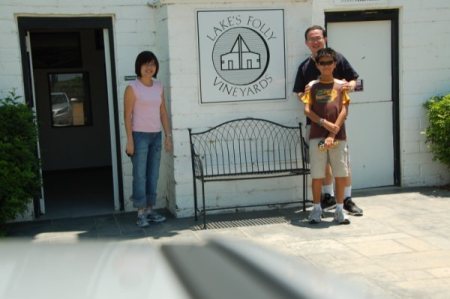 I’ve never really had a very high regard for the wines of Hunter Valley, and my trip there 16-17 December 2009 confirmed my impression. Apart from Brokenwood (even then, only its flagship wines command attention), I feel that the wines in general suffer from a lack of distinction, unlike the rusticity of McLaren Vale, the rich unctuous quality of Barossa shiraz, the plummy structure of Coonawarra, and the tightly-knit fine tanins of a Clare Valley shiraz. Like most wine-growing regions in Australia, Hunter Valley produces too many varietals. The Aussies may rave about that region’s semillon, but this grape has never rocked my boat. If at all, it is the lighter-textured, more transparent quality of its shiraz that gives Hunter Valley some identity. And so, a quick review of some stuff I tasted…
Lakes Folly Chardonnay 2008 –pale straw. Light. Citrus, lemongrass, some minerals. Not memorable. Lakes Folly 1999 cabernets – cab, petit verdot, merlot & 10% shiraz, tasted in presence of the owner-cum-winemaker. Very dark red, ripe dark berries and raspberries. Bold bouquet dominated by smoke, liquorice, alcohol, slightly warm. Very good body, quite well integrated, beginning to develop secondary fruit flavours, still primarily fruit driven though, but I don’t think it commands AUD120. Roche Wines Tallawanta Hunter Valley shiraz 2007(AUD25) – dark, rich, medium-full, fruit driven, layered, red fruits, without the usual pepper/spice notes. Very good. Great value. I bought it.
Tyrrell’s Vat 1 Semillon 2009 (AUD46) – very pale straw, grassy, lemongrass, light lime, not much body. Tyrrell’s Vat 1 Semillon 2002 (AUD48) – slightly heavier, but still not significantly different from the 2009. Honeydew, melons. Too lightweight for my liking. Tyrrell’s Vat 1 Semillon 1998 (AUD100) – beautiful clear yellow. Lovely bouquet – floral, creamy, quite rich but doesn’t quite live up on the palate, although weightier. Guess semillon isn’t my cuppa. Tyrrell’s Brokenback shiraz 2007 (AUD25) – dark dusty red, medium, French oak, well-integrated, easy, relatively straightforward. Tyrrell’s Vat 9 shiraz 1998 (AUD100) – dark, rich, spicy, peppery, leather, saddle, lliquorice, layered, quite complex, full, great mouthfeel. Excellent but expensive.
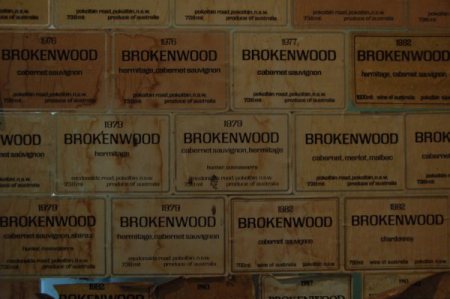 Brokenwood varietal shiraz 2007 – dusty red, light medium, good density but rather simple and straightforward. Brokenwood Wade 2 shiraz 2005 – single vineyard shiraz from McLaren Flat. Dusty red, medium, cassis, liquorice, some spice. Good but not distinctive. Brokenwood Rayner shiraz 2005 (AUD75) – single vineyard shiraz, also from McLaren Vale. Darker red, heavier but deeper aromas of ripe dark berries, resinous, not unctuous, some complexity, peppery texture but the spice doesn’t dominate. Very good. Not cheap. AUD75 from cellar door. Brokenwood Mistress Block shiraz 2007 – true Hunter Valley single vineyard shiraz. Not available at retail. Nice ruby red, deep aromas of plum, cassis, leather, with subtle oak lift. Great mouthfeel, superbly integrated, not at all heavy, good depth and transparency. Very similar in style to the Graveyard (not available for tasting). Excellent. At AUD60, much better value compared to the Graveyard (AUD140).
Tulloch E.M. Chardonnay 2007 – very pale straw. But possesses good body and minerality, well balanced against the limey citrus, ending with a floral lift. Lacking in complexity and depth, but good value at AUD28. Tulloch Pokolbin shiraz 2007 – too simple with nose of alcohol-dominated red fruits.
Tower Estate chardonnay 2007 – light-bodied, too citrusy. Tower Estate shiraz 2007 – simple and straightforward. Not enough body and fruit. Tower Estate sparkling shiraz 2003 – again quite simple, lacking in complexity in spite of bottle age. Poles apart from a Rockford Black Shiraz.
1986 Ch Gruaud Larose
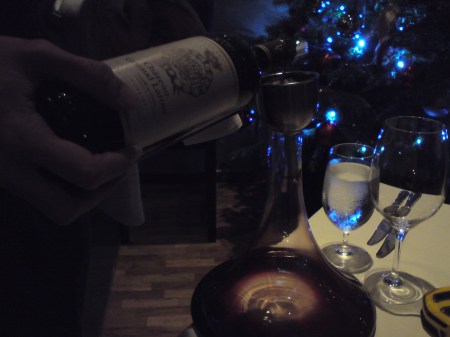 At Absinthe. Things didn’t get off to a good start when I arrived to find that my reservation could not be found. But to the staff’s credit, an additional table was set up immediately adjacent to the restaurant’s entrance, and things got better as the wine was uncorked and decanted, with the manager and the maitre’d enjoying a pour each.
This must be the third time I’ve had the 1986 Ch Gruaud Larose over the past 5 years. Certainly I do remember first tasting it at St Julien restaurant on the occasion of a professorial some years back, courtesy of Hiok, when I was only just beginning to understand Bordeaux. And there was another occasion 3 years ago when I gatecrashed a Gastro dinner at Les Amis bearing this wine as my raison d’tre, as well as another time at home. On both occasions, I recalled it being open, fleshy and succulent.
This wine showed a mature red that was beginning to develop a tawny rim. The initial whiff was full of smoke, saddle, and old leather that leapt of out the glass, as well as flavours of aniseed and dried leaves of classic aged Bordeaux. Medium-bodied. Soft, rounded. Very good grip, though just a little thin on the mid-palate initially, with a bit of a tannic finish. It fleshed out most impressively after an hour, adding more weight and intensity, developing a more generous body, becoming fuller, more expansive and velvety. Quite rich, with good concentration and excellent depth. Structured, but not opulent or outright lush, finishing long. I didn’t catch any graphite note. Would have been difficult to place. Excellent. Only one more left.
The perfect dinner at Iggy’s
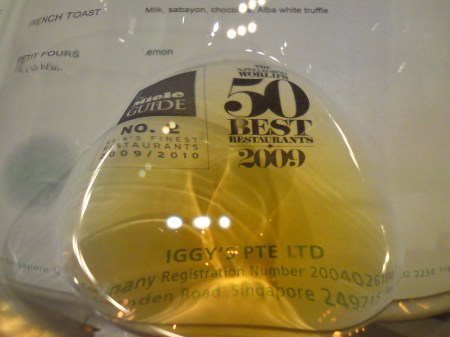 It was difficult to imagine how the last dinner at Iggy’s could have been surpassed, where the food and service had been outstanding, the wines (’02 DRC Grands Echezeaux & ’94 Petrus, inter alia) utterly sublime, and the entire experience unforgettable. But just as records of all kinds could be re-written, we took a quantum leap with our gazetted dining experience on 9 December. There is simply no other outfit in Singapore to better Iggy’s at present, and the miracle was that this restaurant could even better itself on this occasion, fully deserving of its No.2 spot in the 2009/10 Miele’s Guide to Asia’s Finest Restaurants, and to be counted amongst S Pellegrino’s World’s Top 50. How it was done I know not, but I suspect it is only through hard work, the continuous search for inner inspiration, driven by a passion for perfection without fear of boundaries, that the unachievable was attained: we had the perfect dinner.
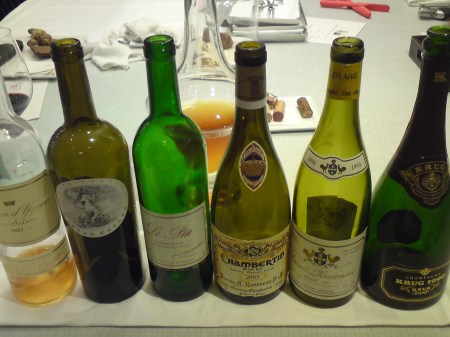
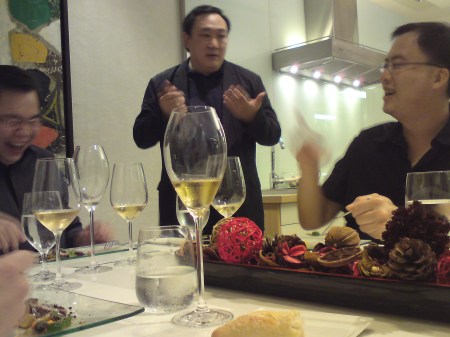 I arrived on time to find proprietor Ignatius Chan himself, ever humble and jovial, engaged in relaxed banter with K and DT at the Chef’s Table, the wines carefully decanted, and soon we were joined by the usual suspects, bearing wines, obviously of immense value, that had been double-decanted and blinded. So familiar were we at the Chef’s Table that we settled into our usual positions, not unlike Arthur’s RoundTable, sipping the 1990 Krug (courtesy K) that flowed freely, as commanded by Bacchus. Light golden, full-bodied, dry (but not to the extent of Salon), with the ripe yeasty note of Krug complementing the lovely deep fragrance of white flowers and malt. As the bubbles dissipated, the wine softened, revealing a complex deeper core topped with caramel, slightly toasty with a smoky afterglow. A complete wine, unquestionably. Wonderful.
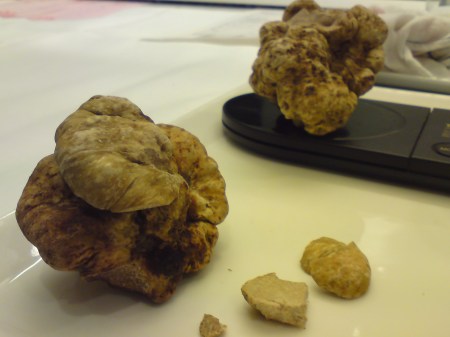 I stared at the customised menu. There were 11 items, plus an impromptu kurobuta pork thrown in along the way for good measure, making it 12 items altogether, plus 2 huge blocks of white Alba truffles that were meant to be shaved down completely just for this dinner. Never have I encountered such an extensive menu at Iggy’s. This was really serious stuff. No wonder Iggy himself was on hand!
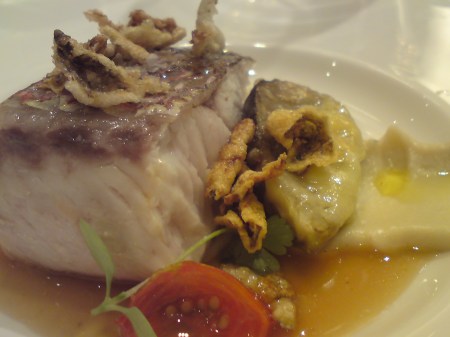 The 1990 Domaine Leflaive Batard-Montrachet Grand Cru (courtesy K), which accompanied the first few courses, shared some similarities with the Krug. A luminous pale marble yellow, quite restrained on the nose, giving away some light minerality. On the palate, the low acidity wine was ultra-smooth, seamless and harmonious, revealing some mild yeasty flavours and deeper notes of limestone after some time. Excellent depth and body. This wine may have been derived from the “bastard”, but it was on its best behaviour: quiet, understated, unassuming, not showy at all, yet multi-dimensional and aristocratic. Caught at its peak. It takes people of similar character to appreciate such qualities…ahem. Lovely.
 The first red was poured. Showing a beautiful deep ruby, it produced a superb fragrance, most intoxicating and sensual, yet delicate and not too sweet on the nose, combined with a great body of red fruits and cherries, rounded at all the right places, silky, possessing good weight and intensity, yet absolutely harmonious, very inviting and seductive. The Armand Rousseau Chambertin (courtesy K) was like a beautiful woman that you really shouldn’t be seen with but you’re helpless, and it was hard to believe that a 2003 Grand Cru could be so supremely effortless at this stage. This is the epitome of finesse and elegance. Just misses the power of a DRC, but that might upset the balance. Truly fantastic!
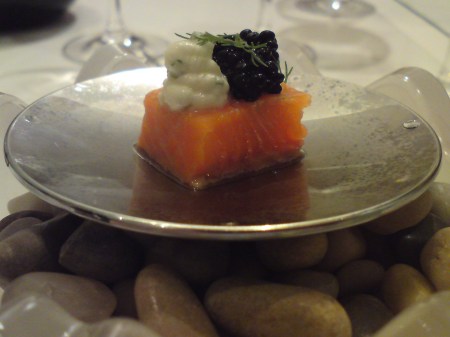 Red #2 (courtesy Hiok), blinded and double decanted, showing an evolving red, was strong on pencil lead, but the entry was gentle, the wine soft and fragrant on the palate with predominantly red fruits, imparting a very feminine feel (but not resembling a Margaux), deeply layered with complex tertiary flavours, structured and superbly integrated. The table was unanimous that this was a quintessential 1990 Lafite Rothschild, but we were brought to our feet when it was unblinded: a 1988 Ch Le Pin!!! We were absolutely flabbergasted. None of us had had any previous experience with Le Pin, only with the exception of Iggy who felt that this vintage of Le Pin was somewhat rustic, but I thought it was beautifully poised at its peak drinking plateau. There was no clue at all that this was a Right Bank, only that it was a mature Bordeaux, but I suppose the lesson is that Pomerol is truly the master of disguises in blind tastings. Outstanding!
 Compared to this, Red #3, also blinded and double decanted (courtesy Hiok), was almost a non-event. The bottle shape, combined with the deep purple as it sat in the glass, gave away that this was a New World and, not only that, it was likely a Harlan Estate. True enough, from 2005. Huge, saturated with ripe fruit, svelte and sweet but not overtly exuberant, showing some restraint, well-controlled with very good balance, revealing deep notes of soy and raisins, obviously still primal with sizzling intensity. Definitely a hedonistic and very sophisticated wine, but, I feel, not distinctive.
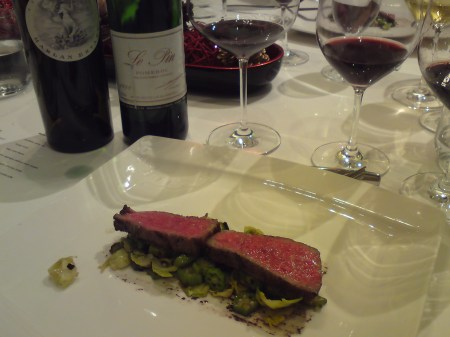 My palate must have taken some beating from this last red, for the concluding Sauternes, a 1983 Ch D Y’quem (courtesy K) took me a while to adjust to. Deep orangey in color, still containing good levels of acidity and intensity, the nectarine flavours nicely balanced and persistent without any edginess, still as fresh as the morning dew, bringing the entire line-up of wines to a beautiful finish.
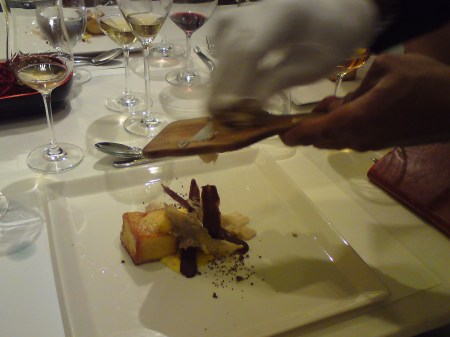 But that wasn’t all. Word was out that had it not been for this evening’s dinner, I would have dined the following evening at Iggy’s for my birthday. The restaurant surprised me with a lovely birthday cake at the end, concluding an extraordinary evening of dining and wining. Along the way, we’d consumed 89 grammes of white Alba truffles that went along with re-invented classics such as cappellini pasta, egg and bacon done the bourgogne way (oeuf meurette), fresh inspirations such as the delectable French toast that Iggy dreamt up with the chef from Jaan, as well as the obligatory wagyu beef, and we had drunk wines that cost 3 times as much as the food. It took a steady hand to sign my share of the food bill which read SGD707.
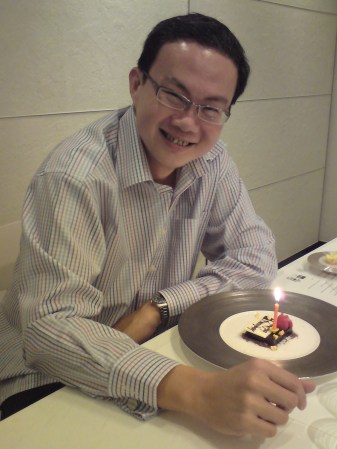 This has been the finest evening in the history of Bacchus. We had taken our wining and dining experience to levels hitherto unheard of, including the price. On the other hand, tonight’s dinner was also something of a bargain, considering that my simple lunch at La Tour D’Argent in Paris already cost about SGD545, and definitely nowhere as extravagant or sublime as this evening’s. Certainly I wouldn’t have had the opportunity to taste these wonderful wines if not for the sheer generosity of these friends, to whom I’m infinitely indebted, and I leave the reader to enjoy these lovely photos that say more than words.
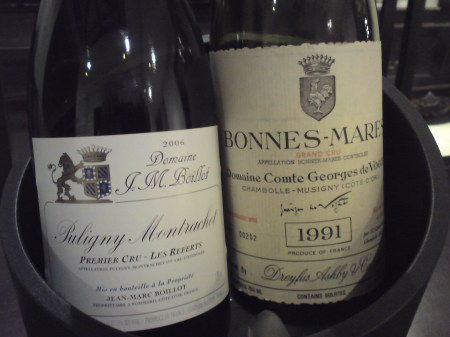
2006 JM Boillot Puligny-Montrachet “Les Referts” & 1991 Comte de Vogue Bonnes-Mares
Through SL’s sheer generosity, I found myself at his place, with JJ and YW, sipping these wonderful wines on a Tuesday evening while the kids amused themselves noisily in the background.
 The 2006 Domaine Jean-Marc Boillot Puligny-Montrachet 1er Cru “Les Referts”, clear light golden, had an absolutely fabulous bouquet that leapt right out of the glass, heavy with limestone, minerals, with penetrating lime and citrus, almonds, wafer, caramel, cinnamon, wave after wave of these wafting over your nose, deep, intoxicating, heavenly. On the palate, the wine was equally penetrating, sharp and pointed with cutting acidity, full-bodied, much more citrusy, somewhat chunky and one-dimensional, steely and austere on the finish. Yet to unravel itself, but clearly will be excellent in another 10 years. Right now, this wine is all about its bouquet. In fact, it kept me so occupied that I kept smelling it for a good 10 minutes without tasting the wine at all.
Pretty much the same could be said about the 1991 Domaine Comte Georges de Vogue Bonnes-Mares Grand Cru. Showing a beautiful deep ruby, it gave off a huge, deep intense bouquet of glycerin, sweetened liquorice, dark red berries and brandied cherries, highly liquered (someone was reminded of Chinese medicine – pi pa gao especially, which I agree) all the while hinting strongly of a wine that would be rich, concentrated and lush, in spite of its age. In fact, if blinded, I would have called this a New World shiraz, given the powerful liquorice flavour. Burgundy would have been last on my mind. I have noted this particular quality of “heaviness” about the Chambolle-Musigny wines of Comte de Vogue, very different from the open, lush concentration of a Domaine Romanee-Conti. On the palate, however, there seemed to be some sort of a disconnect, the medium-full wine coming across as quite mellow, not as deep, nor as rich, as one would have anticipated from the nose, quiet, rather soft, but possessing very good definition nonetheless, seamless and long. It became slightly more intense and weighty after some time in the glass, but I wouldn’t say it’s elegant. Very masculine. But I’m not complaining, especially when someone has so generously opened it for a casual evening. I’m infinitely grateful.
1996 & 1999 Burgundy Grand Cru
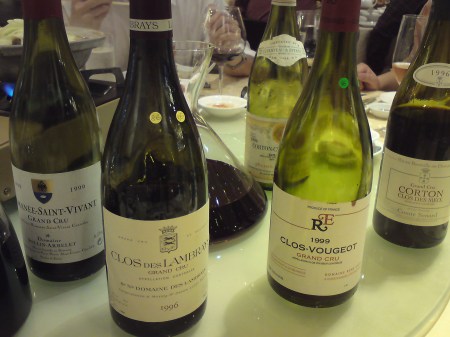 The Burgundian group met again at the superb Jade Palace on the occasion of YW’s return, and again it was KG who mooted the above wine theme. But before all that, we began with a Champagne Verve Clicquot Ponsardin Rose NV (courtesy KG), which was pleasant with some mild yeasty flavours, but on the whole it was simple and straightforward, hollow towards the finish. Very agreeable, nonetheless.
The solitary white was a 1996 Domaine Tollot-Beaut Corton-Charlemagne Grand Cru, brought all the way from Los Angeles by YW. The initial note from this pale yellow wine wasn’t encouraging, being quite lively on the nose with predominant citrus and lime, backed by a significant degree of acidity, but it lacked richness and concentration, as if the fruit was drying out, finishing short. However, it began to flesh out most impressively in the glass, becoming fuller, eventually putting on layers of nutty flavours, attaining greater weight and minerality. It’s a good drop, but it certainly took a long time getting into its stride.
We moved on to a pair of 1996 reds, a Domaine Comte Senard Corton Clos des Meix Grand Cru (which JJ had found in a dusty corner of Denise at Turf City) and a Domaine des Lambrays Clos des Lambrays Grand Cru (courtesy See Lim). Amazingly, the former was still very full and robust, still showing a deep red (for a pinot) and giving off a very attractive fragrance. I’m reminded of roses in full bloom. Very harmonious and even, with quite a bit of fat in the middle, ending with a rather slick finish. This wine has yet to reach full maturity in spite of its years. Quite a find, really. But as much as this was excellent, the Clos des Lambrays was even more impressive – fully mature and lighter in color and texture, offering notes of sweet cherries, soft, supple, totally seamless and harmonious. It got even better in the glass, developing great depth and definition, with aromas even more lifted, showing off wonderful richness and concentration in the middle, very slick, persistent in its finish. I get the impression that it still has plenty of life remaining. Fabulous. A great pairing.
 It was interesting to compare against the 1999 pairing of Domaine Follin Arbelet Romanée-Saint-Vivant Grand Cru (courtesy KG) and a Domaine Rene Engel Clos Vougeot Grand Cru. Both were huge, concentrated, deep in color and full on the palate, almost hedonistic, the latter being the heavier of the two, with a nose that was still closed. The Follin Arbelet, smooth and luxurious, had begun to develop delicious secondary flavours around its deep red fruit, producing good levels of complexity. A wine still very much on the ascent, entering its drinking window. The Rene Engel preferred to express itself on the palate – open, revealing rich flavours of sweet raspberry and brandied cherries with excellent definition and depth, even though its bouquet was quite restrained, ending in a long finish. On the whole, it was rather intense and tight, still primal, but there’s no doubt it has everything it needs to become a great grand cru in another 10 years. This has been a wonderful and highly educational tasting. Clearly, one needs to think twice about opening the grand crus of 1999 at this stage, but one doesn’t need to think twice about acquiring more to lay down.
Tasting at Auric Pacific
Auric Pacific Fine Wines held its year-end mega sale and tasting at its cellars, where I had the opportunity to taste the following wines…2006 Ch Cos D’Estournel (brought by one of Eugene’s customers) – deep purplish red, dominant nose of cashews and toasty oak, giving way after 20 minutes to ripe dark fruits and berries, deeply saturated but not over-extracted, smooth, finishing with well-managed tannins without any trace of heat. Very good, but I feel Cos is becoming too “international”. 2005 Domaine de Chevalier – a perenial favourite, deep red, lots of dark currants, full-bodied, intense, not quite well integrated yet, bit of a tannic finish. Needs lots of time, but I imagine this will be delectable after it has sorted itself out. 2004 Philip Togni cabernet sauvignon – deep purple, saturated with ripe red and dark fruits, well-extracted, full, with great mouthfeel. Correct in every way but not cerebral, nor seductive. 2005 Clos du Marquis, my first chance at tasting this – beautiful deep purple, slightly restrained but obviously has loads of quality fruit underneath, meaty, savoury. Surprisingly accessible on the palate, revealing excellent transparency than thickness, finishing with a deep rich vein of liquer. Excellent stuff, but the price is creeping up. 2006 La Fleur de Bouard – deep purple, full-bodied, yet really smooth, bit of toast and vanilla, excellent fruit quality, finishing long. 2006 Ch Calon Segur – the editors of Decanter rated St Estephe poorly for this vintage, but I found it quite agreeable – deep red, trace of gravel, toast, generous fruit and body, but like Cos, its terroir is not apparent. Prices for 2006 Bordeaux are declining, but I don’t see any compeling reason to buy.
1996/1998 Dom Perignon, 1999 Cheval Blanc & 1985/1999 Haut Brion
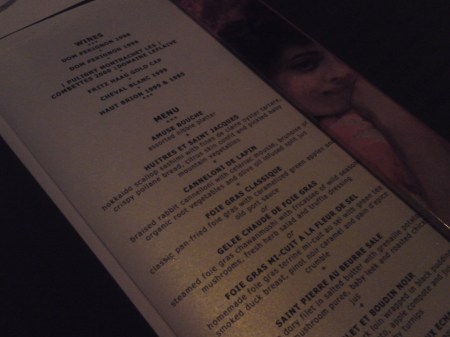 I started the first day of December with a bang at Saint-Pierre, my fourth visit in as many months. K, still flushed over his recent success, was hosting an extravagant dinner, planned to the last detail. The decent thing to do was to offer him a Premier Grand Cru Classe en 1855; why hog these treasures?
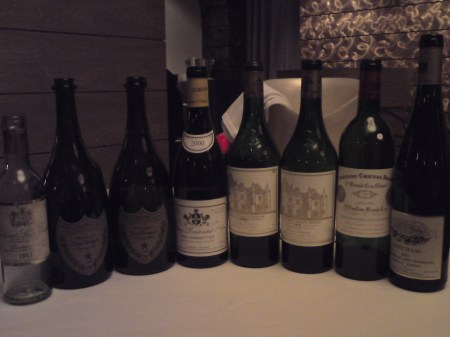
I was the last to arrive, and wasted no time plunging into the opening aperitif, a 1998 Dom Perignon (courtesy K). This was loaded with citrus and lime, light-medium, with excellent body, expansive yet delicate, offering good transparency, very deep, with a fragrance of longans and just the right level of acidity, ensuring a lively finish. It doesn’t have the yeasty note of a Krug, but this was great stuff, preferable than the 2000 vintage. But as good as the 1998 was, the 1996 Dom Perignon (courtesy D), drunk alongside, showed up the former’s deficiencies. One could immediately appreciate that the 1996 was a finer champagne – slightly deeper in color, richer, brimming with lifted aromas of lime and citrus, topped off with a creamy biscuity flavour, weighty and dry (but not to the extent of Salon), yielding greater complexity and depth, yet remaining smooth, even and delicate, avoiding any heaviness, ending on a note of pomelo and exotic tropical fruits, leading to a lingering, bitter-sweet finish. Going back, the 1998 seemed uneven in places, whereas the 1996 was a complete wine, beautifully proportioned. It is only through such side-by-side comparison that one can understand why the 1996 vintage is held in such high esteem. I am truly grateful to have had this great opportunity to taste both. Fantastique!
The solitary white, a 2000 Domaine Leflaive Puligny-Montrachet “Les Combettes” 1er Cru (courtesy K), almost seemed an oddity after such a marvelous start. This was not as deep in color as the 2003 example tasted in August, corresponding to its light-medium feel, with predominant notes of pear, pineapples and green apples (not to be confused with greeness), not quite as minerally or chalky as a Les Pucelles. It took on greater weight in the glass, developing a layer of vanilla and caramel, but the wine began to fade after 2 hours, never really getting into proper stride. Perhaps it had moved out of its temperature window, or because the subsequent auslese had altered my perception irreversibly.
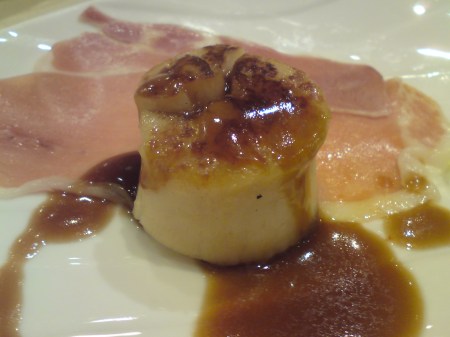
Next, the obligatory foie gras classique came along, paired astutely by K to go with a 2004 Fritz Haag Auslese Gold Cap, earning even the sommelier’s approval that this was more appropriate than a Sauternes, which would have been too cloying, whereas one could never direct such an allegation against an auslese. Pale yellow, conveying a wonderful body of pure nectar and honey with understated acidity, beautifully balanced, very smooth and even across the palate. Amazingly detailed, revealing very deep notes of lychees but it never ever threatened to dominate the food, neither did all the richness come across as being too thick on the mid-palate. It complemented the foie gras perfectly, and I simply can’t imagine how else the pairing should have been. I have to remind myself to keep my 2 bottles for at least 10 years.
 Then came the highly anticipated trio of First Growths, starting with a 1999 Ch Cheval Blanc (courtesy PS). I remembered missing out on this when it was offered for only slightly above SGD300 a few years back. The color was an unattractive dusty red, but it gave off a bold, almost acerbic, bouquet of deep red fruits, plums, olives and wild mushrooms, giving an initial impression of fruit that was drying out, but it dawned upon me later that this was, of course, the predominant cabernet franc, an unique majority in Cheval Blanc, that was speaking. Quite intense and full-bodied, finishing strongly on a note of sweet cherries and raspberries, but the wine lacked the power, opulence and depth of the great vintages, even though it fleshed out more in the glass, becoming more seamless. Strangely though, I recalled having tasted another example at a 1999 horizontal at See Lim’s last year, where it had a level of richness and depth that was missing here, and certainly nowhere near the 1964, plush and pure, tasted two years ago at Iggy’s.
In comparison, the 1999 Ch Haut Brion, sourced from Bob Rees of WEA, showed a deeper red, which translated into a fuller and deeper wine, fruitier, more svelte, with loads of deep dark berries and earthy notes amidst a trace of sweet vanilla. It fleshed out further in the glass, displaying very good levels of richness and concentration combined with quite a bit of verve, well balanced, finishing with fine tannins. A solid wine, perhaps even a tad four-square, but it stayed firm throughout the entire evening. Excellent. However, like the Cheval Blanc, it never achieved the opulence and lushness of a great Haut Brion, as exemplified by the 1985 Ch Haut Brion (courtesy K) that was drunk alongside. Clearly the wine of the night with an evolved red, the 1985 displayed a very open, inviting bouquet of classic aged Bordeaux, consisting of a very unique mixture of predominant red fruits and dry, exotic herbal overtones, yielding a wine that was still considerably bold and deep, yet absolutely seamless and harmonious, bringing out the cliche that “’85s are drinking best now”. It certainly had an antique chic quality that is quite different from an ’85 Medoc – more evolved, more pure. Wonderful.
I’m a sucker for Saint-Pierre’s excellent cheese platter, and K generously obliged with a 1983 Ch Suduiraut from the restaurant’s list. The acidity was beginning to fade in this quasi-liquid gold, losing some freshness, but it still had a deep, rich vein of apricot and nectar, leading to a bit of an austere finish. We probably caught it at the tail end of its drinking plateau, as I recalled a 1983 Rieussec as being considerably more complex and livelier.
We finally staggered out past midnight (no…I felt fine, really). This had been a great dinner, and again I must express my gratitude for the generous opportunity to taste all these wonderful wines, not forgetting to congratulate K for finally exiting the dark tunnel.
A simple dinner
 As I was faced with a most unpleasant week ahead, I decided the only solution was to make sure I ate and drank well. Happily, the usual suspects happened to be in the same boat, and so we adjourned right after a bad Monday to Imperial Treasure T3 for dinner. What was supposed to be a simple affair, predictably, turned out to be somewhat more elaborate, but no one’s complaining.
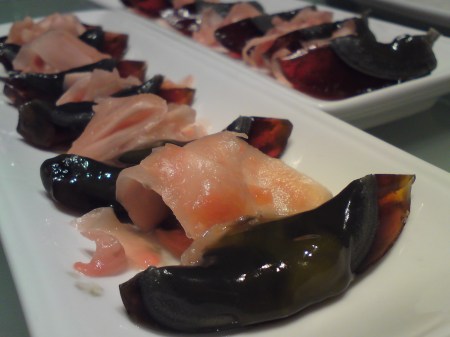
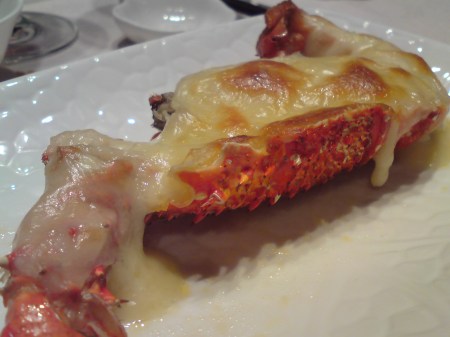
We started off nicely with a 2004 Jean-Noel Gagnard Chassagne-Montrachet “Blanchot-Dessus” 1er Cru (courtesy K). Light clear golden, it was immediately deep and complex on the nose, dominated by chalky, flinty minerals rather than outright citrus notes. It gave the impression of a very “clean” wine, complete with a strong scent of “Dettol”, which added, rather than detract, to its aristocratic aura. A rich, buttery, creamy note took over after some time, the wine continuing to show good intensity with great concentration and excellent focus right till the end. Quite superb, and obviously a great match with the buttered lobster, oysters and the obligatory century egg (nicely rich and runny).
The 2004 Domaine des Lambrays Clos des Lambrays Grand Cru, decanted for an hour, proved to be the perfect red to follow on. The initial nose that emerged from the beautiful deep ruby red seemed rather restrained to me, but it quickly opened up to reveal loads of red cherries and raspberries, deeply-layered with the right degree of fullness and intensity. It developed further complexity with time, taking on a “san-cha-like” coating with a trace of liqourice, developing even deeper fragrance, giving off intense notes of sweet cherries and strawberries with a persistent finish, yet remaining refined and elegant throughout with effortless grace. An excellent burgundy, and would be quite sublime, I’d imagine, if given several more years in bottle.
 Unfortunately, the same couldn’t really be said of the final red, courtesy of David, a 2005 Kay Brothers Block 6 shiraz. A very deep, impenetrable red, revealing a highly-extracted wine of unctuous quality with a whacking dose of alcoholic heat, monster raisins, and liquorice in a disjointed heap, ending in a medicinal finish. Sure, it was smooth and svelte in places, but it proved difficult to drink, delivering a massive knock-out to the palate with the first sip. It reminded me of my visit to its cellar door at McLaren Vale in 2004, where I remembered the 2001 Amery Hillside shiraz tasted similarly bold and bruising. I was informed by K that the 2002 vintage of the Block 6 is altogether different, but I think I’ll still leave my 4 bottles of that alone for a few more years, at least.
Ch D’Aiguilhe @ Asia Grand: 2003 & 2005
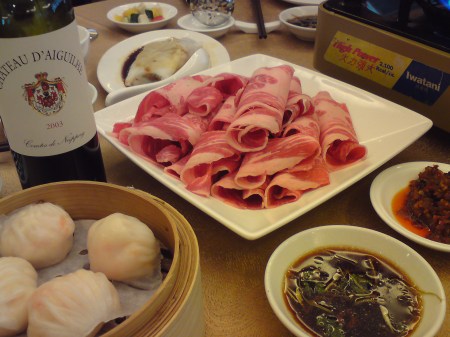 By coincidence, I happened to lunch at Asia Grand twice within a month, each occasion with a generous supply of beautiful wagyu beef, bamboo clams and some delectable dim sum dishes, all washed down with a bottle of Chateau D’Aiguilhe. This may only be an ancient estate in the Cotes de Castillon, on the outskirts of Bordeaux, but once it has been given the Midas touch by Stephan von Neipperg, you can’t go wrong, especially when a half bottle of the 2003 vintage is going for only SGD26 (incl GST). Popped and poured, it showed a very deep garnet red with a purplish rim. The initial bouquet was heavy with liquorice and soy that carried onto the palate, revealing high levels of extraction and thick textures, finishing on a slightly plummy note with tight, firm tannins. Much of its character is related, I’m sure, to the extreme heat of this vintage. After some aeration in the glass, the wine softened somewhat, but it was still essentially an unashamedly modern, young wine that’s happy to stain your tongue, teeth as well as the glass. I recalled a previous tasting at Les Amis couple of years back, also from a half bottle, that seemed a bit softer. No matter. This looks set to last the distance. Will let it sleep next couple of years.
About 3 weeks later, I was back again with Vic, this time with a 2005 over an identical menu. I much prefer this, a beautiful deep dark purple exuding rich ripe flavours of blackberries and blueberries, matched with a gentle entry, great body and mouthfeel, wonderful extraction, quite hedonistic without going over the top, finishing with sophisticated tannins. Still very primal, of course, but there was none of the heaviness or heat taint that marked the 2003, offering a glimpse at the potential depth after it had softened an hour later. Very classy, easily outperforming many other grand cru classe. Some would say it’s almost New World, but I disagree. No one could mistake that wonderful lushness and transparent texture for anything other than a superb Bordeaux. Having tasted quite a range of 2005 Bordeaux, I still maintain that Ch D’Aiguilhe offers the best value for this outstanding vintage.
We finished off with a 2002 Ch De Fargues, an estate under the venerable Lur Saluces of Ch D’Yquem. Light-golden, offering all the right notes of nectar, peach and apricot with a refreshing light touch, underscored by a deeper vein of tropical fruits. Excellent.
 Ric's Wine Journal