RWJ 10,000
Achieving 10,000 hits for RWJ (6 months after hitting the first 5,000) seemed like a really good opportunity to crack a few top drops. A dinner worthy of the occasion was arranged on 23 November 2010 with the usual suspects at Garibaldi, where the maitre’d Paolo, as well as Gilbert (all formerly of Iggy’s), were on hand to take care of the evening’s proceedings. I’d let loose that I’d be bringing a 100-pointer…now hang on…RWJ doesn’t score wines (it’s all in the tasting notes, man), so what are we talking about here?! But everyone got the idea, and the entire line-up (save for the champagne) was double-blinded. Hiok and I had double-decanted our wines, while the remainder were decanted there and then. We drank them in the order described, after which each of us had to declare specifically what we thought we’d drunk.
Kieron got us started with a 2000 Pierre Peters Brut Cuvee Speciale “Les Chetillons”, probably at its best this particular evening since Boon (Wein & Vin) first introduced it to us back in July. Liquid gold. Highly complex on the nose with lifted notes of vanilla, promising deep nutty flavours that broadened on the palate with plenty of sparkling minerality, roast, toast and smoke. Very lively and rounded. Lots of similarities with Krug, a tad less dense, but there’s no lack of complexity, the wine continuing to evolve all the way through dinner. Astonishing results for a vintage that’s not particularly exceptional. Perhaps 2000 has been underrated for champagne?  Whatever it is, this wine has yet to peak, and I’m not opening my 5 remaining bottles anywhere in the near future. A superb start.
Now what about the solitary white , courtesy of David? Brilliant luminous gold. One appreciates the sophisticated density and great concentration, layered with a buttery, creamy texture supported by firm minerality without being metallic. Very lifted, with a distinctive oiliness in the middle lined by some vanilla, displaying superb focus and linearity matched by amazing depth and great persistence. A wonderful experience. This is a white Burgundy of impeccable pedigree. I was reminded of a Corton-Charlemagne. I ventured aloud: Bonneau du Martray? Close. A 2005 Domaine Faiveley Corton-Charlemagne Grand Cru. Very, very lovely.
One look at the 5 blinded bottles of red and we knew from the bottle contours that they’re all Bordeaux, or some sort of Bordeaux blend. The first red (courtesy of PS), bright crimson, was immediately reminiscent of a Ch Leoville Las-Cases on the nose (called out by Kieron, and I tend to agree). There’s plenty of that signature old leather, cassis, slight ferrous minerality and austere mustiness to the fore, peppered with a bit of spice. Rounded, obviously mature with well-integrated tannins, its excellent structure still intact. But later, after having tasted the entire line-up, I thought this was likely to be St-Julien, although probably not a Las-Cases because by then it had developed some sweetness at the edges. A 1982 Ch Ducru Beaucaillou?
The second red (courtesy of Hiok), obviously another mature red judging by its evolved crimson, possessed a slightly herbal, medicinal quality covered with sweet overtones that leapt from the glass. There was quite a distinctive barnyard note on the nose coupled with a hint of rusticity, consistent with the gravelly texture and a steeliness that imparted a sense of toughness on the mid-palate, replete with sexy tannins within a large frame, though somewhat short at the finish where the medicinal tinge again reared its head, the wine threatening to dry out after 2 hours in the glass. Ch La Mission Haut-Brion, 1986?
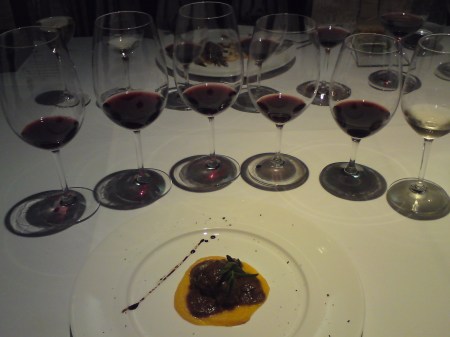 The next red (courtesy of Victor) was immediately different from the above two. Deep inky red. Highly homogenous on the nose with an abundance of Burgundian aromas full of sweet roses in full bloom. Big on the palate with full-blown but ultra-smooth tannins, gravelly in texture and slightly austere at the finish. Not as layered, but it’s beautifully focused. Hmmm…St-Estephe? Ch Montrose?
The fourth red (courtesy of Kieron) was also remarkably similar to the preceding one – deep ruby red with a tightly-knit nose suggesting lots of gravel and heated stones. Medium-full, smooth and seamless and beautifully integrated with a greater degree of depth that wasn’t quite there in the previous wine. This is almost as if we’re drinking some distilled essence, with a bit of biting tannins at the finish. Superb, but what is it? I couldn’t quite put my finger on it.
When the final red was poured, murmurs of “Lafite” went round the table, uttered with confidence. Immeasurably complex with characters of undergrowth and liquer on the nose, glycerin and graphite on the palate, concentrated yet imbued with layers of subtle nuances that arose from its depths. It gradually opened up over time to reveal highly structured, tightly-knit velvety tannins. Just lasts and lasts. Powerful, yet backward with a certain degree of aloofness that’s completely in keeping with the character of this great estate. No, I knew it cannot be Lafite. Everything about this wine spells Delon. It must be the 1986 Ch Leoville Las-Cases I’d brought, a wine that’s already 24 years of age, but still far from its peak.
So what exactly did we drink?
Red #1: 1982 Ch Grand-Puy-Lacoste
Red #2: 1982 Ch Pontet-Canet
Red #3: 2000 Gaja Sperss
Red #4: 1997 Gaja Sperss
Red #5: 1986 Ch Leoville Las-Cases

Well, at least I guessed my baby correctly. It is fascinating how well the 1982s are still performing after all these years, and how the GPL punches way above its weight even from those days when techniques in the vineyard and the cellar were nowhere near today’s standards. That showed just how fabulous 1982 was. It was also fantastic having 2 vintages of Gaja Sperss side-by-side, the vintage of 1997 underlining ts superiority. And finally the 1986 Leoville Las-Cases, which has evolved into a more open wine since the last time I had it some 5 years ago (courtesy of Hiok), when it was still very backward, dark and brooding. It’s simply amazing how the complexities of this wine easily matches that of a First Growth. As far as I’m concerned, Las-Cases is a Premiere Cru through and through. And that concludes a most enjoyable and memorable dinner that, really, would not have taken place without the continued support of everyone who regularly logs onto RWJ.
1990 Ch Lagrange
Ch Lagrange appears to suffer from an image problem. In spite of its consistent quality, befitting its status as a Third Growth in St-Julien, connoisseurs tend to pooh-pooh this estate. Perhaps part of the problem lies in it being successful only from the late 80s onward. Prior to being bought over by Suntory in 1983, its wines were mediocre, missing out on 1982, the key vintage upon which many estates forged their reputation, and wine snobs do not forget easily. 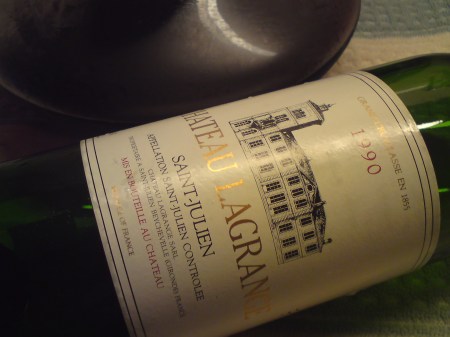 Another reason, perhaps, is because it is priced too keenly in relation to quality? Somehow, there is a certain irrational mentality that only expensive wines are good, which would mean Lagrange doesn’t qualify.
But for those who recognise a top drop, Lagrange is seriously good, almost great occasionally. One such example is the 1990 which I had this evening, 21 Dec 2010, over an excellent fillet mignon at Prive, Keppel Marina, with the wifey and son. Double-decanted for over an hour, the wine, dull red in color, contained a certain mustiness on the nose amidst other notes of old leather, dried leaves and cassis. This blew off after 20 minutes to reveal flavours of blueberries and other darker fruits that tasted remarkably fresh and full. Following a gentle entry, the palate is held in a firm grip by a wine that became increasing full-bodied, seamlessly homogenous, revealing excellent depth and concentration of fruit with complex tertiary flavours capable only from mature claret, framed by mouth-puckering tannins that grew in intensity over time, imparting an accentuated glowing finish. In fact, if tasted blind, I’d have thought this was a Pauillac, for it reminded me very much of a 1988 Ch Pichon Lalande, albeit with greater masculinity. Very lovely.
2002 Fox Creek Reserve shiraz, at a happy hour for all medical Registrars at the office on 4 Nov 2010. Decanted for almost 4 hours. Expectedly, a big wine with loads of plum, spice, leather and licorice, laden with a heavy medicinal aroma and other supporting notes of bush, bramble and balsam. Rather dense, but it managed to avoid any excess of alcohol, remarkably balanced with tannins kept firmly in check, possessing little of the rusticity of McLaren Vale shiraz, being more sophisticated instead. It’s a good drop, but not quite distinguishable from other big Aussie reds.
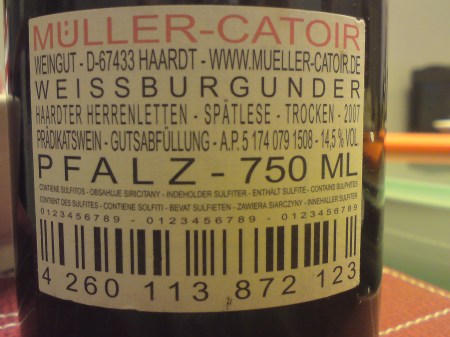 2007 Muller-Catoir riesling, 14.5% alcohol. Light yellow. Dry riesling. Light medium initially, slightly flat. Gaining in body after an hour. Medium-bodied, rounded, clean dry minerality, excellent purity without oily texture. Reasonable depth. Crisp finish.
2000 Les Ormes de Pez, poured from magnum at the annual Dinner & Dance on 6 Nov 2010. Dark red. A classic Medoc nose of old leather, cassis and dark berries with a hint of dew and forest floor. Soft on the palate, rather mellow, but it seemed to lacking in concentration and verve with a predominance of leafy overtones, ending in a stern finish, improving only slightly over time. Fatty came over and lauded it with superlatives, grabbing the bottle away in preference over the 2004 Ducru Beaucaillou (below), but we know better.
2004 Ch Ducru Beaucaillou, popped and poured midway through the annual Dinner & Dance when Hiok came over. A deep garnet red. The bouquet is immediately richer with greater depth, the superior fruit quality at once apparent. Medium-full on the palate, but its entry is ever so gentle with classic notes of dried herbs, wild mushrooms, excellent minerality and a hint of graphite, displaying excellent focus and delineation from start to finish. The body has fleshed out much more than when I first had it in 2007 when it was first released, when it was simply all fruit coated with oaky vanilla. This has turned out to be highy elegant. A classic claret in every sense.
2009 Grosset Polish Hill riesing, at Ming Kee with the wifey on 16 Nov 2010, over its signature crab beehoon. Light faded yellow. Open on the nose with notes of tangy citrus, grapefruit and stony minerality, very rich on the palate with discernible vanilla, somewhat flinty, with none of the petroleum texture often encountered in rieslings. Compared to a previous bottle several months back, this has less cutting acidity and crispiness, all for the better as it made the wine much more homogenous, with a greater feel for depth. Excellent.
2009 Bouldevines Estate sauvignon blanc, at a formal dinner at Equinox private dining (69th floor of the Swissotel Singapore) on 26 November 2010. Rather pale. Light-medium. A predominance of green notes and lemongrass, filled with just adequate minerality, uneven at the finish,lacking in real concentration.
2007 Jean-Luc Colombo Cornas, at a formal dinner at Equinox private dining (69th floor of the Swissotel Singapore) on 26 November 2010. A darker hue of pinot. Notes of cherries and other red berries with a raspberry sheen. Lacking in real depth and concentration, but admittedly a decent effort and rather pleasant. Went well with the fillet mignon.
2004 Ch Grand-Puy-Lacoste
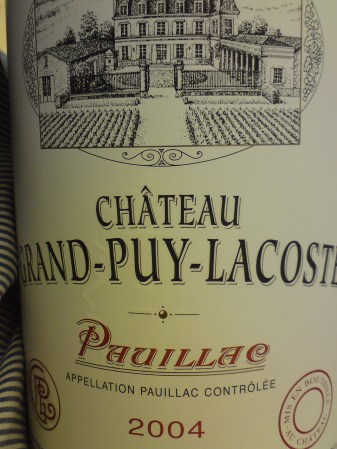 This estate of Xavier Borie is fabulous during great vintages (the 1986, 1989, 1996 & 2000 are firmly etched in my mind), but it can be tannic (2001 & 2003) or leafy (1998) at other times. I’ve had the 2004 Ch Grand-Puy-Lacoste twice thus far, both times decanted over an hour from magnum bottlings sourced from Wine Culture, but with varying results.
First tasted in February 2010 at Taste Paradise, ION Orchard, where I’d brought it straight from my cellar. Highly accessible. Ruby red, with a darkish hue, giving off a lovely bouquet of sweet roasted plums, cinnamon and that dry tobacco note that exemplifies the Pauillac terroir. Medium-bodied with good grip, fleshy, surprisingly soft and transparent, yielding good depth and layering, the fruit beginning to emerge from its shell, revealing structured sweet supple tannins, finishing with a bit of mouth-puckering intensity. Yet to develop further complexity, of course, but this wine has excellent balance and poise that’s almost feminine in quality. Elegant, like a tall beautiful woman in a long flowing gown. A classic claret in every sense of the word.
 However, a second tasting, again straight from cellar to restaurant, at my departmental function at Ember on 17 November 2010 turned out to be somewhat disappointng. A deep violet hue, noticeably darker and more primal in character, dominated by notes of blueberries, raspberries and sweet cassis with just a hint of wild flowers and forest floor. Still rather tight and unevolved, no doubt rich in fruit intensity and velvety tannins on the mid-palate, but lacking in the Pauillac identity, tasting more like a generic red. Definitely needs more bottle time. To be honest, I’d expected far more character, and I’m at a loss to explain the variation between the two magnums. It’d be interesting to gain the impression of a standard bottle. In the meantime, I think I’ll keep my remaining magnum much longer in cold storage.
2004 Ch Malescot St-Exupery
The wines of Ch Malescot St-Exupery seldom feature in tastings, yet this estate is one of the first to be encountered as one negotiates the winding D2 road through the heart of the little town of Margaux. I’ve only had the 1995 a few years back (with Kieron and Daniel at Wild Rocket), which I remembered was huge and almost too tannic, hardly ready for drinking. However, with my experience that the 2004 wines of the Left Bank are drinking rather well now, I decided to try a bottle of the 2004 at Otto (with a couple of Residents) on 10 Nov 2010, its relatively inexpensive price of SGD100 being a further compeling impetus. 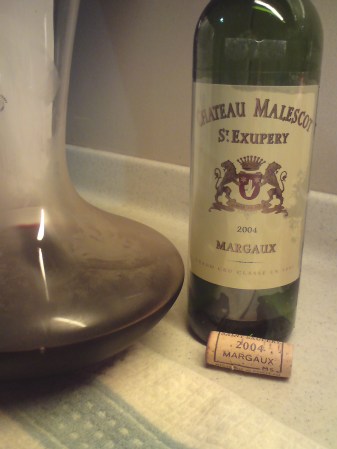 I only had time to double-decant it for about 30 minutes at home before hurrying off to the restaurant, where Paolo and the chef were enthusiastically showing off the new arrival of white truffles from Alba.
The wine displayed a deep luxuriant shade of purple, quite open on the nose with notes of blueberries, fragrant roses in full bloom and a trace of vanilla, although in typical Margaux fashion, it was neither wildly exuberant nor powerful in any sense, firmly in the feminine camp on the quiet side. On the palate, the wine was gentle on the entry, medium-bodied and rounded with ripe cool berries, but a bit of hollowness on the mid-palate was quite evident, eventually replaced by a rich layer of salty minerality in the mid-body, not unlike a premier cru Burgundy, fleshing out with time without any oakiness. The overall impression was one of classicism, poise and elegance, drinking well as expected, a perfect accompaniment to the excellent cuisine of mushroom soup with foie gras, pasta, and wagyu beef, each topped with 2 grams of white truffles.
It’s amazing how fast time passes, as we found ourselves back at Ming Kee Live Seafood again on 29 Oct 2010 for a combined Wards 25/48/49 dinner. This time, John had volunteered to hunt for a very decent Pauillac, so some effort was made to do a white Burgundy/red Bordeaux lineup for the senior table.
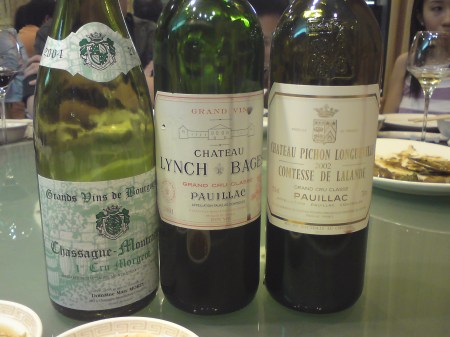 We began with a 2007 Maison Kerlann Macon Uchizy village (courtesy of LW) to go with the restaurant’s signature beehoon crab and mussels. Pale and rather flat after the initial pour, displaying a light touch of delicate citrus, thin on the palate but acerbic and sharp at the finish. It corrected itself after some time in the glass – developing more body, becoming smoother at the finish, although it was still lacking in intensity and concentration. Expectations were a lot higher for the 2004 Domaine Marc Morey Chassagne-Montrachet 1er Cru “Morgeot” (courtesy of PS) and it did not disappoint. Displaying a stronger hue of lemon-green, this wine was much broader on the nose with a richer and more expansive mid-body, developing a creamy texture with time and an attractive layer of smoky minerality in the middle, rather complex, finishing with a touch of grapefruit and pomelo. Very fine, but I fancy a couple of bottles I had two years ago during Christmas was a bit more complete.
The pair of Pauillac reds that followed cannot really be compared side-by-side, as they differ significantly in terroir and vintage. Nevertheless, they provided great drinking pleasure.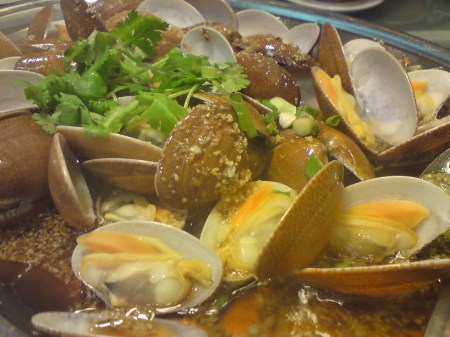 The 2002 Ch Pichon Longueville Comtesse de Lalande, rather dark red for the vintage, was remarkably full on the palate although the Pauillac nose only came through much later. Smooth, rounded and gentle, drinking well, just lacking in real density and depth, although it managed to put on weight as well as some biting intensity with time. My best experience with this wine, definitely much better than samples tasted in May 2009 (SMA Annual Dinner) and May 2010 (at Moomba with the Residents). In contrast, the 2001 Ch Lynch-Bages (thanks to John sourcing for this wine specially for this dinner) had a more evolved hue of crimson, and was a lot more open on the nose compared to the Lalande, the classic Pauillac notes coming through readily. The vintage’s superiority is readily apparent, displaying far greater grip on the palate, greater fullness, depth and complexity without any greeness or tendency towards toughness that is becoming associated with latter-day Lynch-Bages. Very, very attractive. Beginning to loosen up somewhat, but it’d be prudent to let it sleep for another 5 years, if you’re patient enough.
 Finally, I popped a rarity – a 2004 Inniskillin Cabernet Franc Ruby Reserve ice wine that I remembered buying for SGD213 from Changi Airport’s duty-free a few years back. The fashion nowadays amongst connoiseurs is to dismiss such Canadian offerings, but those were the days when I hadn’t quite learnt about German eiswein. True enough, it is ruby red, though not quite penetrating, but certainly its aromatics are quite persuasive – generously rose-scented, very fragrant, plenty of peaches and dried red fruits reminiscent of sancha, not at all heavy or cloying. I actually enjoyed it.
Notes in brief (October 2010): 2002-3 Cullen Diana Madeline, 2006-7 Egon Muller, 2002 Kay Bros Block 6, 2004 The Relic
 2007 Wooing Tree pinot noir (courtesy of PS), over lunch at Moomba. Popped and poured. A slightly heavier pinot tint than usual from this Central Otago offering. Already very open from the first pour. The bouquet expanded further after 30 minutes, with notes of brandied cherries and raspberries leaping from the glass, with a touch of damp forest floor. Medium-full, rounded with excellent density, purity and length. Highly satisfying.
2005 Ch D’Aurilhac, over lunch at Prive. Popped and poured. Deep red, with a modest bouquet of dark berries that carried well onto the palate, settling very quickly to reveal excellent levels of ripeness, weight and intensity with a solid body of minerality, just very slightly metallic and salty towards the finish, rounded at the edges without any sign of astringency in spite of its youth. Compared to my first tasting note some 3-4 months back, this wine appears to have softened and developed slightly greater depth. Excellent value.
2007 Dog Point Section 94 sauvignon blanc, during a very impropmtu happy hour in the office on 7 Oct 2010. Thankfully, I had the good sense to put this bottle in the Dept refrigerator just hours before, in case any “event” arose. Light lemon-green. Powerful bouquet, rich in exotic fruits, particularly of coconut and macadamia. This gave way after a few minutes to a full-bodied wine with notes of bitter-sweet citrus and chalky minerality, expertly balanced, finishing with lively acidity imparting a very refreshing feel to the whole wine. A highly unique sauvignon blanc – I prefer this than the 2006.
2003 Cullen Diana Madeline, at the above happy hour event. Decanted for 30 minutes before tasting. Deep purple. Initially rather reticent on the nose, but it eventually blossomed with complex intense flavours of red and dark berries tinged with a trace of marmalade and graphite, producing an unmistakable New World signature that carried well onto the palate. The tannic structure is immediately apparent upon its entry, providing firm support to the rich fruit within without threatening to overwhelm, perhaps an early sign that the wine is beginning to soften. This is much preferable than a bottle tasted in 2007 at Victor’s place, where the tannins were far too astringent then. Excellent.
2007 Egon Muller Scharzhofberger Riesling Kabinett, a half bottle (courtesy of LW) shared with Vic over a black pepper crab at Long Beach Dempsey. Pale yellow with flavours of lemongrass, lime, green apples and other citrus and a dash of tropical fruits with understated sweetness and acidity. Perhaps not a great example of Egon Muller, the wine lacking in fullness and sweep, but it served its purpose well.
2006 Cesare Pavese Barbaresco DOCG, decanted for 2 hours at a happy hour afterwork on 13 Oct 2010. Dull rusty red with a significant degree of brownish tinge. Not much on the nose, except for a mild scent of rose petals. Soft at the edges, with more of red fruits and cherries representing the nebbiolo fruit, but it was barely enough to mask the 14% alcohol, rather one-dimensional and minty without any real depth. This is a disappointment, as my initial impression at the American Club tasting (see September 2010) had been rather positive. Not much point cellaring this.
2002 Cullen Diana Madeline, popped and poured right after the disappointing Barbaresco above. Dark red, with a deep powerful nose of dark berries and blueberries, displaying excellent concentration on the palate with a dash of earthiness. Yet to come together though, the fruit noticeably disjointed from the tannic frame, imparting a sense of austerity and backwardness. This is a firm, serious wine that’s probably best left alone for at least another 5 years, although one wonders whether will it ever evolve.
2003 Ch D’Aiguilhe, a half bottle that the staff of Imperial Treasure T3 carefully decanted, without prompting. Deep purple with a slightly brighter rim. It seemed to be more open and developed than before, although there is no mistaking the high level of extraction resulting in fruit-forward notes of blueberries, dark currants, kirsch, dark chocolate and raisins amidst some gravelly minerality, ending in a mild austere finish. My last bottle, shared with PS.
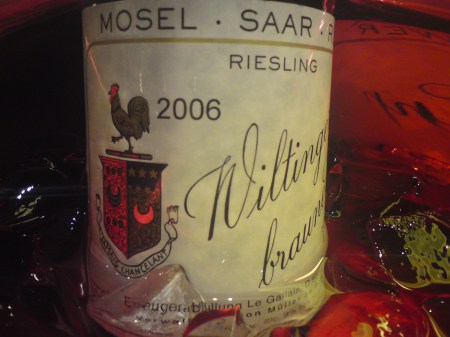 2006 Egon Muller Wiltinger Braune Kupp Riesling Spatlese, shared with the wifey on 15 Oct 2010 at Jade Palace (where we learnt that Fatty eats there thrice weekly without fail). Light golden in color. Notes of nectar, honey, kiwi fruit and a dash of apricot on the nose. Medium-full on the palate, where just the right level of alcohol and understated sweetness (always a good thing) struck a lovely balance against notes of pineapple, tropical fruits and bitter citrus, lively yet elegant. The fruit began to dominate after an hour, resulting in a wine that’s rich, even and fairlyintense. Quite similar in character to another bottle tasted some months back. Excellent, but it’s my last bottle.
2005 Ch De Fieuzal, over dinner at Imperial Treasure ION, 16 Oct 2010. Very deep dark red. Rather enticing on the nose when first poured, loads of delicious dark currants and ripe fruit with a dash of vanilla without any oakiness, settling eventually with more notes of earth and toast, ad none of the banyard pungency that sometimes accompanies Pessac-Leognan wines. However, it’s somewhat flat on the palate, where the predominance of minerals and a certain ferrous quality is evident, but missing the joie de vivre that the quality fruit is capable of. Keenly priced at SGD79 from NTUC Finest, but I don’t think I’m particularly drawn to this wine.
2002 Kay Brothers Amery vineyards Block 6 shiraz, over a superb Monster Burger with bacon at Foo House with the family. Popped from the Stelvin closure and poured right away. Typically very dark red with notes of plum and licorice. Initially disjointed on the palate, where the fruit seemed to be obscured by a faint layer of alcohol. But it came together quite well after 30 minutes, more homogenous, medium-bodied with good presence, surprisingly soft at the edges, littered with spice, black pepper, smoke and a tinge of greeness at the finish. Still rather four-square without any penetrating depth. The impression is that of the winemaker being careful to avoid any excesses in the end-product, with the result that the wine, perhaps, loses some of the distinctiveness that ought to be discernible from 110-year-old vines. I think D’Arenberg and Scarpantoni still hold the aces for McLaren Vale shiraz.
2004 The Relic, a single-vineyard Barossa blend of shiraz with a small percentage of viognier, produced by The Standish Wine Company (courtesy of TEK), drunk at a department function hosted by the three Chiefs on 22 Oct 2010. Decanted for 4 hours. Beautiful deep purple, with dense overtones of licorice, plum and a powerful herbal lift from the ripe warm shiraz fruit with a layer of the vanilla and creme de la creme coming from the viognier. A wine of immense proportions without being overwhelming nor unctuous, smooth and remarkably seamless with superb oak handling, leading to a somewhat austere and medicinal finish. I didn’t realise this was rated 99 points by RP, although it’s probably 92-93 by Ric…what am I talking about?!…RWJ does not score wines!!! It’s the tasting note that counts, man. So, this is obviously a very expertly crafted wine, but I’m beginning to move away from these monsters. Only for connoiseurs of Aussie reds.
2004 Petaluma Coonawarra, drunk at a department function hosted by the 3 Chiefs on 22 Oct 2010. Popped and poured. Deep dark purple. Full-bodied, noticeably extracted, dense and rather fruit-forward, which is a shame, as it tended to obliterate the limestone minerality, robbing it of a sense of the Coonawarra terroir.
2005 Ch D’Escurac, drunk at a department function hosted by the 3 Chiefs on 22 Oct 2010. Popped and poured. This is the complete opposite of the Petaluma, the unmistable terroir of the Medoc immediately apparent from the forthcoming bouquet, extremely rich in earthy minerality in the middle without any hint of greeness with overtones of dried leaves, wood shavings and cigar box. Remarkably well-integrated, displaying excellent concentration and intensity, ending in a slightly stern finish. A superb bargain at only SGD28 from Caveau’s sale.
2005 Episode One (Michel Rolland), aired in bottle for 45 minutes at Anne’s wedding on 24 Oct 2010 at the Meritus Mandarin. Dark red, medium-bodied, showing early signs of mellowing with notes of ripe red and dark berries and some transparency appearing on the mid-palate, revealing moderate depth. Drinking very well, with room for further improvement. This wine tastes better and better each time, with this current experience being the best. I have another 5 bottles to go, and another case yet unopened.
For the first time, the Department booked out the entire Moomba restaurant to host its dinner for the junior officers. A Chef’s menu was crafted, the staff rose to the occasion most commendably, and we all had a great time, starting the evening with 5 bottles of Domaine Chandon Brut NV from the restaurant list. Very pale. Bitter-sweet with a light touch of lively citrus, not too dry. Quite broad on the palate, slightly nutty with notes of almonds and a pungent glow in a positive sense, showing very good oak integration. Not much real depth though, but enjoyable. On top of this, I also brought a Billecart-Salmon Rose NV for my table, the second time I’ve had this within a week. Rather flat initially with more nutty and woody overtones, the commendable minerality coming on only much later, laced with sweet citrus. Not as impressive as the earlier sample a few days prior at Jade Palace, I’m afraid. Following this, we had the 2007 Joh Jos Prum Wehlener-Sonnenuhr Spatlese to go with the scallop and baked squid, a Moomba classic. 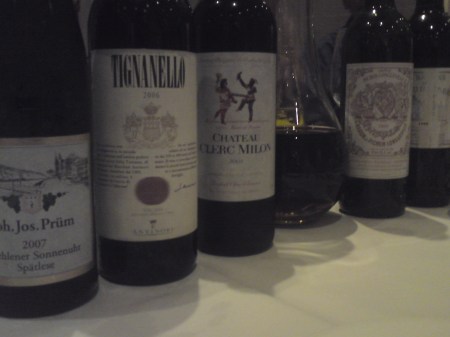 Pale, but it exuded a very smooth layer of tropical fruits, lychees, nectar and fig and a hint of smoked salmon with just the right degree of sweetness, complete with a lovely rich vein in the middle, ending in a complex finish. Excellent.
We kicked off the reds with a 2006 Tignanello (courtesy of Gerard), typically a blend of around 80% sangiovese and 20% cabernet sauvignon. Deep purple. A complex bouquet of sweet cassis and a bit of plum, medium-bodied, developing sexy velvety tannins with time with very attractive biting intensity, the cabernet fruit providing an excellent stern structure with a minty after-glow and finish. Excellent.
The 2005 Ch Clerc-Milon (courtesy of Gerard), made by Mouton Rothschild, a deep garnet red, showed great consistency of character. Typically stern and austere in its youth although there’s no mistaking the Pauillac terroir of dried leaves and cigar box, with a fair degree of salty minerality within the excellent body, displaying great balance and concentration, more fruit forward with time. Leave it for another 10 years, at least. In contrast, the 1999 Ch Pichon Longueville Baron, the only red to be decanted for two hours, was drinking well. There was quite a bit of salty pungency that took some time to blow off, thereafter revealing a lovely nose of dried herbs, cherry-plums and other red fruits, slightly earthy. Not surprisingly, it developed a more Burgundian character after some time. This was much better than a previous bottle opened at Asia Grand a year back, which was very woody. Finally, we rounded off the evening with a 1996 Bahans Haut-Brion (courtesy of F), its label already badly effaced. Fortunately though, the wine, a dusty red, was lovely and seamless, rather full and plummy, displaying excellent concentration and freshness, not at all earthy, finishing long. Tasted more like a classified growth of the Medoc. Very fine indeed.
Le Musigny: 1990 Jacques Prieur & 1997 Comte Georges de Vogue
I met up with KG again for dinner on 18 Oct 2010. There was never any question what we’d be drinking – for sure it’d be Burgundy – the question was which? I suggested aloud that we should try Le Musigny Grand Cru, and the next thing I knew, KG emailed to say he’d procured the above two wines for just SGD1,000. That, surely, must be quite a bargain, considering the vintage and the producers we’re drinking. The choice of Jade Palace as our dinner venue was deliberate – I can’t think of another restaurant where superb Cantonese cuisine and impeccable wine service, inclusive of free corkage, go hand-in-hand. Even Imperial Treasure takes some beating. While waiting for the reds to be decanted, we began with a Billecart-Salmon Brut Rose NV from the restaurant list, dull rose-gold in color with a light-medium body that gained weight with time. There was some toasty oak and roast, seemingly promising on the nose but rather one-dimensional, straightforward and slightly flat initially on the palate, finishing short. Things changed an hour later, the wine developing a liquered complex finish, followed by a weightier and more complex body of green fruits amidst lively acidity, with more nutty and biscuity notes. Quite excellent.
Both reds were tasted simultaneously after about 45 minutes of decanting. The 1990 Domaine Jacques Prieur Musigny Grand Cru, an opague red with a brownish tint, almost murky, had the more fabulous nose of red fruits and cherries, absolutely fragrant and wonderfully rose-scented. 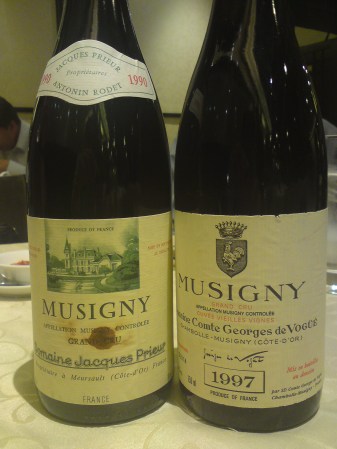 On the palate, the wine was medium-bodied, soft and rounded on the entry, less intense than anticipated from the bouquet, but there was no mistaking the layering and complexity in the mid-body that was immediately apparent. It developed a characteristic salty note with time, gelling together into a broader, more homogenous wine with focused depth and complexity all the way to the finish.
In contrast, the 1997 Domaine Comte Georges de Vogue Musigny Grand Cru, displaying a beautiful clear ruby red, was less developed on the nose initially, much lighter in tone with notes of raspberries and mulberries, lightly rose-scented, almost feminine, which is not something normally associated with Comte de Vogue’s Musigny. However, compared to the Jacques Prieur, the latter is more expansive on the palate, yet lighter in concentration and milder in intensity, probably a reflection of the growing difficulties of 1997. Very refined and focused, the usual mid-body thickness of Comte de Vogue only coming though an hour later as the wine gained in weight, even developing a bit of biting intensity, yet retaining its lovely purity and elegance, just lacking in real depth, finishing with a bit of a stern demeanour. One gets the impression that this is an expertly crafted wine in a difficult vintage without resorting to gimmickry. Quite superb.
An evening at Lien Villa: 1988/1995-96 Pichon Lalande, 1989 Lafite Rothschild & more…
The non-professorial group made good its commitment to meet on 13 September 2010 at Lien Villa, courtesy of Chris, part of a 100,000 sq feet estate belonging to the Lien family. The family name of Lien in Singapore is absolutely unique. 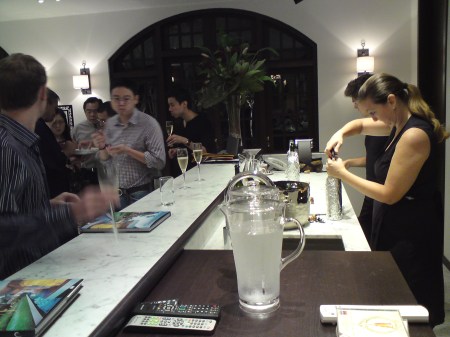 All members of this family can trace their roots to one singular and most extraordinary immigrant from China at the turn of the last century, who went on to found a bank, and the rest is history. Our group is, indeed, lucky to count one such family member amongst us. After the passing of the great patriach, the estate at Holland Park was re-developed into 5 bungalows and a cavernous Villa ( where a GPS would not be out of place in helping one navigate its interior) without any boundaries, known as the Lien Collective. The offer of an evening of private dining accompanied by truly fine wines was too good to pass, and we duly expended our energy on the planning. Karl, who had masterminded a previous private dining session in September 2006 (on the occasion of my promotion), was called upon to plan and execute the menu, and he found the Miele-equipped kitchen entirely up to his professional standards.
  I hit upon the idea of a mini-vertical and, after some deliberation, the wines of Ch Pichon Longueville Comtesse de Lalande was decided upon. Along the way, Chris also offered a 1989 Ch Lafite Rothschild, and PS a mystery wine. And so the die was cast, with Kieron ensuring that all the reds were tasted double-blind so that none of us knew whose wine we’re drinking.
Lien Villa boasts a full-fledged bar that opens out onto the poolside, and so we kicked off the evening’s proceedings by the bar with a pair of 1999 Dom Perignon, courtesy of HPP and LW, while Karl brought out plate after plate of hors d’oeurves. Very light golden, a champagne with a light touch of young citrus and peaches and delicate fragrance without any of the usual heavy yeasty notes. 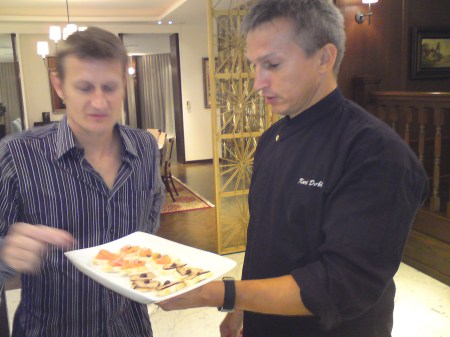 Smooth and biscuity on the palate, revealing a great deal of minerality offset by just the right degree of crisp acidity. With time, it developed a coating with notes of white chocolate, although there wasn’t much depth to the wine at this stage. An excellent start.
A mini-series had also been planned for the whites, centered around the better-known premier cru of Puligny-Montrachet from the famous domaine of Leflaive (not Olivier). The 1997 Domaine Leflaive Puligny-Montrachet “Les Combettes” 1er Cru (courtesy of Kieron), a dull golden, was served way too cold initially, resulting in a shy and reticent nose that, nevertheless, failed to mask the burnished tone – contributed, no doubt, by significant bottle age – that hinted desperately at its potential depth. Eventually though, the true colors were revealed – full of delicate fragrance on the open nose that belies a full-bodied wine stuffed with a characteristic oily texture in the middle, laden with lasting minerality that ran deep, gaining in intensity as it sat in the glass. Quite superb, better than the 2000 Les Combettes (see Aug 2009).
This was followed by the 2002 Domaine Leflaive Puligny-Montrachet “Les Folatieres” 1er Cru (courtesy of David), the largest of the premier cru plots. Beautifully golden. As good as the Les Combettes was, the latter was even more engaging, hitting the correct notes right from the start. Flinty with excellent minerality, larger in body, broader and more expansive on the palate with a greater sense of cohesiveness, fairly intense with a faint hint of honey tapering to a long, complex bitter-sweet finish of pomelo and grapefruit. No doubt the outstanding vintage of 2002 helped. But the best was saved for last, as Hiok made up for arriving late with a dull yellow 1995 Domaine Leflaive Puligny-Montrachet “Les Pulcelles” 1er Cru. Closed initially, but it gradually opened up after some coaxing to reveal rich, lovely flavours of nectar, fig, honey and white flowers of immense complexity, growing in depth and density, with the development continuing right till the end of dinner, amply demonstrating why Les Pulcelles is the most coveted of all Montrachet premier cru.
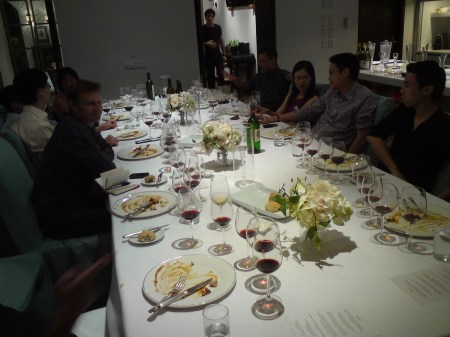 The reds were poured one-by-one, eventually allowing all five to be tasted simultaneously. Red #1 (courtesy of Edward) displayed an evolved red with a deep garnet core. On the nose, scents of wild flowers, sour plums, mushrooms, bramble and damp forest floor dominate. The entry revealed an obviously mature wine, rounded and soft at the edges, imbued with a fair degree of sur-maturite and balsamic character underlined by a trace of sweetness and scattered white pepper, still lively with a bit of biting intensity that became increasingly perfurmed with time, yet remaining very harmonious. What could it be? We were split down the middle between one of the Lalandes and the mystery wine. Most of us leaned towards the latter, given the earthy nose and relative masculinity.
Red #2 was quite similar in color as the first red, just a tad more transparent, but much more open on the nose, and quite different in character altogether. Highly perfumed with the Pauillac hallmark of dried leaves, pencil shavings and tobacco coming through, highly promising. It didn’t disappoint on the palate, caressing with deep, lush and velvety textures, imparting a lovely lift and glow at the finish, although it actually lacked the intensity of the former red. Slightly four-square with food, but it is definitely drinking very well. I thought it was likely to be a 1995 Ch Pichon Lalande, which I’d brought.
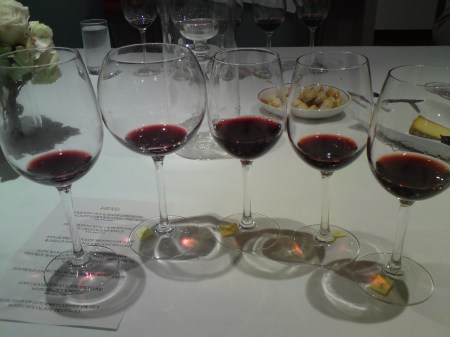 Red #3 (courtesy of Vic) had a bit of bottle stink that eventually blew off to display all the hallmarks of a mature Bordeaux, absolutely enticing on the nose with plenty of cedar-wood and ripe red fruits, almost Burgundian, but it was soft, mellifluous, less full on the palate and slightly short on the finish. It put on weight as it sat in the glass, becoming fuller and broader, taking its time to develop, but the balance was immaculate, the wood and alcohol having dissipated ages ago, leaving behind a seamless wine of stunning purity. I was reminded of the 1988 Ch Pichon Lalande that I had last year at La Tour d’Argent, Paris (see July 2009), and I was pretty sure I was tasting the same wine again.
When it came to Red #4 (courtesy of PS), I was pretty sure I was tasting the 1989 Lafite. How else could one explain the deep feminine bouquet coupled to a classic Pauillac signature with plenty of sur-maturite on the palate, immeasurably complex at the finish? Still somewhat tannic, though, and much darker than I’d anticipated, but having laid my cards for the other reds, I was sure this was a First Growth. Finally, we reached Red #5 (courtesy of Chris). Again very dark-red, tasting remarkably youthful, a wine of large proportions but immensely complex and layered. Solid in the middle, becoming softer and more yielding later, developing more notes of cherries, eventually becoming quite Burgundy-like. We’re unanimous in deciding that this was something outside of Bordeaux, probably the mystery wine.
So, what exactly did we drink?
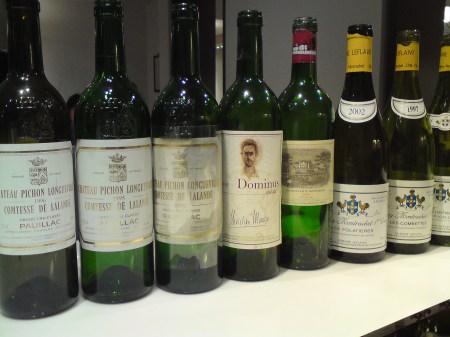
Red #1: 1996 Ch Pichon Longueville Comtesse de Lalande
Red #2: 1995 Ch Pichon Longueville Comtesse de Lalande
Red #3: 1988 Ch Pichon Longueville Comtesse de Lalande
Red #4: 1985 Dominus proprietary red !!
Red #5: 1989 Ch Lafite Rothschild
Only 2 out of 5 hits…wow…that’s a real humbling experience. The ’89 Lafite is tasting so much better than the last time I had it in 2006 (at Iggy’s) and 2007 (SMA Annual Dinner), displaying so much more development and paradoxical youthfulness, whereas it had tended to fade previously after some time in the glass. And a ’85 Dominus!! I never knew it could be found in Singapore. It just shows how successful a totally different terroir could be managed under an outstanding winemaker. What a superb thematic lineup, what a fabulous dinner, and what a venue. THANK YOU.
 Ric's Wine Journal