Champagnes of Bruno Paillard & 2002 Armand Rousseau Clos St-Jacques & 1982 Latour-a-Pomerol
These notes come from a private dinner with Monsieur Bruno Paillard on May 4, 2011, at Imperial Treasure Great World, where YS had been very kind to have extended me an invitation as a guest of Vinum, which was hosting the dinner. In terms of production, Maison Bruno Paillard doesn’t quite count amongst the usual suspects, but its quality quite easily surpasses many of the bigger names. It transpired during conversation that Bruno Paillard is the champagne of choice for the Singapore embassy in France, a wonderful testament to the ambassador’s sophisticated palate as much as to the winemaker’s skill. The wines were served in rapid succession over the course of a sumptious Cantonese cuisine.
First came the Bruno Paillard Premier Cuvee Brut. Pale. High-toned crystalline minerality offset by bitter-sweet citrus. Good body, fairly smooth, not too sharp, revealing some depth, layered with wonderful acidity. Lively and refreshing. An excellent champagne in its own right. I’ve always felt that the reputation of every respectable maison de champagne is built upon its non-vintage cuvee, it’s calling card, and Bruno Paillard certainly does not disappoint.  Following on, the Bruno Paillard Premier Cuvee Rose, with a dull golden rose-scented glow, was deceptively smooth and easy with attractive orangey citrus and a hint of strawberries , coming across as being a bit straightforward and nondescript initially. But it developed most impressively over time, growing in density, fleshing out, becoming more fruity with more minerality coming through. Not quite in the same league as the Jacques Lassaigne rose that I had recently, but this can be rewarding if you have the patience to wait.
The following pair of vintage champagnes proved that Bruno Paillard deserves to sit alongside the champagne greats. The 1996 Bruno Paillard Blanc de Blancs, pale, with lovely clarity, was notably bigger and deeper on the nose with wonderful lifted aromas, the complexity and supple minerality already coming through on the nose. Broad and expansive on the palate with lovely poise and incredible definition, richer over time, leading to a long lasting finish. Not the last word in depth but it more than makes up for it with its excellent integration and balance. Superb as this was, it was trumped by the 1995 Bruno Paillard N.P.U. “Nec Plus Ultra”, made only from grand cru grapes only in great vintages. Just a tad deeper in color than the Blanc de blancs. There’s a sense of great depth on the nose, highly perfumed, topped with yeasty notes, nutty and creamy. Expansive and ultra smooth, showing great body and complexity, gaining in depth over time, seamless and mature, incredibly complex at its long, long finish. A complete wine.
YS had brought along two reds to round off the evening. The 2002 Armand Rousseau Clos St-Jacques 1er Cru was deeply rose-scented and, typically for this producer, deeply-layered with immense complexity in the mid-body, gloriously lush and ripe, highly perfumed with great purity of fruit whilst still remaining tight. This is a wine for the long haul. Like Patek Philippe, it’s perhaps meant for the next generation. The piece de resistance came in the form of a 1982 Ch Latour-a-Pomerol, served from magnum (!). Still retaining a deep red core but obviously mature, exuding a highly complex bouquet that defies description. It has that luminous hallowed glow of aged Bordeaux, slightly salty, imparting flavours of red and dark berries from fruit of great purity with wonderful profound depth. Still remarkably youthful and lively in other respects, quite complete as a wine, just missing the outright lushness of a Pomerol, but probably for the better. I couldn’t have asked for a better way to end the evening.
Hot on the heels of the Palmer dinner came another heady theme, masterminded by YS, featuring three Bordeaux wines from the outstanding 1990 vintage with perfect Parker scores: Châteaux Beauséjour Duffau-Lagarrosse, Montrose and Margaux. Regular visitors to this website will understand that RWJ doesn’t score wines, preferring instead to focus on the actual tasting experience. Everyone knows what 100 (out of 100) marks mean in a math exam, because the marking criteria is standardised, applies equally to everyone, and is reproducible with 100% accuracy. But 100 points awarded to a wine hardly means anything. What is 100 compared with 98? Someone’s 100 could well be another’s 90. In the absence of objective standardisation, scoring a wine is a hopelessly flawed and subjective exercise. At best, numerical scores serve only as a guide to the overall quality of a wine. But in an increasingly dumbed-down world where more and more people need to be guided by numerical cut-offs and benchmarks (without really understanding their true meaning), it is not surprising that the number game is everywhere. Robert Parker Jr has often been blamed for starting it all, but just about every Brit and non-American has succumbed to it as well. Now that numerical scoring has been so deeply ingrained, some thoughts come to mind: How does a 100-pointer wine taste like?  Will I be able to recognise a 100-pointer wine? Interesting. And so when I received an invitation on 14 April 2011 to be part of a 100-pointer dinner that same evening at La Strada, I threw all reservations to the backburner and showed up straight from work. Although the identities of the wines were known, we followed our usual custom, giving the sommelier carte blanche to blind and arrange the order to be served.
To ease us into the tasting, Kieron and David had brought along a 1999 Champagne Philipponnat Clos des Goisses Brut, one of my favourite champagnes. A blend of 65% pinot noir and 35% chardonnay, this high-toned wine displayed a lovely smooth minerality with a layered, sweet pomelo finish. A bit reticent initially as a result of being served too cold, but it gradually warmed up with an explosion of colors, an abundance of chalk and tropical fruits without the usual overtones of malt and vanilla oak, ending in a rich finish. The last sip was the best, the wine finally displaying great depth and bounce to be on par with what I’d remembered of it from a tasting back in September 2009 (see post). Quite superb.
The 1990 Domaine Comte Georges de Vogüé Musigny Grand Cru that followed was originally meant to whet our appetite before the Bordeaux. Consistent with this producer, and especially of Musigny wines, this showed a heavier shade of pinot with a most lovely nose of red fruits as well as some suggestion of plum and orange peel, still youthful, complete with an excellent perception of depth. Open and seamless on the palate, where it was darker in tone, more austere and tight in the middle, rather backward. A big burg that began to open up with time, but the fruit seemed to be beginning to dry and thin out at the finish. The table was split down the middle in opinion; some felt it was evolving faster than expected while others felt it wasn’t quite ready yet. I tend to agree with the latter camp. Whatever, it is always a privilege to have the opportunity to taste a Musigny Grand Cru from the largest landowner of this hallowed plot.
The first of the 1990 wines to be poured was dull purple, exuding a powerful nose of dark ripe berries with a dash of red fruits. This wine was still remarkably fresh and youthful, possessing some density in the middle with more than a hint of soy, broadening on the palate with an expansive sweep. Very harmonious, just a slight accentuation on the mid-palate that evened out over time, tapering to a moderate finish. Very lovely. Of the three 1990 Bordeaux wines, this was drinking the best. I thought this was probably the Beauséjour, where the predominant merlot component was likely to mellow earlier.
This was followed by the second 1990, displaying a vibrant dark purple that produced a powerful nose of violets, blackberries and a good deal of earth with aromas that were lifted, almost perfumed. On the palate, it was soft and rounded, full of elegance and restraint, rather feminine in character but in a dark manner. A dark beauty. But still tight, needing plenty more time. Ch Margaux?
The final 1990 displayed the deepest purple with the most balanced nose of all, coupled with a wonderful sense of black and dark berries. Full-bodied, opulent, almost lush, showing a slightly sharp accentuation that dissipated with time, laying on great concentration, depth and definition, almost hedonistic and irrepressible in the French manner where the wine remains perfectly balanced in spite of the weight and larger proportions. Still very tight. One wonders if another 20 years of cellaring will change anything at all. Given the lineup and going by elimination, I thought it most likely to be the Montrose.
We worked out the math. As there were only 3 wines, this meant there were only 6 possible permutations. And with 6 drinkers, one of us must surely hit the jackpot. And so we all declared our thoughts and called in the sommelier to unveil the order poured. To my embarrassment, it turned out we were poured the 1990 Château Margaux, followed by the 1990 Château Montrose and, finally, the 1990 Château Beauséjour Duffau-Lagarrosse. Zero hits for me, while some of us scored one hit, at most.
So, what can I surmise out of this experience? 1) To be honest, I wouldn’t have known I was tasting a 100-pointer if I hadn’t known beforehand. Mind you, these wines were all very, very lovely. I could have drunk them all night. Each of them provided a wonderful experience in its own unique way. But it simply shows up the inadequacies of the scoring system, because in no way does any kind of summary scoring reflect the character of each wine. 2) I’m really poor at blind-tasting.
My heartfelt thanks to YS for including me in this dinner-cum-tasting. Was it worth the money? Perhaps, just for a singular experience. For sure, I can’t afford to do this sort of thing on a regular basis. 
2004 Clonakilla Shiraz-Viognier
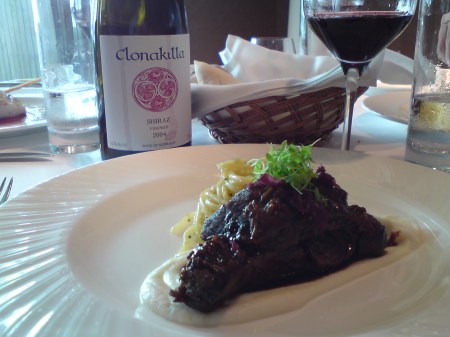 2004 Clonakilla Shiraz-Viognier, at Prive on 29 April 2011. Opened at the restaurant and aired in bottle for around 20 minutes before being consumed over the next two hours. This wine is made in the style of a northern Rhone, where a small fraction of viognier is co-fermented with shiraz (syrah). The benefits are immediately apparent. Already showing a more evolved color than usual, the initial impression was that of a rather effusive nose of aged red fruits, plum and orangey citrus that led to a medium-bodied wine, soft at the edges, rounded and fleshy, remarkably well-balanced with excellent depth and structure, and much more aromatic compared with a straight shiraz, no doubt contributed by the viognier. Over time, more secondary notes of cinnamon, cedar and violets began appearing, growing in complexity, the wine gelling into a seamless whole with an even greater glow of cherries, blueberries and a hint of glycerin, finally developing a mild spicy accentuation at the finish. Compared with the 2002 vintage, which is still dense and backward, the 2004 is evolving at a more rapid pace, already into its drinking window where I have no doubt it should easily hold for several more years. The remarkable thing is, if tasted blind, everyone would have said Old World. No wonder this label has made it into the top rung of Langton’s Classification. Absolutely superb.
2003 Lyndenhurst cabernet sauvignon (courtesy of PS), at a ward dinner at Foo House on 21 April 2011. Decanted for almost 6 hours, I believe. True to its Napa roots, this dark purple wine was still huge in proportion with out-sized herbal and medicinal aromas, the ripe grapes, intense minerality and finely-grained tannins combining to produce a dense, full-bodied wine with an accentuated attack at its finish. It settled down with food, loosening up a little on the mid-palate, but the vanilla from the new oak remained perceptible. You got to accept that this is the style of the Californian terroir. It probably won’t be an appropriate match for fine European cuisine, but on this occasion, it was the perfect counterpoint to 2.4kg of rump beef and a huge platter of crispy pork knuckles.
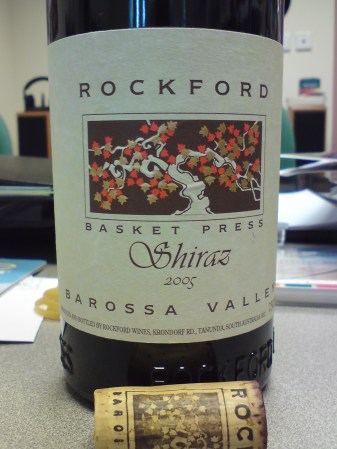
2005 Rockford Basket Press, at the above dinner at Foo House, 21 April 2011. Double decanted for 90 minutes since 0930h (!!), after which it was aired further in bottle for another 7 hours. Surprisingly shy on the nose, preferring instead to express itself on the palate, where warm ripe plummy shiraz fruit with a touch of licorice and a hint of orange peel caressed the palate in broad swathes, medium to full-bodied, rounded at the edges, well integrated and quite seamless, excellent in concentration and depth with tannins kept in check. Still tight. Has enormous potential, but needs plenty of bottle time.
 2004 Ch Smith Haut Lafitte (courtesy of Ben), at Foo House on 21 April 2011. Popped and poured. Even after the initial two heavyweights (above), the SHL has no difficulty establishing its identity. The drier, balanced and layered character of Bordeaux came through easily. In particular, the terroir of Pessac-Leognan was unmistakable right from the first whiff – earthy with a bit of attractive barnyard aromas, saturated with ferrous minerality, poised and elegant. A classic claret. Highly enjoyable now, and I suppose will be extremely rewarding if re-visited during its second decade. Outstanding.
2007 Moss Wood cabernet sauvignon (courtesy of Ben), at Moomba on 15 April 2011 Decanted on-site. Deep purple. Surprisingly soft and accessible, fruit forward both on the nose and palate with notes of red and dark fruits, blueberries and raisins, producing good concentration and density without any jarring edges, the acidity and tannins very much suppressed. I get the impression that it’s crafted to produce a “safe” wine, such that it ends up lacking in distinction. Perhaps it needs plenty more time to flesh out and develop in bottle. We shall see.
Billecart-Salmon rose champagne NV, at Asia Grand on Good Friday with the family. Pale rose tint. Nutty, imbued with lively citrus and overtones of orange peel, somewhat smoky and yeasty. Perhaps the acidity is a little over-bearing, resulting in persistent dryness that remained even at the end of dinner. My last bottle, but I don’t think I’ll miss it.
2008 Peter Lehmann botrytis semillon, at Asia Grand, Good Friday. A dominant note of preserved mango and apricot, underpinned by bitter-sweet pomelo that ensured that the wine’s sweetness remained understated, providing a trace of complexity at the finish as well. I enjoyed it.
2008 Lady May Glenelly. Double-decanted and aired for almost 3 hours; half of the bottle drunk at Tung Lok Classics at Chinese Swimming Club, after which I passed the other half to Kieron, who had this to say: youthful but open nose with notes of licorish sweet vanilla and toasted oak, staggering concentration on the attack, hollows out towards the end, finishing with a little burn. I say that you’ll never guess it hails from Stellenbosch, South Africa. Very impressive.
2004 La Fleur de Bouard (courtesy of F), at a Dept function at Saltwater Cafe, Changi Village Hotel, 27 April 2011. Deep dark purple. A gentle bouquet of dark berries, faintly sweet. Medium-full, fairly dense, a good deal of dryness amidst strong primal notes of ripe fruit.
2002 D’Arenberg Dead Arm, at Changi Village Hotel, 27 April 2011. Deep impenetrable red, from which floated a fairly heady and hedonistic mix of plummy shiraz, warm, ripe and dense without being saturated nor over-bearing. Fleshy, some early development, finishing in a rush of spice and pepper. Lacks clear distinction, though.
1999 Banfi Castello Poggio d’Oro Brunello di Montalcino, on the occasion of Monster’s birthday, 6th April 2011, at Otto. This is the higher end brunello from this estate. Decanted on-site. Deep clear purplish red. Highly engaging nose of blueberries and raspberries that carried well onto the palate with a bit of vanilla coating. Still rather tightly coiled, the alcohol and fruit being concentrated in the mid-body with a slightly deeper note of glycerin. It became more accessible after 90 minutes, much more relaxed with other red fruits appearing, tapering to a lengthy finish, but yet to develop secondary nuances. I’d have thought that 12 years would have been a reasonable length of time for the wine to mature, but given the outstanding vintage and grape selection, it probably needs another 6-8 years in bottle.

Californians & Italians: Ridge, Kistler, Peter Michael, Solengo, Tignanello, Pian Delle Vigne…
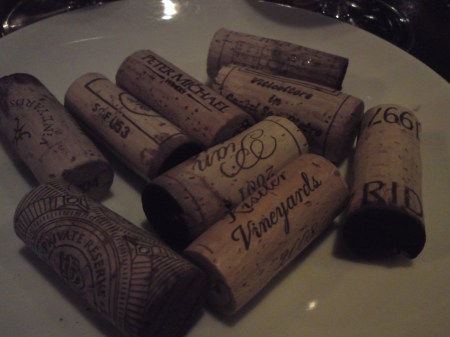 These are brief notes from a Non-Professorial Dinner on 21 February 2011 at Bedrock Grill & Bar. Their steak is, indeed, succulent and can hold its own against the very best, but the whole place is just a bit too smoky for proper wine tasting (it took me a while to realise that the “smokiness” in the wines came instead from the open grill).
We began with a pairing of Californian chardonnay. The 2008 Kistler Parmalee Hill Vineyard (courtesy of KP) was pale golden with a firm body of citrus, lime and melons, topped with complementary notes of cream and butter. Excellent on its own, but rather tight and reserved, balanced but less exuberant compared with the 2005 Peter Michael Belle Cote chardonnay (courtesy of David). This was livelier with a fuller body of lime and citrus, loaded with greater minerality and crisp acidity, giving it greater immediacy. It opened up further with time, becoming broader and more layered, with emerging notes of pomelo that added further depth. Very inviting. More in the mould of a Chablis (from Kieron, I agree). I’ll swear that, if blinded, it would have been quite impossible to tell apart from a Chablis Grand Cru. Superb, as always, from this producer.
The first pair of reds featured a 2007 Umberto Cesare Liano, a blend of cabernet sauvignon-sangiovese (courtesy of Ben). Glorious deep, bright red, peppery with a slight pungent barnyard note that blew off to reveal flavours of red fruits and cherries that carried well onto the palate. Medium-full with surprisingly good depth, balance and suppleness for such a young wine, rounded at the edges, superbly defined, finishing with sexy tannins. Almost Burgundian, just a shade heavier. In contrast, the 2004 Hestan Vineyards cabernet sauvignon (courtesy of Hiok) was, expectedly, a huge monster of a wine. Deep, dark, impenetrable red. Dense (thick, in fact) with a powerful herbal and medicinal note, suffused with licorice. Hedonistic but supremely balanced and controlled, although it can’t hide the fact that it is oversized. Only for aficionados of such style.
The 1999 Solengo (courtesy of Chris) was more memorable on the nose than on the palate – dark red and layered with a deep lovely glow. Medium-bodied, soft and accessible with emerging secondary nuances though without much layering. But it’s drinking very well, which was really what matters. Next to this, the 2002 Beringer Private Reserve has no difficulty establishing itself as a New World. Predictably deep dark red. Made in a big, fruit forward style with dried leaves and herbs bringing up the rear with plenty of plums and bright cherries on mid-palate, tightly structured. It opened up over time but still remained far too dense, lacking in layering and palpable complexity.
We ended with a menage-a-trois of iconic Italian and Californian reds. The 1990 (courtesy of Edward) is the oldest Tignanello I’ve ever had. A much more evolved red with a darkish core, from which leapt out a lovely glow of plummy sangiovese, medium-full but richly layered with a liquered finish within a pliant cabernet frame. Amazingly, I feel this has yet to peak. The 1997 Ridge Monte Bello (courtesy of Kieron) is obviously more youthful, but its style could not have been more contrasting. Still dark red and restrained on the nose, but there was plenty of glycerin and red fruits on the palate, slightly forward, with a great deal of depth and density that hasn’t quite unraveled. Needs to be left alone. And, finally, a grandstand finish in the form of a 2001 Pian Delle Vigne (courtesy of Vic), displaying a beautiful deep ruby, loaded with red and dark berries supported by a lovely deep spine of wonderful complexity, soft at the edges but layered with superb definition all the way to its long and lasting finish. Truly outstanding. No prizes for guessing where my preference lay for this evening’s tasting. In future, we should stop doing Italians side-by-side with Californians. Make no mistake, the latter is also excellent, but I prefer to appreciate the Old and New Worlds separately, as far as I can.
I discover with sudden realisation that my wine-and-dine events have reached a whole new level of experience: small but distinguished group averaging one bottle per head, private room (of course), lofty themes without the need to think twice, food that’s never less than excellent, first-name basis with the entire restaurant staff, dining with the restaurant co-owner and, best of all, everything for just a song. And so it was on 23 March 2011 when I found myself dining with a co-director of the Les Amis group at one of their restaurants, La Strada, over a theme of Ch Palmer vertical that Kieron had come up with. It’s high-class snob, but it feels damn good. Like the Mouton dinner (see Feb 2011), we already knew which vintages of Palmer we’d be drinking, but we left the sommelier to blind and arrange the wines in an order deemed appropriate. For sure, there would be a 1996 (courtesy of YS), 1999, 2000 (Kieron) and 2001 (KG). And guess what? There will be a fifth mystery red as well (courtesy of David). Interesting!
As usual, we popped a champagne to start things rolling. Most rose champagnes are over-rated, but I must say the Jacques Lassaigne Rose NV (courtesy of KG) is a wonderful wine from start to finish, light orangey-pinkish tint with deep notes of malt, peat, and smoky citrus, apricot, pineapples and grapefruit. It was full of lively acidity without going over-the-top, gaining incredible complexity over time, flooring me with its amazing depth each time I poked my nose into my flute. Simply superb.
We got down to serious business right after that, tasting all the 5 reds simultaneously. Red #1 showed a deep dark purple with plenty of ripe dark berries, cedar and black fruits, producing great body and tone, rather firm and masculine, classically structured with excellent depth, framed by supple tannins, just a bit short at the finish, yet to develop further although its potential is enormous. There was an obvious note of vanilla that hinted at its youth. Everyone was unanimous that this was most likely to be the 2001.
Red #2 also contained a deep purple core with some lightening towards the rim, but this wine was much deeper and darker in tone, dense with an almost soy-like quality but well balanced, developing a high aquiline tone over time. The fruit was remarkably ripe, concentrated and fairly intense, saturating the palate with layers of sweet dark berries without any hint of over-extraction, opulent and multi-dimensional, growing in complexity right till the end of dinner. 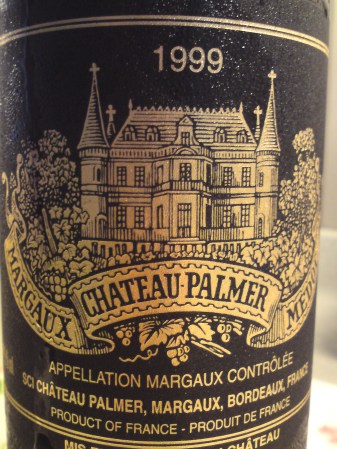 But overall, this is still a youthful wine that’s largely undifferentiated at this stage, just beginning to reveal some secondary nuances, packed with plenty of power and understated charm. Given the line-up, I thought this was most likely to be the 2000, which Kieron concurred.
Red #3, although deep in color was evidently more evolved than the preceding two wines, much more open on the nose with lifted aromas of red fruits, sweet cherries and strawberries. Medium-bodied, rounded, superbly integrated and totally seamless, this wine was quintessentially Margaux in its charm, most befitting of the stereotypical feminine character one expects of wines from this commune, although I wouldn’t go as far to say that it’s voluptuous. Neither does it combine power and elegance, a hallmark of Ch Palmer from the best vintages. In fact, its finish was somewhat short. Must be the 1999, surely, a watered-down year.
Red #4, with a dark purple core, was appreciably heavier and more intense on the nose, rich in ripe sweet fruit with extended depth and concentration, almost opulent, caressing the palate softly with velvety tannins, leading to a lasting luxuriant glow at the finish. Superb in definition from start to finish, perhaps even backward. The closest comparison was with the second red, but I felt that Red #4 didn’t quite integrate as beautifully, almost as if each individual component was just a tad too over-sized. The 1996?
I had the privilege of knowing which mystery wine David had brought; the fun was trying to spot it amongst the line-up. But it stood out immediately, for the classic color and nose of an aged Bordeaux (that made the previous 4 reds appear distinctly youthful) was unmistakable, replete with the glow of cedar, cassis and cinnamon, slightly sweet, amidst the classic Pauillac signature of dried leaves, tobacco and cigar box. It still displayed a dark dusty red at its core but there is no mistaking the evolved bricking at the rim, fully mature on the palate, harmonious and homogenous, seamless yet complex, still retaining its structure with superb definition all the way to its lasting finish. Supremely confident and elegant. A complete wine, caught at its peak and will hold on for years to come. This was, of course, a 1985 Ch Lafite Rothschild (thanks Dave!!!). A quintessential Lafite. I was surprised the thought hadn’t cross the minds of my fellow diners, but it was irrelevant.

So, back to Palmer. Had we been served from youngest to the oldest, in simple order? That was what Kieron and I concurred. But when the answer seems too easily derived, just like in school exams, you get this nagging feeling that you must have screwed up big time along the way. It turned out we were served: 2001, 1999, 1996 and 2000. Only one hit out of four and, to be honest, the 2001 was a dead giveaway. Terrible. What surprised me most was how the 1999 had outperformed all expectations. My previous experience of this wine had been in Aug 2009 (see posting) where its exceptional power, depth and finesse were already noted, but its mid-body seems to developed further over the intervening period with greater fullness, layering and dimension. However, it is clearly far from ready, as evidenced by the way the wine kept increasing in complexity throughout dinner. The winemaker was right when he had said that the 1999 had the edge over the 2000. This is a classic in evolution. I have high hopes that it’ll be the latter-day equivalent of the 1983 in time to come.
My thanks to all for their kind generosity.
1986 Les Carmes Haut Brion
I’ve never really had a chance to try Ch Les Carmes Haut Brion, but when I spotted a bottle of the 1986 last week going for only SGD76 (unbelievable!), I knew there was no better opportunity than this. Opened and decanted this evening at Ristorante da Valentino, a lovely restaurant owned, managed and run by an Italian family off Rifle Range Road in Singapore. The cork was fragmented, but thankfully the wine was otherwise intact. 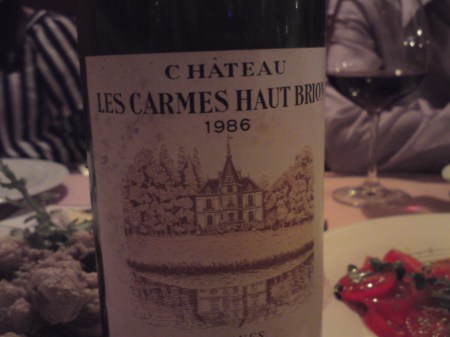 Fully mature in color. A bit reticent initially, but it began giving off enticing aromas of ripe red and black berries, redcurrants, a bit of cinnamon and orange peel with a sense of heated stones, earth and gravel, well mellowed after 25 years, producing a soft, smooth wine that still possesses plenty of body and grip, revealing good concentration and depth, tapering to a plummy glowing finish with barely a hint of rusticity. Has all the attributes of a well-aged claret, a commodity that’s increasingly rare in a world impatient to drink wines in their infancy. This is a wine that’s still holding on at its drinking plateau, with no hint of drying up. You can’t really tell it’s a Pessac-Leognan, as most aged Bordeaux tend to regress towards a common form, but it’s an excellent wine in its own right, and a truly superb bargain.
Notes in brief (March 2011): 1990 Moulinet, 2008 Wilderness chardonnay, 2005 D’Aiguilhe
2000 Comte Senard Corton Clos des Meix Grand Cru, popped and poured over a late dinner on 15 March at Jade Palace. Lovely shade of pinot. Rather reticent on the nose, not offering much apart from a hint of red fruits and preserved dates. Made up for it on the palate with a broad expanse of red berries and cherries, soft and rounded with a bit of tannic bite and grip emerging after an hour. 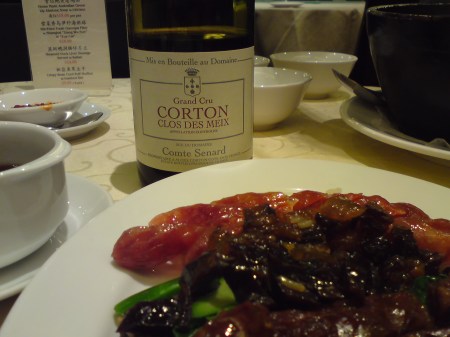 Lacking in layering and true complexity. Very much second division grand cru. Don’t think I’m getting more even though it’s only SGD59 at Denise’s clearance sale at Turf City.
2008 Wilderness Estate Reserve chardonnay, of South-Eastern Australia, from a selection of wines and cocktails at the Hyatt Regency Club lounge at Yogjakarta, Indonesia, on 17 March. The bottle had been opened for some time and I was tasting the last third that was remaining. Surprisingly attractive on the nose with substantial aromas of cream and vanilla, quite weighty on the palate with notes of stony minerality and melons of resonable depth, gathering in intensity towards the moderately long finish. I wasn’t expecting anything much, hence the wine came across as a pleasant surprise. This can measure up against any village Puligny-Montrachet, I swear. Let’s see if I can find any in Singapore.
2008 Wolf Blass cabernet merlot, a one-litre bottle over an excellent tenderloin steak at Foo House. Deep red. As expected, made in a fruit forward manner with loads of blackcurrants, blueberries and red fruits, admittedly ripe and fleshy, producing good mouthfeel, soft and rounded, well balanced but without any depth nor lasting finish. Almost like Ribena plus 13.5% alcohol. A decent quaffer.
2002 Umberto Cesare Liano, a mix of sangiovese and cabernet sauvignon, over a surprisingly good buffet dinner at Cafe Brio, Grand Copthorne Waterfront. Dull dark red. Full-bodied. Fruit forward as well, predominantly dark berries with a top layer of preserved red fruits, some notes of toffee and a faint trace of plum and licorice that probably came from the sangiovese, supported by firm tannins that led to a spicy, peppery attack at the finish. Rather homogenous and unyielding initially, but it opened up after an hour to reveal more depth and layering, with better integration. Still, I prefer the more recent 2007 vintage.
Ca’ Del Bosco Cuvee Prestige NV, at Jade Palace on 29 March 2011 in honor of Dr LHS. Bought for only SGD42 at Crystal’s one-for-one sale. Popped and poured. A blend of pinot bianco, chardonnay and pinot nero, 20% of which actually consists of reserve wine from the finest vintages, and it shows. You can’t tell this apart from a top-flight champagne. Clear golden, hitting all the right notes of walnuts, cashews, cream and caramel, backed by gentle toasty oak , possessing great presence and balance with just the right degree of dryness, leading to a deep long finish. Lovely!
2005 Ch D’Aiguilhe, at the above dinner at Jade Palace, where two identical bottles were poured into the same decanter and aired for almost an hour before serving. Deep dense purple. An assault of vanilla and graphite greeted one on the nose, backed by dense minerality on the palate. It took almost another hour to finally open up, revealing the glorious ripe fruit of predominantly dark berries and blackcurrants, fleshy and rounded at the edges, framed by sophisticated supple tannins. Unlike the 2003 example, the level of extraction here is just right, and I suspect this has the legs to last 20-30 years, easily. Excellent.
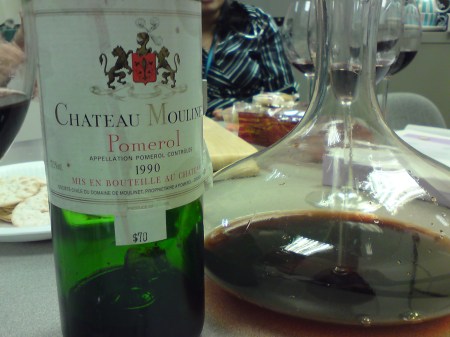 1990 Ch Moulinet, at a happy hour to de-stress after work on 30 March 2011. The cork was far too dessicated and promptly disintegrated when I tried opening it, leaving me with no choice but to push it down into the bottle and carefully decant the wine. A mature, light purplish red with substantial bricking at the rim. A bit thin initially, although the balance was good right from the start, the tannins having melted away ages ago. It began to fade and lose focus after 20 minutes before staging a most spectacular rebound, fleshing out, gaining greater immediacy and body with a lovely soft glow of ripe fruit on the nose, layered with reasonably pure merlot on the palate, still retaining good concentration, neither deep nor intense. This wine is all about fine balance. A very, very fine Pomerol, all the more remarkable that I found it for only SGD70 last week.
1996 Moulin Saint-Georges & 2006 Deux Montille Pernand-Vergelesses 1er Cru “Sous Fretille”
It’s good to see so many restaurants in Singapore participating in Restaurant Week, running from 21-27 March 2011, where full-course lunches and dinners are offered at SGD25 and SGD35, respectively. In the case of top venues, such as Il Lido at the Sentosa Golf Club, there is an additional surcharge of SGD20 but, even then, SGD55 for a generously-portioned 4-course dinner that included a wagyu beef cheek, on top of an amouse bouche and coffee/tea, is superb value.
We began with a 2006 Maison Deux Montille Pernand-Vergelesses 1er Cru “Sous Fretille”, a Burgundy blanc from the Cote de Beaune, bought off the restaurant list for SGD170, part of the restaurant’s one-for-one corkage policy. Dull yellow with an attractive but restrained nose of tropical fruits and pears supported by firm minerality with notes of vanilla, chalk and a hint of cream. Medium to full-bodied, layered with extended depth on the mid-palate, eventually developing a solid wall of stony minerality and a lasting finish of bitter-sweet pomelo fruit amidst some lively acidity.  Well balanced, although it lacks the exuberance and opulence of the great Montrachet whites. I kept waiting for the bouquet to blossom handsomely but in spite of sitting in the glass for almost two hours, that didn’t quite materialise. Needs more time in bottle, but it is rather fine.
This set the stage nicely for the 1996 Ch Moulin Saint-Georges, which I’d brought. Decanted on site for about 90 minutes before tasting. Dubbed a “poor man’s Ausone“, as this estate adjoins Ch Ausone and is, indeed, made by the very same Alain Vauthier of Ch Ausone, this deep purple wine exuded a powerful nose of intense minerality (one could literally smell it) amidst some exotic earthy barnyard aromas which were very attractive, rather than off-putting. Soft and rounded with an excellent mix of red fruits and dark berries, displaying very good concentration and depth with emerging secondary nuances, as evidenced by the sweetness that engulfed the palate. It grew broader with time, becoming rather complex with other notes of mulberry and strawberries appearing, finishing with a touch of plum. This is doing much better than a previous bottle tasted some 3 years ago at Les Artistes Bistro. Excellent.
2001 Lagrange, 1998 Grand-Puy-Lacoste & L’Entrecote
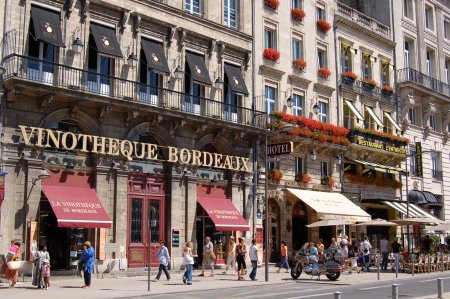 2001 Ch Lagrange, double-decanted and aired further in bottle for a total of 3 hours before sharing it with Kieron at Prive. Clear deep red with only a hint of development at the rim. Quite open with an attractive bouquet of ripe raspberries and blueberries although the initial entry was somewhat thin on fruit, consisting just mainly of its alcoholic structure amidst a dominant note of soy. Gradually, it began fleshing out over time and with food, the flavours of dark berries and dark cherries emerging to the fore. The full potential of this wine was revealed only two hours into the meal, where broad swathes of red fruits, soft and succulent, and other notes of plum and cedar caressed the palate with reasonable depth, supported by firm but supple tannins. Classically structured. Yet to peak. Excellent.
1998 Ch Grand-Puy-Lacoste, double-decanted for 60 minutes before being brought to the excellent L’Entrecote restaurant at Duxton Hill. Deep purplish-red, producing an attractive aroma of raspberries and other dark fruits with a trace of sweetness that followed through on the palate. Unlike a bottle tasted in 2008 that contained too much of green notes, the current one was grippy, rounded and fruit-forward, though without much of a sense of Pauillac, but there was no mistaking the purity of the ripe fruit. Lovely. 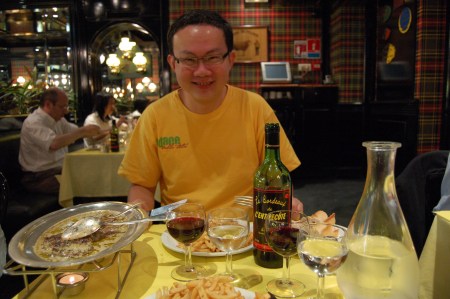 For the uninitiated, L’Entrecote is a chain of restaurants that originated in Paris, with a superb 2-storey outlet in the city centre of Bordeaux itself, that serves only beef steak (done either rare, medium or well-done) paired with thin frites and a generous helping of fresh salad. Half the steak is served to you first (cut in narrow strips), doused in a secret recipe sauce that is simply irresistible, while the other half is replenished onto your plate later, together with additional frites free-of-charge if you desire. I’m pleased to report that the outlet in Singapore, opened some 4 months ago by Laurent Perez, is faithful to the French in every way (apart from the use of the color red, instead of yellow), the steak going for SGD29. Service is smart, attentive and unfussy. And true to the original, just a single type of Bordeaux house red is available, which may be purchased by the glass, carafe (250 ml or 500 ml) or bottle. The wine does its job, but I’d happily pay the SGD30 corkage to bring my own bottle to go with the excellent steak.

