1994 Ch Montrose
 Popped and poured over dinner with the family at Imperial Treasure T3 this evening. Still a deep impenetrable red at the core, lightening up towards the rim. Rather attractive on the nose with a lovely mix of red and dark berries as well as firm minerality (you can really smell that), but the wine was rather thin on the palate initially, devoid of much of the promised fruit, leaving just a structure of drying tannins and alcohol. After 45 minutes, the minerality on the nose grew in intensity, the fruit more forward as well, the wine fleshing out quite beautifully in bold strokes, becoming weightier with greater density and concentration, long-flavoured with notes of soy and rounded at the edges although I must say I didn’t quite get a sense of the St-Estephe terroir. More like a modern St-Emilion. Still, it’s rather fine.
This fastidious grower is quite a household name for flinty Mersault whites, but he has plots of red as well (belonging to his wife’s family, I believe), notably in Corton and Savigny-les-Beaune. 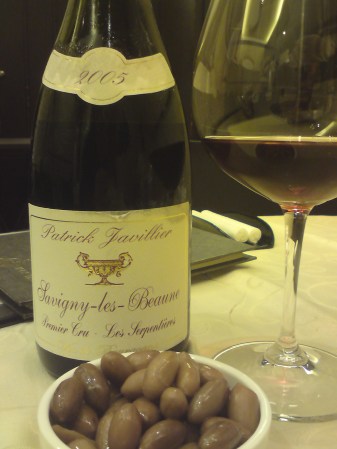 I cracked open one of three bottles of 2005 Domaine Patrick Javillier Savigny-les-Beaune Les Serpentieres 1er Cru, bought about 3 years ago from Le Benaton for only SGD53 each, over dinner with the wifey at Jade Palace last night as I was curious to get an impression of this wine. Popped and poured, showing a classic pinot tint, slightly dull. A generous bouquet of red cherries wafted across that was reinforced on the palate, though initially a tad heavy for pinot noir without any secondary development. Things became interesting an hour later as the wine really opened up to reveal notes of other red fruits and raspberries, fresh and bright, more remarkable for its excellent balance and concentration than outright opulence or depth, with plenty of spine and flavour but rather lean in the mid-body, missing the oily texture of great Burgundy. This is really quite fine and enjoyable, but I’m not touching my remaining two bottles for another 5 years, at least.
Ric’s Most Memorable Wines of 2010
Here goes Ric’s choices, based on the 55 new posts in 2010…
Best Unaffordable Red: 1995 Domaine de la Romanee-Conti Richebourg Grand Cru. Like I said last year, a great burgundy beats everything hands-down. Thanks, Danny.
Best Affordable Red: 1990 Ch Chasse-Spleen (thanks, Hiok). Who would have thought that a Moulis en Medoc can resemble a Haut-Brion? Another deserving winner would be the 1985 Dominus proprietary red…if you can find it. Thanks, PS.
Most Memorable Red: 1998 Ch Ausone and 2003 Pingus, for the wrong reasons: they are the two most expensive bottles that I’ve ever purchased just for the express purpose of drinking; we drank them far too young; they are bloody over-priced.
Best Value Red: 2005 Ch D’Aurilhac, followed closely by the 2005 Ch D’Escurac, both at similar price points of only SGD27, but drinking like classified growths.
Most Disappointing Red: 2001 Beringer Private Reserve cabernet sauvignon. I think Dominus is the best bet for California reds. Period.
Worst Red: 2007 Fontant de France cabernet. Not acceptable to be served on board Singapore Airlines. The 2000 Ch Mouton (not Rothschild!) and the 2005 Domaine Louis Latour Beaune Vignes Franches 1er Cru come close as well in mediocrity.
Best Unaffordable White: None. I don’t have deep pockets, but I don’t think I drank any that I’d consider unaffordable.
Best Affordable White: 2002 Leeuwin Estate Art Series chardonnay (if you can find it…thanks, K), proving that this wine is really a match for the best chardonnays. Close behind is the 2007 Peter Michael Mon Plaisir chardonnay.
Most Memorable White: I’ll opt for a bubbly here, the 1990 Dom Perignon, at the final blowout at Iggy’s, sharing the stage with Ausone and Pingus. Thanks again, Danny boy.
Best Value White: 2007 Dog Point Section 94 sauvignon blanc, that just pipped the 2009 Grosset Polish Hill riesling, both similarly priced at SGD46.
Most Disappointing White: 2007 Heritiers du Comte Lafon Macon-Milly-Lamartine. Worse, it’s over-priced.
Worst White: None, really.
I must thank all friends and contributors who had so unselfishly made available these wines for tasting. Bon vin et merci beaucoup!
Happy 2011 !!
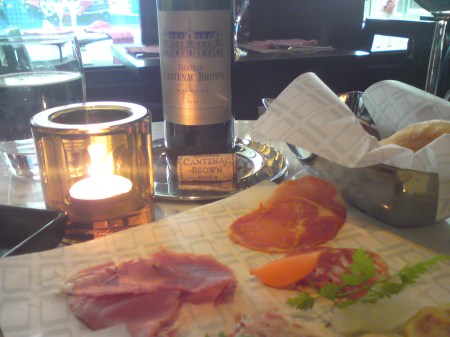 I trust all readers had a good time welcoming in the New Year. I spent New Year’s Eve having dinner at DB (Daniel Boulud) Bistro Moderne at the Marina Bay Sands, Singapore, with a half-bottle of 2004 Ch Cantenac-Brown, SGD95++ from the extensive restaurant list, to go with an excellent sirloin steak. Dark purple. The bouquet is quite gorgeous, generous in its floral fragrance and charm, but one senses some firm minerality as well. On the palate, the wine is feminine in typical Margaux fashion, gentle and rounded with excellent balance, weighty without sacrificing its charm, with secondary flavours of cassis, cinnamon and some complexity from its fruit emerging. Fleshy, though not truly voluptuous. Quite excellent, really. The restaurant’s service, while attentive, lacks polish, but with its attractive upmarket decor, coupled with food that’s very well-prepared at very reasonable prices, I’ll be back at DB Bistro.
Domaine Thibault Liger-Belair
I’d been introduced to this estate through Caveau and Vinum’s annual sale, and the wines I’ve had had acquited themselves very well in terms of both quality and pricing. A 4-course tasting dinner, organised by Bistro du Vin on 29 Nov 2010 for SGD98++ with Monsieur Thibault Liger-Belair the young winemaker himself in attendance, proved to be an irresistible draw and I found myself in the company of like-minded usual suspects. The estate itself has been around for the past 250 years, founded in 1720, and is predominantly sited in Nuits Saint-Georges, with holdings in Gevrey-Chambertin, Vosne-Romanee and Clos Vougeot as well, embracing biodynamic practices from 2005 onwards.
We began with a 2007 Thibault Liger-Belair Hautes Cotes de Nuits “Clos du Prieure” to go along with the selection of canapes. Dull ruby red with a bouquet of dark red fruits and glycerin imparting some sweetness. Rather undifferentiated on palate. Somewhat hollow at the finish, but gained weight with time, fleshing out. The next wine that followed was presented as a mystery wine, but there was something vaguely familiar about the fruit, which tended towards the sweet end, not unlike cordial. Of course, it was the Beaujolais character, the unique taste of gamay which is dominant in this region. 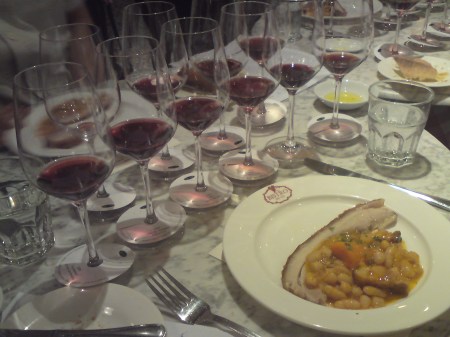 But this wine, being pressed from vines with an average age of 60 years, was significantly darker, deeper and richer in color and flavour, showing good concentration, gaining in intensity over time. Still primal but harmonious, transparent, with a long minty finish. This was the 2009 Thibault Liger-Belair Moulin a Vent VV Grand Cru, aged 8 months in old barrels 2-3 years of age. I found it very agreeable, even though one tends to be put off by the mere mention of gamay.
We moved to Nuits Saint-Georges. The first was a 2007 Thibault Liger-Belair Nuits St-Georges “La Charmotte“, a village, paired with pan-seared foie gras. Classic pinot hue. Subdued on the nose, although it was quite open on the palate, revealing good body and concentration of red fruits with a glycerin coating, becoming more complex over time. The 2007 Thibault Liger-Belair Nuits St-Georges “Les Saint Georges” 1er Cru that followed, from a plot that some regard as being deserving of Grand Cru status, was more complex right off the blocks, showing a lovely clear pinot tint, very open on the nose with loads of red currants, revealing excellent depth, richness and concentration on the palate, supported by forest floor and minerally notes, opening up even further with time. Excellent with the roasted guinea fowl.
The final pair, drunk with pork belly confit, was noticeably a couple of notches higher in quality. The 2007 Thibault Liger-Belair Clos de Vougeot Grand Cru, a huge plot that may often disappoint because of its great variability in quality, held up well. A lovely pinot tint led to an open, voluptuous nose that’s predominantly rose-scented, undoubtedly charming. Layered on the palate and peppered with a bit of spice, a big wine that’s still somewhat unresolved towards the finish. The best was, rightly, left to the end: a 2007 Successeurs Thibault Liger-Belair Corton les Renardes Grand Cru. Deeply complex on the nose. Still tightly coiled and fairly intense on the palate, quite concentrated, ending in a long smoky sexy finish. An intellectual wine, a property that excellent burgundies are fully capable of. The winemaker may be young, but he sure knows his stuff.
For the year-end combined ward dinner on 29 Dec 2010 at Foo House, we thought it would be interesting to compare two syrahs from regions that are, literally, poles apart and outside of Rhone. Both have almost the same number of years of bottle age, and both are 13.5% alcohol by volume.
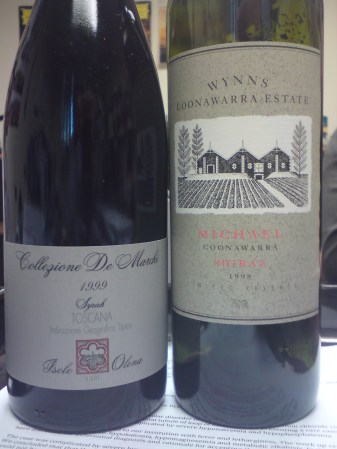 The 1999 Isole e Olena Collezione di Marchi (courtesy of PS), an IGT from Toscana, was aired in bottle for over an hour before being poured. Dark impenetrable red with a rather sweet attractive bouquet that reminded me of cooked bananas (no kidding!), jackfruit and sweetened plums. On the palate, the wine, medium-full, was quite open with predominantly plummy flavours peppered with a bit of spice, noticeably more dense than a true Rhone syrah, supported by a firm bed of graphite-like minerality that translated into finely-grained tannins. But it managed to avoid being heavy-footed, the wine expanding quite evenly on the palate, leading to a linear finish. You could almost drink it on its own. Quite excellent.
In contrast, the 1998 Wynns Michael shiraz, atypically from Coonawarra, was heavier in every way. Having been decanted for more than 2 hours, the wine was noticeably more rounded and softer-toned on the palate, but the hallmarks of an Aussie shiraz are unmistakable: full-bodied, plummy, strong herbal overtones, dense as a result of the very ripe fruit, coating the palate with an abundance of spice and pepper that gave the wine a warm savoury feel. I’m not sure how it’ll develop further in bottle, although it’s my guess that it’s likely to gain even greater concentration and density, not unlike some sort of distilled essence. I still swear by Rockford, but of course, nothing beats a true northern Rhone syrah.
2005 Vincent Girardin Puligny-Montrachet “les Folatieres” & 2000 Moss Wood cabernet sauvignon
2005 Vincent Girardin Puligny-Montrachet “les Folatieres” 1er Cru, over lunch at Prive (courtesy of Kieron). This is a negociant that often provides better value for money. Popped and poured. Almost limey-green in color. Served too cold initially without adequate aeration, where there was a predominance of limey citrus, quite lively, supported by fairly dense minerality. 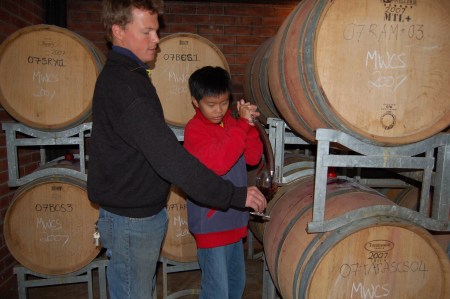 It truly opened up only an hour later, with much deeper notes of nectar and honey emerging to displace the citrus notes, the minerality becoming better defined with a buttery feel without any oakiness. Excellent.
2000 Moss Wood cabernet sauvignon, over lunch at Prive. Good thing I had double-decanted it for 2 hours prior, for the benefits were readily apparent. Still rather dark red. Open on the nose with predominant red fruits, cinnamon, and a bit of leather, a tad heavy. On the palate, it proved to be much more accessible than a bottle tasted a year ago. Medium-full, fairly soft and rounded, showing excellent depth and concentration, still remarkably fresh and fleshy without any tannic attack nor any trace of its 14.5% alcohol. Drinking very well without any tell-tale signs of the New World, but it just doesn’t have that uniqueness of terroir. My last bottle.
Notes in brief (December 2010): 2002 Eileen Hardy, 2007 Peter Michael Mon Plaisir…
Billecart-Salmon Brut Rose NV, over dinner with Prof & Mrs Bill Young at the restaurant Bunga Emas at the Royale Chulan Hotel, Kuala Lumpur, 3 Dec 2010. Popped and poured. A heavier tint of pink with a deep bouquet of toasty oak, roasted almonds, nuts, yeast and malt. Nicely rounded, tapering off to a smooth finish with just the right degree of dryness. Much better than a previous bottle couple of months back.
2007 Peter Michael Mon Plaisir chardonnay, over dinner with Prof & Mrs Bill Young at the restaurant Bunga Emas at the Royale Chulan Hotel, Kuala Lumpur, 3 Dec 2010. Aired in bottle for an hour. Muted on the nose, but it is absolutely glorious on the palate – lovely notes of white flowers and other worldly fragrance of great density perfectly balanced against the delicate citrus and rich minerality, almost creamy in texture, with a finish that just lasts and lasts. Highly sophisticated, superbly crafted. Unlike other New World chardonnays that often try too hard, this has a totally effortless feel about it. Wonderful.
2002 Eileen Hardy shiraz, over dinner with Prof & Mrs Bill Young at the restaurant Bunga Emas at the Royale Chulan Hotel, Kuala Lumpur, 3 Dec 2010. I remembered buying this from duty-free at Adelaide airport in 2008. Deep garnet red with a dense core of very rich shiraz, perfectly ripe from a cool vintage, layered with licorice, plum, forest floor and a mild medicinal tinge, yet cushioned like a velvet glove on the palate, rounded at the edges, proving to be highly accessible. Surprisingly sophisticated without any of the rusticity of McLaren Vale. Excellent stuff.
2007 Alasia, at the Krisflyer Gold Lounge at Changi Terminal 3. This Piedmonte chardonnay displayed a lovely light golden color with a generous nose of chalky minerality infused with vanilla and butter, matched on the palate by an excellent body with a creamy texture. Just somewhat uneven towards the finish, a slight blemish on an otherwise very decent showing.
2006 Lucemonaca Montefiori Rosso, at the Krisflyer Gold Lounge at Changi Terminal 3. Dark ruby, exhibiting notes of damp forest floor, bush and bramble, the 14.5% alcohol distinctly evident. But it evened out after some time, gripping the palate with fairly homogenous intensity. Not bad.
2005 Ch L’Arrivet Haut-Brion, over lunch at Imperial Treasure T3. Popped and poured. Deep red with a bright purplish rim. Very promising initially, with an abundance of cool ripe berries and a hint of sweetness on the nose. But it is still backward with plenty of earthy and metallic notes on the palate, lending a stern demeanour that’s not helped by the unresolved tannins that led to a sharp finish. This needs plenty of time to sort itself out.
2001 Ch D’Escurac, at the office X’mas Eve party. Aired in bottle for 3 hours prior. Dark red. Quite promising on the nose with a rich smooth bouquet of luscious ripe berries and cinnamon, revealing good density and concentration on the palate with very little of the green note or toughness commonly encountered in Medoc cru bourgeois. But it’s still rather stern. Could do with more charm. Perhaps time will help, but it’s certainly a very good effort for SGD38.
2007 Moss Wood chardonnay, at dinner on Christmas Day. Popped and poured from the Stelvin closure. Immediately offers highly enticing notes of creamy smooth vanilla, butter, green apples, limey citrus and stony minerality on the nose and palate. Full-bodied and lively, but not overdone. Very close resemblance to a Leeuwin, just a tad less complex. Excellent, nevertheless.
2005 Ch D’Escurac, over dinner at Imperial Treasure Takashimaya on Boxing Day. I’ve been drinking through half a case of this since May this year, bought very cheaply from Caveau’s mid-year sale. Popped and poured. Dark red with a purplish rim. A powerful nose suggesting ripe dark berries and even a hint of raspberries, brimming with intensity. But on this occasion, it is less attractive on the palate, with a predominance of metallic minerality causing the fruit to be more recessed. Rather austere, finishing with sharp tannins. Still a damn good buy at SGD28. I wouldn’t be surprised if it turns round the corner after a few years, for the better.
2001 Ch Sociando Mallet, at the Dept year-end dinner on 28 Dec 2010. Decanted for 2 hours prior. Dark red. Quite open on the nose with notes of perfectly ripe dark berries, kirsch, game, and a good dose of fine minerality imparting a mild, austere graphite note. Beginning to show some early layering on the palate, the ripe fruit caressing the palate with a trace of sweetness. Still a long way from its peak. Very fine indeed. I suggest you mop up any bottle that costs less than SGD100, and refrain from opening until 2020.
RWJ 10,000
Achieving 10,000 hits for RWJ (6 months after hitting the first 5,000) seemed like a really good opportunity to crack a few top drops. A dinner worthy of the occasion was arranged on 23 November 2010 with the usual suspects at Garibaldi, where the maitre’d Paolo, as well as Gilbert (all formerly of Iggy’s), were on hand to take care of the evening’s proceedings. I’d let loose that I’d be bringing a 100-pointer…now hang on…RWJ doesn’t score wines (it’s all in the tasting notes, man), so what are we talking about here?! But everyone got the idea, and the entire line-up (save for the champagne) was double-blinded. Hiok and I had double-decanted our wines, while the remainder were decanted there and then. We drank them in the order described, after which each of us had to declare specifically what we thought we’d drunk.
Kieron got us started with a 2000 Pierre Peters Brut Cuvee Speciale “Les Chetillons”, probably at its best this particular evening since Boon (Wein & Vin) first introduced it to us back in July. Liquid gold. Highly complex on the nose with lifted notes of vanilla, promising deep nutty flavours that broadened on the palate with plenty of sparkling minerality, roast, toast and smoke. Very lively and rounded. Lots of similarities with Krug, a tad less dense, but there’s no lack of complexity, the wine continuing to evolve all the way through dinner. Astonishing results for a vintage that’s not particularly exceptional. Perhaps 2000 has been underrated for champagne?  Whatever it is, this wine has yet to peak, and I’m not opening my 5 remaining bottles anywhere in the near future. A superb start.
Now what about the solitary white , courtesy of David? Brilliant luminous gold. One appreciates the sophisticated density and great concentration, layered with a buttery, creamy texture supported by firm minerality without being metallic. Very lifted, with a distinctive oiliness in the middle lined by some vanilla, displaying superb focus and linearity matched by amazing depth and great persistence. A wonderful experience. This is a white Burgundy of impeccable pedigree. I was reminded of a Corton-Charlemagne. I ventured aloud: Bonneau du Martray? Close. A 2005 Domaine Faiveley Corton-Charlemagne Grand Cru. Very, very lovely.
One look at the 5 blinded bottles of red and we knew from the bottle contours that they’re all Bordeaux, or some sort of Bordeaux blend. The first red (courtesy of PS), bright crimson, was immediately reminiscent of a Ch Leoville Las-Cases on the nose (called out by Kieron, and I tend to agree). There’s plenty of that signature old leather, cassis, slight ferrous minerality and austere mustiness to the fore, peppered with a bit of spice. Rounded, obviously mature with well-integrated tannins, its excellent structure still intact. But later, after having tasted the entire line-up, I thought this was likely to be St-Julien, although probably not a Las-Cases because by then it had developed some sweetness at the edges. A 1982 Ch Ducru Beaucaillou?
The second red (courtesy of Hiok), obviously another mature red judging by its evolved crimson, possessed a slightly herbal, medicinal quality covered with sweet overtones that leapt from the glass. There was quite a distinctive barnyard note on the nose coupled with a hint of rusticity, consistent with the gravelly texture and a steeliness that imparted a sense of toughness on the mid-palate, replete with sexy tannins within a large frame, though somewhat short at the finish where the medicinal tinge again reared its head, the wine threatening to dry out after 2 hours in the glass. Ch La Mission Haut-Brion, 1986?
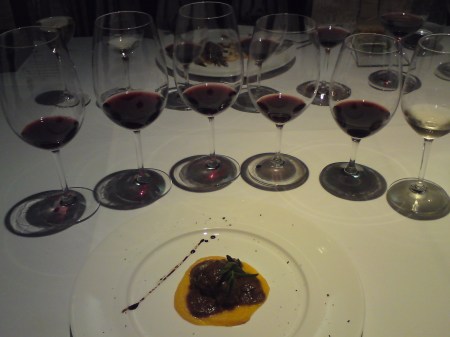 The next red (courtesy of Victor) was immediately different from the above two. Deep inky red. Highly homogenous on the nose with an abundance of Burgundian aromas full of sweet roses in full bloom. Big on the palate with full-blown but ultra-smooth tannins, gravelly in texture and slightly austere at the finish. Not as layered, but it’s beautifully focused. Hmmm…St-Estephe? Ch Montrose?
The fourth red (courtesy of Kieron) was also remarkably similar to the preceding one – deep ruby red with a tightly-knit nose suggesting lots of gravel and heated stones. Medium-full, smooth and seamless and beautifully integrated with a greater degree of depth that wasn’t quite there in the previous wine. This is almost as if we’re drinking some distilled essence, with a bit of biting tannins at the finish. Superb, but what is it? I couldn’t quite put my finger on it.
When the final red was poured, murmurs of “Lafite” went round the table, uttered with confidence. Immeasurably complex with characters of undergrowth and liquer on the nose, glycerin and graphite on the palate, concentrated yet imbued with layers of subtle nuances that arose from its depths. It gradually opened up over time to reveal highly structured, tightly-knit velvety tannins. Just lasts and lasts. Powerful, yet backward with a certain degree of aloofness that’s completely in keeping with the character of this great estate. No, I knew it cannot be Lafite. Everything about this wine spells Delon. It must be the 1986 Ch Leoville Las-Cases I’d brought, a wine that’s already 24 years of age, but still far from its peak.
So what exactly did we drink?
Red #1: 1982 Ch Grand-Puy-Lacoste
Red #2: 1982 Ch Pontet-Canet
Red #3: 2000 Gaja Sperss
Red #4: 1997 Gaja Sperss
Red #5: 1986 Ch Leoville Las-Cases

Well, at least I guessed my baby correctly. It is fascinating how well the 1982s are still performing after all these years, and how the GPL punches way above its weight even from those days when techniques in the vineyard and the cellar were nowhere near today’s standards. That showed just how fabulous 1982 was. It was also fantastic having 2 vintages of Gaja Sperss side-by-side, the vintage of 1997 underlining ts superiority. And finally the 1986 Leoville Las-Cases, which has evolved into a more open wine since the last time I had it some 5 years ago (courtesy of Hiok), when it was still very backward, dark and brooding. It’s simply amazing how the complexities of this wine easily matches that of a First Growth. As far as I’m concerned, Las-Cases is a Premiere Cru through and through. And that concludes a most enjoyable and memorable dinner that, really, would not have taken place without the continued support of everyone who regularly logs onto RWJ.
1990 Ch Lagrange
Ch Lagrange appears to suffer from an image problem. In spite of its consistent quality, befitting its status as a Third Growth in St-Julien, connoisseurs tend to pooh-pooh this estate. Perhaps part of the problem lies in it being successful only from the late 80s onward. Prior to being bought over by Suntory in 1983, its wines were mediocre, missing out on 1982, the key vintage upon which many estates forged their reputation, and wine snobs do not forget easily. 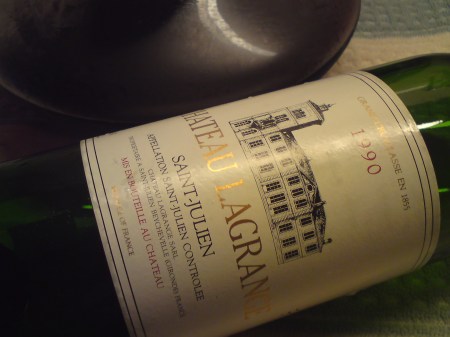 Another reason, perhaps, is because it is priced too keenly in relation to quality? Somehow, there is a certain irrational mentality that only expensive wines are good, which would mean Lagrange doesn’t qualify.
But for those who recognise a top drop, Lagrange is seriously good, almost great occasionally. One such example is the 1990 which I had this evening, 21 Dec 2010, over an excellent fillet mignon at Prive, Keppel Marina, with the wifey and son. Double-decanted for over an hour, the wine, dull red in color, contained a certain mustiness on the nose amidst other notes of old leather, dried leaves and cassis. This blew off after 20 minutes to reveal flavours of blueberries and other darker fruits that tasted remarkably fresh and full. Following a gentle entry, the palate is held in a firm grip by a wine that became increasing full-bodied, seamlessly homogenous, revealing excellent depth and concentration of fruit with complex tertiary flavours capable only from mature claret, framed by mouth-puckering tannins that grew in intensity over time, imparting an accentuated glowing finish. In fact, if tasted blind, I’d have thought this was a Pauillac, for it reminded me very much of a 1988 Ch Pichon Lalande, albeit with greater masculinity. Very lovely.

