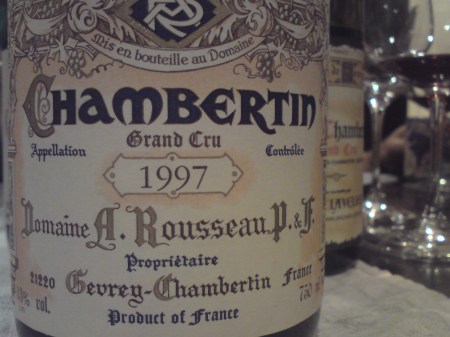
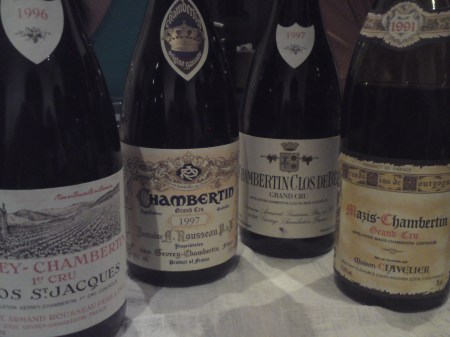
 It certainly pays to have friends who are really generous, for I found myself staring at a top flight of Domaine Armand Rousseau Pere et Fils when I responded to See Lim’s idle SMS to show up at his place for a casual meet-up after dinner on 24 July 2010. All wines were aired in bottle for three hours prior, and so with the drama of Verdi’s La Traviata wafting in the background (Sutherland and Pavarotti) through a pair of Sonus Faber Amati, we went straight into the tasting. But first, we began with a 1991 Maison Clavelier Mazis-Chambertin, showing a mature rosy pinot hue and notes of cherries, red berries and sancha with understated fragrance, quite lovely. However, this turned out to be a wine that promises more on the nose than on the palate, where the concentration of the fruit, although seamless with excellent purity, didn’t quite live up to expectations of a Grand Cru from Chambertin, backward and lacking in the middle layers with a short finish. It only improved marginally over the next two hours, and certainly couldn’t match up to the next three wines.
I moved on to the 1996 Armand Rousseau Gevrey-Chambertin 1er Cru Clos St-Jacques, which had a pale mature pinot hue with an orangey tint, noticeably deeper on the nose with notes of red dates, raspberries and sweet citrus. Medium-bodied, soft, quite lush, displaying great focus and excellent concentration on the mid-palate. It developed into a truly gorgeous wine over the next couple of hours, gaining in power, complexity and layering that was clearly missing from the Maison Clavelier, highly complex in its finish. How would the Clos St Jacques, often regarded as befitting of Grand Cru status, compare against the 1997 Armand Rousseau Chambertin Clos de Beze, a wine that’s supposedly only second to Le Chambertin in the pecking order? The Clos de Beze was significantly deeper in color, more opague and more complex on the nose with a mixture of red and dark berries, evidently of superb quality, and that classic salty note representing the minerality of the the terroir. Medium-full, yielding excellent richness and intensity culminating in a slightly sharper attack on the mid-palate, superbly seamless, eventually developing even greater power with a note of menthol in its lingering finish. This is still a remarkably youthful wine that defies the problems of 1997. But, in a head-to-head comparison, the Clos St-Jacques held the edge by the end of the evening, indicating that vintage is a more important consideration than vineyard location, even between rival Grand Cru terroirs.
Finally, with great reverence, we poured the 1997 Armand Rousseau Chambertin. Outstanding right from the start, a beautiful pure transparent pinot glow, highly complex on the rose-scented nose, featuring rich mature red fruits, sherbet and vanilla, perfectly integrated. Soft on the entry with velvety textures gently caressing the palate, revealing very good concentration of fruit, perfectly seamless and sharply delineated from start to finish, gaining power with time, developing a sacharine-rich coating, ending on a slightly spicy note. Certainly the problematic vintage did manifest itself, the wine not as opulent nor intense as the 2003 example that I’ve had (see “Dec 2009: Perfect dinner at Iggy’s”), missing the layering and depth that an Armand Rousseau easily commands. Nevertheless, it is still a thing of beauty and soul, the effortless finesse, elegance and subtle power all hallmarks of Armand Rousseau, the wonderful craftsmenship of this great producer without resorting to vulgar means appreciated even more in this difficult vintage.
We closed the evening with a rarity, a 1991 Clos Jebsal Turkheim Tokay pinot gris. Very deep rose gold with very pure flavours of apricot and honey. Extremely rich, revealing great viscosity and weight on the mid-palate amidst lowish acidity, with understated sweetness that served to enhance the integrity of the wine, making up for the relative lack of complexity. Quite the perfect way to end a very lovely evening, and I shall, again, remain indebted to my generous host.
1998 Penfolds Bin 28 Kalimna shiraz, over lunch at Imperial Treasure T3. I remembered splitting a case with KP for only SGD40 per bottle, purchased from Auric Pacific Fine Wines some years back. Very deep dark red. Strong hint of ripe, exotic Barossa shiraz on the nose, delivering a full-bodied knockout (almost, in spite of its 12 years) on the palate, with notes of plum, licorice, dark currants and raisins, supported by lively acidity and alcohol and a prominent herbaceous medicinal lift. Still has plenty of youthful exuberance. The balance is there, but the parts are only just beginning to gel together. I’d say this has legs to last another 10-15 years, but alas, that was my last bottle.
1996 Clos du Marquis, over lunch at Prive with Kieron. Bright evolved red with notes of cedar, pencil-box, mature dark berries imbued with sur-maturite and minerality. Medium-bodied, soft, very well integrated and harmonious, the wine shedding some of the backwardness this vintage is known for. Quite excellent, but that was my last bottle.
1995 Ch Lagrange, an impromptu choice at an impromptu dinner at Asia Grand with the wifey. Bought for only SGD75 from Ben Foods some years back. Popped and poured. Dull red, a nose predominantly of some metallic minerality (the so-called “graphite” note of St-Julien), coupled with a mild bottle stink which blew off after a few minutes. It morphed very quickly into a low acidity, harmonious wine, easy on the palate with just enough fruit to avoid any sense of hollowness. I doubt it will improve much further and I was happy to drink up my last bottle of this.
2006 Felton Road Central Otago pinot noir (courtesy of Kieron), at Asia Grand. Deep pinot hue. Very open on the nose right from the outset – sweet red cherries, full of perfumed fragrance, violets and ripe red fruits that carried well onto the palate. Full-bodied, displaying excellent concentration and focus at just the right level of extraction, with glorious rich fruit running deep.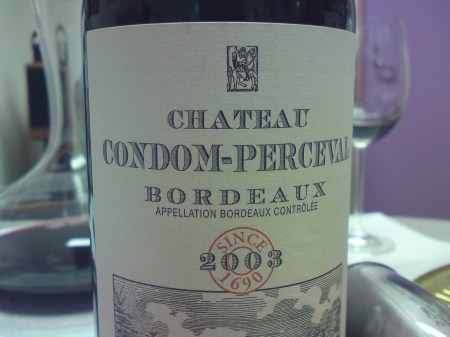 The only thing missing is the sense of place – terroir – otherwise this wine checks all the boxes correctly.
2003 Ch Condom-Perceval (courtesy of Hiok) at an after-hours drinks session. A Bordeaux table wine. How is a wine with this sort of name supposed to taste? Dusty dull red. The fruit is there but it doesn’t taste right – upfront, plummy, notes of orange peel with a sour aftertaste, clumsy, the fruit, acid and alcohol all over the place, restless, ending abruptly with absolutely no sense of place. No better than a supermarket wine. We poured it away. Damn cock.
1996 Ch Cantermerle (courtesy of PS), drunk with the Condom above. Coming after that, the Cantermerle (decanted for 3 hours) seemed like a breath of fresh air, even though this wine isn’t great, by any stretch of imagination. An evolving red, the mature cabernet producing some secondary notes of cedar, grapefruit and cinnamon, but there is already a fair bit of dryness creeping in around the edges, the fruit still remaining quite backward, as expected of this vintage, the oak still making its presence felt.
2006 Dog Point Section 94 sauvignon blanc, over some fabulous mussels and signature beehoon crab at Ming Kee Live Seafood. Upfront with loads of zesty citrus, jackfruit, tropical fruits and a hint of nectar. Medium-full on the palate with flinty minerality, the keen acidity ensuring plenty of vibrancy and freshness. But like all New World wines, it can wear your palate down quite quickly, and the lack of a signature terroir robs the wine of potential greatness.
2003 Ch D’Aigulhe, a half-bottle at Jade Palace. Deep crimson. Dense, evidently with a high level of extraction, producing very deep notes of dark berries, soy and plum, structured with silky smooth tannins, the vanilla from the new oak still quite discernible. Very well-crafted, bordering on the New World in style, if not for the homogeneity and minerality in equal measure to the fruit that is only possible from the Old World.
2003 Wente Riva Ranch chardonnay (courtesy of PS) over dinner at Starz Restaurant, Hard Rock Hotel, Sentosa. Pale yellow, very pleasing with fragrant citrus and melons, imbued with good levels of minerality, medium-bodied, easy on the palate. Nothing very cerebral, of course, but it served its function well.
2004 Ch Corbin, poured from a magnum that was bought at the mid-year Caveau sale, over dinner at Starz Restaurant, Hard Rock Hotel, Sentosa. Dense red with an opague core. Quite open on the nose, with minerals, soy and some plum that expanded with further aeration, revealing excellent fruit quality, medium-full, well-balanced with relatively tame tannins. A grossly under-rated wine. An excellent buy at only SGD65.
1994 Ch Cos D’Estournel (courtesy of TEK), popped and poured over dinner at Starz Restaurant, Hard Rock Hotel, Sentosa, drunk alongside the 2004 Corbin (above). An evolving red revealing flavours of plum, casis and cinnamon with a lovely aromatic lift, supported by excellent fruit without any sign of drying out. Remarkably well-integrated, structured and soft, without any harshness shown bysome wines from this particular vintage. Perhaps the depth and complexity isn’t quite there, but I much prefer this style of Cos than the present-day highly-extracted “international” style. Very good.
Old & New World: bubbly, chardonnay & pinot noir
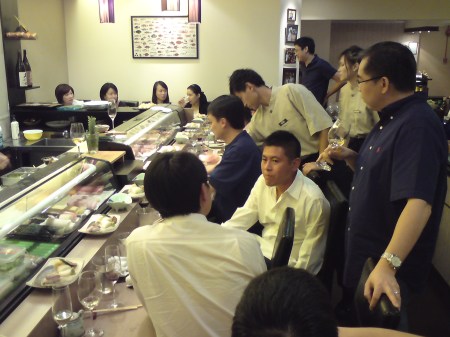
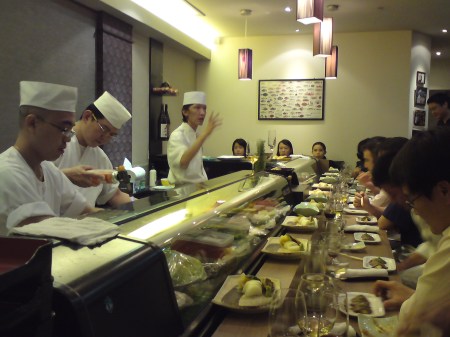 Kome was, yet again, the venue for another vinous dinner on 25 June 2010, when I chose to give up watching the Brazil-Portugal World Cup match (thankfully it ended goalless) in favour of joining Kieron and friends, where we occupied the entire counter. A theme of bubbly / champagne / pinot noir had been specified, and we ended up with the following.
Pierre Peters Cuvee de Reserve Blanc de Blancs Brut (courtesy of Boon). Straw colored with plenty of floral lift, citrus, biscuits, walnuts and toast. Crisp and well-balanced, displaying excellent depth and body without being too dry. Superb, really. Tastes like a much more expensive wine than it really is.
2007 Planeta chardonnay IGT Sicilia (courtesy of PS). Very dense yellow, almost golden. Not much on the nose initially, the wine being served too cold, revealing just a hint of red apples, pure and refreshing with hardly any oak. It opened up later at the correct temperature to reveal honeyed citrus, toast and apricot. Deep, creamy and buttery with wonderful intensity and background minerality. Kept getting better and better with each sip. Trust the Italians…if there is such a thing as a “designer” wine, this comes close. Very lovely.
2004 Leeuwin Estate Art Series chardonnay (courtesy of Damian). This is probably the third or fourth occasion I’ve had this, but each experience is stunning. Pale straw colored. Overwhelming bouquet of delicate lifted citrus, honeydew and rock melons, almost over-the-top. Quite deep but still primal, saturated with great chalky minerality, a wine of great focus and presence. Typically Australian in its brazenness, leaving nothing to the imagination, but no one’s complainng.
 Rockford Black shiraz (2005 disgorgement). A perenial favourite, even amongst guys, not to mention the ladies. Deep ruby glow. Crisp, reflecting the great acidity, with deep notes of blueberries, red and dark fruits, and the hallmark liquer in the mid-body. Expands on the palate, becoming more open with time, developing some sweetness (but never threatening) and notes of raisins and redcurrants within the shiraz complex, showing great balance, delineation and focus, finishing with a persistent menthol note, finally becoming the distilled essence of Basket Press shiraz when the fizz had dissipated. This is probably one of the very best experiences I’ve had with the Black Shiraz. Only one more bottle remaining of the 2005.
We ended the evening with a pair of New World pinot noir. The 2007 Craggy Range Bannockburn Central Otago pinot noir (courtesy of Michelle) had a classic pinot tint, rather fruit-forward, displaying an abundnce of red fruits with a tinge of sweetness and a note of eucalyptus after some time, tapering to a stern finish. Quite a big wine, well-crafted, even with a semblance of delicacy and lightness of touch, but it still lacks real complexity. In comparison, the 2006 Littorai The Haven Vineyard (courtesy of Kieron), showing a slightly deeper color than the Craggy Range, was more “correct” in the pinot mould, displaying greater minerality and depth, aided by riper fruit and higher acidity. Structured and well-balanced, the background oakiness betraying its New World origin.
Sparkling reds, 1990 Bordeaux & more…
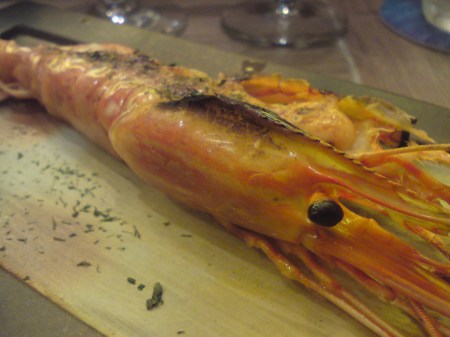
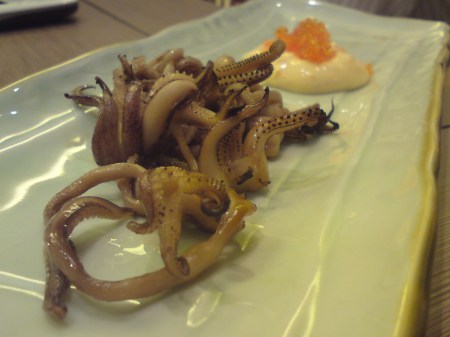
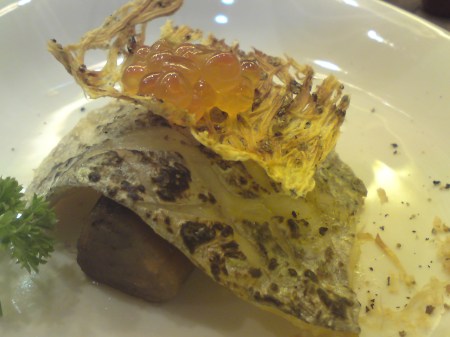 Twice a year, I readily play my role as a honorary cardiologist, especially since it involves only eating and drinking. And so when I was called upon at short notice on 15 July 2010, I happily made my way to Kome, where an unusual mix of wines awaited. We started with a couple of German rieslings, specially handed-over (literally) to the cardio boys from Sea Hing, their man in Deutschland, who has been making the rounds of various vineyards in the Mosel region since his arrival two months before. Both the 2008 Muller-Thurgan Qualitatswein halbtrocken and the 2009 Bastian Spatlese Feinherb exhibited pale colors with scents of lemongrass, the latter showing more floral fragrance with more stuffing but, ultimately, both suffered from a lack of complexity, coming across as rather plain and straightforward.
 The 2003 E & E Sparkling shiraz (courtesy of Hiok), a dark venous red with a lighter rim, showed great typicity of Barossa shiraz, plenty of ripe fruit with notes of blackcurrants, dark berries, licorice and herbs, rounded at the edges without too much fizz, with very good levels of fruit concentration on the mid-palate. It’s essentially a E & E Black Pepper shiraz with added fizz. As the bubbles died out, the wine took on more complexity with some sweetness emerging. Compared to this, the Rockford Black Shiraz (2003 disgorgement, courtesy of Yew Seong), also showing a similar color, was broader with more transparent textures, a case where the bubbles enhance the expanse on the palate rather than distract attention. The complexity normally associated with this highly-sought after wine wasn’t forthcoming initially, but by the third pour when it’d hit the right level of temperature and aeration, it suddenly fleshed out with intense complexity, the liquered layering that’s the hallmark of the Black Shiraz finally making its appearance, the sweetness subdued throughout, leading to a sophisticated finish not found in the E & E. Quite superb.
 Thrown into the fray was a 2006 De Loach pinot noir from Sonoma Coast, displaying a pure pinot tint with a lovely bouquet of rose-scented red fruits, medium-full, broad with very good levels of fruit concentration, suitably intense and rich on the mid-palate, tapering to a gentle finish, developing a sacharine coat after some time. Excellent, just lacking in the minerality of Old World burgundy that’s critical to the expression of terroir. The 2004 Bottega Brunello di Montalcino that followed (courtesy of Jeremy) was bright cherry red with a restrained nose; I could just barely make out some sweet vanilla and preserved fruit. On the palate, the sangiovese fruit was not as intense nor plummy as I’d imagine a young Brunello to be, possessing instead a lovely softness and elegance, showing excellent delineation, leading to a sweet persistent finish. Excellent.
The final three reds were drunk in unison, all having been double-decanted between 1-2 hours before being brought to the restaurant, where it was aired further in bottle. The benefits of double-decanting were readily apparent. The 2004 Ch Pichon Baron Longueville, deep violet, displayed all the attributes of a classic claret – a soft entry gently caressing the palate with ripe black and blueberries, quite plush, open and elegant, although a little short on the finish, but more importantly, the terroir of Pauillac shone through easily. It reminded me very much of the 2004 Grand Puy Lacoste, the Baron being just a tad more masculine (rightly so) with greater fruit concentration without being assertive. On the other hand, the 1990 Ch Pichon Baron Longueville (courtesy of Jeremy), still retaining a deep violet core with a vermillion glow, was fully developed, exuding its classic Pauillac signature of smoke, tobacco, cigar box and dried herbs with much aplomb, the wine considerably mellow but showing superb definition and focus from entry to finish, displaying great purity of fruit and expression of terroir, its masculinity undiminished, its cerebral qualities enhanced, by time. Outstanding!
And the “mystery” wine (courtesy of Hiok), tasted blind? A mature brick-red but still retaining a deeper core, mellow, soft, very harmonious, yet layers of superb quality fruit still emerges from the depths without any sign of dryness. Definitely an aged Bordeaux with all that cassis, leather and earth (from the 1980s perhap?), particularly the hint of clayey minerality that suggested a northerly terroir…St-Estephe? Highly similar in quality to the 1990 Pichon Baron, oozing with class and sophistication. It reminded me very much of a 1985 Cos D’Estournel as well as a 1988 Pichon Lalande. I was dumbstruck when it was revealed…a 1990 Chasse-Spleen from Moulis!! Well, well…it just shows that quality wines are to be found if you know where to look. At only a third of the price of the 1990 Pichon Baron, I’d buy up all remaining stock!!
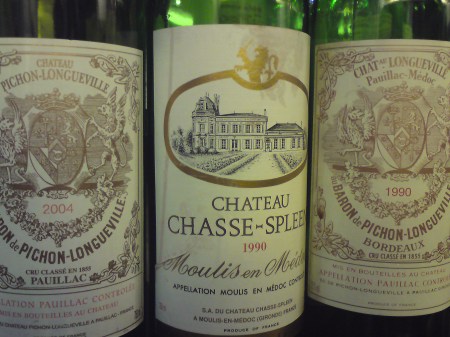
1994 Ch Pontet-Canet
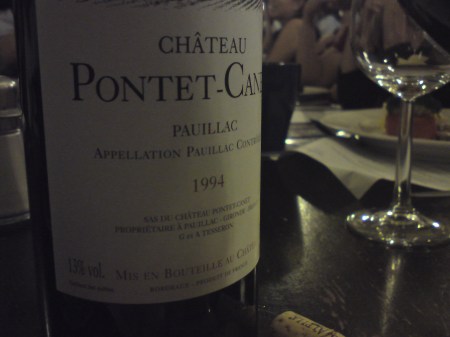 Double decanted for an hour and shared purely between myself and PS at Foo House this evening over an excellent steak, as well as a glass with chef Robert Foo for the outstanding dinner. The 1994 Ch Pontet-Canet was a dull “dirty-looking” purple, but the nose was immediately recognisable as Pauillac, the cedar, ash, tobacco and dried leaves were quite unmistakable. Medium-bodied on the palate with a much gentler entry than a bottle tasted at See Lim’s some 3 years back (where it was dense and monolithic), revealing excellent fruit concentration marked by fairly intense supple tannins, already developing deep secondary flavours of cassis, cinnamon and old leather against a background of plums and dark berries. This is probably the best of several of this same wine that I’ve had over the years. Drinking really well now. Excellent. My last bottle.
KP had a surprise for us when we popped over to his place for mahjong: a 1986 Les Tourelles de Longueville (second wine of Ch Pichon Baron)! I’ve never had a second wine that’s aged more than 20 years and this was really something quite unique, although it was a bit of a disappointment. Dull “tarnished” purplish red with quite a significant cork taint on the nose. On the palate, the wine was soft with less intensity than expected, the fruit beginning to dry out, resulting in some degree of hollowness as well as herbaceous qualty on the mid-palate, although its Pauillac character of ash, cigar box, dried leaves and cinnamon was still discernible. 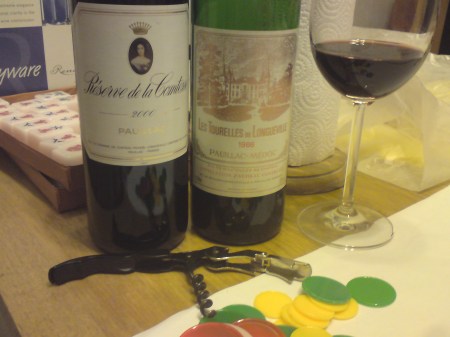 Not terribly impressive, I’m afraid, its deficiencies laid bare by the 2000 Reserve de la Comtesse (second wine of Ch Pichon Lalande, literally just across the D2 highway from Ch Pichon Baron) that followed. Some have scoffed at this second wine, saying that it fails to resemble its grand vin, and I certainly remembered having had a few bottles of the 2000 vntage a few years before, where it was dry and austere. However, tonight’s tasting suggests that this wine has somehow turned the corner, for a rich bouquet of sweet dark fruits and vanilla literally leapt out from the deep inky red, weighty with rich layers of dark fruits and blackcurrants engulfing the palate, revealing excellent concentration and supple tannins, ending in a savoury finish. Yet to develop secondary characteristics, although notes of cinnamon and a velvety texture began emerging with time. Excellent. Pity I’ve long finished all of mine.
Sick of the repetitive old jokes, ill-mannered humor, the growing danger of being fossilised amongst dinosaurs and, worst of all, having to put up with self-important fatasses who don’t play the wine theme fairly, a breakaway faction decided to burn the bridges and wine and dine amongst ourselves instead. So, after a significant interval, we met again at Jade Palace on 22 June 2010 to enjoy some good food, great company and great wines. It also turned out to be Hiok’s 46th, and a First Growth had been promised.
We started with an oddity, the 1994 Ch Gruaud Larose (courtesy of KP), showing a rusty evolving red, rather soft, quite intense and plummy, still harboring a significant degree of minerality leading to a stern finish. Fairly complex, but devoid of opulence and aromatics and, ultimately, lacking in real distinction.
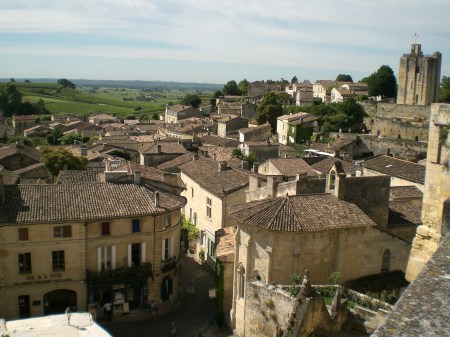 A pair of 1995s took us straight to more serious business. The 1995 Ch Troplong Mondot (courtesy of Chris), dark red with a lighter rim, displayed lovely perfumed aromatics of predominantly red fruits. Soft on the palate, revealing great concentration and intensity betraying its higher extraction, veering towards a rather stern finish. It fleshed out later in the glass, but this is still a rather youthful wine, barely developing secondary characteristics. An atypical ’95 and a very modern St-Emilion, but excellent.
The 1995 Ch Clerc Milon (courtesy of PS), deep red with an evolving rim, was lighter in texture than the Troplong Mondot. Typically Pauillac in character with plenty of smoke, cigar, ash, and secondary aromatics, soft on the palate, yet grippy, displaying excellent depth and transparency, coming across as being very “correct”. The cabernet of Clerc-Milon typically takes ages to mature, but this one has clearly mellowed, fleshing out further n the glass, becoming quite lush with time. Excellent, just lacking in ultimate opulence.
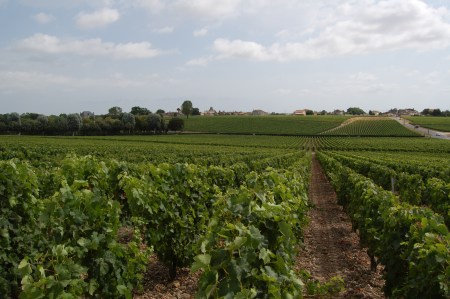 The next pairing amply demonstrates the great impact of terroir on Bordeaux wines and how much the differences may turn out to be even between adjacent communes on the Left Bank within the same vintage. The 1996 Ch Grand-Puy-Lacoste (courtesy of Vic), deep garnet red with vermillion rim, has greater density and concentration than the ’95 Clerc-Milon, yet supple. Rather restrained on the nose, but the suggestion of Pauillac is unmistakable, being more open and layered on mid-palate with ripeness of fruit that eluded the 1995s. A wine of great potential, barely entering its secondary development, beautifully balanced and elegant. This bottle seemed tighter than a bottle tasted in mid-2008 (at a most memorable lunch at Les Amis with Gary Boom, director of Bordeaux Index) as well as another in the presence of the chateau owner Xavier Borie at Iggy’s in Dec 2008, while a third bottle at the last year’s SMA Dinner was also showing beautifully. Perhaps it hadn’t been aired sufficiently. No matter. I think it’s simply wasteful to open any more of this wine. Better to save it till 2026. In contrast, the 1996 Ch Calon Segur (courtesy of Li Wei) was soft and noticeably warmer in tone, with lifted aromas and great purity of fruit and expression of its northerly terroir, reflecting the minerality of the clay soils. More mature than most other Left Bank ’96s, rounded, seamless and absolutely harmonious, consistent with my first experience last year (see Aug 2009).
The final flight consisted of two classic examples of Pessac-Leognan. The 1989 Domaine de Chevalier rouge, one of only two wines to be decanted, displayed a beautifully evolved red with an open on the nose. Not exuberant, but there’s a very controlled expression of fruit and terroir, the suggestion of gravel and earth coming through with fine intensity. Quite lush, with great transparency and depth, persistent on the finish. The nose faded somewhat with time, but the wonderful balance remained without calling attention to itself. Lovely. Truly a connoiseur’s red. 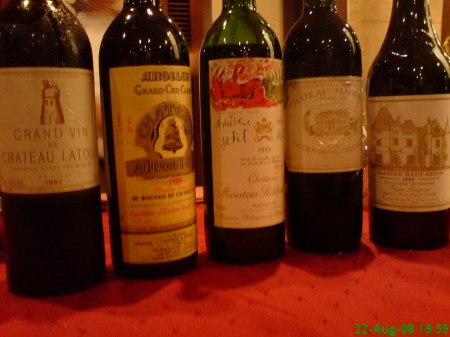 Drunk alongside, the 1994 Ch Haut Brion (courtesy of the birthday boy), a darker dusty red, was more expansive than the Domaine de Chevalier with a fruity plummy core, still quite intense on the nose. Medium full, very even and broad on the palate, absolutely harmonious and seamless, deeply layered. Lacking in opulence of the great vintages, but it still impresses with a certain rightness and ripeness of fruit that belies the vintage. Compares very well with my first experience of a ’94 Haut Brion in May 2006 at the inaugural Bacchus dinner (at the now-defunct Blue Lobster at Frankel). A seriously under-rated wine, as evidenced by how well it held up against a starry line-up of 1986 Margaux, 1982 Latour, 1989 Mouton Rothschild & 1989 Angelus on board the super-yacht White Rabbit back in Aug 2008.
Champagne, Brunello & 1995 Henschke Hill of Grace
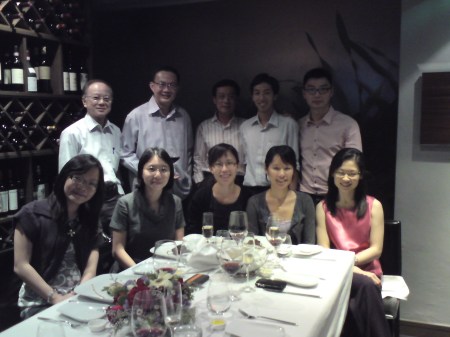 Three promotions at one go within The Firm seemed like a great time to crack open something memorable. And so we gathered at Otto this very evening on 5th July 2010, where it was good to see the affable Paolo again, who settled us to a long table of 10 in a private room and arranged a degustation menu.
We began, once again, with a 2000 Pierre Peters Cuvee Speciale “Les Chetillons” Grand Cru Blanc de Blancs, purchased recently from Wein & Vin after the recent champagne dinner with them (see June 2010). Straw colored. As expected, it lived up well to expectations, exuding immediately deep toasty oak on the nose with abundant notes of yeast, light citrus, vanilla and walnut. Full-bodied, not too dry, becoming smoother and more expansive on the palate with time, gaining an extra dimension in depth. Perhaps it wasn’t as outstanding as the other evening when I first tasted it at Kome, where it had been opened under temperature control for 24 hours prior, and served in a chardonnay glass. In spite of its 10 years, I believe it’s still pretty much on the ascendency, yet to hit its peak. Excellent.
I was wary that the 2004 Tenuta Il Poggione Brunello di Montalcino that followed may be too youthful, but my fears were unfounded. Aired for an hour in bottle, the wine, deep ruby in hue, proved to be surprisingly accessible. Medium-bodied, soft, highly refined with an abundance of perfumed red fruits amidst deeper notes of cassis and superb plummy sangiovese fruit, poised and elegant with tannins that added to the structure without calling attention to itself, ending in a persistent, spicy finish. With time, it developed a further degee of sweetness and minerality, becoming almost Burgundian. Now I begin to appreciate why this estate, always keenly priced, is held in such high esteem. Quite outstanding, and will be even more rewarding with further cellaring, which is exactly what I intend to do with my remaining 3 bottles.
 And finally, the 1995 Henschke Hill of Grace, a wine that I’ve long reserved specially for this occasion, for it was JK who had specially made the trip to its cellar door last year and arranged for 2 bottles to be freighted to me. Decanted for 2 hours before serving. Dull ruby red, but one is greeted immediately by a huge swathe of exuberant aromatics of sweet licorice, cherries and redcurrants full of Old World charm and rusticity, the lifted fragrance carrying well onto the palate with notes of mild graphite, plum and eucalyptus, leading to a lingering minty finish. Not the last word in profundity, but the balance between the lovely fruit and acidity is impeccable, without any trace of alcohol nor wood. Compared to another bottle that I’d hand-carried from the cellar door back in 2008 (and tasted on board the super-yacht White Rabbit in January 2009), this one seemed fresher, giving the impression that it has yet to reach full maturity, in spite of what the Henschke cellar door folks would tell you (I honestly feel the Australian palate is too used to a highly robust style of wine). For me, the Hill of Grace will always remain the benchmark for Australian shiraz as I feel that a Penfolds Grange will never evolve to this stage. Much of this has to do with the fact that the former is truly a single vineyard expression of Eden Valley, which benefits from a higher altitude compared to vines on the warmer Barossa Valley floor. Outstanding. Only one more remaining.
I found no reason to turn down an offer of a 4-course dinner on 14 June 2010 at Bistro du Vin, paired with the 2007 wines of Domaines Sylvie Esmonin and Jean-Jacques Confuron, all for only SGD80++. Both are well-known estates, crafting quality wines that remain most reasonably priced, and both are made by women, Sophie having taken over from her father Jean-Jacques since 1988. As 2007 was a relatively poor vintage, it made perfect sense to drink these wines at this stage while they still retain their youthful freshness before the fruit dries out.
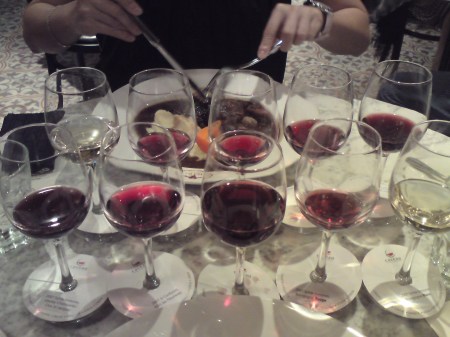 We began with the 2007 Sylvie Esmonin Bourgogne Blanc. Pale straw color with a light touch of citrus and lemon, supported by surprisingly vibrant acidity and chalky minerality. Soft, rounded and persistent. Developed an attractive creamy texture with time, becoming richer with greater intensity and attack without any greeness. Lovely.
It’s red counterpart, the 2007 Sylvie Esmonin Bourgogne Rouge, also kept pace. Dull ruby red and made in a more straightforward style, medium-bodied with fairly good concentration of raspberries and brandied cherries particularly towards the finish where it’s noticeably denser, imparting a lovely fragrance and a lingering finish. Not surprising, perhaps, that it’s rather feminine.
We then moved on to a pair of wines from Jean-Jacques Confuron, the 2007 Nuits St-Georges “les Fleurieres” (a village wine, in spite of a named location) and the 2007 Chambolle-Musigny to go with the pan-roasted barramundi. Compared to the preceding bourgogne rouge, this was ruby red with more stufing in the middle, revealing good concentration of red fruits, significantly richer with greater depth, but I can’t help feeling it’s somewhat flat and clumsy on the mid-palate. Overshadowed on this occasion by the Chambolle-Musigny village which was typically darker red, quite exuberant on the nose with ripe red fruits and occasional blackberries. Rich, rounded, with substantial depth and density in the middle layer which I find are unmistakable hallmarks of Chambolle-Musigny wines. Has power and elegance, in spite of being a bigger wine. Excellent.
We returned to Sylvie Esmonin for the final course of Coq au Vin (slow-cooked chicken leg), paired with the 2007 Gevrey-Chambertin Clos St Jacques, the only wine to be decanted. Dark ruby, exuding a heavier but lovely perfumed fragrance of red and black currrants. Deeper on the entry, with a sharper attack, but it tended to fade towards the finish. Has good density but lacking in the utter opulence that a Clos St Jacques can deliver in excellent years, although it became more even and fuller on the palate with time, developing a mild sacharine coating. In this sense, it was slightly disappointing. After taking prices into consideration, the JJ Confuron Chambolle-Musigny gets my nod as Wine of the Night.
Tasting notes from Caveau wine sale
Caveau, a subsidiary of Vinum Fine Wines, holds a superb sale once every 6 months where prices of its agency wines are slashed below cost. These are entry level Bordeaux cru bourgeois and Burgundy village, but there are occasional gems from the Right Bank, as well as Egon Muller and Alion, and knowing Vinum’s high standards, satisfaction is almost always guaranteed. Here are some notes from a tasting of selected wines at its warehouse as well as some stuff that I bought…
2006 Thibault Liger-Belair Nuits Saint-Georges “La Charmotte”, over dinner at Imperial Treasure ION. A dull tint of red. Bursting with true Burgundian flavours without any woodiness. Soft, gentle and rounded, with excellent concentration of the lovely fruit, somewhat denser at this stage on the mid-palate yet distinctive enough not to be mistaken for a New World pinot. Excellent, really. Only SGD45.
2005 Chateau D’Escurac, a Medoc cru bourgeois, decanted over lunch at Moomba. Very deep purple. Quite muted on the nose in spite of persuasive coaxing. A gentle entry leads to a medium-full wine packed with excellent fruit density. Well-balanced, ripe and supple with fine structured tannins. Has an unforced natural feel about it without any hint of over-extraction nor the usual greeness associated with Medoc wines. Much more pleasurable than Ch Bernardotte. This is performing at the entry-level of grand cru classe. Very good, really. Even Augustine of Moomba was surprised. Only SGD25. I’m glad I bought more.
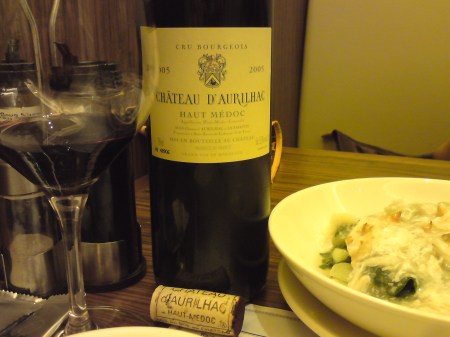 If the D’Escurac was good, the 2005 Chateau D’Aurilhac, a Haut-Medoc cru bourgeois, tasted over dinner at Imperial Treasure ION, was even better. It’s outstanding, in fact. Popped and poured. Very deep red, immediately exuding loads of gorgeous dark fruits with a high tone of minerality and graphite, not unlike a St-Julien in its youth. Fruit-forward, full-bodied, high on extraction but definitely not excessive, the intensity of the glorious fruit density matched by supple sexy tannins with judicious use of wood that was totally unobtrusive. The quality and sophistication puts it definitely well within grand cru classe territory. A terrific buy at only SGD27. Even at its usual price of SGD50 (thereabouts), it’s still a bargain. A strong candidate for RWJ’s Best Affordable Red of the Year.
2007 Egon Muller Scharzhofberger Kabinett riesling, from a case of half bottles bought for only SGD31 per bottle, drunk over chilli crab at a Father’s Day dinner. Very pale. Rather restrained initially, with predominant flavours of green apples, pineapples and lime sherbet, marked by intense acidity, lively but somewhat monotonous. Developed real depth after some time, revealing layers of rich nectarine and floral fragrance, finishing with a tinge of bitter citrus. Quite excellent, but still needs time in bottle.
2005 Bodegas y Vinedos Alion. Tasted at Caveau’s warehouse. Made by Vega Sicilia. Deep red with a vermillion core. Medium-full. Notes of spice, pepper, vanilla and fresh plum from the 100% tempranillo grapes. Slightly tannic, ends in a savoury finish. Perhaps not exactly a bargain at SGD70, but I believe this wine is age-worthy; itjust needs plenty of time.
2005 L’Hospitalet de Gazin. The second wine of Ch Gazin. Deep purple. This Pomerol is very similar in character to Ch D’Escurac (above). Almost feminine. Soft, rounded, easy on the palate but has very substantial ripe fruit and weight to set it apart from a run-of-the-mill Medoc. A good buy at SGD45. Also bought a magnum of the 2004 vintage, going for only SGD70.
 Ric's Wine Journal