Bordeaux 2000
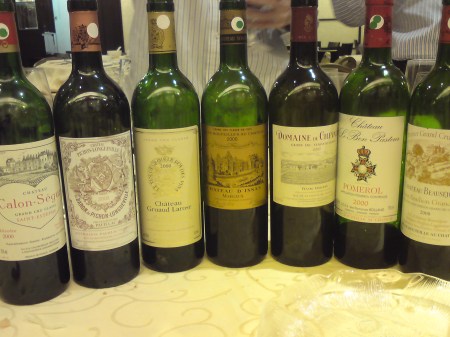
We had an excellent dinner on 23 Feb 2010 at Jade Palace featuring the Bordeaux wines of vintage 2000, with a representation from each commune (except Sauternes). As much as we know that Bordeaux wines only begin to enter their peak drinking period some 15-20 years after vintage, particularly if it was especially outstanding, it can be highly educational to chart the wines’ evolution at an earlier time point, even more so when the order of wines drunk follow the geography of the region, moving northwards, thus allowing one to appreciate the subtleties and nuances of differing terroir.
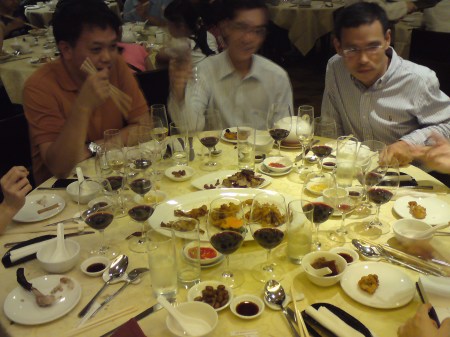 The vintage of 2000 is, of course, legendary by now, and so it seemed logical to assess these wines at the 10 year mark. The original intention was to drink a horizontal of Second Growths (or the equivalent) across the different communes, but it quickly became clear that the 1855 classification is not quite applicable. Firstly, the Right Bank and Graves do not follow the same classification. Secondly, quality has shot up across almost all estates. Thirdly, the old classification is something of a joke for the commune of Margaux: how could Rauzan-Gassies be a Deuxieme cru while Palmer continues to languish as Troisieme? Lastly, the wines of Graves and Margaux offer quality often at prices that are substantially lower than their counterparts in St Julien and Pauillac. Without the means to assemble a Hardy Rodenstock kind of tasting, we decided on a more modest line-up around the SGD200 mark. But it seemed we’re not the only ones with the same idea, for the usual retailers were extremely low in their stock of 2000 Bordeaux, save for Premier cru which are obviously out of reach. In the end, my friends had to resort to buying the wines off me at cost price (dammit), but we still managed to assemble a highly respectable lineup that represented the kind of wines we’re more likely to purchase.
 We kicked off with a Bollinger Grand Cuvee NV as an overture, purchased at the lowest price of SGD79 from Bob Rees of WEA, which was pale-golden, fresh and lively with mild notes of citrus, yeast and peat, not too dry, revealing good body, fairly rounded, ending with a slightly sweet finish. Preferable than a Billecart-Salmon Brut Reserve NV. Very good indeed.
The first Bordeaux to be poured was 2000 Domaine de Chevalier (courtesy LW), a perenial favourite. Often described as the connoiseur’s claret, but on this occasion, it seemed rather dull and uninteresting. Dark red, the nose very muted and restrained. Medium-bodied, soft, finishing with some sweet tannins with a hint of potential depth and greatness beneath, but one can’t escape the dour and austere impression. It’s obviously going through a very awkward phase right now. A bottle tasted last July, popped and poured, was absolutely on song. I’m confident it’ll show its full colours after this pubertal phase. Will rest my remaining 13 bottles for now.
 We then swung over to the Right Bank, pairing the 2000 Ch Bon Pasteur (courtesy Kieron) with the 2000 Ch Beausejour Duffau Lagrosse (courtesy KP, and not to be confused with Beausejour Becot). The former exhibited all the hallmarks of a Michel Rolland wine (this being his personal estate): deep purple, substantially more extracted than a “traditional” claret, intense, yielding notes of soy with traces of alcohol still discernible, giving it a New World feel. Nevertheless, in spite of the density, it was expertly balanced, the fruit never allowed to dominate. It opened up further after a couple of hours, becoming very well integrated, broad and lush, finishing with superbly-managed velvety tannins and a note of sweet licorice. My first encounter with this label, and I must say I’m impressed. It’d have been difficult to place if tasted blind, but that in itself is a hallmark of a Pomerol. In comparison, the Beausejour was actually more impressive initially – deep, ripe and lush right off the starting block, offering sweet dark berries with an alcoholic trace. But it failed to develop further and, in fact, became somewhat flat and disjointed on the mid-palate, whereas the Bon Pasteur, by then, had begun to sing.
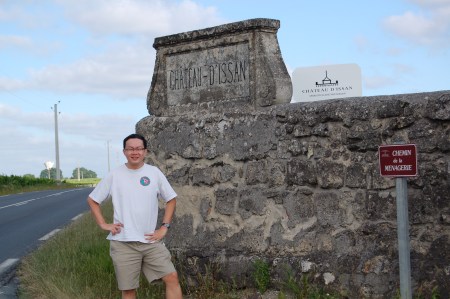 We moved back again to the Left Bank, pairing wines from Margaux and Saint Julien, the 2 communes that you come to as one moves up north on the D2 highway away from Bordeaux city. One of the first estates to be encountered in Margaux is Ch d’Issan (courtesy Vic), a Troisieme cru which lies adjacent to the main road, enclosed by its clos. The wine made in 2000 is deep dark red, restrained, but nevertheless exhibits more than a hint of a perfumed nose, with lifted notes of fig, dark berries and dried herbs, instantly recognisable as a Left Bank. Medium-full, smooth and well-integrated, lush with lovely ripe fruit, not at all assertive. It opened up further as the evening wore on, yet to develop secondary flavours but the potential is huge. This is a wine that’s unmistakably true to its Margaux roots, and the one that’s drinking best right now amongst the evening’s line-up. Excellent. Drunk alongside, the 2000 Ch Gruaud Larose, a Deuxieme cru showing a deep purple, was absolutely glorious, deeply inviting and seductive, offering loads of deep dark fruit and notes of tobacco and graphite. Broad and expansive on the palate, lush, suitably complex at this stage, full of subtle nuances, finishing with luxurious tannins. Brings back memories of the 1986 and 1990, although I’d say the 2000 surpasses both. Gets my nod for the Wine Of The Night. The reason this wine was showing so well could partly be due to the fact that it was the only one in the line-up that was decanted, as its cork had disintegrated.
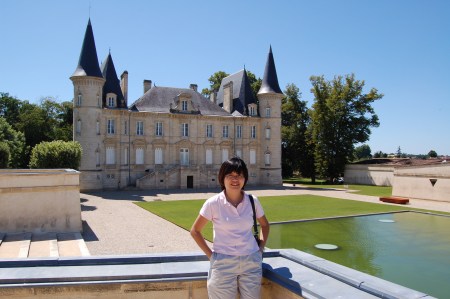 The final pairing saw us moving further up north, through Pauillac and finally Saint Estephe. One can’t ask for a more quintessential Pauillac than the 2000 Ch Pichon Baron Longueville (courtesy Hiok). Deep purple, throwing off a classic Pauillac nose of dried leaves, tobacco snuff, lead pencil shavings amidst its glorious fruit. Rightly masculine, rich and opulent, lush yet elegant within its superb cabernet frame. Great density and concentration. This Deuxieme cru is within touching distance of a Premier cru. It has all the trappings of a great wine in development and eventually will achieve greatness, just as the 1989 and 1990 did. In contrast, the 2000 Ch Calon Segur (courtesy HPP), dark red with a slightly rusty edge, was a tad more rustic and gravelly, betraying its northerly origins. But there is no mistaking its top drawer quality – the excellent density, richness and concentration. Posseses good depth, beginning to develop layers of secondary flavours, ending in a long finish. Has a certain “warmth” and charm that I attribute to the fact that it’s so well integrated and harmonious, with a real feel of the terroir. I always feel that Calon Segur, together with Montrose, is more true to its Saint Estephe roots than Cos D’Estournel, which tend to be more extracted and “international” in feel.
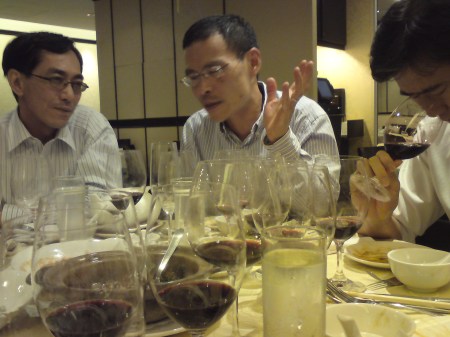 This tasting has been highly educational. Terroir does really matter, and it really does communicate with you through the wines that come from the vines. And the wines of 2000 seem to say that everything clicked together beautifully that year. I found myself repeating the same superlatives for almost each of these wines of 2000, perhaps with the exception of Domaine de Chevalier that seemed shut, proving that one doesn’t need to bust the bank in search of excellent wines even within such a stellar vintage. All are characterised by the right degree of ripeness in the fruit, matched with excellent concentration, depth and weight, yet effortless in retaining a wonderful balance and sense of lightness. No wonder there remains precious little of these on the shelves. I feel the Left Bank has the edge even within such an uniformly outstanding vintage, or perhaps we weren’t drinking the correct wines from the Right. But no matter. Just buy any 2000 you come across that’s friendly to your bank account.
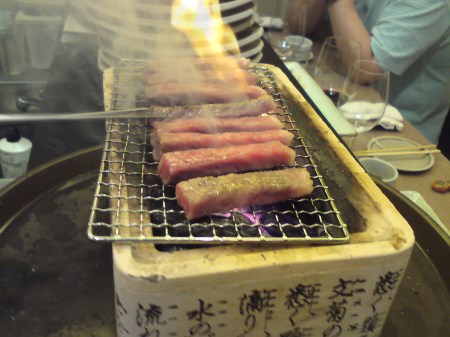
1995 Ch Lynch-Bages & 2005 Stag’s Leap Cask 23, with Kobe beef
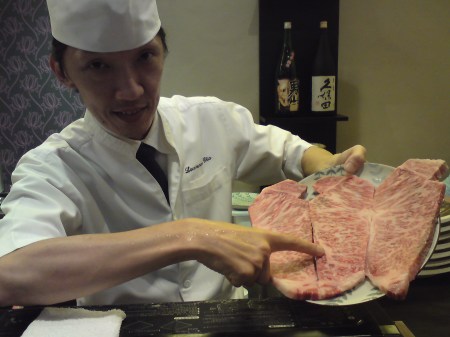
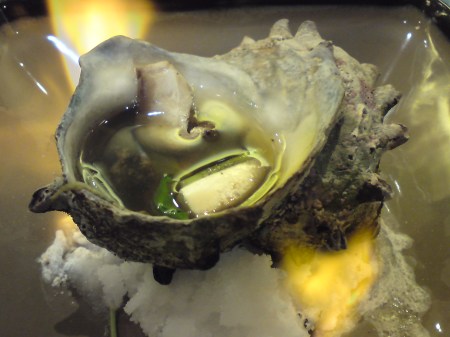 It’s good to know that I’ve not been forgotten as a honorary cardiologist. And so when the Tall Man invited me to partake in some fresh Kobe beef that he’d hand-carried back from Kobe, to be washed down with some Cask 23 at Kome, it was an offer that I couldn’t refuse, and the least I could do was show up with a ’95 Lynch. More about that later.
To his credit, Lawrence had also come up with some new creations (snails, some exotic soup contained inside a seashell), and so while he busied himself preparing the Kobe beef, we began drinking. The 2006 Dr Loosen Wehlenur-Sonnenuhr Auslese, light golden in color, was deeply fragrant, rich in notes of apricot, peach, and that petroleum character (some described it as “diesel”…good luck to those who’ve tasted diesel) so readily apparent in German rieslings. Medium-bodied, with undertones of malt and rye, and just the right amount of sweetness without being over-saturated nor overwhelming. Excellent. But a bottle of wine spread over 9 persons (including Lawrence) meant there wasn’t much to spare. Hence, we needed another white. The 2005 Domaine Patrick Javillier Mersault Les Clous was, perhaps, at a disadvantage coming right after the auslese. This producer, however, is a household name in Mersault and it shows. Straw colored, slightly yeasty with, again, a bit of malt and very little citrus notes. But, true to its roots, it offered loads of chalk and gravelly minerality. Somewhat thin initially, but it gained weight and intensity nicely after an hour, the hollowness on the mid-palate replaced by rich vanilla and caramel flavours, open and expansive, ending on a slightly grassy note. Now I remembered why I bought it from Le Benaton some time back, but that was my last bottle.
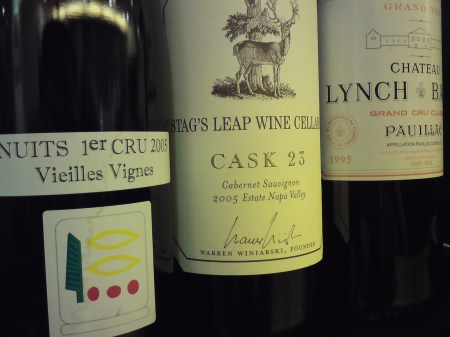 The 2005 Domaine Prieure Roch Nuits-Saint-Georges 1er Cru is somewhat of a curiosity. Purportedly owned by somebody who has a share in Domaine de la Romanee-Conti (don’t quote me…I may be wrong), it sports a weird-looking tiny modern label and a nose that suggests more of chemicals than red fruis and cherries. Minty, dense, and rather undifferentiated on the palate, with some sour plums and pickled cherries. It gained greater focus and definition with time, but never developed any real depth nor complexity. It certainly doesn’t taste anything like a SGD200-300 wine. Gimme a Armand Rousseau anytime.
 Another oddity cropped up in the form of a 2000 Ch Mouton, minus the Rothschild. Sounds impressive, and it even had the right level of deep garnet red, complete with a decent bouquet of dark fruits, dank undergrowth and a touch of banyard pungency. But it was a letdown on the palate – bland, austere, resinous, monolithic and undifferentiated, topped with a significant degree of alcoholic heat even after 10 years. Drinkable, I suppose, but I preferred not to waste my hepatocytes on it.
And so finally, we arrived at the two quality reds. The 1995 Ch Lynch-Bages, displaying an evolving red, was simply gorgeous, offering deep notes of red and dark fruits, and sweet berries against a background of dried herbs and tobacco. Soft, rounded with unobtrusive acidity, but still rather full-bodied in spite of its 15 years, superbly integrated with wonderful grip, focus and delineation across the palate. Perhaps not as complex nor deep as its bouquet had hinted, but this didn’t detract from its innate elegance that’s consistent with most of the Left Bank clarets of 1995. A wonderful wine.
In contrast, the 2005 Stag’s Leap Cask 23 cabernet sauvignon, an impenetrable red, was undeniably attractive with plenty of dense ripe fruit packed into a powerful wine of fierce intensity, obviously tannic with leafy undertones, producing a structured but austere and monolithic wine, toasty and resinous on the finish. To be honest, though, I’d have great difficulty identifying this as one of Napa’s pillars, for it lacked adequate distinction to set it apart other Napa reds, and I daresay that a Heitz Martha’s Vineyard is probably better and preferable. Nevertheless, I am grateful to have had the opportunity tasting it.
Notes in brief… (February 2010)
2006 Domaines Leflaive Macon-Verze, at the in-laws. Pale lemon color. Flavours lean towards light citrus, lime, green apples and grassy notes. Light-bodied, lacking in weight, density and depth. I daresay a Leflaive bourgone blanc is better. Not buying any more of this.
2000 Parker Estate Terra Rossa First Growth, at the EMSS AGM at Trader’s Hotel. Impenetrable crimson, a huge wine with undifferentiated flavours of licorice and dark berries of undeniably high extraction, very ripe with spicy notes, ending in a substantial trail of alcholic heat even after 10 years. Lacking in depth and complexity. Not my idea of a Coonawarra cabernet sauvignon. I thought I’d been drinking a Mclaren Vale shiraz until I saw the label. Certainly very different from a previous bottle tasted in June 2009 at Ed’s wedding, which was more accessible with some layering and complexity. My last bottle, but will not be missed. The 1998, and even the 1999, is much more preferable, and I have high hopes for one last bottle of the 1996.
I happened to bump into HK at Moomba (below) and, coincidentally, he poured me a 2001 Ch Langoa-Barton which provided a great opportunity for comparison with the Lagrange side-by-side. Although I’ve long admired this estate, I feel that Lagrange is the better buy, given that they both sell at similar price points, and this comparison proves it. Very similar in color and bouquet, but the Langoa-Barton is just a tad more rustic and lighter in texture, missing the opulence that Lagrange is sometimes capable of. Nevertheless, I’m happy to drink the former anytime.
2001 Ch Lagrange, over dinner at Moomba. This is my fifth bottle from a case bought cheaply for only SGD58/bottle a few years back. I have a soft spot for Lagrange for the fact that it still sells at realistic prices even though quality has improved by leaps and bounds ever since Suntory bought over in 1983, and this evening’s showing proved just how good it is. Dark red, imparting a sweet nose of dark fruits, blackcurrants, soy and that unmistakable metallic note of graphite that spells Saint Julien, with a hint of sizzling intensity. Medium-full, with excellent levels of richness and density producing a firm grip on the palate, the fruit beginning to develop secondary flavours, ending in a savoury finish with fairly sophisticated fine tannins without any hint of wood. To hell with label drinkers; connoiseurs of claret recognise a good drop when they taste one, and Lagrange is a great example.
2007 Heritiers du Comte Lafon Macon-Milly-Lamartine, my second and last bottle over yusheng. I regretted buying this. I’d mistaken it for the “clos du four” which hails from the same producer, but this isn’t, and it shows. Very dry, crisp and tight. Short on flavour and length, tasting more like a New World riesling than a white burgundy. Not good.
2007 JJ Christoffel Erben Uziger Wurzgarten Riesling Auslese, probably one of the best wines to drink in the sweltering heat of Lunar New Year. Light golden-green. A wine of low acidity, smooth, producing solid notes of nectarine, apricot, mangoes, lychees and a touch of honey underscored by a level of sweetness (not overwhelming at all for an auslese) that lingered on and on, making you long for sip after sip. Excellent.
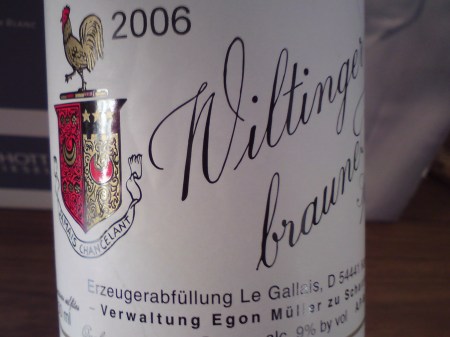 2006 Egon Muller Wiltinger Braune Kupp Riesling Spatlese (difficult-to-find; purchased from Vinum’s warehouse sale), at the Reunion Dinner on 13 Feb 2010 over steamboat delicacies. Beautiful clear yellow. An abundance of nectarine and apricot on the nose, highly perfumed, living up to its promise with a generous expression of tropical fruits, immediately leading to a deeper vein of exotic flavours that danced persistently across the palate, vibrant and vivacious without the acidity being overly crisp. Simply quite sublime.
2006 Dog Point Section 94 sauvignon blanc, at Imperial Treasure T3 on the occasion of Ben Ng’s visit. Pale, but exuding a lovely bouquet of floral fragrance with a hint of jackfruit and longans. Full-bodied, vivacious, showing great presence, dovetailing to a slightly grassy note at the finish. Excellent.
2004 Pahlmeyer merlot (courtesy Hiok), during an after-work happy hour with bak kwa, foie gras and smoked duck. Dark red.Very fruity and rich. Gentle on the entry, leading to a relatively soft wine with unobtrusive acidty. Quite resinous though, with a smoky note pervading the whole wine. Lacks the mouth-puckering suppleness of Old World merlot, but this is drinking well, I must say.
2003 Ch D’Aiguilhe, a half bottle over a tenderloin steak at Foo House. A big wine, but it’s better integrated now than 6 months before. Laden with very ripe dark berries and plums, highly extracted, warm, meaty, very full but it is becoming more seamless, ending with savoury chewy tannins, though the 14.0% alcohol is still quite apparent beneath. A good casual drop, but I don’t think I can take too much of this monster.
Rockford Black Shiraz (2009 disgorgement)
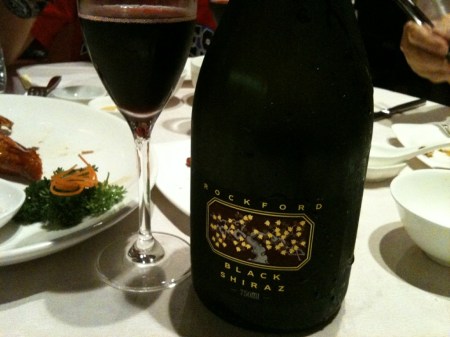 Only the land from Down Under has this penchant for producing sparkling reds, and of all these, only the Rockford Black Shiraz reigns supreme, the rest being either too sweet, too bland or too simple. What exactly is this Black Shiraz?? It is actually disgorged annually from a solera that is derived from the renowned Rockford Basket Press shiraz. Every year, some 30% of the current vintage of Basket Press is added to the solera which, of course, contains back vintages of Basket Press that had been added in previous years. Part of that is disgorged and matured in seasoned oak for three years before being bottle fermented and left on lees for another year. Only some 2500 cases of the Black Shiraz is disgorged and sold only at the cellar door at Krondorf Road in the Barossa every December (loyal fans on its mailing list – known as the “Stonewallers” – get the first cut in October), the whole lot being completely sold out before Christmas. Each customer is only allowed a measly carton of 3 bottles, max. Priced originally at AUD56, it is usually sold for well over AUD100 by the time you see it in retailers and restaurants. I have made it a point to obtain some every year, since 2003, directly from the cellar door either in person or by proxy. For the 2009, I’m absolutely indebted to AW for procuring 12 bottles. Fantastic effort!!
Popped and poured at Imperial Treasure T3. Bright purple, offering a bouquet of raspberries and brandied cherries. Medium-bodied. Slightly thin initially, but it rapidly gained weight with notes of redcurrants, strawberries and a hint of licorice underscored with liquered herbs. This is not the most complex nor layered of Black Shiraz that I’ve had, of course, for these things need time and another 5-8 years of careful cellaring can be extremely rewarding. No…I’m not in any hurry to drink up my stash of Black Shiraz.
1983 Ch Lynch-Bages @ Wild Rocket
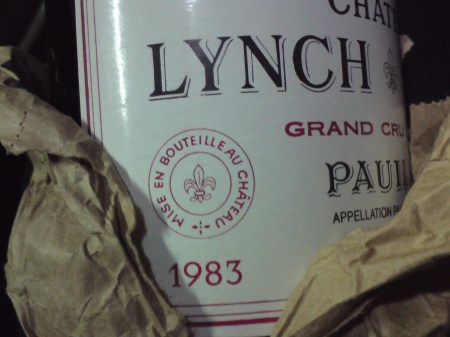 Vic finally made good his promise to buy his illegitimate sister dinner, and so we met over a 6-course set dinner at Wild Rocket. However, the portions threatened to rival those served at Les Artistes Bistrot, such that we had to add another half portion of pasta each.
We began with a 2006 Gaja Alteni Di Brassica that Vic had carried back from Italy. Very pale, but the bouquet was lovely – very fresh, floral, creamy and buttery, laced with a tinge of sweetness. It had a nice zesty zing on the palate without being over-exuberant, remaining well-balanced with understated acidity, the sauvignon blanc producing a complex body of lime, minerals, melons and lemongrass, ending wth traces of longans and pomelo, all contained within a body of excellent depth and concentration. Supremely effortless compared to its usual counterparts from New Zealand. Quite outstanding.
Great wines are meant to be shared with great company, and I definitely had no hesitation in offering a 1983 Ch Lynch-Bages, purchasd last month from Bob Rees of WEA who, in turn, had sourced it from a collection in California. The capsule definitely appeared worn, the ullage sat at high shoulder and the wine was a dusty red. But I needn’t have worried. The bouquet was unmistakably that of a beautiful mature Pauillac, offering an abundance of cedar, dried herbs, tobacco snuff, a touch of cinnamon and, of course, that note of pencil shavings with an afternote of licorice. Medium-full, soft, rounded, absolutely harmonious with infinite complexity, the glorious fruit still tasting very fresh, gripping the palate right to its savoury finish. It reminded me very much of the 1988 Pichon Lalande, for these wonderful Pauillac wines, when fully matured, are simply irresistible. Superb!! In return, I have been promised an ’89 Lynch-Bages at The White Rabbit at Dempsey over wagyu beef in the near future. I can’t wait.
A Napa evening (followed by the suffering)
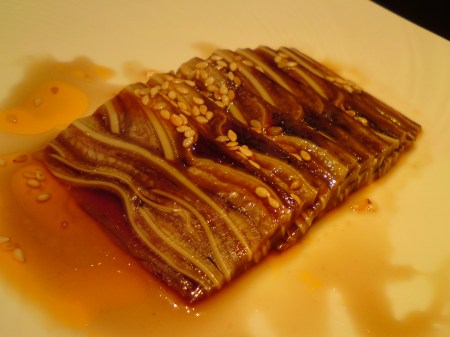 This entry sure took a long time in coming, but more of that later. The opening of the the brand-new Imperial Treasure flagship restaurant at Paragon had long been eagerly awaited by its legion of loyal fans (ie. people like us), so much so that when we finally did manage a private seating there on 14 January 2010 with a Napa theme, we were ready to whip out all superlatives in anticipation of a heavenly meal. Lester, decked out gaily in pink pin-stripe with matching pink (and white polka dots) tie and looking way too busy, seemed barely able to contain his excitement as he suggested a few specials and we were set. Kieron had been dying to showcase a Napa ‘special’ which he had arranged to be shipped back from his cache with Bordeaux Index, hence the theme and, to try to prove that Napa wines are worth their every cent, the wines were blinded.
We began with yet another 2006 Kistler McCrea Chardonnay (unblinded; courtesy PS…who’s complaining?), which lived up to its lofty expectations. This was pale lemon yellow, producing a very complex bouquet full of buttery notes, roasted cashews and almonds, brimming with rich minerality that ran deep. Dry, weighty, broad and intense, developing a creamy texture with time, ending on a slightly grassy austere finish, maintaining its poise and wonderful balance throughout. Beautiful, as expected. As good as this was, though, side-by-side comparison with a 1998 Domaine Leflaive Puligny-Montrachet “Les Clavoillon” (unblinded; courtesy David) immediately revealed why the top white burgundies are so special: the lovely fragrance of white flowers in full bloom, the lifted aromas of sweet vanilla – rich, creamy and buttery. On the palate, however, this wine was less concentrated and expansive than the Kistler, offering more of stony minerality than sheer fruit. Overall, its elegance cannot be faulted, a cardinal feature of Old World charm. Excellent.
Red #1 (courtesy Don), sporting a bright red, exuded a dominant nose of varnish (…yes…), rosewater syrup and red fruits. Heavily scented, almost Burgundian in character. A young wine, undoubtedly, judging from the primary flavours on the palate. Well balanced, its velvety tannins gripping the palate firmly, showing good depth and concentration, but rather short on the finish and yet to develop further complexity. I must say I liked it.
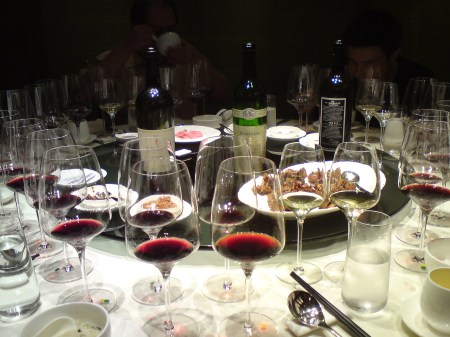 Red #2 (carried back by Hiok from a cellar door purchase), deep inky red with a bright rim, displayed the strangest bouquet of all – a thick metallic note, reminding me of emulsion and, even more strikingly, of anti-parasitic syrup (albendazole comes to mind) that parents love to force on their kids in the good ol’ days. Huge, monolithic, obviously a wine in its infancy, dense and weighty, full of primary fruit flavours, ending in a sweet finish. It seemed disjointed and short initially, eventually becoming more focused with time and food. Still, however, its harsh bouquet didn’t agree with some of us. If a wine can make one recall instantly of anti-parasitic syrup, that’s a serious repulsion. A pity.
I had decanted Red #3 hours ago at 12 noon at home, allowing it to air for 6 hours before pouring it back into the washed bottle, the reason being that I remembered my last impression of this wine some 3 years ago was that it’s a huge tannic monster. I had an initial sip just after it was popped. It tasted downright metallic and horrible, to be honest. By the time we had it, the wine had had another 3 hours of airing in bottle. By then, it had mellowed, perhaps in fact way too mellowed, for it was surprisingly muted on the nose, the flavours of raspberries and sweet licorice coming through only on the palate. Rich and concentrated, but unfortunately not distinctive, lacking in depth and secondary development in spite of almost 10 years of bottle age. Quite a bit of a disappointment. Perhaps I shouldn’t have aired it for so long.
And so, finally, we moved on to Red #4 that Kieron had brought. Indeed this was something quite special from the first whiff. An evolving red, with lovely lifted aromas of red fruits and other worldly fragrance, almost Burgundian right down to its character on the palate – quite harmonious, good depth and definition, weighty yet elegant, beautifully balanced with plenty of Old World charm, finishing long with tightly-knit tannins. A wine of great finesse and class, from a Brit in Napa. Kieron loves to relate the story of how he’d chanced upon the winemaker Sir Peter Michael at The Vineyard at Stockcross, Newbury in Berkshire, the latter’s private hotel-cum-spa. Ahh…some folks seem to have all the luck.
The lineup that evening was obviously rather uneven. The key question was: would we have recognised them as Napa, if double-blinded? To be honest, the character of the terroir of Napa Valley still remains elusive, as evidenced by the fact that Napa wines can be outright fruity, or moulded into something almost Burgundian (viz. Red #1 & Red #4) or almost Old World (Dominus easily come to mind). I suppose we can’t always be drinking the same old grand cru classe. An occasional foray into the New World would be welcome, warts and all.
And how about the food?? Not great, I’m afraid. The pig’s ears (gelatinous and served cold) wasn’t special, the beef rather ordinary, and the Peking duck not particularly inspiring. Worse was to come. After two episodes of watery GE that night, I tried going to work the next day with my whole body racked with chills, myalgia, and a splitting headache. The nausea finally got the better of me mid-morning, and I had to retire, literally. The GE continued for all of Friday and Saturday, ensuring that my misery for the weekend was complete. Must be the century egg, which didn’t seem quite right. That’s it. I’ve had enough pairing of chardonnay with century egg. I’m not gonna do that again in future.
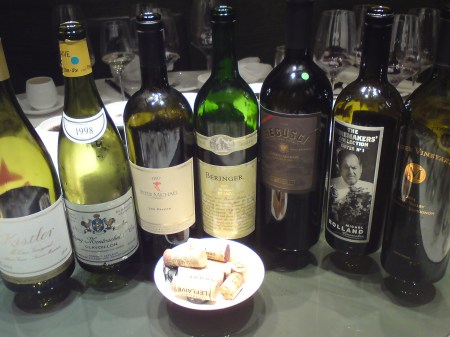
Red #1: 2004 Meyer Vineyard
Red #2: 2005 Regusci cabernet sauvignon
Red #3: 2001 Beringer Private Reserve cabernet sauvignon
Red #4: 1997 Peter Michael “Les Pavots”
2002 Leeuwin Art Series, 1994 Clinet, 1998 Moss Wood @ Moomba
I was back at Moomba today with friends for what turned out to be a lovely meal over scallops and braised short ribs. Moomba is fantastic for excellent food at reasonable prices, as evidenced by a full crowd, and, of course, its BYO policy for Fridays and Saturdays, which is a great draw. Why can’t everyone do the same??
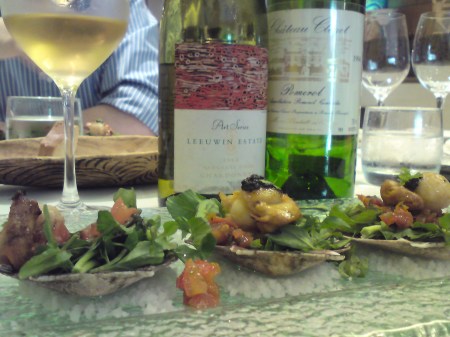 The 2002 Leeuwin Art Series chardonnay (courtesy K) was an absolute stunner right from the first pour. Beautifully golden, a touch heavy in color, exuding a very lovely and complex bouquet of nectarine, apricot, cinnamon, roasted cashews, creme de la creme , complete with a very deep minerality with an overlying yeasty character that we’ve only encountered from the wines of Corton-Charlemagne, principally from Bonneau du Martray, but which was present in great abundance in this Leeuwin, giving it a very sophisticated and aromatic lift. Great body, density and richness on the palate with lots of acidity still, ensuring that the wine remained fresh and lively right down to its lingering finish. It held on right till the end of the meal. I don’t think we’ve ever encountered such Old World charm and utter sophistication in any Leeuwin before, nor in any other Aussie chardonnay. Even Giaconda would take some beating. This is definitely the best example of Leeuwin Estate that I’ve ever had, and one of the best New World chardonnays. Truly memorable.
The 1994 Ch Clinet that followed was darker in color than the previous example I had in June 2009, displaying a bouquet of aniseed and dried herbs, the fruit beginning to dry out a bit. Medium bodied, smooth, but lacking in richness, depth and concentration, still a little tannic and hollow on the finish in spite of its age and having been decanted for more than an hour. My last bottle, and my third tasting over the past 18 months. It showed better today than six months ago, but it’s not going to improve further. Would have been quite perfect with more delicate cuisine, such as Japanese, but it didn’t quite match up to the excellent braised beef short rib.
But a surprise was in store…Augustine Kum of Moomba happened to chance upon us and very generously poured for each of us a glass of 1998 Moss Wood cabernet that had been opened for 8 days. It is amazing that this wine is still alive and kicking. Dark red, very open on the nose, producing a superb bouquet of tertiary flavours – cedar, ripe red and dark fruits, leather, sweet liquorice, and soy. Full-bodied, structured, rich without being unctuous, revealing good depth and density, its tannins suitably tamed, tapering to a long minty finish. Excellent stuff!
Today’s tasting seemed to demonstrate that the best Aussie wines possess longevity in abundance and are perfectly capable of superb results with careful cellaring whereas the French, true to its roots, couldn’t really care about how things would end up.
Notes in brief (January 2010)
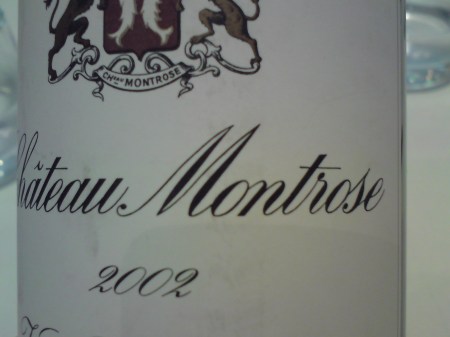 2002 Ch Montrose, over a quick but efficient lunch at Moomba. Plummy red. Seemed alarmingly thin and disjointed at first, but it gained weight after 30 minutes with more fruit to the fore, becoming more rounded. However, it’s still quite backward, as expected of Montrose, with most of the mulberry and blackberry flavours lurking very much in the background, and it doesn’t appear to be developing further depth or complexity anytime soon. Nevertheless, a very decent effort for a weak vintage.
2005 Domaine Louis Latour Beaune Vignes Franches 1er Cru (courtesy PS), at W48 dinner at Ming Kee. A heavy color for pinot. Hint of cherries but it is just too bland and heavy on the palate. Monotonous, in fact. Not at all like pinot. Disappointing.
2005 Domaine Bruno DeSauney-Bissey Gevrey-Chambertin, at W48 dinner at Ming Kee. Only Le Benaton carries this small producer. Quite a rich color for pinot. Lovely fragrance of sweet red fruits and cherries. Medium-bodied, rounded with well-managed tannins, but not showing any depth or complexity. A pleasant, decent effort.
2007 Heritiers du Comte Lafon Macon-Milly-Lamartine, at W48 dinner at Ming Kee. Very pale yellow. Promising nose full of lime, citrus, and melons, but a letdown on the palate – dry, tight, rather austere (most unlike previous examples from this source), short on substance and finish. Slightly more open after an hour, with more minerality coming through, but still unattractive. Diasappointing.
2005 Ch Reignac, over an excellent dim sum lunch at Golden Peony with K and D. My first tasting of this wine, which has been lying in my office ever since it was delivered to me after en primeur in 2008. Popped and poured. Deep garnet red, immediately exuding a lovely bouquet of rich dark berries with sweet plums, nicely ripe. Rather full-bodied, as expected, but it’s surprisingly gentle on the palate and soft at the edges, displaying great concentration with a nice layer of fat in the middle and just the right amount of extraction (unlike D’Aguilhe which is over-the-top), revealing excellent definition and structure, finishing with superbly-managed tannins. No gimmickry here. This is definitely on par with a grand cru classe. Has great legs that will last the distance. Excellent.
2007 Roche Wines Tallawanta Hunter Valley shiraz, bought direct from the cellar door for AUD25; drunk over dinner at Crystal Jade T2. Double decanted for about 90 minutes. Very deep red with a purplish rim. Muted nose. On the palate, primarily fruit-driven – loads of dark berries, raisins and raspberries carried by an alcoholic bed that tried to stay out of the way. There’s a charred quality to the wine, no doubt due to the extreme Aussie heat these days, but the fruit quality is undeniably very good, suitably dense but not unctuous, finishing with svelte tannins. A nice, easy table wine. Just don’t ask for depth or complexity.
2004 Ch Gruaud Larose, at Imperial Treasure T3, a wine that has benefitted immensely from Parker’s lowly rating of 87 (with an insulting question mark to boot), keeping current prices well below SGD100. Purplish red, with a bright red rim and an attractive nose of red and dark fruits, with a lovely lift of sweet cherries, leading to a soft entry, a wine that’s medium-full with a good grip but mellowing on the mid-palate, the excellent fruit quality readily apparent, producing a hint of sweet meat. It’s still unresolved on the finish, rather cluttered and tannic, although this softened considerably after an hour. It seemed to be evolving faster than other 2004 clarets. Overall, a good wine, actually. I enjoyed it.
Happy New Year!!
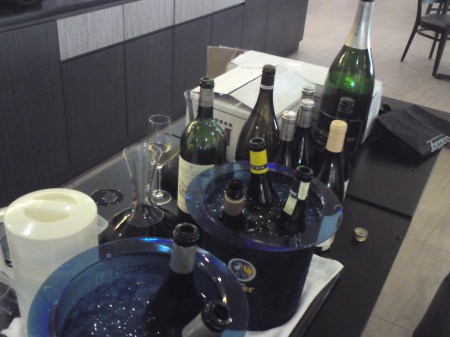 My New Year started off with quite a bang, but also hit a bit of a tragic note, literally. For the second year in a row on New Year’s Day, we met at Kome (again!!) for a LONG SLOW lunch in the kaiseki style that began at 1.00PM, ending only at 6.30PM as the sun was setting and the dinner patrons were arriving, far exceeding last year’s event (which had ended by 4.50PM). Lawrence had set us up in a long row with our WAGs and we settled down to enjoy the afternoon, starting off with a Billecart-Salmon NV Brut Reserve (courtesy K), served from a 3L double-magnum. This was dull golden in color with a solid body of cutting acidity and yeasty undertones, very dry on the finish, serving its purpose well.
The 2004 Mischief & Mayhem Puligny-Montrachet 1er Cru “Les Referts” that followed was light golden, with a nose dominated by far too much citrus and lime, the acidity cutting through sharply. It was noticeably hollow on mid-palate, only gaining some fullness towards the finish. Although it took on some caramel note with time, becoming more even, it didn’t really carry much complexity nor depth. The overall character was similar to another “Les Referts” (2006 JM Boillot) that I had last month: a sharp predominance of citrus, promising on the nose but somewhat of a letdown on the palate. In contrast. the 2004 Joseph Drouhin Puligny-Montrachet (courtesy PS), a tad lighter in color, was a better wine with a lovely floral nose, revealing a good balance between fruit and minerality, with flavours of melons and pineapple. Well balanced, not at all heavy, maintaining its delicate poise throughout. This is a classic instance where a village wine from a good producer can easily outshine a premier cru from lesser hands.
 Thrown into the fray was, once again, the ubiquitous 2004 The Moorooduc chardonnay (that’s what happens when everyone buys the same thing to slosh around), a product of Victoria, Australia. Surprisingly though, it held up well against the French competition, slightly fuller than the Joseph Drouhin, very even and well balanced, very pleasing without trying too hard. Probably my best experience with this chardonnay.
But the afternoon’s choice of white belonged to the 2003 Marc Morey & Fils Chassagne-Montrachet 1er Cru “Virondot” (courtesy Damien). Even lighter in color than the Drouhin, almost pale, but possessing the best bouquet. Bigger, fuller, yet floral and delicate, generous on the palate, revealing good depth and concentration, with great minerality. Has a sense of place…the terroir is communicating with you, not the winemaker. And that’s what a good wine is all about. Excellent.
At long last, we moved on to the reds, beginning again with a Mischief & Mayhem, the 2003 Charmes Chambertin Grand Cru, darker red than usual for a pinot, with hues of red fruits, cherries and red currants, showing good concentration and grip, smooth and even on the palate, but not terribly complex, lacking in real richness and depth. Very agreeable, neverthless. In fact, drinking very well on its own, a bargain Chambertin grand cru, its deficiencies only shown up when compared to the 2002 Domaine des Lambrays Clos des Lambrays Grand Cru (courtesy K), served from magnum, that was drunk alongside. This is the real deal – a touch lighter but truer in color, exuding a classic nose of lifted cherries and raspberries, revealing great depth and concentration, very importantly with that crucial “fat” in the middle adding that extra ounce of richness and complexity that’s to be found only in great burgundies. Very classy, as always with Clos des Lambrays, never ever disappoints. Keeps drawing you to it, getting better and better with each sip. I could just keep drinking this happily. Great stuff.
 At 4.30PM, we relocated to the counter to enjoy Lawrence’s selection of delectable sushi, polishing them off with a magnum of 1999 Ch La Mission Haut Brion that I’d sourced from Bob Rees of WEA. The wine displayed an evolving red that gave off earthy notes, blueberries, dark chocolate, and smoke with aromas of charred leaves (from K, I agree!), revealing excellent concentration and depth without any hint of wood, just developing its secondary flavours of cedar and gravel (here resembling the graphite of St Julien) with the right degree of intensity, possessing a slightly rustic feel compared to the polished effort of its sister estate Haut Brion across the road, but entirely consistent with its traditional Graves character, providing a wonderful sense of place. With time, it became totally seamless and harmonious, soft and very inviting. I was surprised that this magnum bottling wasn’t at all tough or disjointed, given that large formats usually evolve slower. Who’d have guessed a ’99?? A wonderful wine, reinforcing my soft spot for the wines of Pessac-Leognan.
So what was so tragic about the above? Well, I discovered the next day that I’d accidentally discarded my little red leather-bound notebook containing almost all of 2009’s tasting notes into my condo’s trash. It was gone by the time I realised what I’d done. Boomz…that’s it. At least I had the good sense to blog everything online. Now I’ll need another notebook:)
I must thank K for organising the event, and to all concerned for their generosity in contributing the wines, and to Lawrence and the Kome staff for the great effort.
Ric’s Most Memorable Wines of 2009
From everything that I’ve tasted in 2009…
Best Unaffordable Red: A tie between 2002 Domaine de la Romanee-Conti Grands Echezeaux Grand Cru, as well as 2003 Domaine Armand Rousseau Chambertin Grand Cru. Now I understand why the best burgundies blow everything else.
Best Affordable Red: 1995 Ch Figeac, wonderful old-fashioned Saint-Emilion.
Most Memorable Red: 1988 Ch Pichon Longueville Comtesse de Lalande, a beautiful wine drunk at a most memorable venue – La Tour D’Argent, Paris. And I suppose 1988 Ch Le Pin as well, for it was the first time, and probably the last, I got to taste this unaffordable label.
Best Value Red: 2005 Ch D’Aiguilhe, followed closely by the 2005 Les Hauts de Smith, both at similar price points.
Most Disappointing Red: 1997 Domaine de la Romanee-Conti Richebourg Grand Cru, reminding us again that label isn’t everything.
Worst Red: 1993 Ch Rauzan-Segla, an empty wine, unacceptable for a grand cru classe.
Best Unaffordable White: 2001 Domaine Leflaive Batard-Montrachet Grand Cru…expensive bastard.
Best Affordable White: 2005 Talbott Diamond Estate Monterey County chardonnay, followed closely by 2005 Leeuwin Estate Art Series chardonnay.
Most Memorable White: I’ll opt for a bubbly here, the 1999 Philipponnat Clos des Goisses, memorable for its inviting draw and supreme elegance at an equally memorable dinner, sharing the stage with DRC and Petrus.
Best Value White: 2007 Jean-Marc Boillot Bourgogne Aligote, and 2007 JJ Christoffel Erben Uziger Wurzgarten Riesling Kabinett, both performing way above their status.
Most Disappointing White: 2003 Maison Louis Latour Puligny-Montrachet. Not worth even the SGD20.
Worst White: None, really.
I must thank all friends and contributors who had so unselfishly made available these wines for tasting. Bon vin et merci beaucoup!
 Ric's Wine Journal