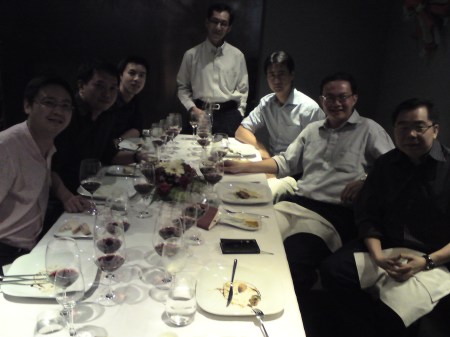
Cullen dinner at Flutes at the Fort
I have a healthy respect for the chardonnays and cabernet-based wines of Margaret River, especially after visiting the region last year. Favourites include Leeuwin Estate Art Series chardonnay, Moss Wood for their chardonnay as well as cabernet sauvignon, and the Cullen Diana Madeline, a true Bordeaux blend. These are just about everyone’s favourites as well. However, it would be idle to pretend that these wines match up in every way to actual Burgundy whites and Bordeaux reds, as this tasting of Cullen wines on 12 August 2009, with Vanya Cullen herself in attendance, amply shows.
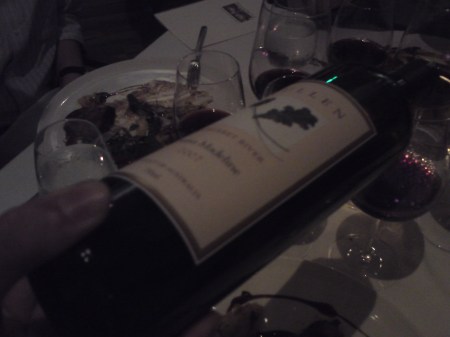 We started off with a 2008 Cullen Sauvignon Blanc Semillon. The Aussies love this sort of blend, but I just don’t get it. Very pale straw-colored, light and “grassy”. Straightforward and simple, although it had a fresh, zesty feel about it. I still don’t get it.
A pair of chardonnays followed. The 2007 Cullen “Kevin John” Chardonnay, light yellow, was served too cold initially, but one could discern some nutty flavours as well as caramel. It eventually did open up when the temperature was right, revealing good minerality and body, but not much complexity. Rather one-dimensional. Perhaps it needs more bottle time. Next to it, the 2002 Cullen Chardonnay, with the benefit of bottle age, was far more complex, with more depth of color and more intense, lifted aromas. It even managed more than a nod in the direction of a Giaconda, with a certain weightiness and layering that only mature, good quality fruit can deliver. Quite excellent.
Next came the much-anticipated duo of Diana Madelines, but which turned out rather disappointing. The 2007 Cullen Diana Madeline (84% cabernet sauvignon, 8% merlot, 4% each of cabernet franc & petit verdot) was very deep red and rather muted on the nose, although one could sense the intensity of fruit beneath. Medium, velvety, but somewhat disjointed, with a fair amount of leafy greeness. Didn’t quite seem like the Diana Madeline that I knew and loved, where the velvety supple tannins from the merlot matched seamlessly with the cabernet structure. Vanya Cullen seemed rather upbeat about the 2007 vintage, but I wasn’t convinced. The 1998 Cullen Carbenet Sauvignon Merlot (actually 68% cabernet sauvignon, 25% merlot and 6% cabernet franc, aged 18 months in 20% new oak) was even more disappointing. Still a very dark unevolved red after all these years. A huge wine, thick, bitter undertone, almost unctuous, very dense, shot through with a prominent liquered note, ending with a short finish. It’s as if one is drinking the distilled essence. Instead of the wine opening up with tertiary flavours, this is almost a complete opposite, a reduction. Is this how a Bordeaux blend is supposed to be after 11 years, tasting like a Barossa shiraz?? Not my type, for sure. This tasting only reinforced my allegiance towards Moss Wood as the torchbearer for Margaret River cabernet sauvignon – a 2000 vintage drunk earlier this year was very “correct” and pleasurable, and still very much on the ascent.
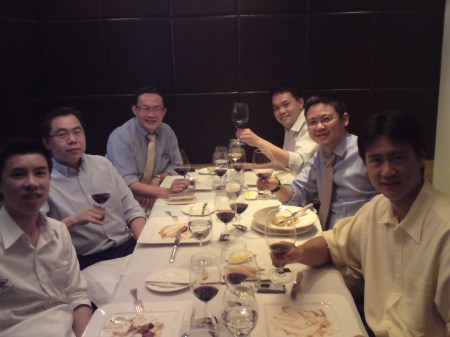 True friendship transcends all barriers and difficulties. This was amply demonstrated when an impromptu gathering at Saint-Pierre was called at very short notice, a wine of the vintage was readily proferred, and everyone turned up in spite of their busy schedules. We were given a private room, the wines decanted, the main courses of wagyu beef and kurobuta pork expertly prepared, and we were ready for an intense but highly enjoyable meal.
The 2002 Dubrueil-Fontaine Corton Charlemagne Grand Cru (courtesy K), a shade off golden, displayed great purity and minerality. Very fresh, balanced, elegant, with good acidity and complexity. Drier compared to a Bonneau du Martray, which will probably carry a layer or two of additional complexity, but this is still excellent. A great start.
The 1998 Ch Montrose (courtesy PS) that followed was deep red with a ruby rim. The nose was rather muted and restrained initially, but it eventually opened up, revealing dollops of rich, dark fruit which were amply replicated on the palate. Very good body and density, the firmness of St Estephe already beginning to soften. Excellent stuff. Should have bought this at Carrefour 4-5 years ago, when it was available for less than SGD100.
Next to it, the 1999 Ch Palmer had greater depth, power, and concentration. Not overtly voluptuous, already mellowing, harmonious, carrying great finesse and balance. Only wines from Margaux commune (actually only those of Ch Margaux and Ch Palmer) seem able to combine masculinity and charm so successfully. Tasted twice before: first in Aug 2006 (private dining on the occasion of my promotion) where it held its own against the likes of 1986 Haut Brion and 1983 Leoville Las Cases, and then last year at a 1999 horizontal at See Lim’s, showing well against Cheval Blanc. This vintage is known to favour estates south of the Medoc, with the sweet spot falling on both Ch Margaux and Ch Palmer. I feel this Palmer is still on the ascent. Like other great wines, it has become really expensive over the past year, and increasingly difficult to source. Will have to space out my remaining 7 bottles properly!
Slow lunch with 1985 Leoville Las Cases, 1982 Leoville Barton & 1982 Ducru Beaucaillou
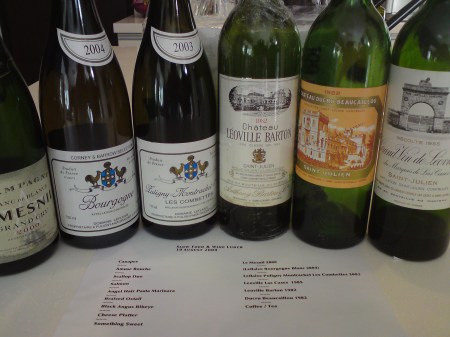
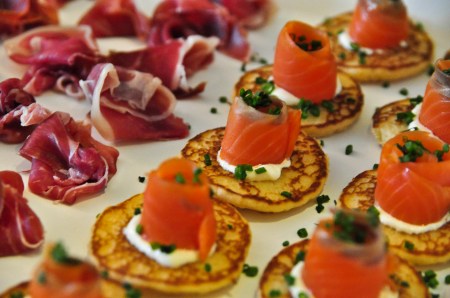 When a friend suggested that he’d host a long slow lunch, tied to a superb mini series of St Julien wines from outstanding vintages in the 1980s, we couldn’t refuse. Hence, at 1230h on 10th August 2009, we gathered at his residence and wasted no time ploughing into an excellent bottle of 2000 Le Mesnil Blanc de Blancs Grand Cru champagne to get things rolling. We got off to a good start; this was light-golden, fresh, lively, medium-bodied, maintaining a sense of delicacy amidst its sweet floral notes. Quite the perfect aperitif.
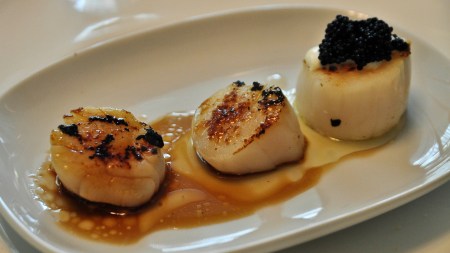
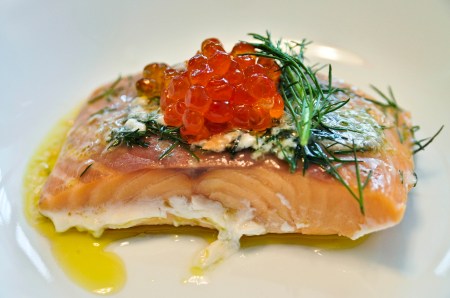
A couple of whites from Domaine Leflaive accompanied the first 3 courses of scallops, salmon, and angelhair marinara pasta. The 2004 Bourgogne, light-golden, gave off a huge fantastic nose full of minerality and vanilla that hinted at a wine of great complexity and body. Quite unbelievable, coming from a generic bourgogne, again emphasising the dictum that producers matter most for burgundy wines. However, this wine didn’t quite reach up to its promise on the palate, being medium-bodied and soft, with less than the anticipated level of complexity.
 Side by side, the 2003 Puligny-Montrachet 1er Cru “Les Combettes”, darker hued, was lighter in texture, more fragrant, more floral and delicate. Nevertheless, it put on more weight after an hour, the slick oily character so typical of Leflaive becoming apparent. Definitely more complex, with that extra layer of depth missing from the generic bourgogne. A more complete wine that showed up the bourgogne’s deficiencies, although the latter, on its own, would have been very satisfactory.
Then came the highly-anticipated trio of reds to go with the braised oxtail and black angus ribeye. The 1985 Ch Leoville Las Cases, brownish red with a tawny rim, had the sort of nose found only in top-flight aged Bordeaux, although this was somewhat stern and less exuberant compared to what a Pauillac can offer. But once on the palate, it exuded its class and impeccable breeding with notes of blackcurrants and bit of plum in the background, possessing great depth, seamless harmony and focus, gaining a velvety feel with time with only just a slight hint of oak remaining. I was reminded that this was the third time I’ve tasted this wine – initially in late 2006 at Iggy’s, then sometime in 2007 at a private function. A wonderful wine at its peak, and still there. Having had the 1986 four years back (Hiok), which was still very backward, I fully agree that 1985 is the best vintage to drink now from that decade.
 Compared to this, the 1982 Ch Leoville Barton, showing a similar red but just a tad lighter, was initially less powerful and leaner in texture with a shorter finish, although the wine was absolutely harmonious with great purity of fruit, without any wood. It gained weight in the glass, to its advantage, eventually turning very delicious. Definitely much better than the bottle we had at the SMA Dinner in May. Great stuff, but it goes to show why Las Cases remains at the top of the pecking order for the three Leoville estates.
The piece de resistance for the afternoon was, without doubt, the 1982 Ch Ducru Beaucaillou. Absolutely magnificent, and it was not difficult to tell why: of the three St Julien wines, it had the deepest red, the liveliest nose, great entry, and that extra dimension, depth and grip that even the Leoville Las Cases didn’t possess (albeit from a different vintage). Great delineation and focus from start to finish. Rich, intense and luxurious. Still packed more than adequate power, though mellowed by time. It recalled memories of the 1982 Ch Leoville Poyferre, but the Ducru is even better. Definitely has the legs to last another two decades; in fact, I feel it still hasn’t peaked!!
Lunch finally ended after 5PM with a 1994 Ch Rabaud-Promis, a Sauternes that easily stood up to more well-known estates. By then, we were all done in by the food (2 full helpings of pasta!!) and the preceding wines to fully appreciate this, which was a bit of a waste. Discounting this, it was 6 bottles for 4 persons. One would have thought that would be really excessive (it was!) but with these beauties, there wasn’t the slightest bit of fatique on the palate. I dare say the reds that we’d drunk will be irreplaceable. But what’s the point of keeping these purely as trophies? Great wines must go with great food and great company. I’ve come to realise that such opportunities are scarce, and so when they arise, one must push the boat out. I’m glad we all did. I must really thank the host for the time, energy and generosity that had gone into making this lunch possible. Knowing us, there’ll probably be more of such decadence to come in the near future.
Notes in brief (August 2009)…
2005 Ch de Fieuzal, decanted and poured over dinner at the in-laws. I’ve never really been drawn to the wines of this estate, partly because of the very un-French name. However, this tasting may change my attitude. Deep ruby. Very shy on the nose, not revealing anything. However, it carries all the hallmarks of the great 2005 vintage: medium-bodied, good body of cool ripe fruit, silky smooth, quite seamless from start to its lingering finish with absolutely no trace of wood nor heat. It began to open up after a couple of hours, developing a more intense savoury note, but still retaining its wonderful balance. Hasn’t got complexity nor depth presently, and doesn’t quite match up to Domaine de Chevalier. But at SGD71 (cheapest deal, from Crystal Wines), it’s definitely worth acquiring more to lay down.
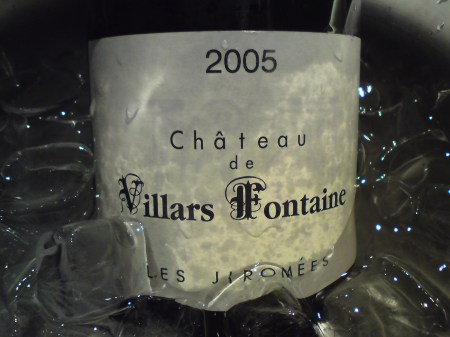 2005 Chateau de Villars Fontaine Les Jiromees, over a simple dinner at Ka-Soh. This is a white Burgundy close to Nuit St-Georges, and always highly recommended by Patrick of Le Benaton. Dull golden, with intense flavours of chalk and limestone on both the nose and palate. Good body, but not much in the way of depth or complexity, perhaps obscured by the high acidity, giving it a crisp edge with a hint of undergrowth. Very tight. This is the second time I’ve had this since the first at Imperial T3 a year ago where it had seemed more open and less intense. The ageing potential is not in doubt. I remembered drinking a 1991 and a 1994 at See Lim’s couple of years ago, and they were gorgeous. Perhaps it just needs more bottle time. Four more left.
2005 Les Hauts de Smith, second wine of Ch Smith Haut Lafitte, over lunch at Imperial Treasure T3. Compared to the Grand Vin, this is, strangely, not so easy to find on the shelves, especially the stellar 2005 vintage. I gained a healthy respect for this wine after having been served the 2004 vintage at Les Sources de Caudalie, where I thought I’d been drinking the Grand Vin, until the bill came. Beautiful ruby red, fairly deep nose of dark fruits with bit of plum. Medium-bodied, with good mouth-feel and grip, without being over-extracted. Not quite complex, but it has good balance, ripe fruit, and excellent oak handling, finishing with some mouth-puckering tannins, but never obtrusive. I’ve not tasted the actual SHL ’05, but I believe this is cut from the same cloth. Excellent value at SGD58, from Wine Gallery.
2002 Ch Rauzan-Segla, from a half-bottle just bought from Vinum, all to myself over a late night juicy steak at Foo House alone. Dull red. The initial note wasn’t encouraging – decent entry but disjointed finish, subdued fruit, a touch of green. But it evolved very quickly over a few minutes, settling into a wine that’s fairly intense, medium-bodied, even, with fairly good grip, and most importantly, the green note had disappeared. A very decent effort from a difficult vintage. Went well with the steak. But don’t keep. Drink now.
2003 Domaine Armand Rousseau Clos de la Roche Grand Cru, at the Boathouse with Fatty’s usual suspects. The class and impeccable breeding is at once evident. Beautiful autumn red, deep, powerful nose of red berries, laced with a tinge of sweetness. Carries nicely onto the palate – sensuous, slick, quite full, great depth and layering. Yet to develop further complexity, but most certainly will, with time. Superb.
1993 Ch Rauzan-Segla, also at the Boathouse. A classic case where the wine is only about how it excites your olfactory senses – very fragrant, floral, with a layer of vanilla. Otherwise, it’s just an empty shell. Hollow, too much wood and lacking in quality fruit.
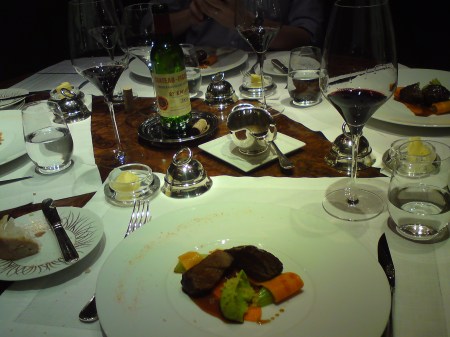 2000 Ch Figeac, from a half-bottle over lunch at Les Amis. Beautiful deep but clear red. Rich, dark fruits. Lovely perfumed fragrance of cabernet franc framed by sterner structure of cabernet sauvignon. Softening, beginning to develop its tertiary flavours, but there is still quite a bit of persistent wood. I was glad to have the chance to taste this, as I have a couple of bottles lurking somewhere.
2005 Domaine Patrick Javellier Mersault, drunk with the Figeac above. From one of the renowned producers of Mersault. Supposedly fastidious in his winemaking. It shows: a very expressive and scented bouquet, very floral. Beautiful nose. Medium-bodied, good minerality but it’s a bit hollow. Could do with more stuffing. Very agreeable, nonetheless. From a half-bottle.
2003 Joh. Jos. Prum Wehlenur Sonnenuhr Spatlese, with chilli crab at Long Beach on National Day. Pale golden, lifted aromas of citrus, medium bodied, just the right level of acidity, some bitter-sweet undertone, finishing on a pomelo note. Not as sweet as one would expect a spatlese to be. Lacking in complexity and richness. Could do with more stuffing. Not a great example of JJ Prum, and I don’t think it’ll improve further. Nevertheless, went well with the meal.
 2000 Ch L’Arrivet Haut Brion, over lunch at Imperial Treasure. You’ll pass by this estate enroute to Smith Haut Lafitte in Pessac-Leognan. I’m partial towards the wines of Graves, as I feel they represent the last vestiges of traditional Bordeaux style and goodness – unadulterated, pure, reflective of terroir and vintage, without being over-priced. This wine was no exception: luminous red, immediately exuding its scorched earth character on the nose, quite rich, ripe, good structure, bit of firm tannins but it is beginning recede. Great typicity of Graves. Quite similar to Domaine de Chevalier, but less sophisticated. Entering its drinking window. I’d tasted the 2005 last year, which was richer than this 2000. This is an excellent Graves, better than Ch Carbonnieux for about the same price.
1998 Penley Estate Reserve cabernet sauvignon over lunch at TMCC. Made by former winemaker of PENfolds Bin 707, Kym TolLEY, hence PENLEY. One of my favourite cabernet sauvignons from Coonawarra – I make it a point to visit its cellar door every trip there. I’d purchased 6 bottles shortly after my return to Singapore in 2004, mostly from Star Cellars, and another couple more from Auric Pacific. First tasted in mid-2005 at Romanee’s, after which I’ve opened a bottle once every year or so. Still going strong. Dark cherry red, lovely fruit with notes of redcurrant and plum, quite full, good grip, depth and structure, finishing long and cool. But lacking in the extra dimension that’s only found in a true Bordeaux blend. Nevertheless, it mellowed nicely in the glass. Drinking beautifully. Better than the last time I tasted it at Imperial Treasure last year, and marginally less evolved than another bottle at See Lim’s last year (when I pitted it blind against a horizontal of 1998 Bordeaux reds). I have to stop opening this. Only 2 bottles left!
Penfolds wine dinner
I suspect most of us probably started discovering wines, when we were young and penniless, through the Penfolds bin lots. It’s been a long time since I last tasted any of those (with the exception of Bin 28) after I got my hands dirty with expensive Old World stuff. When the opportunity came to revisit these wines, as well as Magill Estate and Grange, at the newly-renovated Saint Pierre on 29 July 2009 with Magill Estate’s Sommelier Remon Van de Kerkhof in attendance, it was time to return to roots.
We started off with the 2008 Penfolds Autumn Riesling as aperitif. Served too warm, it was dry and simple, with dominant notes of lime. This was followed quickly by the 2007 Private Release Chardonnay (paired with foie gras and porcini jelly) that was slightly off-golden, showing good body and minerality, with undertones of vanilla and cream. But, on the whole, still rather straightforward and unexciting.
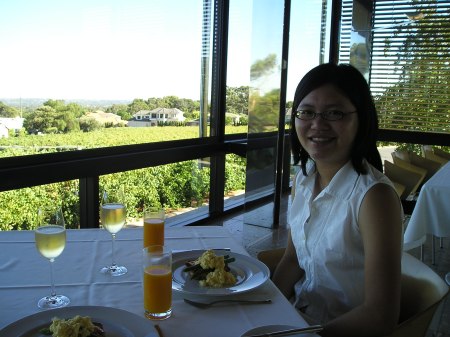 During my sabbatical year in South Australia, I remembered seeing vast parcels of Penfolds vines practically in every wine region: Adelaide Hills (even in the Lenswood sub-region), Langhorne Creek, McLaren Vale, Barossa Valley, Clare Valley, Padthaway, Coonawarra. Penfolds has always advocated multi-district blends for its reds, achieving a consistent “house style” year in year out, as exemplified by the following trio from 2006, an outstanding vintage in South Australia, on par with 1998 and 2004. Each displayed an impenetrable deep red foreboding a full-bodied, masculine, upfront style of wine. This was the best Koonunga Hill (paired with barramundi) I’ve ever had, showing great concentration of blackcurrant flavours with a richness and density not previously encountered from this label, without any trace of alcoholic heat. The blend of shiraz and cabernet was seamless (there is another Koonunga Hill blending cabernet with merlot, so look carefully at the label!). Really excellent for its price, even hauling itself from the plonk league. In contrast, the Bin 407 (with lamb loin), a straight cabernet sauvignon with notes of dark bitter chocolate, was steely, austere and really backward. Very dark and brooding, not revealing itself. Real sophistication kicked in with the Bin 389 (with caramelised duck breast), a 50:50 shiraz-cabernet blend in the Provencal tradition of Coteaux d’Aix. It was more open on the nose, the plummy ripe shiraz supported by firm cabernet structure, ending on a medicinal, liquered note with intense but well integrated tannins. It didn’t evolve much in the glass. In general, wines from the Bin series need plenty of bottle time, and I’m sure this 389 will age very well.
The final pair of wines was what everyone had come for: the Magill Estate single vineyard shiraz (paired with braised pork tenderloin), and the flagship Grange (paired with braised beef short-rib), both from the fabulous 2004 vintage. Tasting the former recalled the morning of 19 February 2004, the very first day of the 2004 harvest, when the missus and I had breakfast (expensive, for a new AC then) at the renowned Magill Estate restaurant, watching the rows of vines being harvested against the backdrop of Adelaide city lying below the gentle slope. This is the only day of the year when the winery’s restaurant is open for breakfast. This wine is a definite step up in quality from the Bin series, the aromas are more lifted, the tannins more velvety and sophisticated. Expansive on the mid-palate, showing great balance, focus and restraint. Great purity. It doesn’t have the unctuous quality of very ripe Barossa fruit, which is not a bad thing. This is a shiraz smack from the Magill district of Adelaide, and an excellent one.
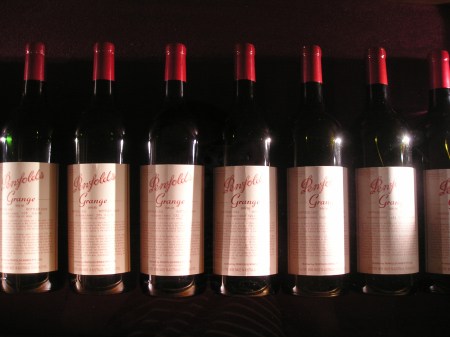 Finally, the 2004 Grange. Beautiful deep red. Much more open than I’d have imagined. Great entry, lovely fruit caressing the palate with its silky and velvety tannins, excellent structure, great depth, very “correct”, very cerebral (from Kieron, I agree), dovetailing to a cool and long finish without any trace of heat. A wine of obvious power and beauty, like a Ferrari in absolute control. Utterly sophisticated. A great Grange. Although the preceding Magill Estate shiraz was excellent, this Grange shows up the former’s deficiencies. That says a lot. I was quite speechless for several moments.
This is only the second time I’ve had a Penfolds Grange, the previous one being a 1992 that was rather unexceptional and lacking in complexity. But, as they will tell you at Penfolds, there is no such thing as a bad Grange. I was trying to think how this would compare with Henschke’s single vineyard Hill of Grace. The Grange has greater concentration and a more immediate feel, whereas I’d imagine the HoG is likely to show more finesse and layering, leaning towards the Old World (a recent 1995 comes to mind). Is this 2004 Grange worth the price of almost SGD500? Frankly, I’ve always felt that Penfolds wines are priced at a premium. It’s like dining at an expensive posh restaurant, when better food is available elsewhere for less. But I suppose it’s not a matter of cost. Acquiring this wine is akin to getting that Ferrari – it says a lot about that person than itself. I would, in my case, for the sake of remembering those wonderful days in Adelaide, witnessing the 2004 harvest in person.
Notes in brief (July 2009)…
 1994 Wynns Michael Shiraz, 31 July 2009 at Imperial Treasure T3. Dark reddish-brown with bit of tawny rim. After 15 years, still huge. Ripe, cool fruit from Coonawarra, without alcoholic heat. Plum, liquorice and touch of spice. Not as jammy as Barossa shiraz. I’ve come to the conclusion that most aged shiraz from Australia remain big and jammy, without much complexity, after all the alcohol and wood have receded. I prefer those that can develop with an Old World feel. So far, only Rockford Basket Press and Henschke Hill of Grace impress. I don’t have enough experience with top tier Penfolds to make a call.
2001 Quinault L’Enclos (Kieron), 28 July 2009 at w49’s dinner at Man Fu Yuan, Intercontinental Hotel. Impenetrable red, dense, notes of dark fruits and soy sauce (sounds weird, but appropriate). A big wine, very full, but unyielding. One senses a lot of complex flavours tightly coiled within, but not given the opportunity to shine. I’m not sure if it’ll ever evolve. A very modern St Emilion approach, but not my preferred style.
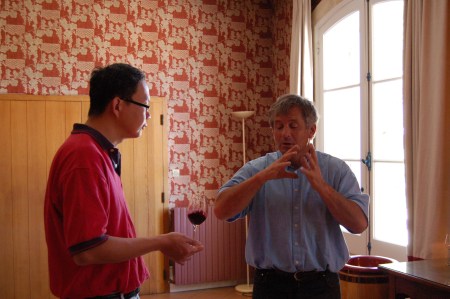
2000 Domaine de Chevalier rouge (me), drunk alongside the ’01 Quinault L’Enclos (above). A personal favourite. Beautiful deep red with purplish edge. Classic notes of earth and gravel intermixed with dark fruits. Great typicity of Graves. Full, almost velvety tannins, just the right level of concentration and richness. Will last the distance. Showing better than a previous bottle last year at Crystal Jade. Truly a connoisseur’s claret, as Parker says. I’m glad I have 13 more bottles. Need to buy more!!
2001 Ch Du Tertre (brought by PS), at Tunn Lin’s wedding 25 July 2009. Nicely balanced and elegant, the bouquet suitably floral in line with its Margaux origin. Prim and proper, not showy in any way. Drinking very well.
1998 Turkey Flat shiraz, drunk alongside the ’01 Du Tertre. The cork disintegrated and flopped inside the bottle, but the staff at the Pan Pacific did a great job double decanting, filtering off the debris. Ripe, warm Barossa fruit, without the heat. Not unctuous, but nevertheless, still a big wine, filling the mouth with plum and liquorice. Entering its drinking window, but hasn’t peaked yet. Clearly has the legs to last several more years, but I’m not sure how it’ll evolve. Only 1 bottle left.
2004 Ch Latour-a-Pomerol, at Hiok’s bar on 16 July 2009 (David). Another classic claret from a very good, if not great, vintage: red with a tawny rim, flavours of raspberry, smoke, and a touch of game. Expands on the palate. Good grip. Very elegant, doesn’t try too hard to please. Cool finish. Where’s the tannin? Excellent.
1996 Clos du Marquis, drunk alongside the Latour-a-Pomerol (me). Mature red with some bricking, complex flavours appearing but not quite fully developed yet, soft and lush. Drinking very well, but hasn’t peaked. Excellent stuff, easily on par with a Third Growth.
2004 Ch Les Ormes de Pez, at ward 49’s dinner at Kome on 1 July 2009, poured from magnum (Kieron). My previous experience with this, back in early 2007 also from a magnum that was going for only SGD95 at Carrefour, was disappointing. I remembered it was bright purple in color (!), and tasted thin and lightweight. Two years later in bottle and it’s totally different. Now it’s beautifully clear red, much deeper and weightier. Muted nose, medium-bodied, soft, simple but very pleasant, with notes of gravel, saddle and faint plum marking its Medoc character. Great value.
2003 Domaine Nicolas Potel Clos de la Roche Grand Cru, (Kieron) later at the same dinner when two of us sat down with chef Lawrence to polish off this as well as the 1995 Figeac (below), whilst ruminating over life issues. The bouquet was absolutely fragrant and perfumed, almost seductive, leading one to expect a delicate, feminine wine. Its character, however, was a complete contrast on the palate: a relatively big wine done in a modern manner, full, with some alcoholic heat leaving a touch of spice at the finish that’s quite typical of Potel. The alcohol dissipated after some time, leaving behind a big, opulent wine, ending on a sweet note.
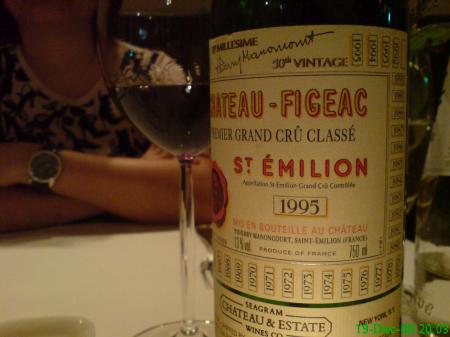 1995 Ch Figeac, (me) drunk alongside the Potel above, over some complimentary delicacies Lawrence had whipped up. This is the vintage sporting the special 50th anniversary label. I feel Figeac has always been grossly, and unfairly, under-rated. It is one of the few estates that remains unashamedly rooted in the St Emilion tradition, faithful to the characetristics of each vintage. Already mature, reddish-brown, fragrant with undertones of sweet red fruit. Soft, low acid, harmonious, drinking very well, smooth, showing great delineation from entry to finish, with tannin structure still intact. Complex. Not a powerhouse, but rather poise and elegance in abundance. Excellent depth. A classic, mature claret at its peak. Bon vin!
Pio Cesare wine dinner, with Pio Boffa
When Ms Lydia Yee of Excalibur Wines rang me up late afternoon last week saying she’d be inviting me to dinner, I had no idea that it would at The Tower Club, featuring the famous barolos of Pio Cesare of Alba, with the owner signore Pio Boffa himself (great grandson of founder Cesare Pio back in 1881, and often mistakenly addressed as Pio Cesare!!) in attendance! Needless to say, I jumped at the invitation, and when I arrived at The Tower Club this evening, 27 July 2009, I was met by Mr Antonio Koo, a Hongkonger who owns Ponti Wine Cellars, and who was hosting the dinner. It was the first time I’d met the affable Mr Koo, an extremely gracious gentleman and wine lover who, obviously, had traveled extensively and had gained the acquaintance of many in the wine industry.

The dinner itself was a private affair for only about 20 guests. I quickly realised that practically everyone in the room knew their stuff about wine. Apart from Pio Boffa himself, Mr Koo had also invited Mr Joel B Payne, an American residing in Cologne and a leading authority on German wines, being the author of the Gault Millau Wine Guide, who is also a brand ambassador for Pio Cesare. While waiting for everyone to arrive, we began with the 2007 Pio Cesare Gavi DOCG, made from 100% Cortese grapes. This wine was full, with good acidity and minerality imparting fresh, lifted notes of lime, citrus and a hint of peach and apricot. There was, perhaps, just a bit too much stuffing in the middle, but I could have easily mistaken it for a good, young village Burgundy.
We settled down to dinner, where I found myself sitting opposite Mr Payne. The 2008 Pio Cesare L’Altro Chardonnay that accompanied the low temperature ocean trout, in contrast to the Gavi, was much lighter in texture. Served too cold initially, it appeared simple and straightforward, with dominant notes of fresh lime and a touch of leafy mint. It opened up gradually in the glass, gaining greater body and fullness. Several diners (notably the ladies) commented favourably, but this isn’t my preference for chardonnay.
We quickly moved on to the evening’s pair of reds: the 2005 Pio Cesare Barolo DOCG, drunk alongside the 2004 Pio Cesare Barolo “Ornato” DOCG, paired with saute foie gras and the main course of chargrilled Angus beef fillet. Both wines are 100% nebbiolo, with the Ornato coming from a single vineyard. The 2005 Barolo had a distinct nose of plum and spice. Full-bodied, quite lush, good mouth-fill but not much in the way of structure, not unlike a straight merlot. Initially it came across as a bit four-square with a rustic feel. However, as dinner wore on, it expanded more on the palate, revealing the purity of the excellent nebbiolo fruit, becoming softer and more elegant.
In contrast, the 2004 Ornato, displaying a slightly deeper red, was rather muted initially, but with gentle coaxing, notes of dark cherries, truffles and creamy vanilla came through, betraying the new oak. A big wine with a plush entry, very full, somewhat monolithic, more structured, with sophisticated but unresolved tannins. Nevertheless, these never threatened to obscure the richness and density of the fruit, the superb quality of which was clearly evident. Like the preceding Barolo, it expanded further in the glass, developing greater depth and lushness, although the oak remained omnipresent.
Although 2004 is generally acknowledged as an outstanding vintage, Pio Boffa maintained that the 2005 actually pipped the former in quality, an opinion not, however, shared entirely by Mr Payne. Based on tonight’s experience, the 2005 Barolo is singing at this point of time, but I feel that the 2004 Ornato will last the distance and hit all the right notes years down the road. We wrapped up dinner with the 2007 Pio Cesare Moscato d’Asti DOCG – light, delicate and refreshing, a perfect foil for the evening’s reds and the accompanying white chocolate nitro.
I must really thank Antonio for the generous hospitality, and the presence of signore Pio Boffa and Mr Payne, for what has been a wonderful educational opportunity into the nuances of Barolo Old World.
Dinner with David
While I have been privileged to attend a large number of nice wine dinners, few are the occasions where all the the wines came together so beautifully. Tonight, 22 July 2009 at Otto (once again), was one of those that exceeded my expectations. The occasion was a get-together for the Changi alumnus – current as well as potential members – which, I think, will gain in size and regularity as time goes by. We gave the chef carte blanche to do as he pleased, Paolo put us up in a private room, and we were set.
We started with the 2002 Louis Latour Corton-Charlemagne Grand Cru (me), which initially was very shy; one could barely discern any notes in spite of desperate coaxing. The full colors emerged after a couple of hours, taking on a familiar thick creamy layer with loads of caramel, vanilla and new oak. Medium-bodied, vivacious, fresh with good acidity. It’ll last a long time, and I suspect its going through an awkward period presently. Will open my next bottle 5-6 years down the road.
Next, we had 3 flights of reds. I must say that I cannot recall a dinner where all the reds were drinking so beautifully. One can’t tell from the line-up on paper. We started with a pair of 1994s to go with the wagyu carpaccio and foie gras, cooked to perfection. The pair of wines could not have come from such disparate origins, yet turned out so individualistic and so beautiful with age. The Mount Mary Quintet, deep red, gave off a big, deep nose of sweet cherries and raspberries. It was soft, ripe, extremely balanced and elegant. The wood had completely receded. If tasted blind, it would have been difficult to place whether it’s Old or New World – it certainly leaned more towards the former. Halfway through dinner, it became more intense and velvety, before giving way to a more mellow character infused with loads of sweetness, almost a like a ripe aged Burgundy. This is my first experience with an aged Mount Mary, and I liked it immensely. Side by side, the La Mission Haut Brion (Kieron) displayed a different sort of beauty – gravelly notes layered with an velvety intensity, matched to earthy notes that announced “Pessac-Leognan” with plenty of elegance and grace. Somewhat rustic around the edges, unlike its more famous sister Haut Brion, but totally in keeping with its renowned character. We caught it at its peak. Wonderful stuff.
 The next pair of Bordeaux, from side-by-side estates of St Julien and Pauillac, served as a reference point for classic, mature claret, going well with the pasta with kurobuta pork. The 1990 Ch Lagrange (PS), deep garnet red with lifted aromas of dark berries, displayed a delicious entry. Soft, medium, structured and layered. Not particularly complex at present, but definitely developing its tertiary character, a great Lagrange entering its peak window. Hard to place initially, but it snapped into focus after an hour in the glass, showing excellent delineation from entry to finish, drinking very well but will benefit from several more years in bottle. The 1988 Ch Lynch-Bages, always a favourite with Hiok, was unmistakably Pauillac with all its typicity in place. Fully matured, complex, great structure (still) without any trace of wood or tannin. Very long. The quintessential, aged Pauillac. Bon vin!!
A final pair of Italians rounded off the evening. The 1997 Biondi-Santi Tenuta “Greppo” Brunello di Montalcino (Vic) showed a brighter red with a slight tawny rim. Already matured and medium-full. Very classy, elegant and poised. Superb. In fact, its origin would be hard to commit in a blind tasting. In retrospect, the sangiovese element did come through on the palate, but in the most sublime and integrated manner. The piece de resistance, the 2001 Sassicaia (David), managed, most successfully, to contain all its richness, density and intensity within a velvet glove. Already showing subtle nuances here and there, a touch of austerity but entirely appropriate for such a big wine, ending on a savoury note. Gorgeous yet elegant. Obviously has plenty of legs to last a long while. Trust the Italians to make a wine resembling a beautiful woman.
When I reviewed my notes, I found the same few words describing each wine: mature, balanced, elegant, drinking beautifully. It’s clear that we caught every red tonight at or close to its peak. So seamless were the wines, and such was the level of sublimity, that I only discovered back home that I’d forgotten to snap a picture of the line-up!! A shame, but, never mind, the memories linger…just like great wines.
Meeting Herr Wolfgang Blass
There wasn’t much preceding publicity about his appearance at Jason’s of Paragon on 14 July 2009, but an advertisement a week earlier had caught my eye. When I arrived at the scheduled time of 7.30PM, only small group of people had gathered, and a couple of promoters were desperately trying to drum up some fanfare. A shame, really, considering that Herr Wolfgang Blass himself is one of the few winemakers who advocated growing shiraz vines in the Barossa Valley more than 30 years ago, when the Australian wine industry was in its doldrums, and he has tirelessly promoted his Wolf Blass range of wines to its present highly successful business. Dressed in a tweed suit and looking dapper and energetic, you’d hardly guess he’s 75. He gamely autographed my bottle of the 2003 Wolf Blass Platinum Shiraz, agreeing with me that it needs plenty of sleep. “Open it when you get married or divorced!”, he said. Wow.
 The organisers had generously made available the 2004 Wolf Blass Black Label (SGD145) for tasting. Perhaps due to the wide range of quaffers in the Wolf Blass line-up, I’d forgotten how good the Black Label is: dark red, powerful bouquet displaying notes of sweet plums, cedar, and liquorice. Full-bodied, no less, structured, mouth-saturating but not over-bearing, ending with the unmistable stamp of warm, ripe Barossa fruit producing a touch of spice. The excellent quality of the 2004 fruit was such that the sophisticated silky tannins and alcohol never dominated. Really good. I wonder how the Platinum Shiraz will fare. At the current price of SGD220, I’m not opening mine.
American Club Burgundy Masterclass & Tasting
Thanks to the generosity of a colleague, I was invited to the above event on 11 July 2009, right after my return from Paris, tutored by Ms Lisa Perotti-Brown, MW. At SGD170, this was superb value given the lineup. Ms Perotti-Brown started off with a 25 minute lecture on the characteristics and nuances of white and red Burgundy wines of various regions, after which we launched into the most insightful part: the actual tasting.
We began with 4 whites centred around the south of the Cote de Beaune. The 1999 Domaine Leflaive Puligny-Montrachet 1er Cru Les Folatieres was pale golden, with the nose and palate dominated by lifted aromas of lime, citrus and a huge dose of minerality, coming across as big and powerful. The sample we had was served at a temperature that was probably too warm, for the wine, although crisp and fresh, was soft and somewhat flat at the finish. I’d expected more richness and intensity, and was rewarded after it sat in the glass for a further 30-40 minutes, when it took on a nutty and caramel character that was quite appealing. It’s actually quite excellent, and should be, given the reputation of this producer and the outstanding vintage. At 17.64 ha, Les Folatieres is, by far, the largest of the Puligny premier crus. But with uneven distribution, its quality is definitely below that of Les Pucelles.
The 2000 Domaine Ramonet Puligny-Montrachet 1er Cru Les Champs-Canet was darker in hue, and served too cold. However, one could already discern a fabulous bouquet leaning towards peach and apricot against a background of toasted cashews and a faint “yeasty” note that was simply quite exotic. Rich, with excellent mouthfeel and complexity. Bit short on the finish, but I liked this very much. My favourite of the 4 whites.
Showing a similar color, perhaps a tad lighter, was the 2002 Domaine Roger Bellard Mersault-Santenots 1er Cru, giving off a very floral note full of apricot, lime and pineapple flavours. A big wine, dominated mainly by citrus notes, showing some “oily” thickness on the mid-palate, with good acidity and a strong finish. Ms Perotti-Brown hailed it as the quintessential Mersault. In spite of the outstanding vintage, it lacked the subtle nuances that comes so effortlessly from a Puligny-Montrachet.
Another Domaine Ramonet, the 2001 Chassagne-Montrachet Clos de la Boudriotte 1er Cru, rounded off the line-up of whites. Like the earlier Ramonet, this wine carried more weight and body, with lifted aromas of lime and citrus. Quite complex, with a lingering finish. I liked it.

Unlike most wine tasting sessions that tend to get off to a slow start, Ms Perotti-Brown moved us on to the reds, beginning with the 1995 Morey-St Denis from Domaine Dujac. Clearly in advanced maturity, it exhibited the bouquet of the night: a very fragrant, floral nose of sweet red fruits. Soft, medium, plush, with extreme purity and lasting finish. This demonstrates very well the age-old dictum when it comes to Burgundy wines – foremost consideration goes to the producer, above all else. Who’d have guessed that this was a village wine?
Then came what was unanimously hailed as the wine of the night: 1999 Mommessin Clos des Tart, a Grand Cru monopole. It displayed the deepest red of the entire line-up, and a nose that was still reticent, needing plenty of coaxing. Underneath lurked a full-bodied wine rich in red and dark fruit characters that had yet to develop tertiary flavours. Traces of vanilla betray the presence of unresolved new wood, perhaps not surprising given its breeding in such an outstanding vintage. The nose opened up a bit an hour later, but clearly this beauty, offered at SGD408 (!), still needs plenty of sleep. Superb, but not to be touched.
After this magnificent showing, the 2002 Geantet Pansiot Chambolle-Musigny 1er Cru that followed tried its best to impress with a very emergent sweet floral bouquet, combined with a wine that was full, rich and dense on the mid-palate, quite characteristic of reds from this region, particularly premier crus and above drunk less than 10 years from an outstanding vintage. In fact, some of this intensity might be misconstrued as being syrupy. Good linearity and finish. I felt it was excellent and I liked it. However, it failed to flesh out in the glass, and didn’t really excite some of my fellow tasters. Part of the reason was, perhaps, because it was sandwiched between the Mommessin and the 2000 Comte de Vogue Chambolle-Musigny. As mentioned earlier, a great producer can do amazing things with a village production. This wine was absolutely superb, again giving off the richness, intensity and density typical of a Chambolle-Musigny, but with wonderful layering, structure and complexity that was missing from the Geantet Pansiot, in spite of 2000 not being particularly outstanding. Fabulous stuff, but comes at a price.
The most highly anticipated wine in the line-up also turned out to be the biggest disappointment: 1997 Domaine Romanee-Conti Richebourg Grand Cru. Light red, with a delicate floral nose suggesting a lighter wine. Good entry, medium-bodied, but lacking in richness and the expected complexity failed to materialise. The fruit, clearly, was drying out, suggesting the wine was already over the hill. Perhaps we had expected too much, but at SGD1500, we have a right to do so. The only other DRC that I’d tasted , a 1993 Echezeaux courtesy of Fatty (surprise!) last year, was far more superior.
The tutored tasting ended with the 2001 Robert Arnoux Echezeaux Grand Cru, typically a big wine from this producer with plenty of red and dark fruit characters, but the complexity was not quite evident, and the finish was dry, almost to the point of being astringent.
We didn’t quite realise, but we had tasted 10 serious wines. This was not the end. We then adjourned to the next room for a buffet of oysters, shellfish, fresh prawns (superb!), as well as a selection of lamb and beef cutlets, to be washed down with a free flow of 60 different Old and New World chardonnays and pinot noirs, courtesy of Hermitage Wines. I hoped they managed to recoup their costs, for I remembered tasting, freely available: 1999 Domaine Leflaive Bourgogne Blanc (good but relatively expensive), 2003 Maison Verget Chablis “Vaillons – Villes Vignes des Minots” 1er Cru (crisp & delicious), 1997 Domaine Leflaive Puligny-Montrachet, 2006 Kistler Dutton Ranch Russian River Valley Chardonnay, 2006 Kistler McCrea Vineyard Chardonnay (rich, creamy, great depth; better than the Dutton Ranch), 2003 Beringer Private Reserve Napa Valley Chardonnay, 1999 Armand Rousseau Charmes-Chambertin Grand Cru (wonderful but still not ready), 2002 Domaine Joseph Faiveley Echezeaux Grand Cru, 2003 Armand Rousseau “Lavaux St Jacques” 1er Cru (excellent…how can it not be??), 1981 Maison Henri Boillot Pommard “Les Rugiens” 1er Cru (still alive & drinking well), and 2006 Felton Road Block 3 Pinot Noir (now I understand why this is so highly sought after). The most memorable highlight was the 2004 Bonneau du Martray Corton-Charlemagne Grand Cru – creamy, rich, complex, great finish…a complete wine. I’m glad I’d bought some earlier this year during Ponti’s closing sale, at only SGD128.
I must have drunk well beyond 750 ml of wine that evening. Frankly, I was struggling to keep my hatch shut at the end. I must thank John Lim and his associates (particularly that delicious babe who was pouring the reds) from Hermitage Wines for their unstinting generosity in providing us with such a glorious opportunity, and to the American Club for organising this event, which was worth way beyond the SGD170 I paid.
 Ric's Wine Journal