1986: Gruaud-Larose & Leoville Poyferre
A quiet, efficient but excellent dinner at La Barca on 24 Oct 2012, where the 1.2 kg wagyu Fiorentina with truffles is still the best available, period. When I arrived, the 1986 Ch Gruaud Larose (courtesy John) had already been decanted for 45 minutes. To my surprise, this bottle was darker and a lot fresher in appearance and taste compared to a previous tasting back in Dec 2009 (see post). 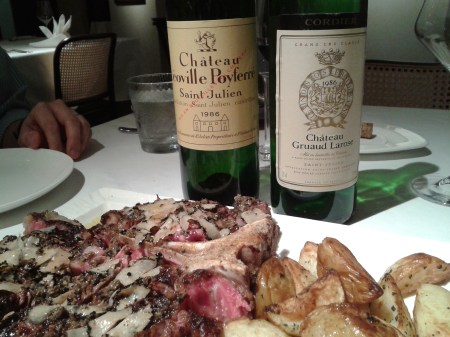 There was an abundance of earthy, mild medicinal aromas from a wine that was initially almost full-bodied, full of spice and attack. It softened considerably after some time, with more of wild mushrooms and cassis appearing, very linear with excellent depth and layering but still slightly backward in overall impression in spite of all its 26 years. Side by side, the 1986 Ch Leoville Poyferre (my third bottle from a case imported from Bordeaux Index), decanted on site, was much softer and open right from the first pour, medium-bodied, the red and dark fruits still decent in concentration, yet to dry out, but clearly fully matured and mellow. Although not quite the last word in complexity, the wine still tingled with vibrancy at the edges, fleshing out with more fat in the mid-body over time. Although these wines are drinking very well now, I didn’t quite get a sense of the usual St-Julien terroir, missing in the ferrous minerality, tobacco, toast and cigar box characters, though I fancy the Gruaud-Larose was fuller and has the legs to last longer. My thanks to John for organising this dinner. And oh…have I mentioned that La Barca is now BYO on Wednesdays?
Notes in brief (Sep 2012): 1990 Pavie, 2006 Clos du Marquis, 2006 Grand-Puy-Lacoste
2011 Sileni Hawkes’ Bay pinot noir, SGD70 off the restaurant list of Barossa, 5 Sep 2012, paired with its all-you-can-eat steak buffet. Popped and poured, displaying a very clear lovely rosy tint with attractive aromas of sweet cherries, raspberries and ripe strawberries, very bright and uplifting. The wine is gentle and well-balanced on the palate with just the right weight and presence, just a tad full in light of its youth, finishing with a touch of sea salt. A good drop.
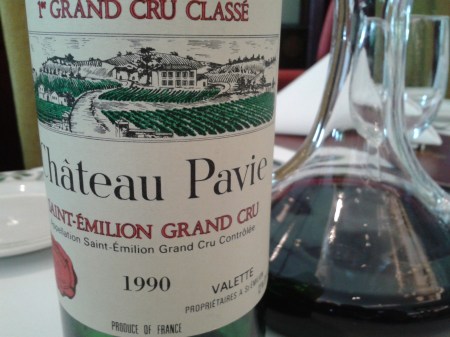 1990 Ch Pavie (courtesy of John), over a succulent prime rib at Lawrie’s, 7 Sep 2012. Decanted on-site. Dull purple with some mild bricking at the rim. Notably restrained. It required quite a bit of patience before notes of raspberries, dark berries, some violet and cedar could be coaxed from the glass. The wine was distinctly mature, soft and medium-bodied on the palate with a touch of ferrous quality at the finish, the fruit rather backward for a 1990 such that it lacked opulence and lushness, almost nondescript without imparting a sense of terroir. To be honest, if I’d tasted it blind, I wouldn’t have known it’s a 1990. Could certainly do with more soul and character.
2006 Ch Clos des Prince, at Jade Palace, 8 Sep 2012. Popped and poured. Deep purple, possessing good weight and concentration although its bouquet was, at best, generic, the wine straightforward and one-dimensional on the palate. Surprisingly though, it opened up some 45 minutes later, revealing more layering within and better definition of flavours, offering notes of blueberries, sultanas and earth, smooth on the palate with unobtrusive tannins. Not bad.
2009 Domaines Leflaive Macon-Verze, paired with home-cooked pasta, 10 Sep 2012. My third bottle in as many months, with consistent notes. Generous flavours of green apples, melons and yellow citrus dominate, well-balanced against the lively acidity, supported by a rich bed of earthy minerality that added a steely note or two to the finish. Very good indeed. As I’d commented before, this is the best vintage for this wine. Will age well.
2005 Ch De La Tour Clos Vougeot Grand Cru (courtesy of David) at Otto Ristorante, 12 Sep 2012. Aired in bottle on site. A heavier shade of pinot, translating into a bigger wine that is consistent with Grand Cru from this plot. Generous with notes of strawberries and dark cherries, medium-full, rather tight and savoury initially but it opened up quite rapidly, lightening up in texture as brighter notes of raspberries began emerging, supported by abundant earthy minerality that eventually tapered to a slightly dryish finish. Didn’t quite achieve the expected level of lushness, however, in spite of its excellent concentration. Nonetheless, this is highly satisfying, a wine that can hold its place amongst good food and company.
2006 Ch Grand-Puy-Lacoste, poured from magnum at La Barca, 14 Sep 2012. Decanted on-site. This wine is drinking superbly now, seemingly having gained more weight and concentration over the past year, throwing off notes of red fruits, cherries and rose cordial that seemed almost Burgundian. On the palate, the wine is rounded in tone and body, framed by subdued tannins, remarkably fresh with just barely a hint of the Pauillac dryness towards the finish. Quite the epitome of elegance and balance, the perfect accompaniment to the outstanding 1.5 kg Fiorentina steak. Excellent.
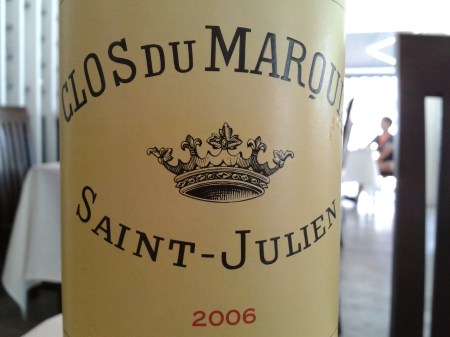 2006 Clos du Marquis (courtesy of Ben), at Wall St Bistro, 19 Sep 2012. Popped and poured. A lovely shade of purple, exuding powerful aromas of ripe wild berries, raspberries and blueberries with a mild tinge of vanilla, hinting at a dense opulent wine. However, this couldn’t have been further from truth, for the wine was very open and transparent on the palate, almost delicate, gentle at the edges. It gained further in intensity over time, the tight svelte tannins sweeping most attractively across the palate, leaving traces of sweet essence in its wake. This is really good. Distinctly Bordeaux, the only criticism being that it had little, if at all, of Saint Julien in its character.
2006 Domaine Ramonet Chassagne-Montrachet “Le Boudriotte” 1er Cru, at Al Borgo with Ben and Vic, 20 Sep 2012. Popped and poured. Generous bouquet with aromas of ripe rock melons, green apples and limey citrus. Rich, almost creamy on the palate, well-supported by understated minerality, tapering to a quiet but complex finish. Still far from maturity even though it is very lovely now. Excellent.
2002 Ch Le Hermitage (courtesy of Ben), popped and poured at Al Borgo, 20 Sep 2012. I had not encountered this St Emilion estate before, and so was curious to see how it’d turn out in this vintage that most people try to avoid. It turned out quite well, surprisingly, the wine deep purple in color, made in a fruit-forward style that showed off nicely notes of dark berries, raisins, earth and a trace of licorice, well-extracted and slightly tarry, carrying excellent weight and definition, if not outright opulence. This style of wine thrives well in difficult vintages.
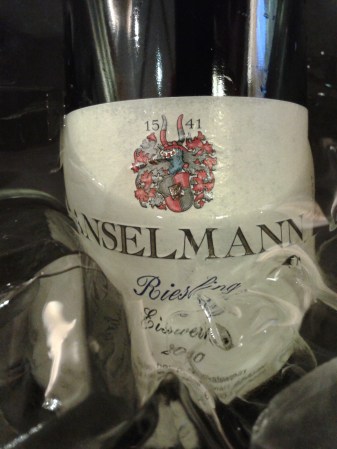 2010 Anselmann riesling eiswein, aired in bottle for almost an hour being served at Asia Grand, 22 Sep 2012. Purchased for less than EUR30 at Frankfurt duty-free. Notes of ripe pear, apricot, melons and orangey citrus dominate, medium-full with an illusion of fizz on the palate, decent in complexity, the sweetness neither overbearing nor superficial. Lively and refreshing. Worth every cent at this price.
2005 Ch L’Arrivet Haut Brion, decanted on-site at Moomba, 28 Sep 2012. Compared to a previous bottle about 3 years ago, this wine seemed to have evolved quite significantly with generous notes of ripe blueberries and dark currants married to fine supple tannins, medium-full yet soft-grained, excellent in concentration and depth without any vegetal trace that commonly plague these peripheral estates, eventually settling into a fleshy and seamless wine. This is the finest example I’ve had from this estate and I’d certainly acquire more if the price is right.
Notes in brief (Aug 2012): 2009 Domain Rd, 1993 Carpineto Montepulciano Riserva, 1983/1999 Leoville Las-Cases…
2000 Ch D’Angludet, at the newly-renovated Prive, 1 Aug 2012. Popped and poured. Compared to a previous tasting some 6 months ago, this bottle seemed rather unsettled. For sure, there’s substantial quality fruit that’s beginning to develop secondary nuances of cedar and violets, supported by a slightly salty minerality but, at the same time, there are traces of vegetal notes at the edges that dampened the bouquet, resulting in a fair degree of unevenness on the palate. However, another bottle (my last) from the same batch tasted just a week later (10 Aug) at Wall St Bistro was much more successful, displaying none of the greenness. A qualified buy, if the price is right.
2007 Ch Les Carmes Haut Brion, my final half-bottle of this wine at Wall St Bistro, 3 Aug 2012. Popped and poured. Deep glossy purple, displaying very good density of ripe raspberries, dark currants and other wild berries, almost full-bodied with well-managed tannins, finishing with just a trace of ferrous minerality. Still hasn’t shed its coat of vanilla. Somewhat one-dimensional at this stage. Give it another 3-5 years and you’ll probably catch it at its sweet spot.
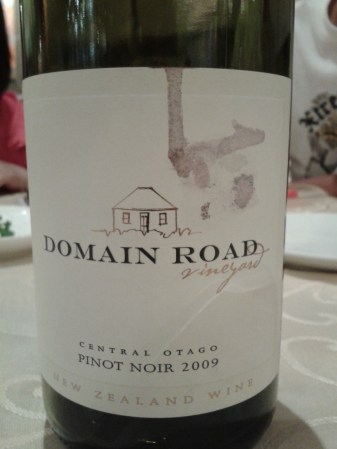 2009 Domain Road pinot noir, at Jade Palace, 4 Aug 2012. This is top quality stuff, almost superb. Popped and poured. One expects, at this stage, the pinot to be more forward and that is, indeed, the case. Saturated with top-drawer fruit with generous notes of ripe raspberries, dark cherries and redcurrants but not over-extracted, coupled with fine supple tannins that are very well-integrated into the slightly salty minerality with excellent depth and transparency, although it doesn’t quite possess the layering of a true Bourgogne. But this is really an excellent pinot noir in its own right regardless of its bargain price and I daresay it will be glorious in another 5-7 years. Buy.
2009 Domaines Leflaive Macon-Verze, popped and poured at Hinoki, 7 Aug 2012. As good as my initial encounter just a couple of months ago in June. Excellent body with subdued minerality, allowing more of the fruit to come forward. Mainly notes of green apples, melons and citrus, lively without the cutting acidity. Very good.
2001 Ch Lafleur-Gazin, at Hinoki, 7 Aug 2012. Aired for an hour in bottle. This is drinking rather well now. Rounded and mellow. Notes of redcurrants, wild berries and a bit of plum with adequate depth, although it lacked the gloss and density of the better known Pomerol heavyweights. More feminine, I’d say, all the better to match the delicate Japanese cuisine.
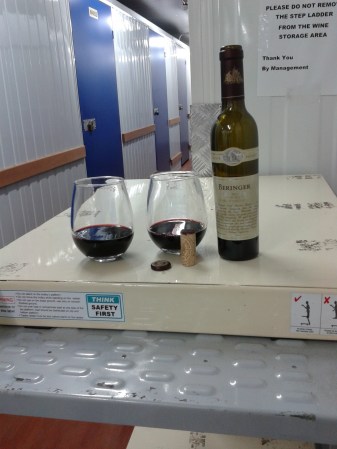 2001 Beringer Private Reserve cabernet sauvignon, a half-bottle courtesy of Kieron at an impromptu meet-up at our off-site cellarage at Extra Space, Kallang, 9 Aug 2012. I must say I cannot recall the last time I’d drunk a glass of wine at an ambient temperature of 13 degrees Celsius. Aired in bottle for about 30-45 minutes, and drunk over the next hour. Dark inky red, saturated with ripe cabernet, more fruit forward, cloaked in supple discreet tannins with very little of the dryish character of a Bordeaux. Highly enticing on the nose where there is an abundance of plummy fruit amidst dark berries and other notes of dark chocolate, licorice and raisins, although it is still rather tight and it seemed to recoil into its shell after some time. Don’t be mistaken – there is no suggestion of a fruit bomb whatsoever; just a top-notch straight cabernet that needs another decade of cellaring to do it justice.
2004 Ch Latour-a-Pomerol, at Trattoria L’Operetta, 10 Aug 2012. Part of a case imported from Bordeaux Index. Popped and poured. In spite of having spent some time in bottle, this wine is still far from ready for drinking, saturated with loads of ripe dark fruits, slightly tarry, boasting excellent structure and sophisticated tannins, but the wood and vanilla is still way too evident, not helped by the fact that the restaurant is extremely warm, hardly the right setting to appreciate a good bottle in spite of the excellent food. Guess I shouldn’t pop any more of these until 2014, perhaps.
2010 Elderton Merlot, courtesy of Vic at his office, 14 Aug 2012. Popped from screw cap. This is not the estate’s flagship bottling, but it was, nevertheless, most impressive. Saturated with ripe Barossa fruit with its unmistakable warmth and notes of orangey citrus, raisins, chocolate and licorice, very well crafted such that it was never jammy, full-bodied without knocking out your palate. Weighty and layered. If I hadn’t glanced at the label, I’d have thought I was drinking a shiraz, such was its vibrancy and verve. A class act.
2006 Albert Ponnelle Eschezeaux Grand Cru (courtesy of LW at her farewell party), back again at Tratorria L’Operetta, 15 Aug 2012. Popped and poured. Medium-bodied, salty, smoky with a spicy trail arising from a tannic spine, lacking in subtlety. Hardly distinctive, in spite of its supposed lofty origins. To be fair though, as I’d mentioned earlier, the ambient temperature at L’Operetta is far too warm for any kind of meaningful wine appreciation. A pity, as the food is good. I wouldn’t come back again if I’m bringing a bottle.
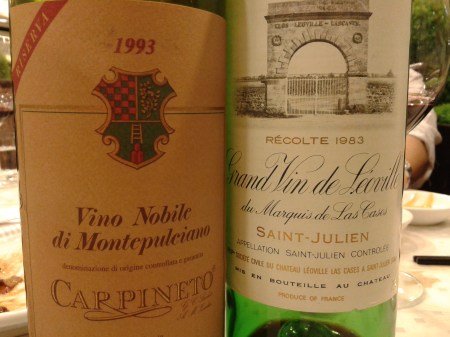 1983 Ch Leoville Las-Cases (courtesy John) at Imperial Treasure Nan-bei on 15 Aug 2012, shared with PS as well. My second time with this wine in as many months. Decanted on-site; only about a third was remaining by the time I arrived. This is probably the best example of this wine, by far. Rather dark in color, indicative of a slow evolution, still remarkably fresh and lively. There is that powerful hallowed glow of a mature claret all over with complex notes of plum, dark orange, cinnamon and dark currants amidst the dry flavours of mushrooms and tea leaves, beautifully proportioned with excellent depth and layering, laced with just a trace of ferrous minerality that’s unmistakably Saint Julien. This can easily last for many more years. Outstanding.
1993 Carpineto Vino Nobile di Montepulciano Riserva, at Imperial Treasure Nan-bei on 15 Aug 2012, shared with PS and John. This is part of a vertical presented to me last Christmas by Steven and Rosy. Decanted on-site, displaying a deep purple with an evolved rim. There were notes of violets, blueberries and some darker fruits on the bouquet as well as palate initially, where it certainly possesed excellent weight and depth although it was somewhat disjointed on the mid-body, the flavours seemingly more concentrated at the bottom, finishing with a dash of spice and pepper. It quickly settled into a more seamless entity, the merlot component emerging to dominate the palate with supple plush tannins, sloshing around in the absence of a cabernet structure while the predominant sangiovese provided a plummy note in the background, together with a trace of salty minerality, reveling in its Tuscany terroir. It remained in this manner for the rest of the evening, remarkably lively, fresh and youthful still. Quite superb.
Henri Giraud Esprit de Giraud NV, at Salt Grill and Sky Bar, ION Orchard, 17 Aug 2012. Popped and poured. It ticked all the right boxes with quite a generous dollop of oxidised yeasty overtones, malt, crackers and toasty oak supported by crystalline minerality of decent weight. Would have been very good if the bubbles had been softer and more open, but at least it wasn’t acerbic. Preferable than the ubiquitous Charles Heidsieck or Verve Cliquot.
1989 Ch Chasse-Spleen, at Onion restaurant, 17 Aug 2012. Popped and poured over 90 minutes. Amazingly full-bodied and almost hedonistic in spite of its bottle age, with the ripe cabernet exuding notes rich in blueberries, blackcurrants amidst velvety sexy tannins. This eventually settled into a more open, medium-bodied and seamless wine with the hallmarks of a mature claret, dominated by an attractive salty minerality. Lacks the last ounce of depth and complexity that a classified growth can summon, but this is very satisfying over a good steak.
Verve Cliquot Rose NV, at ordered off the wine list (not by me!) of Melt World Cafe, Mandarin Oriental hotel, 20 Aug 2012. There are notes of what could pass off as cherries and melons, but I didn’t get a sense of the yeasty oxidation nor depth, the entire wine being just a dry brazen one-dimensional blitz on the palate. Forgettable.
2001 Ch Bernardotte, poured from magnum at Porta Porta (Stanley St), 21 Aug 2012. Soft and fleshy with notes of blueberries and other wild berries, ripe and classic in poise and balance without any of the vegetal characters commonly found in Medoc wines, possessing fairly good definition. Highly attractive and drinking well.
2002 Domaine Faiveley Gevrey-Chambertin Champonnet 1er Cru, popped and poured at House, Dempsey, 25 Aug 2012. I find that restaurants nowadays in Singapore are too warm to allow for proper appreciation of a wine’s character, and this instances no exception, perhaps contributing to the attenuated body, dominated instead by a rather sharp tannic attack. However, this eventually settled over time, turning into a medium-bodied wine with some lovely notes of rose cordial and cherries, supported by a bed of earthy minerality, slightly salty, rounded and soft at the edges, almost taking on an oily note in the mid-body after an hour, becoming quite harmonious. 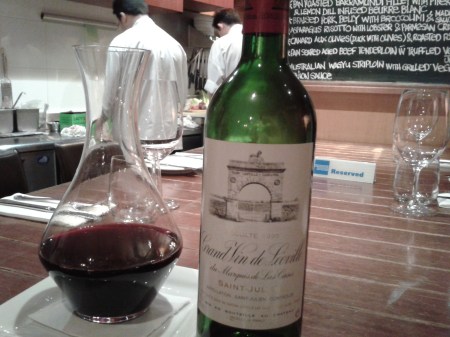 Undeniably attractive, but would have been better had we drunk it in a cooler environment.
1999 Ch Leoville Las-Cases, decanted on-site at Mag’s Wine Kitchen, 25 Aug 2012. Dark red with just a hint of bricking at the rim, offering loads of dark berries, earth, and sparkling ferrous minerality that was palpable even on the nose, excellent in concentration with generous notes of soy, graphite, traces of plummy fruit and secondary nuances of cassis and dried herbs, brimming with quiet intensity and tightly-knit tannins. This wine has yet to peak, but I like so-called off-vintages that are caught just before they peak, when they are most exciting. Excellent.
2003 Ch Duhart Milon, at Wall St Bistro, 30 Aug 2012. Decanted on-site and drunk over the next 90 minutes. All the signs of a hot growing season are there, the wine displaying a raisiny note with a discernible trace of burnt at the edges although it is full and rounded on the mid-body, the ultra-ripe fruit taking on an unprecedented level of sweetness that goes well with the lowish acidity, the wine somewhat unresolved at the finish although the absence of any alcoholic heat was most welcome. Ultimately, it lacks real distinction, its character atypical for a claret.
2007 Poggio Al Santi Montepulciano d’Abruzzo, SGD69 off the restaurant list of Donna Carmela, 31 Aug 2012. Decanted on-site and drunk over the next hour. Highly attractive on the nose, fruit forward with notes of plum, strawberries and a mix of red fruits and orangey citrus that came on strong with a sharp tannic attack when first tasted, somewhat light-bodied. It settled very quickly, gaining weight, the tannins receding away rapidly to produce a very smooth, rich and even wine, developing some degree of dryness over time. Not bad at all.
Penley Estate: An evening with Kym Tolley
I’ve long been an admirer of Kym Tolley and the wines he makes at Penley Estate, Coonawarra, South Australia, having visited the estate on three different occasions since 2003 and being privileged enough to have had several bottles of the outstanding 1998 Penley Estate Reserve Cabernet Sauvignon, in addition to the 2002 and 2004 vintages. When the opportunity arose to meet him in person at a tasting of the wines of Penley Estate at The Marriott, Singapore, 28 Aug 2012, organised by Ponti Wine Cellars, I had no hesitation in showing up. 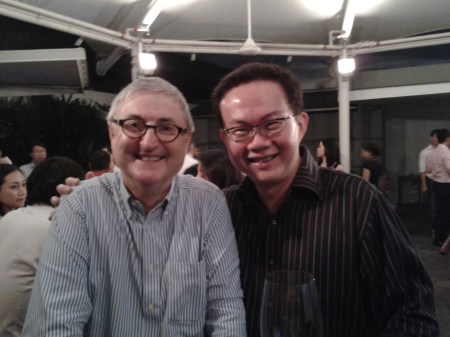 Kym turned out to be highly affable, relating how his mother was related to the Penfolds family, which provided Kym the opportunity to helm the estate’s famous Bin 707 Cabernet Sauvignon before he eventually left to found Penley, the name being a hybrid of PEN (from Penfolds) and LEY (the suffix of Tolley).
2009 Penley Estate Arcadia Chardonnay. Lovely bouquet of melons, white flowers, green apples and fresh citrus, rich on the mid-palate with loads of chalky minerality that was a tad overwhelming, laced with fresh acidity at the sides. Very agreeable and I’d be happy to pair this with a succulent Alaskan crab or any of my favorite Asian dish.
2009 Penley Estate Phoenix cabernet sauvignon. Dark impenetrable red, loaded with ripe cabernet with notes of dark cherries, wild berries, bitter chocolate and a hint of forest floor, coated at this stage by a sheen of vanilla and a trace of emulsion from the new oak – tight, concentrated and weighty on the palate, slightly peppery at the finish. However, one is struck by the immaculate balance, structure and restraint in spite of its youth, surely the result of Kym’s expert craftsmanship. It may not be the estate’s flagship cabernet, but this wine has enormous potential.
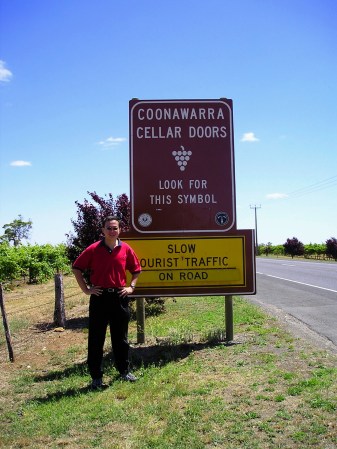 2010 Penley Estate Hyland Shiraz. Dark impenetrable red with dollops of racy red fruits and dark currants, with shiraz that is undeniably ripe yet cool in temperament (a hallmark that I’ve noted in Coonawarra shiraz, as opposed to the warm and plummy Barossa shiraz), slightly spicy towards the finish, resulting in a wine that is full-bodied yet elegant without any of the alcoholic heat that tends to accompany shiraz. I don’t usually pay attention to this line, but I must say I’m suitably impressed. Good stuff.
2009 Penley Estate Condor Shiraz Cabernet. This is probably the least satisfactory in the evening’s line-up. There’s nothing wrong technically, the warmer shiraz framed within a discernible cabernet structure, but it just doesn’t gel. Far better to stick with either the straight cabernet or shiraz above.
2005 Penley Estate Special Select Shiraz. Deep purple. In spite of all the relative heavyweights that had coated the palate earlier in the evening, one is immediately struck by the predominant red fruits, bright cherries and rosy fragrance on the bouquet, producing a powerful aromatic lift that carried the deep vein of fruit with it on the palate, medium to full-bodied, structured and elegant, finishing with a controlled mix of mint and other medicinal aromas. Will be quite stunning after another 5-8 years in bottle.
Although the estate’s flagship Reserve Cabernet Sauvignon was missing from the line-up, this was a good opportunity to acquaint oneself with Penley’s other wines. I must say I came away with a great deal of newfound respect for the excellent work and philosophy of Kym and his team, for one is struck time and again by the balance, elegance, restraint and ageing potential, which I feel is the most attractive aspect of the wines, and I’ll be sure to catch up with him at Penley on my next trip to Coonawarra.
1999 Bruno Paillard Assemblage, an aperitif recommended by Director of Wines Timothy Goh at Les Amis, 24 Aug 2012, taking on a noticeably heavier golden hue than usual. Immeasurably complex, where the bouquet of toast, malt, light citrus, a touch of pungent yeast and roasted almonds exploded on the palate with bursts of crystalline starlight amidst soft bubbles that were ever so refined and gentle, generous and lengthy, finishing with a twist of pomelo and grapefruit.  The wine took on an even greater purity and intensity after the bubbles had faded, with an added sweetness and creamy overtone. This is still not the most profound of champagnes I’ve had but it is wonderful.
We followed that up with a 1996 Michel Lafarge Beaune-Greves 1er Cru. Aired in bottle, showing a lovely pinot tint, just a shade darker than usual that promised a fully mature wine, displaying attractive aromas of red fruits and roses, striking an excellent balance between the ripe pinot fruit and the slightly salty, earthy minerality with a good deal of depth and length, absolutely harmonious without any hint of rusticity. I never knew Beaune reds are capable of such elegance and finesse. It may not have that added lushness nor layering of a Chambertin or Musigny, but priced well below SGD200 off the restaurant list, this wine is most satisfying.
La Conseillante: 1976 & 2004
Two bottles drunk side-by-side at Porta Porta (Stanley St), 21 Aug 2012. After having had a wonderfully superb 2004 Ch La Conseillante about 3 years ago where it was surprisingly open and inviting, I thought it’d be worth re-visiting again. Aired in bottle for an hour. This time round, the 2004 appears to be darker and tighter, initially teasing the nose and palate with notes of dark fruits and currants from a concentrated pool of ripe fruit, reasonably soft without any jarring edges, ending on a mild peppery note with a trace of new wood, but nothing effusive, the overall demeanour being one of restraint, almost shut. 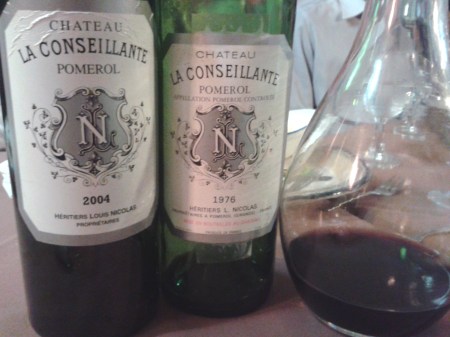 Over time, it just kept opening up bit by bit to reveal more of red fruits that initially appeared towards the finish before gaining further prominence, such that by the time dinner was almost over, a lovely rosy bouquet was leaping out of the glass and the wine much more palpably relaxed. I think it is coming through the usual awkward phase when the wine is between 5-8 years of age, so probably best to lay your remaining bottles until after 2015.
If you want to know how the above wine would be like when fully matured, I suppose the 1976 Ch La Conseillante (courtesy John) may yield some clues. Decanted on site and drunk over two hours, displaying a vermillion core with a good deal of bricking. The cork had disintegrated, but the wine was still remarkably fresh, somewhat weak on the nose but it was definitely well and alive on the palate with notes of red fruits and cherries, reasonably bright and pure and almost Burgundian although time has robbed a good deal of its acidity, still carrying decent weight and length, staying the course throughout dinner without fading away. Quite impressive. I have never been disappointed by La Conseillante and this tasting appears to confirm my point of view.
1983 Leoville Las-Cases, 1995 Calon Segur, 1999 Pichon Baron…
Some brief notes from a dinner at the reliable Restaurant Ember, 18 July 2012, on the occasion of a farewell dinner for LW before she leaves for sabbatical. As usual, when we’re out of ideas, it’s always Bordeaux. All wines were aired in bottle on site, and tasted simultaneously.
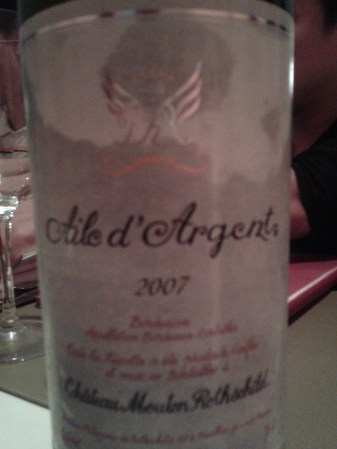 2007 Ch Mouton Rothschild Aile d’Argent (courtesy PS). I wasn’t aware that Mouton made this, a blend of sauvignon blanc, muscadelle and semillon, hence accounting for its light golden color with aromas of fig, white flowers and traces of honey, supported by clear crystalline minerality. Yet to shed its vanilla coat. Not quite as full on palate, although it became weightier over time, taking on a mildly austere note. Interesting, but I think I’ll stick to white burgundy.
I didn’t have high hopes for the next wine, a 1999 Ch Pichon Longueville Baron, finding it woody and bereft of quality fruit last time I had it over a year ago. On this evening, it had the most promising bouquet of raspberries, dark and red berries with a plummy note, complete with the dryish Pauillac character although, as expected, it was a letdown on the palate initially, the fruit seemingly having thinned out alarmingly. What I hadn’t expected was the dramatic turnaround after it had been aired for well over an hour, when it suddenly transformed into a wine of considerable presence and weight, beautifully integrated, rounded and balanced, fleshing out with red fruits all the way. Quite lovely, really, if not exactly lush.
 The 1995 Ch Calon Segur (courtesy Hiok) that followed had an abundance of largely red fruit, warm, ripe and highly inviting, the supple cabernet structure lined by silky tannins that caressed the palate with a smooth and easy touch, with some of the dry overtones of neighbouring Pauillac creeping in. This is probably the third time I’ve had this wine in as many years, with consistent notes each occasion. Excellent.
I recalled the last time I had a 1983 Ch Leoville Las-Cases (courtesy KP) was back in Aug 2006, where I remembered it to be soft, pliant and relaxed, seemingly entering into its autumnal phase after obviously having been quite gorgeous at its drinking peak. On this occasion, this bottle was quite consistent with my previous impression, although I felt that it was livelier and fresher, fully matured with a generous effusive glow of an aged claret, lush and utterly seamless with just a trace of ferrous minerality to remind you of its Saint Julien origin. Beautiful.
Finally, we rounded off the evening with what was perceived to be a heavyweight, the 2003 Clos des Papes CdP (courtesy Vic). It lived up to expectations, a dark impenetrable red, coming across with loads of redcurrants and ripe brandied cherries, topped off with rich medicinal overtones. I can’t really say I like CdP enough to enjoy it, but I think it deserves to be left untouched for another 8-10 years.
Notes in brief (July 2012): 1986 Poyferre, 1999 Bonneau du Martray, 1996 Montrose, 1996 Malescot St-Exupery, 2006 Pintia…
2010 Vincent Girardin Bourgogne blanc (courtesy Ben), at Wall St Bistro, 6 July 2012. Popped and poured. Lighter in style with an attractive clear crystalline minerality imbued with some vanilla fragrance, white pepper and a dash of white flowers. Slightly short at the finish and congested on the mid-palate at this stage. Needs another 2-3 years to sort itself out but undeniably a good drop at only SGD37, direct from J D Burleigh.
2005 Ch Lalande Borie, at Wall St Bistro, 6 July 2012. Popped and poured. I’m halfway through a case that I bought last year, and it gets better and better each time. At this stage, it is saturated with notes of ripe raspberries and blueberries, slightly “gritty” on the palate (I find this attractive) with a dash of vanilla. 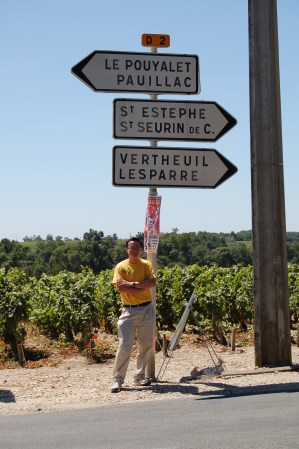 Utterly smooth and seamless. It took on an even more sophisticated sheen after about 45 minutes, oozing with class and confidence. Thoroughly delicious. Buy!
1996 Ch Malescot St-Exupery, at Wall St Bistro, 6 July 2012. Aired in bottle for almost 2 hours. The initial impression was that of a wine stripped of its excesses, just a predominance of red fruits against an earthy backdrop framed by mild supple tannins. It then gradually grew in weight and character, developing the characteristic hue of mushrooms and dried herbs that’s classic of a well-aged claret whilst becoming more forward with a touch of creme de la creme, imparting a sense of lushness, immeasurably complex. It’s just entering its drinking window, and will probably remain at its peak for years. Excellent.
1999 Domaine des Comte Lafon Volnay Santenots-du-Milieu 1er Cru, a late night cap at Taberna, 12 July 2012. This premier cru from the Cote de Beaune is an astute selection by Kieron, considering that this renowned producer hardly makes any reds. Darker and perhaps more extracted than usual for pinot with a generous bouquet of plummy fruit and strawberries. Weighty on the palate, where it came across as still being rather tight and dense with a significant tannic attack towards the finish. I didn’t quite get a sense of the layering. Perhaps we’ve under-estimated its bottle age. Needs more time.
2006 Pintia by the glass, with the compliments of Caveau at the opening of its new wine bar, 13 July 2012. This is simply quite outstanding, displaying an abundance of aromatic raspberries and blueberries, very open and inviting, caressing the palate with chewy savoury tannins that led to a lasting finish. Way better than the 2003, which is far too tannic. Buy.
1998 Parker Estate Terra Rossa First Growth, at House restaurant, 14 July 2012. Decanted on-site. This is a coveted vintage for South Australia, and it shows. Still youthful in appearance, saturated with ripe dark berries and ferrous minerality of excellent concentration and density that provided an aromatic lift towards the finish, framed by a cabernet structure of subtle velvety tannins, managing to avoid the usual heaviness. However, it seemed to lack the layering and secondary development that I was searching for. Will still keep for many more years.
1996 Ch Montrose (courtesy John), at Otto Ristorante, 18 July 2012. Decanted on-site. This is quite superb. Still showing a deep garnet red with just a trace of bricking at the rim, exuding effusive aromatics that are more fruit-forward than usual for a 1996 with an abundance of sweet dark berries, tarry in character, beautifully integrated with the classic Bordeaux dryness at the sides, becoming fuller and developing a bit of an attack after some time before settling into a languid, rounded and layered wine that’s almost voluptuous, quite unheard of for a Montrose. I could just stick my nose inside the glass all day. Very lovely.
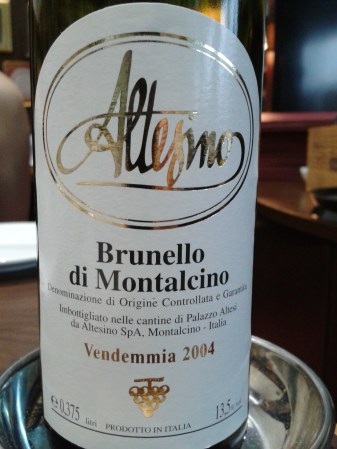 2004 Altesino Brunello di Montalcino, a half bottle at Amarone Ristorante, 19 July 2012, SGD72 off the restaurant list. More evolved in color than I’d expected but even then, it was rather restrained and unresolved on the palate initially, finally revealing its true colors only an hour later as the plummy note of sangiovese appeared, together with early secondary nuances of dark cherries and a hint of raisins amidst deeper, medicinal aromas. Enjoyable.
1999 Bonneau du Martray, private dining at Tunn’s celebratory dinner at Absinthe (now relocated at Boat Quay), 20 July 2012. Aired briefly in bottle. There were initial notes of coconut and apples, much less of the usual butter and cream, but in spite of the significant bottle age, it was still rather concentrated and tight with quite a bit of brazen attack initially on the palate. I got the impression that it began to fade quite considerably as it warmed up in the glass, and a certain oxidised note seemed detectable at the edges. Rather underwhelming for this producer, confirming my impression from two previous bottles (from the same case). Frankly, I’d expected it to be a lot more racy and exuberant.
1986 Ch Leoville Poyferre, private dining at Tunn’s celebratory dinner at Absinthe, 20 July 2012. From an OWC which had just arrived two weeks prior from Bordeaux Index, London. Poured from two identical bottles that were decanted on-site and aired for around 90 minutes before serving. Both were remarkably consistent, displaying a deep garnet red at its core. A gorgeous bouquet of predominantly ripe red fruits and raspberries amidst some bluberries and dark currants, leading to a medium-bodied high-toned wine with a touch of salty, earthy minerality on the palate, layered and open, suitably complex. Not at all backward. Absolutely at its drinking peak with all indications that it will continue to hold for many more years. Wonderful.
1994 Ch Montrose, at Saint-Pierre, 31 July 2012. Aired on-site in bottle. Probably at its best for this particular vintage. Dark vermillion, soft, fleshy and rounded, medium-bodied with fruit that is decent in quality with a few bright spots without any dryness, aided by the recessed tannins, well-integrated although lacking in definition and lushness. A good drop nevertheless, as long as the food and the company is great.
2003 Mouton Rothschild, 2006 Climens, 1999 Dom Perignon…
It was very kind of Ms Angelina Teh from the Singapore office of Bordeaux Index to invite me for dinner at Imperial Treasure Great World on 11 July 2012, saying she couldn’t wait to share with us a bottle of 2003 Ch Mouton Rothschild. I can’t imagine anyone would turn down such an offer. And so, we duly showed up and drank the following over a simple but highly-refined Cantonese cuisine.
1999 Dom Perignon (courtesy Kieron). Soft bubbles, subdued effervescence, leaner than the 2000, the citrus notes gelling very well with the crystalline minerality without much of the usual oxidation. A quiet bystander, but it certainly has the stuffing to hold its own against more exuberant rivals. A good start.
2007 Peter Michael Mon Plaisir. Aired in bottle for an hour. Too cold initially, resulting in a subdued affair although notes of green apples and melons with a mild grassy overtone were apparent. As the temperature warmed up, and with further airing, it fleshed out considerably, gaining in body and presence with further notes of bananas, pineapples and other tropical fruits emerging nicely, just missing the last ounce of complexity that comes from a Burgundy. Lovely.
 2003 Ch Mouton Rothschild (courtesy Angelina). We had been promised that this wine, contrary to all expectations, is drinking very well now, and it certainly was. Aired in bottle considerably before being served. Very open on the nose, with some of the classic Pauillac signature of tea leaves and tobacco box already apparent. Incredibly, it became even more open over time, the wine soft and fleshy against the recessed wood and tannins, leaving behind just enough of the cabernet structure without any tell-tale sign of burnt, just missing in tertiary characteristics at this stage. It reminded me of other wines of 2003 that I’ve had over the past year — Clerc Milon, Sociando Mallet, Lagrange — that had, similarly, seemed to be evolving at a much faster pace than usual for Bordeaux. An effect of the heat-stressed vintage?
 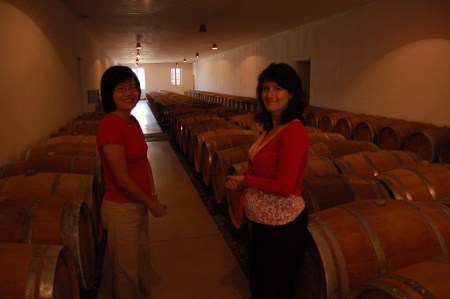 Will it last the distance, or fall off the cliff completely? Only time will tell. But if you do have enough of this wine to spare, now is a good time to get to know it better.
2006 Ch Climens (courtesy Pipin). In my opinion, Climens is the true flagbearer of the entire Bordeaux dessert wine industry. Classic Barsac character, where making an understatement is the order of the day. Apricot, some honey, fig, sancha, sparkling with just the right level of acidity and a deeper vein of orangey citrus amidst a certain austre steeliness. Superb at this stage, and should hold for many years to come. The perfect way to conclude a wonderful evening. My sincere thanks to everyone for their contributions.
From The New World: 1996/2006 Ridge Monte Bello, 1988 Dominus, 1991 Mondavi, 2006 Colgin…
The wine theme for this dinner drew its inspiration from Kieron’s return from the New World. Naturally, there’s an unspoken rule amongst Bacchus to drink either well-matured wines from well-known estates, or any vintage from cult producers, and I think what we had this evening, 9 July 2012, at Jade Palace was fairly consistent.
Dinner began with an Alaskan King crab, frog legs and soon hock fish, all washed down with the less commonly found 2009 Kistler Hyde Carneros Chardonnay (courtesy Kieron). This weighty chardonnay was rich in notes of tropical citrus, melons, honeydew and pomelo that were more dense towards the finish, well supported by a crystalline minerality that turned more austere over time, providing excellent contrast to the creamy buttery texture. Very, very fine although it still doesn’t quite measure up in true complexity to a true Burgundy. But it is quite superb in its own right.
Moving on to the reds, we paired the 1988 Dominus with a 1991 Robert Mondavi Reserve Cabernet Sauvignon (courtesy Vic). The Dominus, aired in bottle and decanted only just before serving, was the distilled essence of a great wine, stripped of all unnecessary frills and decoration. What was remaining was just pure fruit, still remarkably fresh and vibrant, the tannins and wood no longer evident, just missing initially in the classic dryness of a Bordeaux though making up for it by gaining in weight and intensity over time, becoming more youthful and exciting. Outstanding. In contrast, the Mondavi, still a very dark red, was immediately heavier with a trace of sweet plums, showing great concentration and weight without being jammy, beautifully open yet bursting with youthful vigor even after 21 years. 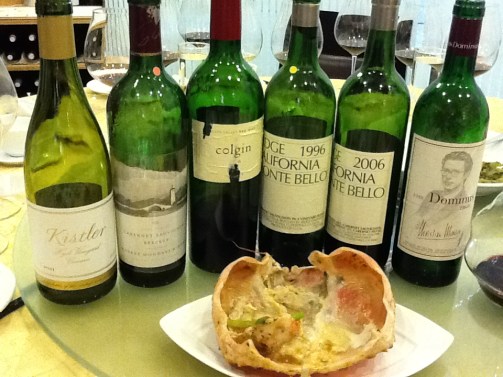 It became incredibly complex after some time, developing some semblance of Bordeaux dryness and just got better and better. Superb. But perhaps best to lay away another 10 years?
As Daniel had confessed that he’d brought a spoiler, we drank his blinded contribution alone as the third red. Aired in bottle, this wine displayed the classic stamp of the Old World, noticeably lighter in color but remarkably open and fresh on the nose, giving off high-toned lifted aromas of predominantly red fruits of immense purity with a slightly pronounced medicinal overtone towards the finish. I was amazed that some people at the table were spot-on in calling it a Rioja, for it turned out to be the 1994 Bodegas Lopez de Heredia Vina Tondonia Rioja, apparently an estate with a cult following amongst lovers of classic Rioja. Excellent.
It made sense to taste the pair of Ridge Monte Bello side-by-side, both of which were almost identical in color, a dark impenetrable red. The 1996 (courtesy Kieron) had, perhaps, just a trace of bricking at the rim and a modest bouquet but it was absolutely glorious on the palate, full, rounded and open, saturated with warm, ripe plummy fruit that was immeasurably complex, but it was clear that this wine was nowhere near its peak and would probably evolve at a glacial rate. On the other hand, the 2006 (courtesy KP), expectedly, was generous in top-drawer fruit that was already developing into a highly polished wine but, at this stage, still primal and concentrated with a pronounced vanilla coat. Great potential, of course, but it ain’t giving anything away. And finally, we were treated to a Californian cult, the 2006 Colgin (courtesy Hiok) which, at this stage, shared more similarities than differences with the latter Ridge – dark inky red, weighty and full-bodied, gripping the palate in a tight grip of dense vanilla, varnish and emulsion, culminating in a hot spicy finish, hardly surprising in view of it’s 15.6% alcohol. If there are one or two take-home messages from this tasting, it’d be that Californian wines keep very well indeed and, in fact, demand to be treated in the same manner as their Bordeaux counterparts, to be drunk only after 20 years.
 Ric's Wine Journal