Notes in brief (July 2012): 1986 Poyferre, 1999 Bonneau du Martray, 1996 Montrose, 1996 Malescot St-Exupery, 2006 Pintia…
2010 Vincent Girardin Bourgogne blanc (courtesy Ben), at Wall St Bistro, 6 July 2012. Popped and poured. Lighter in style with an attractive clear crystalline minerality imbued with some vanilla fragrance, white pepper and a dash of white flowers. Slightly short at the finish and congested on the mid-palate at this stage. Needs another 2-3 years to sort itself out but undeniably a good drop at only SGD37, direct from J D Burleigh.
2005 Ch Lalande Borie, at Wall St Bistro, 6 July 2012. Popped and poured. I’m halfway through a case that I bought last year, and it gets better and better each time. At this stage, it is saturated with notes of ripe raspberries and blueberries, slightly “gritty” on the palate (I find this attractive) with a dash of vanilla.  Utterly smooth and seamless. It took on an even more sophisticated sheen after about 45 minutes, oozing with class and confidence. Thoroughly delicious. Buy!
1996 Ch Malescot St-Exupery, at Wall St Bistro, 6 July 2012. Aired in bottle for almost 2 hours. The initial impression was that of a wine stripped of its excesses, just a predominance of red fruits against an earthy backdrop framed by mild supple tannins. It then gradually grew in weight and character, developing the characteristic hue of mushrooms and dried herbs that’s classic of a well-aged claret whilst becoming more forward with a touch of creme de la creme, imparting a sense of lushness, immeasurably complex. It’s just entering its drinking window, and will probably remain at its peak for years. Excellent.
1999 Domaine des Comte Lafon Volnay Santenots-du-Milieu 1er Cru, a late night cap at Taberna, 12 July 2012. This premier cru from the Cote de Beaune is an astute selection by Kieron, considering that this renowned producer hardly makes any reds. Darker and perhaps more extracted than usual for pinot with a generous bouquet of plummy fruit and strawberries. Weighty on the palate, where it came across as still being rather tight and dense with a significant tannic attack towards the finish. I didn’t quite get a sense of the layering. Perhaps we’ve under-estimated its bottle age. Needs more time.
2006 Pintia by the glass, with the compliments of Caveau at the opening of its new wine bar, 13 July 2012. This is simply quite outstanding, displaying an abundance of aromatic raspberries and blueberries, very open and inviting, caressing the palate with chewy savoury tannins that led to a lasting finish. Way better than the 2003, which is far too tannic. Buy.
1998 Parker Estate Terra Rossa First Growth, at House restaurant, 14 July 2012. Decanted on-site. This is a coveted vintage for South Australia, and it shows. Still youthful in appearance, saturated with ripe dark berries and ferrous minerality of excellent concentration and density that provided an aromatic lift towards the finish, framed by a cabernet structure of subtle velvety tannins, managing to avoid the usual heaviness. However, it seemed to lack the layering and secondary development that I was searching for. Will still keep for many more years.
1996 Ch Montrose (courtesy John), at Otto Ristorante, 18 July 2012. Decanted on-site. This is quite superb. Still showing a deep garnet red with just a trace of bricking at the rim, exuding effusive aromatics that are more fruit-forward than usual for a 1996 with an abundance of sweet dark berries, tarry in character, beautifully integrated with the classic Bordeaux dryness at the sides, becoming fuller and developing a bit of an attack after some time before settling into a languid, rounded and layered wine that’s almost voluptuous, quite unheard of for a Montrose. I could just stick my nose inside the glass all day. Very lovely.
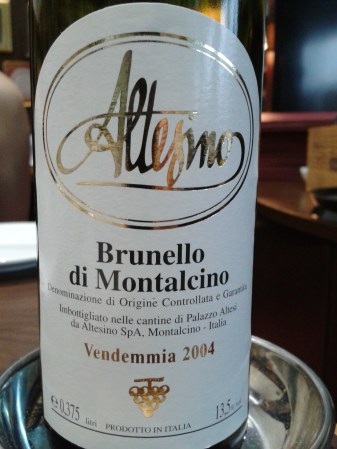 2004 Altesino Brunello di Montalcino, a half bottle at Amarone Ristorante, 19 July 2012, SGD72 off the restaurant list. More evolved in color than I’d expected but even then, it was rather restrained and unresolved on the palate initially, finally revealing its true colors only an hour later as the plummy note of sangiovese appeared, together with early secondary nuances of dark cherries and a hint of raisins amidst deeper, medicinal aromas. Enjoyable.
1999 Bonneau du Martray, private dining at Tunn’s celebratory dinner at Absinthe (now relocated at Boat Quay), 20 July 2012. Aired briefly in bottle. There were initial notes of coconut and apples, much less of the usual butter and cream, but in spite of the significant bottle age, it was still rather concentrated and tight with quite a bit of brazen attack initially on the palate. I got the impression that it began to fade quite considerably as it warmed up in the glass, and a certain oxidised note seemed detectable at the edges. Rather underwhelming for this producer, confirming my impression from two previous bottles (from the same case). Frankly, I’d expected it to be a lot more racy and exuberant.
1986 Ch Leoville Poyferre, private dining at Tunn’s celebratory dinner at Absinthe, 20 July 2012. From an OWC which had just arrived two weeks prior from Bordeaux Index, London. Poured from two identical bottles that were decanted on-site and aired for around 90 minutes before serving. Both were remarkably consistent, displaying a deep garnet red at its core. A gorgeous bouquet of predominantly ripe red fruits and raspberries amidst some bluberries and dark currants, leading to a medium-bodied high-toned wine with a touch of salty, earthy minerality on the palate, layered and open, suitably complex. Not at all backward. Absolutely at its drinking peak with all indications that it will continue to hold for many more years. Wonderful.
1994 Ch Montrose, at Saint-Pierre, 31 July 2012. Aired on-site in bottle. Probably at its best for this particular vintage. Dark vermillion, soft, fleshy and rounded, medium-bodied with fruit that is decent in quality with a few bright spots without any dryness, aided by the recessed tannins, well-integrated although lacking in definition and lushness. A good drop nevertheless, as long as the food and the company is great.
2003 Mouton Rothschild, 2006 Climens, 1999 Dom Perignon…
It was very kind of Ms Angelina Teh from the Singapore office of Bordeaux Index to invite me for dinner at Imperial Treasure Great World on 11 July 2012, saying she couldn’t wait to share with us a bottle of 2003 Ch Mouton Rothschild. I can’t imagine anyone would turn down such an offer. And so, we duly showed up and drank the following over a simple but highly-refined Cantonese cuisine.
1999 Dom Perignon (courtesy Kieron). Soft bubbles, subdued effervescence, leaner than the 2000, the citrus notes gelling very well with the crystalline minerality without much of the usual oxidation. A quiet bystander, but it certainly has the stuffing to hold its own against more exuberant rivals. A good start.
2007 Peter Michael Mon Plaisir. Aired in bottle for an hour. Too cold initially, resulting in a subdued affair although notes of green apples and melons with a mild grassy overtone were apparent. As the temperature warmed up, and with further airing, it fleshed out considerably, gaining in body and presence with further notes of bananas, pineapples and other tropical fruits emerging nicely, just missing the last ounce of complexity that comes from a Burgundy. Lovely.
 2003 Ch Mouton Rothschild (courtesy Angelina). We had been promised that this wine, contrary to all expectations, is drinking very well now, and it certainly was. Aired in bottle considerably before being served. Very open on the nose, with some of the classic Pauillac signature of tea leaves and tobacco box already apparent. Incredibly, it became even more open over time, the wine soft and fleshy against the recessed wood and tannins, leaving behind just enough of the cabernet structure without any tell-tale sign of burnt, just missing in tertiary characteristics at this stage. It reminded me of other wines of 2003 that I’ve had over the past year — Clerc Milon, Sociando Mallet, Lagrange — that had, similarly, seemed to be evolving at a much faster pace than usual for Bordeaux. An effect of the heat-stressed vintage?
  Will it last the distance, or fall off the cliff completely? Only time will tell. But if you do have enough of this wine to spare, now is a good time to get to know it better.
2006 Ch Climens (courtesy Pipin). In my opinion, Climens is the true flagbearer of the entire Bordeaux dessert wine industry. Classic Barsac character, where making an understatement is the order of the day. Apricot, some honey, fig, sancha, sparkling with just the right level of acidity and a deeper vein of orangey citrus amidst a certain austre steeliness. Superb at this stage, and should hold for many years to come. The perfect way to conclude a wonderful evening. My sincere thanks to everyone for their contributions.
From The New World: 1996/2006 Ridge Monte Bello, 1988 Dominus, 1991 Mondavi, 2006 Colgin…
The wine theme for this dinner drew its inspiration from Kieron’s return from the New World. Naturally, there’s an unspoken rule amongst Bacchus to drink either well-matured wines from well-known estates, or any vintage from cult producers, and I think what we had this evening, 9 July 2012, at Jade Palace was fairly consistent.
Dinner began with an Alaskan King crab, frog legs and soon hock fish, all washed down with the less commonly found 2009 Kistler Hyde Carneros Chardonnay (courtesy Kieron). This weighty chardonnay was rich in notes of tropical citrus, melons, honeydew and pomelo that were more dense towards the finish, well supported by a crystalline minerality that turned more austere over time, providing excellent contrast to the creamy buttery texture. Very, very fine although it still doesn’t quite measure up in true complexity to a true Burgundy. But it is quite superb in its own right.
Moving on to the reds, we paired the 1988 Dominus with a 1991 Robert Mondavi Reserve Cabernet Sauvignon (courtesy Vic). The Dominus, aired in bottle and decanted only just before serving, was the distilled essence of a great wine, stripped of all unnecessary frills and decoration. What was remaining was just pure fruit, still remarkably fresh and vibrant, the tannins and wood no longer evident, just missing initially in the classic dryness of a Bordeaux though making up for it by gaining in weight and intensity over time, becoming more youthful and exciting. Outstanding. In contrast, the Mondavi, still a very dark red, was immediately heavier with a trace of sweet plums, showing great concentration and weight without being jammy, beautifully open yet bursting with youthful vigor even after 21 years. 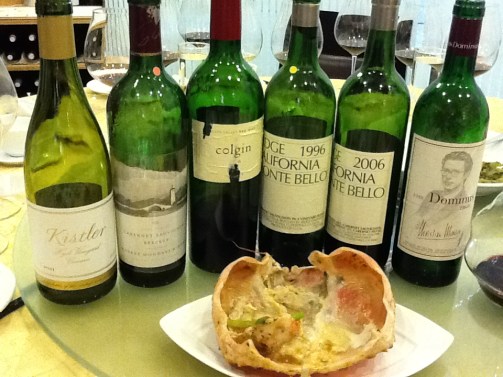 It became incredibly complex after some time, developing some semblance of Bordeaux dryness and just got better and better. Superb. But perhaps best to lay away another 10 years?
As Daniel had confessed that he’d brought a spoiler, we drank his blinded contribution alone as the third red. Aired in bottle, this wine displayed the classic stamp of the Old World, noticeably lighter in color but remarkably open and fresh on the nose, giving off high-toned lifted aromas of predominantly red fruits of immense purity with a slightly pronounced medicinal overtone towards the finish. I was amazed that some people at the table were spot-on in calling it a Rioja, for it turned out to be the 1994 Bodegas Lopez de Heredia Vina Tondonia Rioja, apparently an estate with a cult following amongst lovers of classic Rioja. Excellent.
It made sense to taste the pair of Ridge Monte Bello side-by-side, both of which were almost identical in color, a dark impenetrable red. The 1996 (courtesy Kieron) had, perhaps, just a trace of bricking at the rim and a modest bouquet but it was absolutely glorious on the palate, full, rounded and open, saturated with warm, ripe plummy fruit that was immeasurably complex, but it was clear that this wine was nowhere near its peak and would probably evolve at a glacial rate. On the other hand, the 2006 (courtesy KP), expectedly, was generous in top-drawer fruit that was already developing into a highly polished wine but, at this stage, still primal and concentrated with a pronounced vanilla coat. Great potential, of course, but it ain’t giving anything away. And finally, we were treated to a Californian cult, the 2006 Colgin (courtesy Hiok) which, at this stage, shared more similarities than differences with the latter Ridge – dark inky red, weighty and full-bodied, gripping the palate in a tight grip of dense vanilla, varnish and emulsion, culminating in a hot spicy finish, hardly surprising in view of it’s 15.6% alcohol. If there are one or two take-home messages from this tasting, it’d be that Californian wines keep very well indeed and, in fact, demand to be treated in the same manner as their Bordeaux counterparts, to be drunk only after 20 years.
2011 Lis Rivis Chardonnay, at a performance of Tosca at the Deutsche Oper Berlin, 13 June 2012. Rather shallow, lacking in body and delicacy with an abundance of grassy overtones.
2011 Dolle Gruner Veltliner, at the Lufthansa Senator lounge, Frankfurt airport, 17 June 2012. An Austrian white from the region of Kamptal (gruner veltliner is the grape variety in this example) displaying good body and fullness, veering more towards a dry citrusy edge, supported by stony minerality and fresh acidity.
2011 Naegele Grauburgunder Trocken, at the Lufthansa Senator lounge, Frankfurt airport, 17 June 2012. Dry German riesling. Displaying excellent body and purity and a crystalline minerality with just the right degree of acidity, imparting remarkable freshness an balance. Very good.
2009 Domaine Follin Arbelet Pernand-Vergelesses 1er Cru “Les Fichots”, shared with KP over lunch at Bedrock Bar & Grill, 20 June 2012. Decanted on site. As expected, a tad heavier than usual for pinot both in color and on the palate, leaning more towards ripe raspberries and wild cherries rather than bright red fruits. It took another hour to open up, becoming lighter in weight and texture, the fruit turning lighter and brighter with a lovely freshness that wasn’t there initially. A good drop – only SGD53 from Caveau’s clearance sale. I think it’s difficult to go wrong with anything from 2009.
2001 Cullen Diana Madeline, at Imperial Treasure T3, 22 June 2012, a bottle that I’ve cellared for several years. Decanted on site. Heavier than usual for a cabernet-merlot with deep sultry notes of ripe grapes, almost raisiny though not to the point of jamminess, and a palpable sense of the arid and hot Western Australian terroir. It opened up a bit after further airing, with notes of toast, dark currants and chewy biting tannins being more apparent. Obviously, this wine can easily keep for another 10 years, although I’m not sure how all that density and heaviness will change. Perhaps better to match it with a juicy steak, rather than fine Cantonese cuisine.
1996 Domaine Harmand-Geoffroy Gevrey-Chambertin 1er Cru “Le Bossiere” Monopole (courtesy of F), over dinner at Wall St Bistro, 22 June 2012. Popped and poured, immediately displaying the classic Old World pinot character, although one is struck by the extreme salty tone on the palate that seriously threatened to obscure the underlying fruit. It lifted somewhat after some time, the acidity still remaining quite lively, the fruit still elegant and restrained, yet to dry out. I’d have preferred a bit more weight and power, though.
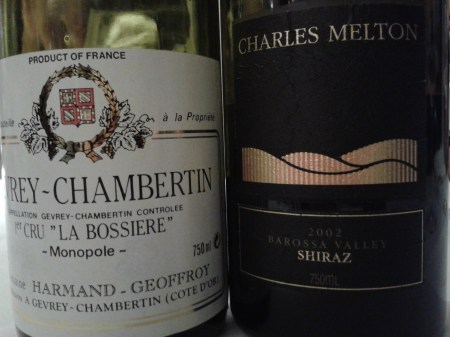 2002 Charles Melton shiraz, a bottle that I’ve stored carefully for the past seven years, given to me by Prof Gary Wittert. Popped and drunk over dinner at Wall St Bistro, 22 June 2012. As expected, a big wine but this has elegance and balance, the warm barossa shiraz fruit having morphed into a seamless harmonious whole with a good mix of red and dark berries infused with a touch of chocolate and a hint of sweet meat, very even and linear on the palate, the tannins well-recessed. Excellent.
2009 Domaines Leflaive Macon-Verze, popped and poured at Ming Kee Live Seafood, 23 June 2012. This vintage is probably the best example of this wine over the years, displaying excellent weight and stony minerality with notes of well-defined citrus and white flowers that even managed to float across with a touch of delicacy, with very little of the usual grassy overtone that was prominent in previous vintages. very good, and likely to improve with time. Only SGD45 at Caveau’s clearance sale.
2005 Ch Cissac at Culina, 26 June 2012. Decanted on site. This is clearly the best example of this Cru Bourgeois. Deep red, saturated with highly enticing aromas of fresh ripe red and dark berries with a dash of mulberry, weighty with excellent definition and unobtrusive tannins, fresh and vibrant. A perfect accompaniment to the superb striploin. Excellent.
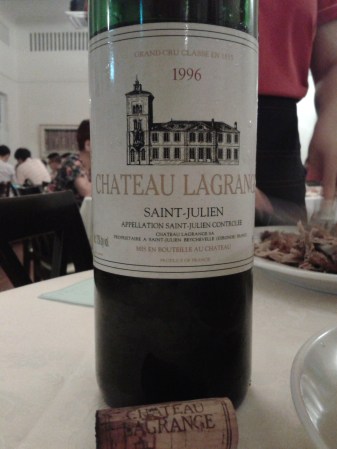 1996 Ch Lagrange at Choon Seng Punggol Seafood restaurant, 30 June 2012. Popped and poured. Even though I have a soft spot for this estate, I must say that on this occasion I was totally blown away. Rich, tarry, medium-toned with top-drawer fruit that added to the superb definition. It developed bit of attack after some time before settling into a soft, layered, concentrated wine, almost opulent I’d say, which is unusual for Lagrange, the tannins well-integrated into the outstanding cabernet structure. This wine has yet to peak, but I’m glad I caught it at this stage where it is most exciting. Superb.
Steirereck, Vienna
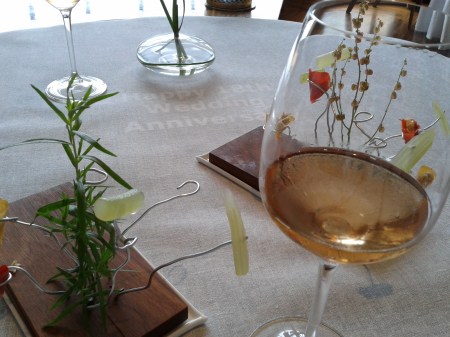 As part of the family’s summer holiday, we dropped by Steirereck, the highest-rated two-Michelin star restaurant in Vienna, for lunch on 11 June 2012 to mark our 18th wedding anniversary. Located in the middle of the city’s Stadtpark (Vienna’s answer to NYC’s Central Park, about a-third the size), the single-storey restaurant is spaciously decked out in modern elegant decor, with a touch of the avant-garde (most noticeably in the restrooms!). Typically consistent with European tradition, the service is a mix of warm hospitality combined with a certain distant, business-like Viennese temperament.
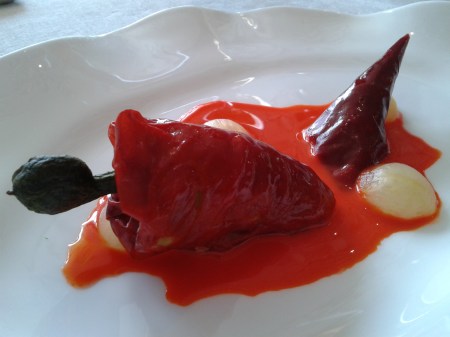 Three options for lunch are available: a full degustation of 6 courses, or a 4- or 5-course option (EUR 65 & EUR75, respectively), each course generously offered in five different choices that should suit all tastes. What sets Steirereck apart from other one- or two-star establishments is the highly imaginative interpretation of real food in real portions with a light touch without any adulteration of the ingredients, ensuring that the dishes remain faithful in taste whilst enhancing the dining experience. The char with beeswax is prepared right on your table where the molten beeswax is poured onto a tray of fish and allowed to solidify, while the pepper with cabbage, chilli and snails is overstated in presentation but utterly understated and sublime in taste.
 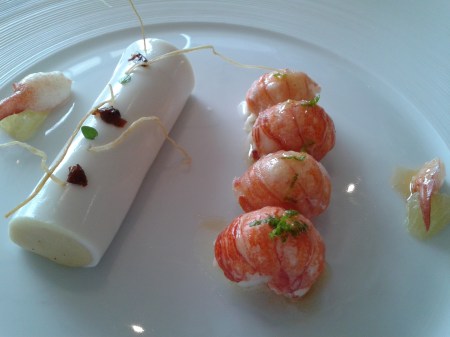 My main course of crayfish was delightful while the wifey and son enjoyed their meal of barbecued sturgeon and piglet cheeks, respectively.
We toasted our anniversary with a glass each of Gonet-Medeville Rose NV, imbued with forward notes of orangey tangy citrus, cherries and a lovely rosy fragrance, generously replicated on the palate, framed by lively acidity at the edges and well-supported by clear crystalline minerality, becoming more high-toned over time. Very good. The wine list was rather modest with the usual listings of Italian, Spanish, Bordeaux and Burgundy, the reds and whites separated physically, the latter offering a good range of Austrian indigenous whites and dessert wines. 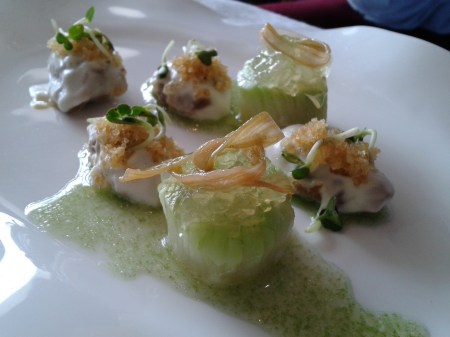 I guess when one is in Austria, one should drink its offerings. We settled for a half-bottle of 2007 Patrick Bayer In Signo Sagittarii, made from 100% blaufrankisch grapes from the Austrian region of Hochberg. This was decanted for almost an hour, a dull opague red that was medium-full and weighty with notes of licorice, ripe wild berries, a firm trace of medicinal and other herbal aromas, revealing some chewy tannins and a hint of rusticity at the edges, but well-balanced. It reminded me of a syrah. Nothing much to really shout home about, but I wasn’t asking for too much either.
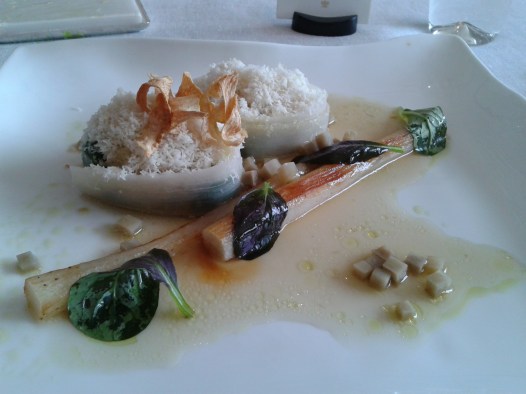
The staff didn’t forget about our special occasion and brought out the obligatory mini-fanfare before presenting us a check for EUR329, which seemed a mild bargain considering the generous spread. Enjoy the pictures.
Notes in brief (May 2012): 2000 Latour-a-Pomerol, 1995 Sociando Mallet, 2010 Tomassini”Ripasso”…
2006 Peccavi chardonnay, over an early sumptious lunch of dim sum and wagyu beef at Asia Grand on 01 May 2012, something I haven’t done for some time. Decanted for about 40 minutes prior. This Margaret River chardonnay is full-bodied and generous with the classic character of vanilla, almonds, yellow citrus and stony minerality, complete with the buttery texture. However, it is far too bold and brazen for its own good, jagged at the edges, lacking in subtlety and real complexity of a Leeuwin Art Series. Almost acerbic. Perhaps it needs more bottle time?
2009 Ch Lalande Borie, half of a full bottle, aired for almost an hour at Foo House, 6 May 2012. The 2009s are appearing on the shelves now. Don’t let the initial notes of high-toned ferrous minerality and its leafy, austere and almost bitter character put you off. It’s evident that beneath all that, this wine is saturated with ripe cabernet that slowly appeared after an hour, taking the form of sweet blackcurrants infused with some cedar and violets. It’ll need plenty of time to shed its awkwardness, but fans of Xavier Borie should load up while stocks last. SGD61 from Carrefour.
Duval Leroy Brut NV, a freshly-popped bottle at the Krisflyer Lounge of Changi Airport Terminal 3, 7 May 2012. Grassy with accentuated notes of bitter citrus, lemon, pomelo with a hint of malt and trailing green notes. Medium-bodied with well-defined minerality, not too dry, imparting a sense of depth at the beginning but fading towards the finish.
2010 Te Kairanga sauvignon blanc, at the Krisflyer Lounge of Changi Airport Terminal 3, 7 May 2012. Compared to other exuberant offerings from the famed Marlborough region, this wine, from the same origin, seems terribly tame, grassy with a hint of tropical fruit, green appples and Kiwi fruit, pleasant enough but hardly distinctive, lacking in liveliness and vibrancy.
2009 Ch D’Arcins, at the Krisflyer Lounge of Changi Airport Terminal 3, 7 May 2012. In spite of the outstanding vintage, this Haut Medoc doesn’t seem to have benefitted. For sure, there is an abundance of cabernet fruit, but this wine is sadly one-dimensional, heavy in undergrowth and other leafy notes. Not worth quaffing.
 Henriot Brut Souverain NV, on board SQ352 Business Class to Copenhagen, 8 May 2012. Quite attractive on nose with a good deal of delicate citrus, bitter lemon and peaches, veering on the dry side. Unfortunately, it is way too straightforward and simple on the palate, a tad hollow, fading towards its finish.
2009 Balthasar Ress Hattenheimer Schutzenhaus Riesling kabinett, on board SQ352 Business Class to Copenhagen, 8 May 2012. Possesses a mild level of sweetness with subdued acidity, laced with nectarine but quite straightforward. Nevertheless, riesling is always a safe choice when drinking on board.
2008 Ch D’Aurilhac, on board SQ352 Business Class to Copenhagen, 8 May 2012. Soft, fruit-forward with a predominance of raspberries and red fruits. Rustic at the edges, lacking the intensity and concentration of the best vintages.
2009 Domdechant Werner Hochheim Rheingau Riesling, at Peter Lieps Hus, Copenhagen, 9 May 2012. Medium bodied, green apples yellow citrus laced with a touch of mangoes and apricot. Doesn’t quite sparkle as much due to subdued acidity, but it’s very agreeable and so easy to quaff down with the fresh salmon.
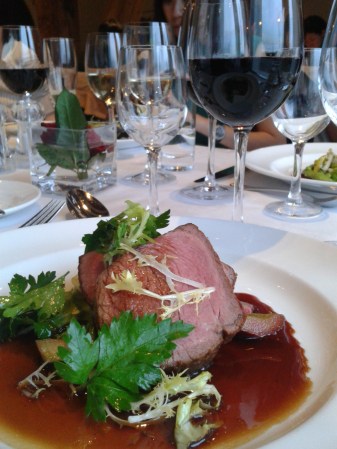 2010 Tomassini Bolla le Poiane Valpolicella Classico “Ripasso”, at Peter Lieps Hus, Copenhagen 9 May 2012, over a meal of deer meat that came from the deer park within. In spite of its youth, this wine possesses surprising weight and concentration of raspberries, red currants and violets that did very well to overcome the extreme gamey nature of the meat, more expansive on the palate over time with tannins kept in check, managing perhaps even a bit of layering. Very good.
Silver Cap blanc de blancs as an aperitif at Salt restaurant, Copenhagen, 10 May 2012. Unfortunately, this is a poor example of a blanc de blancs, way too dry and brittle, one-dimensional throughout with upfront bitter lemon and green citrus. Almost acerbic.
2010 Cape Grace chenin blanc, at Salt restaurant, Copenhagen, 10 May 2012. I didn’t know the label at first, and thought this was a decent chardonnay, soft and medium-bodied with fruit that is adequately ripe and recessed minerality that doesn’t get in the way, finishing with a touch of leafy green.
2007 Chateau de Grave, a Cote de Bourg at Kr235 at the Fraegerek restaurant along the Nyhavns harborfront, Copenhagen, 11 May 2012. Popped and poured. Very soft and almost thin initially. I left it in my glass for a good half hour, after which it seemed to have fleshed out, seemingly a lot weightier than before, characterised by forward notes of dark berries still cloaked in some vanilla, restrained and nondescript, earthy and slightly austere without any further development. It was the cheapest wine in the restaurant’s very limited short list of what looked like cheap wines (the final item, however, being three different vintages of Ch Mouton Rothschild!!) and, normally when faced with such a situation, I’d just go for the cheapest. After all, what difference does it make?
2009 Durvillea pinot noir from Marlborough, at the SAS Gold lounge of Copenhagen airport, 12 May 2012. Attractive bouquet of rose-scented red fruits and varnish, medium-full on the palate, rather too linear but carrying good weight all the way to the finish. Very decent.
2010 Jean Paul Vauclavs, a southern Rhone rouge at the SAS Gold lounge of Copenhagen airport, 12 May 2012. A very decent effort hitting the right notes of plummy fruit and wild berries with a touch of green and forest floor, adequately dense with a spicy edge, trailing linearly to its finish without any hollowness.
2004 Penley Estate Reserve cabernet sauvignon, at Gourmet Plus, 13 May 2012. Popped and poured. A darker-toned cabernet compared to Old World blends, more of dark berries and dark chocolate against a background of woody dusty tannins and forest floor, missing the characteristic violets and cedar of traditional claret, slightly austere. It took more than an hour to flesh out with some brighter notes of concentrated fresh berries breaking through, but this is still a rather youthful wine, perhaps undergoing an awkward stage.
1995 Ch Sociando Mallet (courtesy John), at Moomba, 18 May 2012. Decanted on site. Dark purple with notes of dark cherries and raspberries and a touch of briar, noticeably acidic (still) during the first few sips. Medium to full bodied, weighty, taking on a brighter note as it began opening up after 30 minutes, becoming a lot more smoother and broader. I’d say it’s yet to peak which surprising for a 1995, but it definitely has the legs to last for several decades. Keep.
Jacques Lassaigne Brut NV Rose, at Ming Kee Live Seafood on 22 May 2012. Tasted after airing in bottle for 30 minutes. Reasonably deep bouquet with notes of toasted oak, a touch of yeast and a hint of red fruits. But compared to a previous tasting note last year, this bottle seemed to lack the complexity and nuances normally associated with this producer, far too flat and dry on the palate.
2007 Inniskillin Vidal ice wine (courtesy of LW), at Ming Kee Live Seafood on 22 May 2012. This wine simply saturates the palate with a one-dimensional swathe of intense sweetness without any discernible subtlety nor layering. Most people (usually the ladies) like this, but I much prefer German eiswein.
1999 Chateau du Moulin, a gift that I received a couple of weeks ago, at Wall St Bistro, 23 May 2012. Decanted on-site. Dark purple. The initial impression was rather unremarkable, certainly nothing special on the muted bouquet, the wine soft and medium-bodied and drinkable, carrying just enough weight but lacking in charm and character. However, it rapidly fleshed out over the next 30 minutes with more red fruits emerging to the fore, of which I thought cabernet franc was distinctly discernible, producing notes of fresh strawberries and raspberries, becoming much more weighty and substantial with some degree of sweetness creeping in at the sides, even taking on a little vibrancy and attack on the mid-palate, which were all very welcome. Quite an amazing transformation from this estate in Puissequin-Saint Emilion. Very good stuff, I must say.
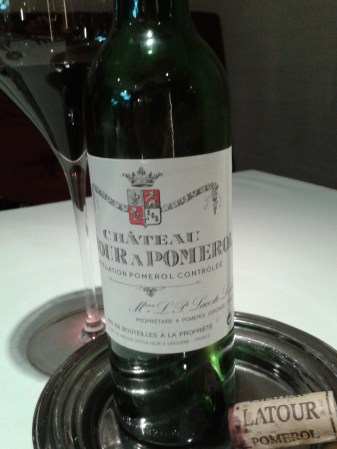 2000 Ch Latour-a-Pomerol, a half bottle at Les Amis, 25 May 2012, just in time for a final appreciation of chef Armin Leitgeb’s culinary art before he leaves for good end of May. This estate is steadily gaining in prominence and I must say I’ve never had a disappointing Latour-a-Pomerol, and this bottle, displaying a deep ruby, is a prime example. A rich bouquet of red fruits and bright berries dominate, leading to a soft fleshy medium-bodied wine of excellent concentration, layered in texture and depth, caressing the palate with fine velvety tannins, almost lush. Structured but highly elegant, though evidently still far from its peak. Excellent.
2005 Ch Bernadotte, poured from magnum, at Bistro 103, at a farewell dinner for the outgoing CEO, 25 May 2012. Dark red, packed with outstanding ripe cabernet from this stellar vintage, producing a dense solid core of fruit wrapped with fine velvety tannins with a sprinkling of graphite, tarry in texture with excellent definition. This level of quality is unprecedented for this estate in the Medoc. Still highly primal at this stage, of course, and will take more than a decade to mature. An absolute steal at only SGD88 per magnum. Excellent.
2000 Ch Chasse-Spleen, at Bistro 103, at a farewell dinner for the outgoing CEO, 25 May 2012. Aired in bottle for around 45 minutes. Coming right after the Bernadotte above, this wine is more placid and open and obviously more developed with notes of cedar and cinnamon, displaying excellent depth with some early layering, very well integrated and fleshy and, like the Bernardotte, packed with a generous core of stellar fruit that’s yet to uncoil. Very similar to my first encounter with this wine at Gunther’s back in Nov 2011, and perhaps less dry. Great stuff. Think I’ll place my remaining five bottles in cold storage for another 5-8 years, at least.
2005 Ch Lalande Borie, popped and poured over a nice tenderloin steak at Gourmet Plus, 31 May 2012. This has real weight, concentration and quality fruit but it is somewhat unsettled at this stage. Still rather backward in spite of persistent coaxing, coupled with an austere, uneven finish that contained a metallic note. It snapped together quite nicely at the final pour, which seemed delicious and more forward. Best to leave it in bottle for another 3 years.
The wines below were drunk over an 11-course degustation menu at Saint-Pierre, 29 May 2012, on the occasion of Chris’ farewell as he embarks upon a sabbatical to the New World. The restaurant seemed to have, yet again, undergone another change of personnel since the last time I ate there. Most of the staff are new, including its sommelier, except for Desmond and, inevitably, this resulted in an uneven level of service throughout dinner. The wine theme was kept informal, each of us simply bringing what we felt would be appropriate for a friend who’d be going away.
The sommelier did well to recommend me the Jacquesson Cuvee No. 734 Brut NV, a blend of chardonnay, pinot meunier and pinot noir, whilst awaiting for everyone to arrive.  This proved to be very open and lifted with aromas of yellow citrus and roasted almonds, boasting excellent weight and great vibrancy, layered with a hint of tropical fruit beneath – most unusual, no doubt contributed by the pinot grapes – and not as yeasty compared to usual champagne, exceedingly smooth. It became even more open towards the end, developing lovely aromatics, almost nectarine in character, as well as some grassy overtones. Excellent.
The rest of the table opened the evening’s proceedings with a 2000 Dom Perignon (courtesy Vic). Compared with the Jacquesson, this wine is much lighter in body but higher-toned, very lifted on the nose, clear, crystalline and seamless on the palate though yet to develop it’s nuances. It became slightly heavier after some time, the classic yeastiness and toasted oak of Dom Perignon coming on along with a bit of sweetness that crept in. Excellent stuff, but it needs another 10 years of rest. The obligatory white that followed came courtesy of GPP, a 2006 Domaine Joseph Drouhin Corton-Charlemagne Grand Cru that was notably restrained, almost muted, covered with just a mild creamy sheen. It could certainly do with a greater degree of fullness in the mid-body, while it is still certainly unresolved at the finish. Some felt that it was highly sophisticated but I begged to differ…a Bonneau du Martray will most certainly put this in the shade.
We drank the three reds simultaneously, although poured in the order, firstly, of a 1983 Ch Cos D’Estournel (courtesy KP). This bottle was popped and poured instantly, as KP and Hiok, who’d had the same wine before recently, felt that it would fade rather quickly. However, this bottle was anything but dead. Some forest floor and barnyard aromas greeted one on the nose but that blew off quickly, revealing some rather glorious fruit that was still remarkably fresh and full, exuding classic aged Old World aromatics that recalled old leather, cinnamon, mushrooms and snuff.  It was just a tad short but very satisfying nontheless, the wine retaining great acidity right till the end of dinner. Quite wonderful. What followed next was my penultimate bottle of 1988 Ch Leoville Las Cases (double decanted for 2 hours), predictably dense with a trace of licorice but nobody would have expected the lifted fragrance and fresh acidity to last after all these years, the wine full-bodied, structured and stern on the palate. Absolutely harmonious with great definition. Superb. The final wine, a 1996 Ch Lynch Bages (courtesy Hiok) that had been double decanted as well, was full bodied and intense, throwing off an almost soy-like quality. It didn’t take long for the classic dry Pauillac signature to develop, along with a trace of sweetness at the edges. Still rather tight and backward. Needs plenty more bottle age, but no doubt at all this is a great wine going through its adolescence.
Brokenwood Graveyard 2001, 2002 & 2003
This is a retrospective post of a dinner on 21 March 2012 where everything went wrong: the good folks at the wonderful Teochew restaurant Chao Shan could not locate our reservation, their signature dishes were not available, people were held back by last-minute emergencies at work such that some exquisite Rhone shiraz that had been promised could not materialise. The only wines available were those I’d brought along, a mini-vertical of Brokenwood Graveyard that I had cellared for several years. All wines were popped on-site and aired in bottle for around 30 minutes. 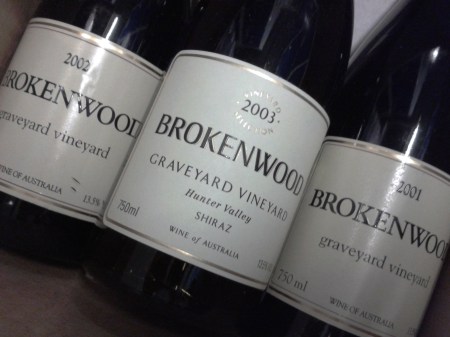 Prior to this, I cannot recall when was the last time I had a Graveyard, apart from a 1994 that was hopelessly corked some 4-5 years ago.
The 2003 showed a dull purple with pronounced minty and herbal aromas that promised a spicy, assertive wine on the palate, rather unremarkable and four-square. It became less jarring over time, fleshing out somewhat but the real fruit never quite emerged from the depths and any hope of it surfacing were dashed by the alcoholic edge, which seemed more apparent than the declared 13.5%. The 2002 also cast a similar impression, a dirty dull purple with forward medicinal and herbal aromas. However, it was noticeably fuller and more layered in the mid-body with notes of bitter coffee, eventually developing a metallic, graphite-like minerality that inevitably imparted a stern demeanour to the whole wine. I had high hopes for the 2001, which I do recall being delicious and fleshy when I last tasted it at an office function some 6-7 years ago. True enough, it had the most open bouquet of the night, rosy with a predominance of red fruits, matched to a full rounded body. It fleshed out beautifully over time, gaining in sweetness and perfumed fragrance, soft and elegant in the best tradition of Hunter Valley shiraz. Lovely.
A great great month…
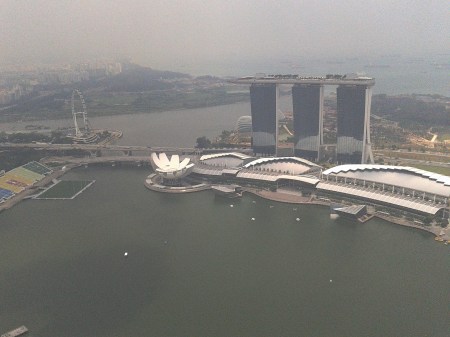 1996 Ch Moulin St-Georges, decanted on-site at Stellar, part of 1-Altitude at the 62nd floor of One Raffles Place on the occasion of Monster’s birthday, 6 April 2012. Earthy and dusty on the nose initially although, on the palate, it was fresh with notes of red and dark berries, soy, lighter tones of violets and cedar with a little bit of salty minerality creeping in. The bouquet became more lifted after some time, offering more of dark cherries laced with significant sweetness, highly inviting, the wine mellowing into a soft and seamless whole. Compared to a previous bottle last year, this wine has shed the backwardness of this vintage, caught here at almost its peak, and will probably hold for many years to come. A “poor man’s Ausone“? From the same winemaker, no doubt, but it lacks the last ounce of weight, depth and distinction. Still, it’s very very good.
2005 Ch Dominique, at Imperial Treasure ION, 7 April 2012. Popped and poured. Deep dark red. Loads of very ripe dark berries, a dash of red rruits, orangey citrus, soy and licorice. Dense, tight, weighty and assertive with a rising tannic spine as one moves towards its spicy finish, as if reminding one of its explosive potential. Almost like a New World in character, save for the emerging complexity on the palate that prevents this from being a fruit-bomb. This is totally different from another bottle, also bought at the same time a few years ago from Carrefour, which was a lot more open, softer and approachable, which had led me to think that this wine was evolving faster than most. Apparently not. If properly cellared, I doubt if it’ll be ready within this decade.
 2001 Ch Lafleur-Gazin, at Otto Ristorante, 11 April 2012. Popped and poured. Dull red. Rather restrained on the nose, although the predominant red fruits, kirsch, blueberries, earthy and leafy tones are evident. Soft, medium-bodied, the flavours staying within a fairly narrow spectrum, but this is a wine that prefers not to stand out from the crowd, almost nondescript although it’s perfectly drinkable. Shy.
2007 Lookout cabernet-shiraz, a bottle popped for a casual Examiners’ Lunch in the midst of a MRCP PACES mock exam, 14 April 2012. Medium to full-bodied, ripe with notes of wild berries, wild mushrooms and leafy morning dew. A simple quaffer.
2009 Domaine Vincent Girardin Bourgogne Rouge Cuvee St Vincent. After an entire Saturday wasted on the mock exam on 14 April 2012, I treated myself and the family to a lovely meal at Brasserie Gavroche, a relatively new bistro along Tras St that’s extremely quaint (it doesn’t have a signboard) and very French (run by real Frenchmen and women), somewhat similar in setting to Bistro du Vin, except Gavroche is far better in terms of service and setting. Nevertheless, I was surprised that a faux pas should occur when the waiter (who seemed to be looking after the wine service, though perhaps not a true sommelier) placed 3 white wine glasses and proceeded to pour a tiny volume for me to taste. He seemed surprised when I pointed out that he should be serving the wine in Burgundy stemware instead, and he had to revert to the manager (presumably, for he said he’d “check” and popped out of sight) before returning to rectify the error, with apologies. At SGD78 off the restaurant’s modest list (their corkage policy is a one-for-one), this is actually a very good drop. Deep ruby in color that correlated with a higher level of extraction than usual for pinot (consistent with the house style of Vincent Girardin), this wine exuded a modest bouquet of roses and red cherries, predictably heavier and almost full-bodied as the palate is awashed with ripe red berries, heavily rose-scented with a hint of vanilla and varnish, displaying excellent depth, cohesion and fullness in the mid-body, rounded at the edges, tapering linearly to a long finish, eventually loosening up after an hour, the mid-body taking on a chewy note. An over-achieving generic bourgogne, I’d say, one that is likely to turn out very well given further bottle age. Do keep a lookout.
2001 Ch Bernardotte, from magnum, at Foo House, 18 April 2012. Popped and poured. Dark red with violets, dark cherries and sweet wild berries with a touch of green juxtaposed in perfect balance, fleshy and rounded, weighty as well. Will improve further. A classic claret, perfect for the everyday meal as well as the marbled steak. Very good. A steal at SGD75 from Crystal.
1996 Ch Pape Clement (courtesy of John), over beef tenderloin and pork knuckles at Foo House, 18 April 2012. Aired in bottle. Remarkably weighty, infused with rich earthy minerality. The fruit is still rather recessed and backward, shielded by an opague sheen that opened up only slightly after an hour, affording a hint of the huge potential that lay beneath. Far from being ready, in spite of the years past. I’d wait till 2016, at least.
2007 Egon-Muller Scharzhopfer, a half-bottle at Jade Palace, 20 April 2012. Unbelievably rich and full on the palate with a wonderful explosion of tropical fruits, nectarine, white flowers, jackfruit and a dash of apricot, dancing across the palate, full of sparkle and vibrancy. Astonishing, for a kabinett. But then again, it’s Egon-Muller. Wonderful.
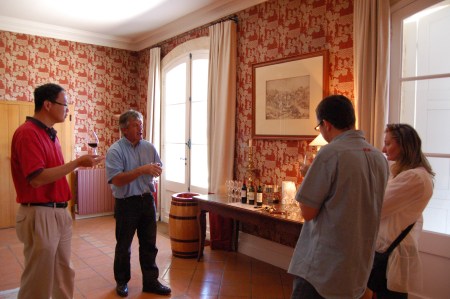 2000 Domaine de Chevalier, popped and poured over lunch at Absinthe, 20 April 2012. Compared to previous experience, this wine seems to have come out of its shell, finally displaying a glorious blaze of ripe earthy tones, sweet dark currants, graphite and fine minerality cloaked in svelte tannins, utterly smooth and sophisticated, carrying much more weight than this wine has ever had, possessing such natural balance with a trace of secondary development at the edges, throwing off even deeper notes of violets and cedar over time. A true connoiseur’s red. Proves that you don’t need to bust your bank to satisfy your palate. Excellent.
Zardetto Prosecco Brut NV, off the restaurant list of Bistecca, 21 April 2012. A lovely blend with the impression of peaches, green apples and green melons with a trace of sweetness although there isn’t much real complexity, lively without being too dry. Most agreeable, though.
1995 Ch Lafon Rochet (courtesy of Ben) at Bistecca, an restaurant along Mohd Sultan Rd that serves very good Italian cuisine. Decanted on-site for about 40 minutes. A wine marked by dominant earthy overtones on the nose with a trace amount of bottle stink that threatened to obscure the fruit beneath, which seemed slightly underwhelming and a tad hollow on the mid-palate. Soft and noticeably lowish in acidity, consistent with the vintage. Didn’t quite flesh out over time. Nevertheless, it was quite an agreeable accompaniment to the Fiorentina and ribeye steaks.
1990 Ch Cos Labory, decanted on-site to go with a tomahawk steak at Bedrock Grill & Bar, 24 April 2012. Dark opague red. Still amazingly youthful and assertive with notes of dark chocolate, blackcurrants, a dash of tangy citrus, graphite and a mild of leafy tone, the acidty still remarkably fresh at the edges. Compared to a previous note last year, this wine seemed weightier and fresher this time around, and may actually develop further if properly stored, proving to be a good match with the 1986 Cos D’Estournel below.
1986 Ch Cos D’Estournel (courtesy of John), decanted on-site to go with a tomahawk steak at Bedrock Grill & Bar, 24 April 2012. Remarkably fresh after all these years, caressing the broad with broad swathes of ripe cabernet, redcurrants, cedar, violets and sweet dark chocolate amidst other old world aromatics, immeasurably complex and seamless, almost velvety in texture. Very lovely. Possesses greater fullness and depth compared to a previous bottle I had in July 2007.
2007 Domaine Vincent Girardin Volnay VV, popped and poured at Brasserie Gavroche again, 25 April 2012. Bright and beautiful in color, as always from this negociant producer. Slightly dry in texture with bitter cherries held in restraint, the minerality being more ferrous and austere towards the finish, entirely in keeping with its origins. Drinking really well after an hour, but I guess the appeal for Volnay can never surpass that for Chambertin or Musigny.
2009 Ch Bernardotte, at the Dept dinner at Cafe Brio’s, Grand Copthorne Waterfront, 25 April 2012. Popped and poured from magnum. Deep purple, substantially weightier than the last time I had it. Primarily fruit forward, notably of raspberries and perfumed red berries with a bit of vanilla coating, the 8% petit verdot that the winemakers from Pichon Lalande favour making its presence felt. Rather simple at this stage, but the depth and stuffing is certainly there from this stellar vintage, and I guess it’ll need another 5 years or more to transform into something really sophisticated.
 2001 Ch Sociando Mallet, at the Dept dinner at Cafe Brio’s, Grand Copthorne Waterfront, 25 April 2012. Popped and poured. Very dark purple oozing with layers of dark berries and sweet dark currants, excellent in weight and depth but still remarkably youthful, the velvety tannins still pulling a tight punch. Still going through a troublesome adolescence – a good sign – and will be absolutely glorious when fully mature. Like I’d said before, buy as much of this as you can and sit tight for another 10 years.
1985 Ch Sociando Mallet (courtesy of John), at the Dept dinner at Cafe Brio’s, Grand Copthorne Waterfront, 25 April 2012. A more transluscent red with a rusty tint. Still remarkably full-bodied and dense with notes of licorice and a medicinal overtone, quite seamless although lacking in sophistication, the alcohol still marking its presence. This is the oldest Sociando I’ve ever tasted, but I daresay the wines of this remarkable estate over the past 12 years are better crafted and far more sophisticated.
Eleven Madison Park, New York.
And finally, the piece de resistance, hot on the heels after Per Se, Marea and Picholine. I checked out of my hotel on 4 April 2012, made a couple of futile trips to two so-called flagship Coach stores in search of an elusive Hamptons Weekend Collection, but all in vain, before I strode right on time at noon into Eleven Madison Park at East 24th St and Madison Ave, where Kieron had, of course, made no mistake in ensuring that we had a table reserved exactly four weeks prior to the very date. 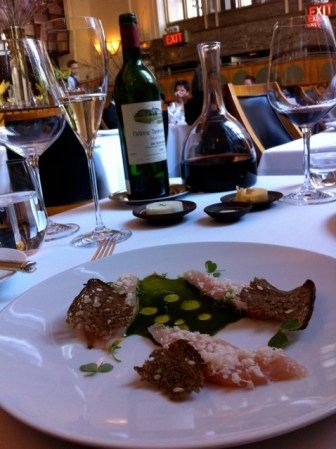 That’s exactly what Eleven Madison Park is all about – the top dining venue of choice in New York City, where you only have one shot at getting a table the moment the reservations line is open.
By now the setting of these top restaurants is familiar: spacious dining halls with tall ceilings adorned in modern, comfortable and elegant decor that isn’t too heavy, where the restrained use of wood paneling, bright marble flooring and cheerful shades combine to enhance the anticipation of what is to come, staffed by young and friendly faces who provide knowledgeable, attentive but discreet service. We were settled into a quiet corner and wasted no time in ordering some champagne to get the afternoon going. The persuasive maitre’d had no hesitation in recommending the Vilmart Brut Blanc de Blancs NV, showing a beautifully clear liquid gold, promising an open, transparent and layered wine with less of cream and vanilla but more of crystalline minerality stuffed with delicate white and yellow citrus, demonstrating great balance, carrying just enough weight and presence yet never too dry. Outstanding.
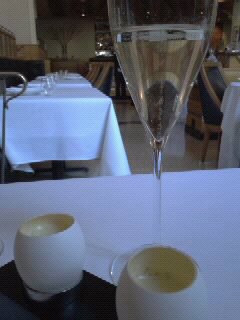 We began perusing the generous wine list whilst sipping this wonderful champagne. One wouldn’t expect the wines to come cheap, but what struck me, surprisingly, was its relative affordability with back-vintages that seemed to be priced at minimal mark-ups, which is most unusual for a top restaurant but, again, probably another reason why Eleven Madison Park is what it is. Of course, Kieron had done his homework the night before, perusing through the very same list online and shortlisting a few options.
There are two choices for lunch, a 4-course menu, and a 8-course chef’s tasting menu that requires at least four hours. As the prospect of being stranded at JFK International was to be avoided at all cost, we took the 4-course menu, itself presented in a very simple and unique 4 x 4 matrix, each comprising just a single word (“Duck”, “Lobster” etc…you get the gist). But there is an additional option, which is to replace the conventional third course with a roasted duck (at additional cost) that is carved by your table-side, reputedly even better than La Tour d’Argent’s famous canard. Naturally, upon hearing that, we opted for it, at the same time requesting if we could tour the kitchen later.
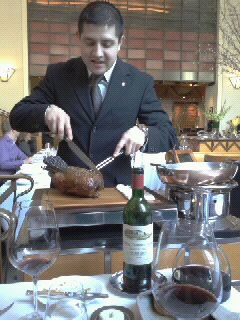 There was no doubt what we would be pairing the duck with: a 1988 Ch Troplong Mondot, priced at USD265. I was reminded that a half-bottle of Pichon Lalande of the same vintage at the one-Michelin-star La Tour d’Argent already set me back EUR165 three years ago, meaning this full bottle here at this three-star venue may be considered an absolute bargain.
Decanted on-site, this wine displayed some evolution at the rim but still remained a deep crimson at its core, giving off an arresting and generous bouquet of aged old world aromatics, weighty and complex, a glowing sense of sur-maturite, soy, old leather, cinnamon and dried herbs. It opened up further as lunch wore on, lightening up in texture, revealing greater layering and definition, lush and very well-integrated, though not totally seamless thanks in part to its masculine character, developing some aromatic lift towards the long finish – the perfect accompaniment for a world-class long lunch. Indeed, it brought back memories, of course, of my lunch three years ago at La Tour d’Argent where I had the 1988 Pichon Lalande, but also another lunch around the same time with Kieron as well at Saint-Pierre where we had an entire bottle of 2000 Monbousquet to ourselves. 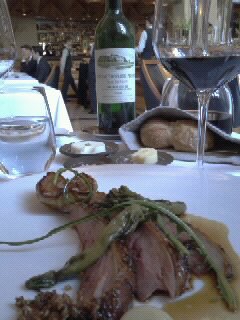 Sometimes, you don’t need a top classified growth to complete the meal. Just great food, great ambience, great company, the allure of a lovely wine that can only come from a well-cellared bottle where each sip awakens your senses to greater heights, and plenty of time to enjoy all that.
And so while the 1988 Troplong-Mondot did its magic, we started reminiscing about the great meals we’ve had together over the years and, inevitably again, about which restaurants in Singapore come close to Eleven Madison. Certainly Iggy’s and Les Amis come to mind, but they are just a little short on the surprises in the presentation and execution that earns an already superb restaurant its third star. And as if to illustrate this point, while we were floating on air from the intoxication, the maitre’d approached to say that the kitchen was ready for us to tour. We nearly fell off our seats…they actually remembered our request!! Of course, we needed no further prompting and followed her into one of the top kitchens of the world, where we were greeted by the sight of 20-30 chefs each at the helm of their art and passion. It might seem chaotic to the uninitiated, but clearly everything ran with clockwork precision. And in an unobtrusive corner stood a high table with two empty dessert glasses…our dessert glasses…our dessert (the contents of which had slipped my mind) was about to be prepared and served live in front of us, a deceptively simple concoction that we downed on-the-spot right there and then, savouring the experience. However, when we’d returned to our seats, we realised that wasn’t even our actual dessert (which was on its way). 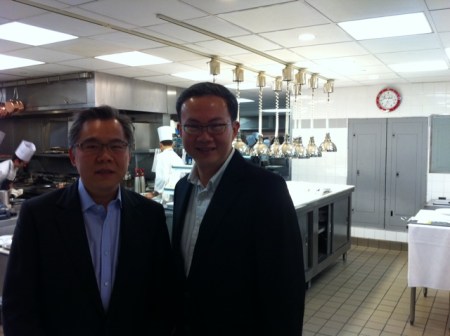 Another surprise! These are the kind of things – attentiveness to every detail and going all out to ensure that the diner is left with an indelible experience – that firmly cement the final star.
Again, when the bill came – just a shade above USD300 per head – it didn’t seem too bad compared to what one would have to pay in Paris or London, confirming my point of view that New York has the best value-for-money fine dining. Which was better: Per Se or Eleven Madison?? There’s little to choose between them, but I’ll have to pick the latter. The friendliness (the chef actually bothered to go around each table) and the kitchen tour just about sealed it, bringing my week-long sojourn in the Big Apple to a perfect end.

