Notes in brief (July 2009)…
 1994 Wynns Michael Shiraz, 31 July 2009 at Imperial Treasure T3. Dark reddish-brown with bit of tawny rim. After 15 years, still huge. Ripe, cool fruit from Coonawarra, without alcoholic heat. Plum, liquorice and touch of spice. Not as jammy as Barossa shiraz. I’ve come to the conclusion that most aged shiraz from Australia remain big and jammy, without much complexity, after all the alcohol and wood have receded. I prefer those that can develop with an Old World feel. So far, only Rockford Basket Press and Henschke Hill of Grace impress. I don’t have enough experience with top tier Penfolds to make a call.
2001 Quinault L’Enclos (Kieron), 28 July 2009 at w49’s dinner at Man Fu Yuan, Intercontinental Hotel. Impenetrable red, dense, notes of dark fruits and soy sauce (sounds weird, but appropriate). A big wine, very full, but unyielding. One senses a lot of complex flavours tightly coiled within, but not given the opportunity to shine. I’m not sure if it’ll ever evolve. A very modern St Emilion approach, but not my preferred style.
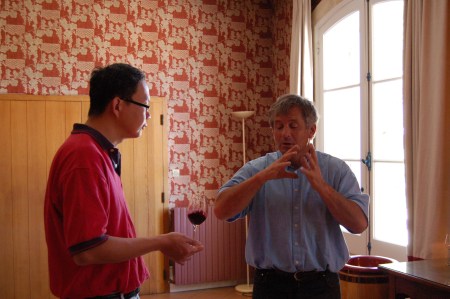
2000 Domaine de Chevalier rouge (me), drunk alongside the ’01 Quinault L’Enclos (above). A personal favourite. Beautiful deep red with purplish edge. Classic notes of earth and gravel intermixed with dark fruits. Great typicity of Graves. Full, almost velvety tannins, just the right level of concentration and richness. Will last the distance. Showing better than a previous bottle last year at Crystal Jade. Truly a connoisseur’s claret, as Parker says. I’m glad I have 13 more bottles. Need to buy more!!
2001 Ch Du Tertre (brought by PS), at Tunn Lin’s wedding 25 July 2009. Nicely balanced and elegant, the bouquet suitably floral in line with its Margaux origin. Prim and proper, not showy in any way. Drinking very well.
1998 Turkey Flat shiraz, drunk alongside the ’01 Du Tertre. The cork disintegrated and flopped inside the bottle, but the staff at the Pan Pacific did a great job double decanting, filtering off the debris. Ripe, warm Barossa fruit, without the heat. Not unctuous, but nevertheless, still a big wine, filling the mouth with plum and liquorice. Entering its drinking window, but hasn’t peaked yet. Clearly has the legs to last several more years, but I’m not sure how it’ll evolve. Only 1 bottle left.
2004 Ch Latour-a-Pomerol, at Hiok’s bar on 16 July 2009 (David). Another classic claret from a very good, if not great, vintage: red with a tawny rim, flavours of raspberry, smoke, and a touch of game. Expands on the palate. Good grip. Very elegant, doesn’t try too hard to please. Cool finish. Where’s the tannin? Excellent.
1996 Clos du Marquis, drunk alongside the Latour-a-Pomerol (me). Mature red with some bricking, complex flavours appearing but not quite fully developed yet, soft and lush. Drinking very well, but hasn’t peaked. Excellent stuff, easily on par with a Third Growth.
2004 Ch Les Ormes de Pez, at ward 49’s dinner at Kome on 1 July 2009, poured from magnum (Kieron). My previous experience with this, back in early 2007 also from a magnum that was going for only SGD95 at Carrefour, was disappointing. I remembered it was bright purple in color (!), and tasted thin and lightweight. Two years later in bottle and it’s totally different. Now it’s beautifully clear red, much deeper and weightier. Muted nose, medium-bodied, soft, simple but very pleasant, with notes of gravel, saddle and faint plum marking its Medoc character. Great value.
2003 Domaine Nicolas Potel Clos de la Roche Grand Cru, (Kieron) later at the same dinner when two of us sat down with chef Lawrence to polish off this as well as the 1995 Figeac (below), whilst ruminating over life issues. The bouquet was absolutely fragrant and perfumed, almost seductive, leading one to expect a delicate, feminine wine. Its character, however, was a complete contrast on the palate: a relatively big wine done in a modern manner, full, with some alcoholic heat leaving a touch of spice at the finish that’s quite typical of Potel. The alcohol dissipated after some time, leaving behind a big, opulent wine, ending on a sweet note.
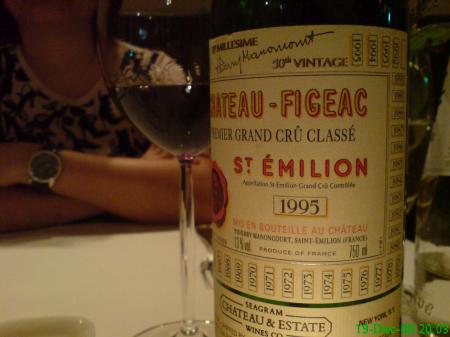 1995 Ch Figeac, (me) drunk alongside the Potel above, over some complimentary delicacies Lawrence had whipped up. This is the vintage sporting the special 50th anniversary label. I feel Figeac has always been grossly, and unfairly, under-rated. It is one of the few estates that remains unashamedly rooted in the St Emilion tradition, faithful to the characetristics of each vintage. Already mature, reddish-brown, fragrant with undertones of sweet red fruit. Soft, low acid, harmonious, drinking very well, smooth, showing great delineation from entry to finish, with tannin structure still intact. Complex. Not a powerhouse, but rather poise and elegance in abundance. Excellent depth. A classic, mature claret at its peak. Bon vin!
Pio Cesare wine dinner, with Pio Boffa
When Ms Lydia Yee of Excalibur Wines rang me up late afternoon last week saying she’d be inviting me to dinner, I had no idea that it would at The Tower Club, featuring the famous barolos of Pio Cesare of Alba, with the owner signore Pio Boffa himself (great grandson of founder Cesare Pio back in 1881, and often mistakenly addressed as Pio Cesare!!) in attendance! Needless to say, I jumped at the invitation, and when I arrived at The Tower Club this evening, 27 July 2009, I was met by Mr Antonio Koo, a Hongkonger who owns Ponti Wine Cellars, and who was hosting the dinner. It was the first time I’d met the affable Mr Koo, an extremely gracious gentleman and wine lover who, obviously, had traveled extensively and had gained the acquaintance of many in the wine industry.

The dinner itself was a private affair for only about 20 guests. I quickly realised that practically everyone in the room knew their stuff about wine. Apart from Pio Boffa himself, Mr Koo had also invited Mr Joel B Payne, an American residing in Cologne and a leading authority on German wines, being the author of the Gault Millau Wine Guide, who is also a brand ambassador for Pio Cesare. While waiting for everyone to arrive, we began with the 2007 Pio Cesare Gavi DOCG, made from 100% Cortese grapes. This wine was full, with good acidity and minerality imparting fresh, lifted notes of lime, citrus and a hint of peach and apricot. There was, perhaps, just a bit too much stuffing in the middle, but I could have easily mistaken it for a good, young village Burgundy.
We settled down to dinner, where I found myself sitting opposite Mr Payne. The 2008 Pio Cesare L’Altro Chardonnay that accompanied the low temperature ocean trout, in contrast to the Gavi, was much lighter in texture. Served too cold initially, it appeared simple and straightforward, with dominant notes of fresh lime and a touch of leafy mint. It opened up gradually in the glass, gaining greater body and fullness. Several diners (notably the ladies) commented favourably, but this isn’t my preference for chardonnay.
We quickly moved on to the evening’s pair of reds: the 2005 Pio Cesare Barolo DOCG, drunk alongside the 2004 Pio Cesare Barolo “Ornato” DOCG, paired with saute foie gras and the main course of chargrilled Angus beef fillet. Both wines are 100% nebbiolo, with the Ornato coming from a single vineyard. The 2005 Barolo had a distinct nose of plum and spice. Full-bodied, quite lush, good mouth-fill but not much in the way of structure, not unlike a straight merlot. Initially it came across as a bit four-square with a rustic feel. However, as dinner wore on, it expanded more on the palate, revealing the purity of the excellent nebbiolo fruit, becoming softer and more elegant.
In contrast, the 2004 Ornato, displaying a slightly deeper red, was rather muted initially, but with gentle coaxing, notes of dark cherries, truffles and creamy vanilla came through, betraying the new oak. A big wine with a plush entry, very full, somewhat monolithic, more structured, with sophisticated but unresolved tannins. Nevertheless, these never threatened to obscure the richness and density of the fruit, the superb quality of which was clearly evident. Like the preceding Barolo, it expanded further in the glass, developing greater depth and lushness, although the oak remained omnipresent.
Although 2004 is generally acknowledged as an outstanding vintage, Pio Boffa maintained that the 2005 actually pipped the former in quality, an opinion not, however, shared entirely by Mr Payne. Based on tonight’s experience, the 2005 Barolo is singing at this point of time, but I feel that the 2004 Ornato will last the distance and hit all the right notes years down the road. We wrapped up dinner with the 2007 Pio Cesare Moscato d’Asti DOCG – light, delicate and refreshing, a perfect foil for the evening’s reds and the accompanying white chocolate nitro.
I must really thank Antonio for the generous hospitality, and the presence of signore Pio Boffa and Mr Payne, for what has been a wonderful educational opportunity into the nuances of Barolo Old World.
Dinner with David
While I have been privileged to attend a large number of nice wine dinners, few are the occasions where all the the wines came together so beautifully. Tonight, 22 July 2009 at Otto (once again), was one of those that exceeded my expectations. The occasion was a get-together for the Changi alumnus – current as well as potential members – which, I think, will gain in size and regularity as time goes by. We gave the chef carte blanche to do as he pleased, Paolo put us up in a private room, and we were set.
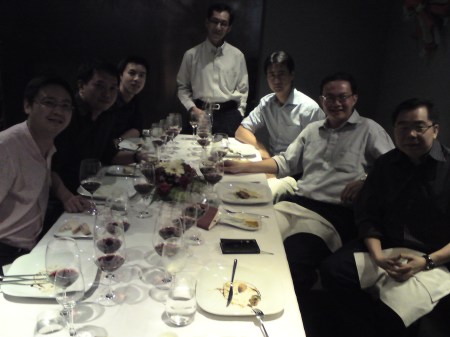
We started with the 2002 Louis Latour Corton-Charlemagne Grand Cru (me), which initially was very shy; one could barely discern any notes in spite of desperate coaxing. The full colors emerged after a couple of hours, taking on a familiar thick creamy layer with loads of caramel, vanilla and new oak. Medium-bodied, vivacious, fresh with good acidity. It’ll last a long time, and I suspect its going through an awkward period presently. Will open my next bottle 5-6 years down the road.
Next, we had 3 flights of reds. I must say that I cannot recall a dinner where all the reds were drinking so beautifully. One can’t tell from the line-up on paper. We started with a pair of 1994s to go with the wagyu carpaccio and foie gras, cooked to perfection. The pair of wines could not have come from such disparate origins, yet turned out so individualistic and so beautiful with age. The Mount Mary Quintet, deep red, gave off a big, deep nose of sweet cherries and raspberries. It was soft, ripe, extremely balanced and elegant. The wood had completely receded. If tasted blind, it would have been difficult to place whether it’s Old or New World – it certainly leaned more towards the former. Halfway through dinner, it became more intense and velvety, before giving way to a more mellow character infused with loads of sweetness, almost a like a ripe aged Burgundy. This is my first experience with an aged Mount Mary, and I liked it immensely. Side by side, the La Mission Haut Brion (Kieron) displayed a different sort of beauty – gravelly notes layered with an velvety intensity, matched to earthy notes that announced “Pessac-Leognan” with plenty of elegance and grace. Somewhat rustic around the edges, unlike its more famous sister Haut Brion, but totally in keeping with its renowned character. We caught it at its peak. Wonderful stuff.
 The next pair of Bordeaux, from side-by-side estates of St Julien and Pauillac, served as a reference point for classic, mature claret, going well with the pasta with kurobuta pork. The 1990 Ch Lagrange (PS), deep garnet red with lifted aromas of dark berries, displayed a delicious entry. Soft, medium, structured and layered. Not particularly complex at present, but definitely developing its tertiary character, a great Lagrange entering its peak window. Hard to place initially, but it snapped into focus after an hour in the glass, showing excellent delineation from entry to finish, drinking very well but will benefit from several more years in bottle. The 1988 Ch Lynch-Bages, always a favourite with Hiok, was unmistakably Pauillac with all its typicity in place. Fully matured, complex, great structure (still) without any trace of wood or tannin. Very long. The quintessential, aged Pauillac. Bon vin!!
A final pair of Italians rounded off the evening. The 1997 Biondi-Santi Tenuta “Greppo” Brunello di Montalcino (Vic) showed a brighter red with a slight tawny rim. Already matured and medium-full. Very classy, elegant and poised. Superb. In fact, its origin would be hard to commit in a blind tasting. In retrospect, the sangiovese element did come through on the palate, but in the most sublime and integrated manner. The piece de resistance, the 2001 Sassicaia (David), managed, most successfully, to contain all its richness, density and intensity within a velvet glove. Already showing subtle nuances here and there, a touch of austerity but entirely appropriate for such a big wine, ending on a savoury note. Gorgeous yet elegant. Obviously has plenty of legs to last a long while. Trust the Italians to make a wine resembling a beautiful woman.
When I reviewed my notes, I found the same few words describing each wine: mature, balanced, elegant, drinking beautifully. It’s clear that we caught every red tonight at or close to its peak. So seamless were the wines, and such was the level of sublimity, that I only discovered back home that I’d forgotten to snap a picture of the line-up!! A shame, but, never mind, the memories linger…just like great wines.
Meeting Herr Wolfgang Blass
There wasn’t much preceding publicity about his appearance at Jason’s of Paragon on 14 July 2009, but an advertisement a week earlier had caught my eye. When I arrived at the scheduled time of 7.30PM, only small group of people had gathered, and a couple of promoters were desperately trying to drum up some fanfare. A shame, really, considering that Herr Wolfgang Blass himself is one of the few winemakers who advocated growing shiraz vines in the Barossa Valley more than 30 years ago, when the Australian wine industry was in its doldrums, and he has tirelessly promoted his Wolf Blass range of wines to its present highly successful business. Dressed in a tweed suit and looking dapper and energetic, you’d hardly guess he’s 75. He gamely autographed my bottle of the 2003 Wolf Blass Platinum Shiraz, agreeing with me that it needs plenty of sleep. “Open it when you get married or divorced!”, he said. Wow.
 The organisers had generously made available the 2004 Wolf Blass Black Label (SGD145) for tasting. Perhaps due to the wide range of quaffers in the Wolf Blass line-up, I’d forgotten how good the Black Label is: dark red, powerful bouquet displaying notes of sweet plums, cedar, and liquorice. Full-bodied, no less, structured, mouth-saturating but not over-bearing, ending with the unmistable stamp of warm, ripe Barossa fruit producing a touch of spice. The excellent quality of the 2004 fruit was such that the sophisticated silky tannins and alcohol never dominated. Really good. I wonder how the Platinum Shiraz will fare. At the current price of SGD220, I’m not opening mine.
American Club Burgundy Masterclass & Tasting
Thanks to the generosity of a colleague, I was invited to the above event on 11 July 2009, right after my return from Paris, tutored by Ms Lisa Perotti-Brown, MW. At SGD170, this was superb value given the lineup. Ms Perotti-Brown started off with a 25 minute lecture on the characteristics and nuances of white and red Burgundy wines of various regions, after which we launched into the most insightful part: the actual tasting.
We began with 4 whites centred around the south of the Cote de Beaune. The 1999 Domaine Leflaive Puligny-Montrachet 1er Cru Les Folatieres was pale golden, with the nose and palate dominated by lifted aromas of lime, citrus and a huge dose of minerality, coming across as big and powerful. The sample we had was served at a temperature that was probably too warm, for the wine, although crisp and fresh, was soft and somewhat flat at the finish. I’d expected more richness and intensity, and was rewarded after it sat in the glass for a further 30-40 minutes, when it took on a nutty and caramel character that was quite appealing. It’s actually quite excellent, and should be, given the reputation of this producer and the outstanding vintage. At 17.64 ha, Les Folatieres is, by far, the largest of the Puligny premier crus. But with uneven distribution, its quality is definitely below that of Les Pucelles.
The 2000 Domaine Ramonet Puligny-Montrachet 1er Cru Les Champs-Canet was darker in hue, and served too cold. However, one could already discern a fabulous bouquet leaning towards peach and apricot against a background of toasted cashews and a faint “yeasty” note that was simply quite exotic. Rich, with excellent mouthfeel and complexity. Bit short on the finish, but I liked this very much. My favourite of the 4 whites.
Showing a similar color, perhaps a tad lighter, was the 2002 Domaine Roger Bellard Mersault-Santenots 1er Cru, giving off a very floral note full of apricot, lime and pineapple flavours. A big wine, dominated mainly by citrus notes, showing some “oily” thickness on the mid-palate, with good acidity and a strong finish. Ms Perotti-Brown hailed it as the quintessential Mersault. In spite of the outstanding vintage, it lacked the subtle nuances that comes so effortlessly from a Puligny-Montrachet.
Another Domaine Ramonet, the 2001 Chassagne-Montrachet Clos de la Boudriotte 1er Cru, rounded off the line-up of whites. Like the earlier Ramonet, this wine carried more weight and body, with lifted aromas of lime and citrus. Quite complex, with a lingering finish. I liked it.

Unlike most wine tasting sessions that tend to get off to a slow start, Ms Perotti-Brown moved us on to the reds, beginning with the 1995 Morey-St Denis from Domaine Dujac. Clearly in advanced maturity, it exhibited the bouquet of the night: a very fragrant, floral nose of sweet red fruits. Soft, medium, plush, with extreme purity and lasting finish. This demonstrates very well the age-old dictum when it comes to Burgundy wines – foremost consideration goes to the producer, above all else. Who’d have guessed that this was a village wine?
Then came what was unanimously hailed as the wine of the night: 1999 Mommessin Clos des Tart, a Grand Cru monopole. It displayed the deepest red of the entire line-up, and a nose that was still reticent, needing plenty of coaxing. Underneath lurked a full-bodied wine rich in red and dark fruit characters that had yet to develop tertiary flavours. Traces of vanilla betray the presence of unresolved new wood, perhaps not surprising given its breeding in such an outstanding vintage. The nose opened up a bit an hour later, but clearly this beauty, offered at SGD408 (!), still needs plenty of sleep. Superb, but not to be touched.
After this magnificent showing, the 2002 Geantet Pansiot Chambolle-Musigny 1er Cru that followed tried its best to impress with a very emergent sweet floral bouquet, combined with a wine that was full, rich and dense on the mid-palate, quite characteristic of reds from this region, particularly premier crus and above drunk less than 10 years from an outstanding vintage. In fact, some of this intensity might be misconstrued as being syrupy. Good linearity and finish. I felt it was excellent and I liked it. However, it failed to flesh out in the glass, and didn’t really excite some of my fellow tasters. Part of the reason was, perhaps, because it was sandwiched between the Mommessin and the 2000 Comte de Vogue Chambolle-Musigny. As mentioned earlier, a great producer can do amazing things with a village production. This wine was absolutely superb, again giving off the richness, intensity and density typical of a Chambolle-Musigny, but with wonderful layering, structure and complexity that was missing from the Geantet Pansiot, in spite of 2000 not being particularly outstanding. Fabulous stuff, but comes at a price.
The most highly anticipated wine in the line-up also turned out to be the biggest disappointment: 1997 Domaine Romanee-Conti Richebourg Grand Cru. Light red, with a delicate floral nose suggesting a lighter wine. Good entry, medium-bodied, but lacking in richness and the expected complexity failed to materialise. The fruit, clearly, was drying out, suggesting the wine was already over the hill. Perhaps we had expected too much, but at SGD1500, we have a right to do so. The only other DRC that I’d tasted , a 1993 Echezeaux courtesy of Fatty (surprise!) last year, was far more superior.
The tutored tasting ended with the 2001 Robert Arnoux Echezeaux Grand Cru, typically a big wine from this producer with plenty of red and dark fruit characters, but the complexity was not quite evident, and the finish was dry, almost to the point of being astringent.
We didn’t quite realise, but we had tasted 10 serious wines. This was not the end. We then adjourned to the next room for a buffet of oysters, shellfish, fresh prawns (superb!), as well as a selection of lamb and beef cutlets, to be washed down with a free flow of 60 different Old and New World chardonnays and pinot noirs, courtesy of Hermitage Wines. I hoped they managed to recoup their costs, for I remembered tasting, freely available: 1999 Domaine Leflaive Bourgogne Blanc (good but relatively expensive), 2003 Maison Verget Chablis “Vaillons – Villes Vignes des Minots” 1er Cru (crisp & delicious), 1997 Domaine Leflaive Puligny-Montrachet, 2006 Kistler Dutton Ranch Russian River Valley Chardonnay, 2006 Kistler McCrea Vineyard Chardonnay (rich, creamy, great depth; better than the Dutton Ranch), 2003 Beringer Private Reserve Napa Valley Chardonnay, 1999 Armand Rousseau Charmes-Chambertin Grand Cru (wonderful but still not ready), 2002 Domaine Joseph Faiveley Echezeaux Grand Cru, 2003 Armand Rousseau “Lavaux St Jacques” 1er Cru (excellent…how can it not be??), 1981 Maison Henri Boillot Pommard “Les Rugiens” 1er Cru (still alive & drinking well), and 2006 Felton Road Block 3 Pinot Noir (now I understand why this is so highly sought after). The most memorable highlight was the 2004 Bonneau du Martray Corton-Charlemagne Grand Cru – creamy, rich, complex, great finish…a complete wine. I’m glad I’d bought some earlier this year during Ponti’s closing sale, at only SGD128.
I must have drunk well beyond 750 ml of wine that evening. Frankly, I was struggling to keep my hatch shut at the end. I must thank John Lim and his associates (particularly that delicious babe who was pouring the reds) from Hermitage Wines for their unstinting generosity in providing us with such a glorious opportunity, and to the American Club for organising this event, which was worth way beyond the SGD170 I paid.
La Tour d’Argent, Paris
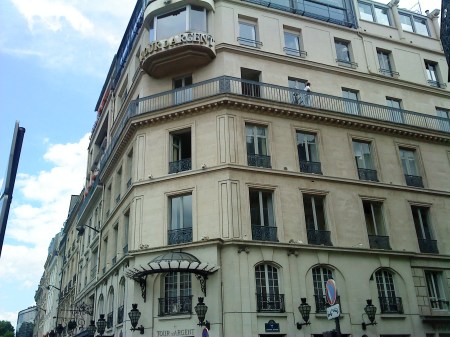 On 7th July 2009, I headed down to La Tour d’Argent, at 15 Quai de la Tournelle in the 5th arondissement, for what surely must count as one of the culinary highlights of my life. This had been recommended to me by Kieron, and I discovered that this is an institution in France, as far as grand dining is concerned. The oldest restaurant in Paris, its history dates back to 1582, when it was first established to separate itself from the cheap inns of Paris. King Henry III was one of the first to dine there, where he discovered the usage of the fork. Since then practically every King & Queen or notable person has dined there. The venue is still the same, overlooking the Seine with the Notre-Dame just in the background. Absolutely stunning.
 When I arrived at the appointed hour of 1230h, I found the general manager, another staff member and a page boy waiting at the front entrance. The ground floor is basically a museum, decorated in late 18th century décor, the way it was. Photographs and autographs of luminaries who had dined there lined one of the walls. The page boy, who ushered me to the elevator and operated it as well, was dressed in period costume. When I reached the 6th floor, all the wait staff, dressed in coat-tails, greeted me in French. Very formal. I was the first one there, and was ushered to a window seat, overlooking the Notre-Dame. This is the prime seat! Very soon after, the restaurant filled up, and a few Americans came as well but, thankfully, they were not loud. The entire décor in the restaurant was 18th century period European.
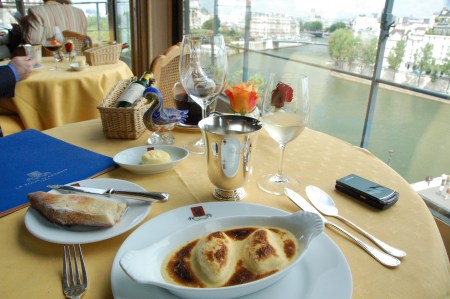 I started with some still water, which was poured not into a cup, but a goblet made of pewter, with the restaurant’s coat of arms. It could have passed off as the Holy Grail. Then the waiter served me a trio of amuse bousche, explaining it all in French (he could actually speak English). I didn’t catch a word. They looked like miniature pastries and puffs, but simply melted in the mouth. I ordered the prix-fixe menu, at €65. This must be considered a bargain, considering the equivalent for dinner is €220, before any wine! Their speciality is, of course, the canard (duck), which I enquired. However, the waiter shook his head, saying it’s meant for 2 persons and would be too heavy. Instead, he pointed out a smaller version (canette) which is available on the lunch menu which I took, preferring it to be pink on the inside as recommended, instead of brown. I chose their trademark “Andre Terrail” (a direct descendant of the early owners; died 2006) Pike dumpling as entrée, and a strawberry tart for dessert.
 The young Sommelier then came over and planted a huge thick book, the size of two encyclopedias, on my table. This is the famous wine list!! Everything is there, in breadth and depth. Verticals of various chateaux abound, at prices that do not seem too unreasonable. After spending 10-15 minutes browsing through the Bordeaux section, I engaged the Sommelier in some serious discussion, and settled on a glass of white, and a red. The former was a 2007 Domaine Jean-Marc Boillot Bourgogne Aligote (€15). This is an impressive thing: pale yellow, but immediately exuding its class with quality fruit, minerality and acidity imparting a wonderful freshness.
  The wine service was even more impressive. When I enquired about the producer but failed to catch the name, the Sommelier actually had the wine label removed, stuck it onto the restaurant’s card (resembling a greeting card), and presented the whole thing to me in a sealed envelope!
As this is a traditional restaurant, the servings are generous. The entrée consisted of 2 dumplings, made of the softest of textures, with mushroom stuffing, the whole thing being covered in a generous coating, the ingredients of which slipped me, but I’m sure egg, custard, cheese and butter played significant roles. Superb. The canette was even more impressive: a big slice, laid on a base of green-colored sauce. The presentation was so perfect that I didn’t touch it for 10 minutes. Since 1890, the restaurant has been serving duck, done its way, amongst other things. Each duck that’s slaughtered since 1890 is numbered, and a certificate is issued to the diner. Halfway through mine, the mâitre’d came over and planted a postcard-sized certificate on the table, indicating that I was eating the 1079824th duck in the restaurant’s history.
 It went perfectly well with the half bottle of 1988 Château Pichon Longueville Comtesse de Lalande (€165). I had initially considered having either the 1988 Ch Trotanoy or the 1989 Ch Pichon Baron, but the Sommelier suggested the Comtesse instead, and he was absolutely spot on. The wine was fully matured, displaying an evolved red that was bordering on vermillion. The nose was unmistakably that of a top-flight aged Bordeaux, the wood and tannins having receded far away, leaving the glorious fruit to shine, revealing all its complex tertiary flavours in full cry. Medium-full, structured but softened by time, perfectly balanced and elegant, ending on a sweet glycerin note that lasted and lasted. Unbelievable, coming from a half bottle. Who needs First Growths when you have this? The Sommelier seemed impressed with my wine experience and, as lunch wore on, we got along very well, talking at length about wine and Bordeaux. I asked to visit their renowned cellar, but was told it’s under renovation.
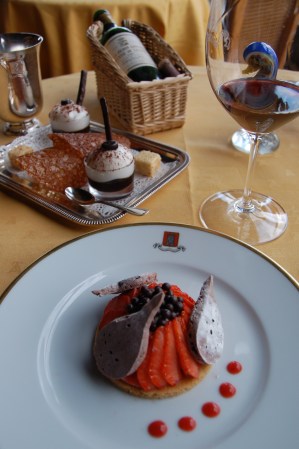 And so I munched there, taking my own sweet time to appreciate the food, the view, the superb service (perfect on this occasion even though various internet discussion groups have suggested that it can be highly variable), and snapping away on my camera. The whole experience was almost surreal. This restaurant lost a Michelin star in 2007 following the demise of Andre Terrail, becoming a one-star restaurant. But based on my experience, I’m rooting for it to regain its former glory. It can, and should, achieve that through its history, uniqueness, and uncompromising quality.
The strawberry tart was just nice, and the petit-fours and superb café rounded off a most remarkable lunch. When the bill came, it didn’t seem too bad. On the other hand, it was a lot of money, no doubt about that. Was it worth it? Well, there are many mindless ways to blow away good money. But on this occasion, at least, I knew it was spent on a most memorable and, perhaps, once-in-a-lifetime experience.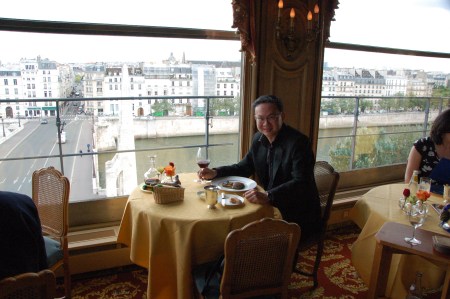
Paris: L’Entrecote & Bistrot du Sommelier
Never turn down any offer of a trip to Paris, which was what I did after receiving an email some months ago from the organisers of the XIX World Congress of Gerontology & Geriatrics. Who says I don’t practise Geriatric Medicine? I made sure my abstract submission was successful, and made my way there.
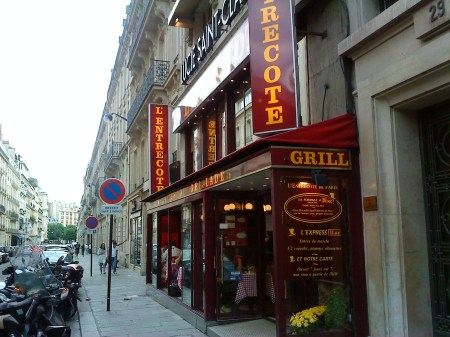 Although this is my third trip to Paris in 6 years, one never gets tired of the famous sights. While walking along the Champs-Elysees, I spotted the familiar L’Entrecote restaurant. I’d come to know L’Entrecote after my trip to Bordeaux last year. It’s basically a sit-down meal of steak done fast food style, and very successful too. They don’t accept reservations. Just queue up, sit down, specify your steak (cut in small thin slices immersed in mustard sauce) in what manner to be done (they don’t serve any other food), your choice of a generic Bordeaux, either rouge, blanc or rose (in either glass/half/full bottle) and you’re done. However, the L’Entrecote here in Paris is obviously a franchise, and less attractive. You don’t see any crowd (not a good sign), the distinctive yellow decor is missing, and the menu is more expensive, almost twice than the one at Bordeaux. The same set menu of walnut salad + steak/fries + half bottle 2007 Kressman Bordeaux red (which doesn’t warrant any blog space) + Vittel bottled water + ice cream came up to 43 Euro per head, while I remembered paying only 55 Euro for 2 persons in Bordeaux. And here, they don’t top up your steak and fries! Not a good deal. Even the franchise outlet in Barcelona is more true to style, and less expensive.
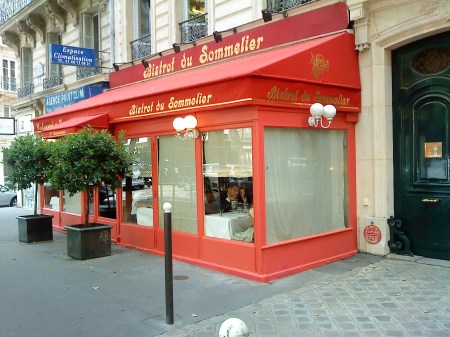 The next day, I found my way to Bistrot du Sommelier, reputedly one of the best dining venues in Paris, located along 97 Boulevard Hausmann in the 8th arondissement. After emerging from the nearest metro, I made my way but after 1 traffic junction, it didn’t seem right. I asked for directions from a Frenchman in my broken French (“excuse-moi, direction Bd Hausmann, sil-vous plait?“), who replied me back in anglais. They’re friendly. I had gone the opposite direction. Soon after, I located the Bistrot, a small red diner jutting out into the pavement. To my horror, I noted that all the waiting staff wore suits! The maitre’d looked like that gay chap from Runway Project. He was standing behind the glass door that was shut. Initially I thought perhaps I was early, but when I read the menu that was stuck outside, I managed to make out that they open at 1200h, and it was already 1230h. So I unslung my bag and approached the door. The maitre’d looked unbelievingly at this chinois fella in a yellow polo-T, but he opened the door nonetheless. I introduced myself in a few words of French, that I have a reservation, and he showed me to the table. The service was efficient and fuss-free, but all the wait staff carried about them an air of aloofness typical of the Parisiens.
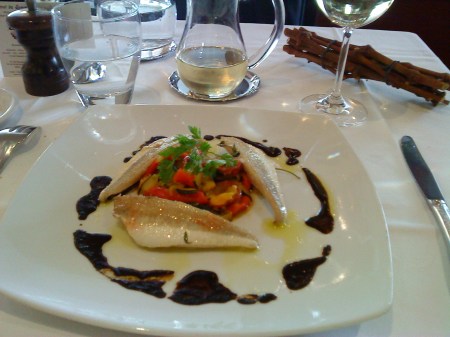 The menu was simple, each set of entree or plat or dessert having just 3-4 choices. The lunch wine list was also fairly simple, mostly Vin de Pays, with 2003 Ch Cantermerle and 2003 Ch Lafon Rochet being the most recognisable, each wine being available in either verre/carafe/demi or bouteille. At 32 Euro and 30 Euro respectively (carafe), those 2 Bordeaux grand cru classe didn’t seem attractive. So instead, I chose the prix-fixee dejeuner (3-course, 39 Euro), starting with foie gras terrine, followed by fish, and then biscuit moelleux, which turned out to be a tart, washing all down with a carafe of 2007 Domaine Les Heritiers du Comte Lafon Macon (16 Euro). The food was excellent, although the fish wasn’t particularly outstanding. Perhaps I should have opted for the beef, but with the prospect of lunch at La Tour d’Argent looming the next day, I think I made the right choice of not going too heavy. The wine, which is available in Singapore for SGD50-60 per bottle, is actually very good: clear light yellow, lifted aromas of citrus and lime, more than adequate stuffing with good body, acidity, and minerality. Not particularly complex, but it expands a little in the glass. Perfect for a light lunch. In fact, I got a little light-headed, such that I didn’t realise the staff had short-changed me by 10 Euro for the 100 Euro bill I had given them. It clearly wasn’t intentional, for moments after I had pocketed my change (without realising the error), the waiter handed me another lot of change, with the correct amount! Being the honest Singaporean, I handed back the second change, assuming they’d made a mistake. The maitre’d checked his accounts, then said the money’s mine! Something wasn’t connecting in my head, as I insisted that I’d received my change, and I left the restaurant, with the staff thanking me quite effusively. I realised my mistake the moment I stepped out into the sun. Heck! I decided to forget about it. That’ll teach me not to be so bloody cock-sure.
Ward 48 dinner at Ming Kee
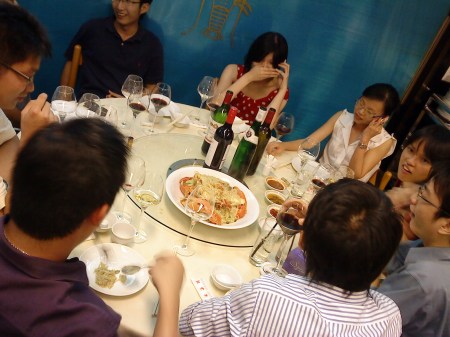
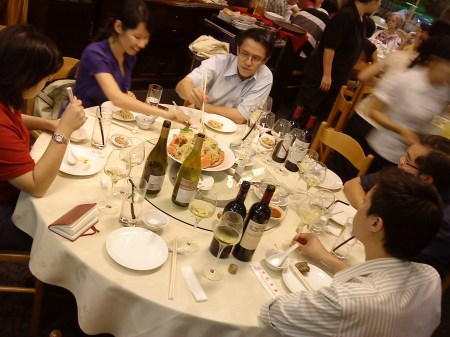 Time flies, and, once again, we settled down to another one of the famous ward 48 dinners for the HOs and MOs. We returned to Ming Kee, which is an absolute gem located along MacPherson Rd. Where else can one locate a air-conditioned Chinese restaurant, with polite and attentive uniformed staff, that serves superb dishes at prices that are most reasonable (if you feel that SGD671 for a full-course dinner for two tables, including a gigantic crab each, is expensive, you don’t belong to this planet) without any service charge, GST, nor corkage for unlimited usage of tall Mikasa glasses?? The Prime Minister obviously knew better, for a framed photograph of him and the restaurant’s chefs lined the wall at the entrance. Ang Mohs are known to frequent this place with cartons of wine. I strongly suggest you look up this place before the owners wise up. Advance bookings are essential.
The senior staff table began the evening’s proceedings with a pair of Aussie whites: 2007 Moss Wood chardonnay and 2004 Leeuwin Estate Art Series chardonnay. Both hail from the Margaret River wine region, and both were pale lemon yellow in color, with initial notes of citrus, lime, and minerals (more with the Leeuwin). The Moss Wood seemed to lack sufficent depth and body initially, compared with the Leeuwin, which was immediately fuller, showing great balance between fruit and acidity. But with time, the Moss Wood opened up, gaining in weight and intensity, with lifted creamy, floral notes tinged with honey. In fact, over time, both these wines became very similar on the nose, with the Moss Wood eventually edging ahead, slightly, on the palate. However, both fell way short off the mark in comparison to the previous night’s Giaconda and Talbott (see below).
We paired the meat dishes with two Bordeaux reds and two Aussie reds. The 1999 Grand Puy Lacoste, already brownish-red, threw off a strong sweet note of glycerin. However, the wine came across as lacking in quality fruit and rather four-square, with the wood and alcohol being quite evident. Disjointed. Somewhat symptomatic of the vintage, although I remembered a bottle 2 years ago at KP’s place showed much better. The 2000 Grand Mayne, much darker red in color, also smelt of sweet glycerin. This wine, on the other hand, was huge, dense and monolithic. Yet to develop secondary flavours. This will last many more years, although I’m afraid it’s not my preference – just too extracted, a wine that tries too hard.
The pair of Aussies actually fared better. The 2003 D’Arenberg Dead Arm, impenetrable red in color, gave off unmistakable flavours of aged shiraz. Still huge, with prominent notes of liquorice, plum, and loads of alcohol (much heavier than my previous bottle with the Mayo endocrinologists in Feb 2009), the whole package coming across as being rather predictable and four-square. I’d say the previous bottle was better. I can’t say I enjoyed it.
 The 2001 Cyril Henschke (Kieron) was easily the wine of the night. A blend of cabernet sauvignon, cabernet franc and merlot, it hit the right notes from the start: huge nose of lifted, ripe warm fruit, with a hint of medicinal notes on the finish. Full, mouth-saturating, yet leaves you still wanting for more. Richer and more sophisticated in its handling of wood, alcohol and fruit than the Dead Arm. Excellent stuff, but I think one really needs a robust steak to go with it.
The MOs thoroughly enjoyed themselves, polishing off 4 bottles (2000 D’Arenberg Dead Arm, 1996 Haut-Bages-Liberal, Penfolds Bin 407 (vintage?), as well as a German riesling) and becoming totally disinhibited in the process. They even went further to order another house plonk. This is, by far, the best showing from the HOs and MOs, and I can imagine ourselves returning to Ming Kee regularly.
Private dining at Au Petit Salut
I found myself back again at Au Petit Salut last evening, 24 June 2009, but this time upstairs at their private dining lounge, on the occasion of a colleague’s success (I shan’t elaborate). We had liaised ahead with the chef Karl (who had also handled the private dining affair at Monk’s Hill back in 2006 when I celebrated my promotion), who had prepared a special menu. The private dining lounge was spacious, and immediately exuded a very welcome feel with its sophisticated use of understated colors and furnishing. 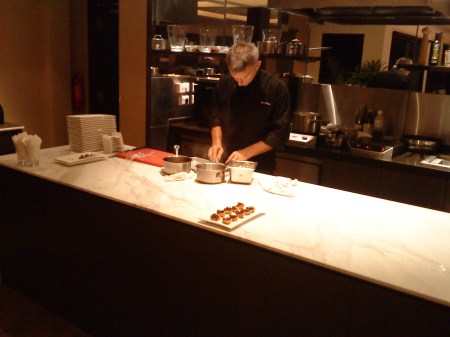
While Karl kept himself busy with a continuous flow of various amuse-bouches, we began with a 2000 Dom Perignon that started the evening off perfectly, the nose already very open, with just the right mix of citrus, minerality, zest and body. Certainly not the sort of heavyweight champagne exemplified by Krug; this had a touch of delicacy that did not intrude into the subsequent whites.
The superb double entree of Hokkaido scallops carpaccio and angel hair pasta (with mud crab and scampi tail) served as the perfect foil for the pair of New World chardonnays that followed: 2005 Talbott Diamond Estate Monterey County (Kieron) and 2002 Giaconda. Both were light-golden in color, with the latter being heavier in tone. However, in terms of flavours and complexity, the Talbott appeared to have the edge, displaying lifted aromas of peach, caramel, and notes of freshly roasted cashews. Amazingly complex, yet showing off its nuances in the most elegant and subtle manner. Fantastic purity, superb balance, not a hint of oak anywhere, ending on an understated note of lychee that lingered almost indefinitely. The Giaconda was similar in some respects – excellent body, creamy, soft, pure, with sophisticated handling of wood, ending on a strong lychee note, but overall, less exuberant than the Talbott. I couldn’t help but noticed a whiff of “yeast” at the beginning, which blew off. Both gained greater complexity and weight in the glass, although the Talbott nose faded slightly over time. One would be hard-pressed to identify these as New World chardonnays in a blind tasting. Absolutely superb, but the Talbott definitely held the edge. I’d venture to say it’s even better than Kistler. Period.
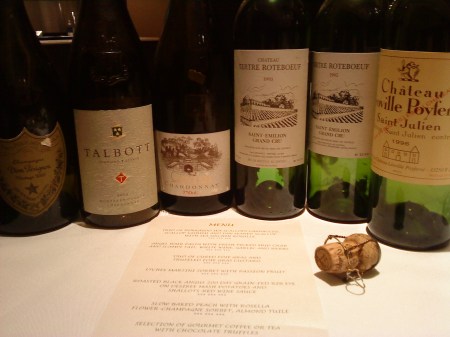 For the main course of Black Angus ribeye, we paired the 1993 & 1995 Tertre Roteboeuf (the latter courtesy of PS). The wines from this St-Emilion estate, attaining almost cult status, may seem rustic in their youth, but this pair had developed beautifully with time. 1993 may have been a wet year, but the hallmark of a great chateau is its ability to make good wines even in weak vintages, as this 1993 can attest to: bright red, aromas of mature red and dark fruits, good body, soft, just lacking the richness and intensity one would find in an excellent vintage, as exemplified by the 1995, which was darker, throwing off a bouquet that was immediately biger and layered with luxuriant dark fruits, chocolate and coffee. Full-bodied, mouth-filling, wonderful depth, ending with fine sophisticated tannins and a savoury finish. I was glad to have the opportunity to taste these two.
We ended the evening with the 1996 Leoville Poyferre (Kieron) to go with the delectable selection of cheese. You cannot mistake the powerful, penetrating nose – laden with graphite, tobacco, cigar, and so-called notes of lead pencil shavings in great abundance – as anything apart from classic St Julien. You would not even have mistaken it for a Pauillac. Absolutely intense and huge, ending on a savoury note. Clearly has plenty of legs left. I’d leave it – as a matter of fact, any 1996 – alone for another 10 years, at least. Superb.
This had been a superb evening of wining and dining, and I’m infinitely grateful to the host for his kind generosity. The only letdown was the coffee, which led to some dyspepsia overnight, but that was, nonetheless, worth the evening’s experience!
1994: Chateaux Clinet, Cos D’Estournel
This month of June, being our anniversary month, will see a series of wines from 1994 being drunk at various dinners. As this Tuesday of 2 June 2009 was just too good to waste away, I returned to Otto with the missus in tow. Paolo, who still remembered the previous week’s Masseto, settled us in. We opted for the degustation menu, comprising Hokkaido scallop carpaccio, asparagus with truffles and egg, prawn pasta, tenderloin beef and warm chocolate cake, to go along with a 1994 Chateau Clinet. 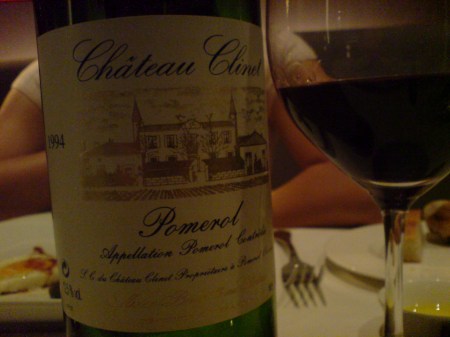 This wine was noticeably darker compared with a previous bottle I had last year at Kome, almost dark brown with a bit of lightening at the rim. There was quite a bit of bottle stink initially, which took a good 45 minutes to blow off. The nose was unmistakably characteristic of an aged Bordeaux, with mellow red fruit characters that followed through on the palate with a trace of sweetness. The wine was still cloaked within some tough tannins, but this melted away in the glass, eventually becoming quite harmonious with the predominant merlot fruit coming to the fore. Medium-bodied, moderate finish. This bottle is much tighter than my previous one. Can be kept for another few more years but the fruit is beginning to dry out, and based on the 2 differing samples I’ve had, I suspect there may be quite a bit of bottle variation. I suppose it’s not Clinet on top form, but at current prices (I noticed the prices of Clinet in recent vintages have dropped), it’s worth exploring.
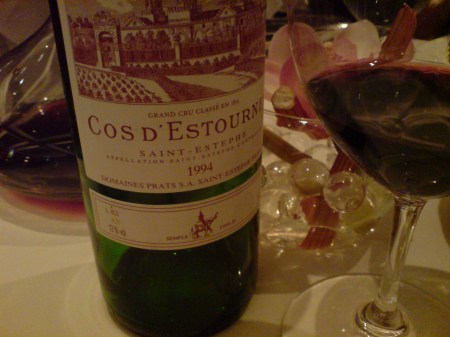 On June 11th, we celebrated our 15th anniversary at Au Petit Salut. I must say the food quality is excellent at reasonable prices for this level of dining, but service quality, although improved, lacks the kind of personalised touch that epitomises Les Amis and Iggy’s; even the folks at Otto do a better job. I brought along the 1994 Cos D’Estournel, which is the second time I’m having this wine. It exhibited an evolved reddish-purple, tapering away at the rim. The nose revealed notes of cherries with an underlying layer of darker fruits that carried onto the palate. Medium-bodied, soft, good depth, finishes with a touch of cigar and tobacco note. Unlike most 1994 Left Bank cabernet that is drying out, the fruit quality of the Cos is still excellent, just lacking the final coat of power and finesse one would find in an outstanding vintage. My records showed I paid SGD143 for this, which I feel is worth every cent.
 Ric's Wine Journal