Apart from catching a couple of football matches at Manchester and White Hart Lane, as well as concerts at the Wigmore Hall, Royal Festival Hall and the Royal Opera, Covent Garden, my recent trip to London included a couple of dining experiences at Zafferano, Knightsbridge, and The Ledbury, Notting Hill. There wasn’t much of a palpable difference between these one- and two-Michelin star establishments, respectively, though I thought I fancied the former slightly more.
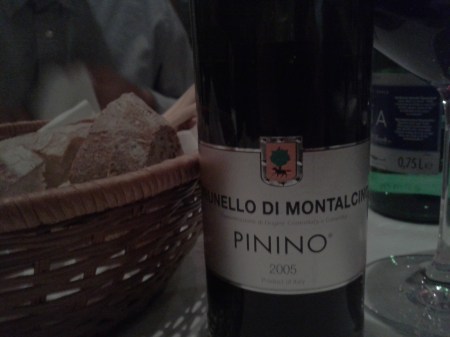 2006 Pinino Brunello di Montalcino, a half bottle from the restaurant list over dinner at Zafferano, 19 Oct 2011, for GBP52. Rather full-bodied and one-dimensional initially, almost overwhelming with a mix of red and darker berries, although one appreciates the excellent concentration and balance without any jarring edges in spite of its relative youth. The alcoholic trace receded over time and food, the red fruits becoming more dominant, the wine opening up to reveal more layering, supported by darker fruits beneath whilst the subtle plumminess of sangiovese became more noticeable. Very good, really. I find that Tuscan reds offer some of the best value in restaurant lists and this is no exception.
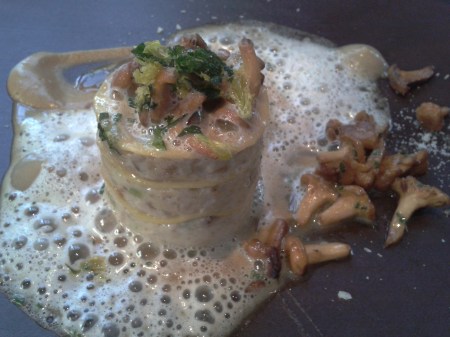 2006 Domaine Dujac Morey St-Denis 1er Cru, a half-bottle from the restaurant list over lunch at The Ledbury, 21 Oct 2011, for GBP54. A shade heavy in color for pinot, but arresting in its exuberant bouquet of sweet strawberries, cherries and other red fruits right from the first pour, matched by an intensity that held the palate in a firm grip. It opened up quite quickly over time, revealing layers of brambly fruits and cedar, the tannins more relaxed and supple, eventually transforming into a soft fleshy wine true to its Burgundian spirit with excellent balance and depth. Highly rewarding, but needs time.
Notes in brief (Oct 2011): 1998 Clos Fourtet, 2002 Faiveley Gevrey-Chambertin 1er Cru, 2006 Dead Arm, 1988 Rieussec
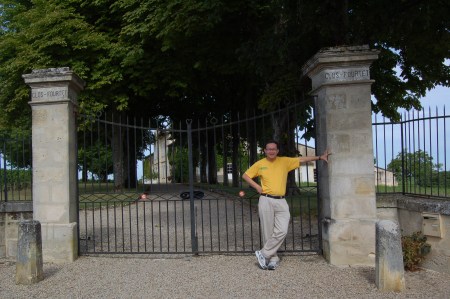 1998 Ch Clos Fourtet, over dinner at Pete’s Place, Grand Hyatt Singapore, 1 Oct 2011. In spite of having been decanted for 3 hours prior, this wine was still, surprisingly, bold and unyielding, extracted in a more modern style of St-Emilion with a salty tone in the mid-body, obviously generous in red fruits and darker berries but still rather unsettled, weighing in with hefty tannins that grew in stature over time instead of receding away.
2005 Winemaker’s Collection Episode One, at Etoile on 4 Oct 2011. Decanted on site. Deep purple with a slightly evolved tint. This is the last bottle from my first case of twelve that I started drinking since 2008, and it’s showing the best. Highly expressive on the nose with notes of ripe red and dark berries and a bit of plum, grippy and generous on the palate, excellent in concentration, fleshy and layered with raisins and cinnamon, the predominant softer merlot component all adding up to a highly inviting proposition. This is one instance where Michel Rolland’s preference for longer fruit hang and greater extraction has worked wonders on an otherwise so-so terroir.
2009 Ch Bernardotte, popped and poured from a magnum at Azur, Crowne Plaza Hotel, 6 Oct 2011. Deep purple, primarily fruit forward with notes of ripe blackcurrant and blueberries, supported by mild vanilla oak. Pretty simple and straightforward. Only time will tell whether it will gain further weight and complexity with time. At only SGD75 for a magnum, no one’s complaining.
2006 Ch de Pressac (courtesy Gerard) at Azur, Crowne Plaza Hotel, 6 Oct 2011. Popped and poured. I must say this wine was rather enticing on the nose, a healthy dollop of ripe red and dark berries that ran fairly deep with more than a hint of complex minerality. On the palate, however, it was utterly disappointing – thin, green, stern and austere at the finish witha rusty ferrous quality, a total disconnect from its bouquet.
2005 Domaine Michelot Mersault 1er Cru “les Genevrieres”, from the restaurant list at Absinthe where we were seated right inside its cellar, 7 October 2011. Absolutely lovely on the nose with exuberant creamy minerality and notes of butter, a hint of vanilla and white flowers against a soft citrusy tone. Rounded and smooth, displaying very good depth and concentration. Yet to develop further complexity but I can imagine it’ll be really excellent when that time comes.
2002 Domaine Faiveley Gevrey-Chambertin 1er Cru “Champonnet“, at Absinthe, 7 October 2011. Decanted on-site for an hour. A lovely red for pinot, soft and supple, rather feminine in character with good purity and concentration of red cherries and strawberries, medium-bodied with a light touch, elegant and beautifully balanced, totally devoid of excesses. However, it is clearly not in the same league as Clos St-Jacques. Nevertheless, it was the perfect accompaniment for lunch.
2005 Domaine Leflaive bourgogne (courtesy LW), at Tunn’s housewarming party, 26 Oct 2011. Popped and poured. Medium-bodied, relatively generous with notes of cream and vanilla, well-balanced against the moderate minerality, neither too citrusy nor crispy. Didn’t develop much further in spite of food and further aeration. Definitely well worth cellaring and re-visiting 5 years later.
2005 Wyndham Estate Black Cluster shiraz (courtesy LW) at Tunn’s housewarming party, 26 Oct 2011. Popped and poured. Dark red, typical in character with flavours of warm medicinal and herbal aromas of ripe shiraz, laced with an attractive sweetness and a trace of liquer at the finish, spicy and peppery but well-balanced, consistent with its Hunter Valley origin. Definitely not over-the-top.
2006 D’Arenberg Dead Arm shiraz, at Tunn’s housewarming party, 26 Oct 2011. Decanted for about an hour. As expected, very deep impenetrable red with aromas of ripe shiraz, dark-fruited with briar and blueberries and a touch of licorice, full-bodied and rich, excellent in concentration without being over-saturated, a lot more sophisticated than the preceding Wyndham Estate above.  Over time, it opened up to reveal layers of dark chocolate, toffee, earth and that inevitable bit of spice that accompanies all Aussie shiraz without any alcoholic trail, always a good sign. I’d say the aging potential is excellent, and I’d leave my remaining bottles untouched for another 5-7 years, at least.
1988 Ch Rieussec, a half-bottle at Tunn’s housewarming party, 26 Oct 2011. Deeper in color than usual for a Sauternes, showing its age with low levels of acidity that doesn’t quite support the remaining fruit, imparting a rather dull lustre to the notes of peach, orangey citrus and apricot, missing much of the nectar and honey that would have added a much needed lift to the perfumed aromatics.
La Barca
I don’t suppose, at this point of time, that many residing around the Katong area of Singapore realise that deep inside Goodman Rd (off Tanjong Katong) is a brand-new restaurant named La Barca, owned and helmed by one-Michelin-star chef Michele Sorrentino, who earned his star in 1999 and held it till he sold off his restaurant in Siena in 2009 to move to Singapore. La Barca is a classy and sophisticated setup in the most unlikely of places. Unlike other better known establishments where star chefs lend their names to their restaurants without being around, maestro Sorrentino is permanently on site, and personally sees to the creation of every dish that is ordered. While the service is smart and attentive, it still has some way to go (perhaps a tad more subtlety may help) before it can vie for star status (if the Michelin guide ever comes to Singapore) although the quality of its Italian fare is already right there at the very top. Starters of whipped cod and raw tuna were utterly fresh and inviting, oozing with natural flavours, whilst the traditional first course of pasta, available in several styles, combines the rusticity of traditional Tuscany cooking with the lighter touch of modern cuisine. Of the main courses, the greatest draw must be the 1.1 kg of T-bone beef, which maestro Sorrentino personally carves by your tableside into thinner slices, revealing the glorious perfection of his culinary art, the steak barely seasoned yet downright juicy on the inside, practically melting in your mouth. 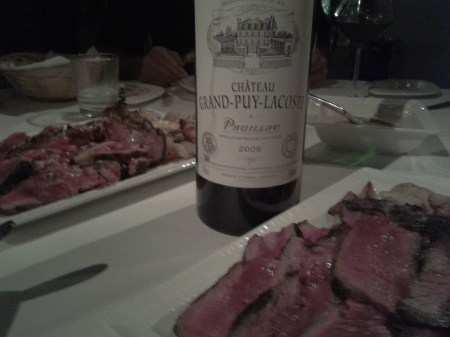 Utterly sublime. It is so good that it even eclipses the best efforts of Bedrock Grill.
We washed down the succulent steak with a magnum of 2006 Ch Grand-Puy-Lacoste, which was popped on site and drunk over the next 2 hours. This is the third occasion (all from magnum) I’ve had this wine, the current being the most impressive. Deep ruby red with notes of blueberries and some darker fruits, already accessible from the first pour where its soft body and unobtrusive tannins glided down the hatch with utmost ease. It fleshed out over time, gaining in some salty minerality, the tannins turning more chewy at the finish, but it never strayed from its medium-bodied elegance. Not much of a Pauillac signature at this stage, and I suspect it may shut down over the next few years before blossoming into an even more lovely drop. Hold.
1994 Ch Beau-Sejour Becot
Restaurant Week came round again this week, which prompted a return to Garibaldi again, with the wifey and a bottle of the 1994 Ch Beau-Sejour Becot which the manager Paolo Colzani was kind enough to waive the corkage after I’d ensured that he and Raj, who was serving us, each had a glass to enjoy. 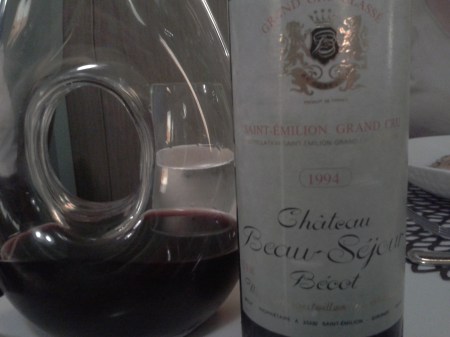 Decanted on-site, where the dark and opague wine immediately exuded an attractive bouquet of blueberries and sweet blackcurrants, medium-bodied, soft and fleshy on the palate, saturated with fruit of surprisingly high quality that provided decent depth and body. With time, some of classic dryness of Bordeaux crept in with notes of dry leaves and mushrooms, the wine actually thinning out slightly. But with further aeration after an hour, it regained its fullness with further extension in depth and expanse, the wine still remaining remarkably fresh amidst emerging notes of earth, tar and a hint of raisins, fairly complex without any hollowness. 1994 is highly under-rated and, I suspect, is just beginning to come together after all these years. Quite excellent, for only SGD91 at Carrefour.
Notes in brief (Sep 2011): 2001 J J Prum Bernkasteler Badstube, 1995 Leoville-Barton, 2005 Rockford Basket Press…
2005 Domaine Patrick Javillier Savigny-les-Beaunes “Les Serpentiere” 1er Cru, over dinner at Jade Palace, 3 Sep 2011. Opened and drunk over the next 90 minutes. Shade of dusty red that’s entirely appropriate for pinot. Good concentration of red fruits and cherries, slightly oily in the middle, shrouded within a thin layer of saccharine. Elegant and balanced with decent depth, if not the power of top-flight burgundies. This is drinking a lot better than a previous occasion last year. 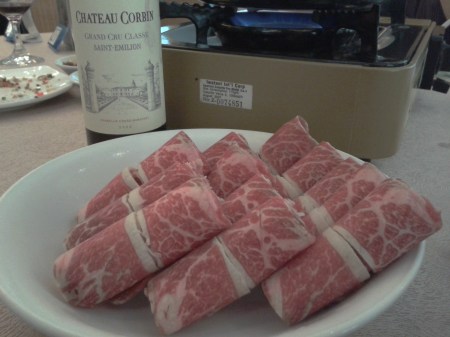 At only SGD53 from Le Benaton, it’s very good value.
2006 Ch Corbin, at Asia Grand over some excellent wagyu beef. Popped and poured from a half bottle. Compared to previous tastings, this wine finally seems to be putting more weight now, the forward fruit quality well-balanced against chewy tannins with a hint of soy. Not bad at all.
2005 Ch Reignac, after hours with colleagues on 7 Sep 2011 over cheese and crackers. This came from a half-dozen bought as en primeur. Dark red with a vermillion tint. In spite of having been decanted for 4 hours prior, this wine still came across as a bit of a monster, extracted to the hilt, heavy with notes of licorice, raisins, toast and vanilla, still primal in character, becoming more tannic as the evening wore on. Absolutely far from ready. May turn out to be better with proper food, but I’m gonna shove my remaining 4 bottles into cold storage.
2005 Domaine Thibault Liger-Belair Nuits-St-Georges “Les St-Georges” 1er Cru, at Etoile, 9 Sep 2011. Decanted on site. Much darker in color for pinot, translating into a big heavy wine with notes of very ripe blueberries and dark cherries, almost as if suffering from overhang, replete with toasty oak, tasting much like a New World pinot although I fancy the best ones from the New World may display more subtlety and grace.  Not to my liking, I’m afraid. Perhaps it needs another 7 years, I’d imagine.
2009 Domaine Christian Moreau Chablis 1er Cru “Les Vaillon”, over a meal of KFC and pizza on 10 Sep 2011. I’d taken the trouble to decant this for almost 90 minutes, which proved to be most beneficial as an abundance of dense sweet minerality engulfed the nose and palate, rather crisp at the edges, supported by understated notes of cream, butter and biscuits. Of course this is way too young at this stage, but its rich tone suggests that it has the legs to last the distance in the cellar. Very good.
2004 Petaluma Coonawarra, over dinner at Prive with a couple of my Residents, 13 Sep 2011. This is actually a blend of cabernet sauvignon and merlot. Decanted on site and drunk over the next 2 hours. Purplish red with notes of dark cherries and bitter chocolate amidst deeper layers of ferrous minerality, imparting a somewhat angular and austere demeanour initially. It took another 90 minutes to open up, revealing a rich core of ripe fruit with layers of raspberries and blueberries, grippy but much softer at the edges, tinged with lasting sweetness that became more and more impressive with each sip. Excellent.
2001 Joh. Jos Prum Bernkasteler Badstube spatlese riesling (courtesy Ben) at a private dinner at the Tanglin Club, 15 Sep 2011, hosted by Ben and LW. Very impressive right from the start with peaches, apricot, nectar, melons and a mix of tropical fruits of excellent concentration, depth and balance, the substantial sweetness countered by bitter citrus at the edges and finish, totally seamless. Highly inviting. Excellent.
1989 Ch Chauvin, a magnum bottling at the Tanglin Club, 15 Sep 2011. Aired in bottle for an hour, showing an evolved red that’s still fairly concentrated in color. 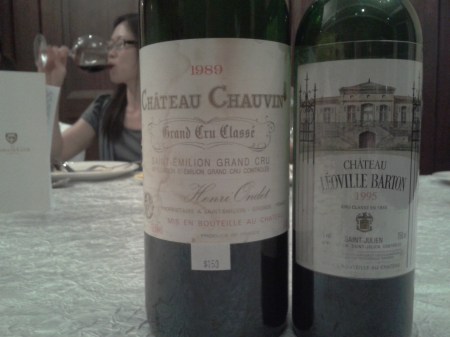 A high-tone salty minerality with a hint of soy was obvious on the nose. On the palate, however, the wine was somewhat uneven initially, slightly hollow on the mid-palate although the fruit concentration and density was readily apparent at the periphery. After some food and with further aeration, it morphed into a fairly homogenous wine that covered any prior hollowness, very even with echoes of kumquat and orange peel, although not particularly deep. At SGD150, however, I’m not complaining.
1995 Ch Leoville Barton (courtesy Ben), at the Tanglin Club, 15 Sep 2011. Aired in bottle for almost 2 hours. Deeper and richer in color, marked by ferrous minerality, possessing excellent depth and density if not the layering one expects from this renowned estate, framed by fine supple tannins but prefers to put on a rather unsmiling and stern demeanour particularly towards the finish, the dry ferrous quality again rearing its head. It clearly needs more time in bottle. Rather unusual for a 1995, but then again, Saint-Julien wines do take a long time to turn around.
2008 Ch Citran, at the in-laws on 18 Sep 2011, only SGD35 at a promotional price from Carrefour. In spite of being aired in decanter for an hour, the initial impression wasn’t favourable, the wine utterly nondescript with plummy fruit that could certainly do with more stuffing and extraction. Things improved after an hour and after some food, gaining some biting tannins but this Haut-Medoc doesn’t seem to aspire to be a Sociando Mallet.
2005 Rockford Basket Press, over a tomahawk steak at Bedrock Bar & Grill, 23 Sep 2011. Double-decanted for almost 3 hours and aired further in another decanter in the restaurant. Dark red with a vermillion tint. Apart from some herbal medicinal aromas and hefty tannins on the palate with a hint of warm Barossa fruit and licorice, it remained rather shut and tight. It only opened up much later at the last pour, but what a glorious transformation: softer, the unctousity giving way to a much more transparent texture that revealed complex layers of ripe fruit that ran deep, finishing with an uplifting touch of liquer and roses. This is one for the long haul. Excellent.
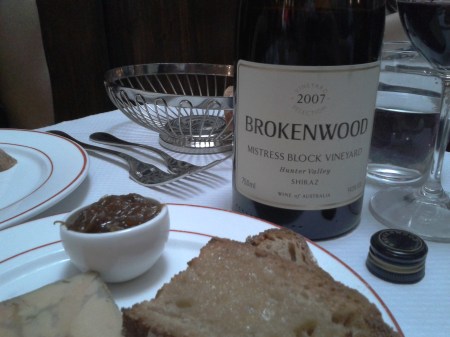 2007 Brokenwood Mistress Block shiraz, at L’Entrecote on 27 Sep 2011. Popped and poured. This is a single vineyard shiraz that demonstrates the qualities of Hunter Valley shiraz – there’s plenty of primary flavours from the generous fruit, lots of raspberries and red fruits, and less of the typical flood of warmth and licorice and plumminess that one associates with Aussie shiraz, bold but very finely balanced with understated tannins, leaving your palate unscathed. Just a notch below the estate’s famous Graveyard shiraz, but it’s very good.
Daniel’s wedding: 1990 Gagnard-Delagrange Montrachet, 1994 Haut Brion, 1970 Margaux, 1987 Mouton-Rothschild,1982 Montrose…
Danny boy finally tied the knot in a lavish reception at the Ritz-Carlton Millenia, Singapore, on 16 Sep 2011. Danny had seated me amongst a group of serious oenophiles whom, hitherto, I’d never met and, as such, we didn’t coordinate the wines.  But great minds think alike, for the lineup turned out to be the most astounding that I’d ever encountered at a Chinese wedding dinner. All wines were opened on-site.
First off was a 2002 Paul Bara Brut (courtesy Hsien Min), chilled on site (the Ritz-Carlton staff are marvellous). Pale in color, but this champagne impressed immediately with a deep burnished tone of yeasty characters, malt, rye and some toast amidst an indescribable halo of intense complexity, the minerality completely understated and unobtrusive. As the bubbles faded, it grew even more intense with emerging rose-scented aromas, yet never weighty, remaining perfectly balanced throughout. Fantastic.
Peter then produced a white that was blinded. But from the golden hue, it was obvious that this is a well-aged wine, giving off powerful earthy barnyard aromas right from the first pour. This blew off quickly, allowing the true flavours of vanilla, cream, butter, bittersweet citrus and overtones of apricot to emerge, shrouded with caramel, highly complex with great density in the mid-body, yet lithe on the palate without being weighty, glowing in this manner throughout dinner. Peter made us play a guessing game. Most of us felt it was likely to be one of the Montrachet Grand Crus, but none expected it to be Le Montrachet itself, from Domaine Gagnard-Delagrange, 1990!! Truly outstanding!!
The first of the reds was the 1995 Ch Calon-Segur, a wine of low acidity that was smooth and easy on the palate, highly understated and almost nondescript. It took almost two hours to open up, with eventual notes of dried leaves and tobacco, gaining greater weight with a more savoury character, although the St-Estephe terroir remained elusive. Following on was a 1994 Ch Haut-Brion that I’d promised Danny, one of his favourite wines, which still appeared to be remarkably fresh and lively with fragrances of roses and red berries and notes of orangey citrus, supported by excellent density and depth, framed by understated tannins, the earthy minerality of Pessac-Leognan only appearing much later. This had more character than a bottle I’d brought to Otto in July 2011 (see post).
We drank the next pair together. Kelvin had brought a 1987 Ch Mouton-Rothschild. Compared with a previous tasting during a Bacchus Mouton vertical in January 2011 (see post), the present bottle was even more impressive from this unlikely vintage, exuding a lovely deep rose-scented bouquet of red fruits underpinned by a slightly prominent minerality. Fully mature, of course, yet it is still holding on very well with very good density in the mid-body, the wine totally seamless throughout, only lacking in real opulence and complexity, but it never faded. The 1982 Ch Montrose (courtesy Hiok), seemed like a real First Growth. Still deep in color, very open on the nose, the glorious fruit still retaining all its richness, minerality and concentration, remarkably youthful and very lovely to drink. If blinded, it’d have been difficult to place it as a St-Estephe, for it felt more like a Pauillac. Superb.
And just when we thought we’d completed the lineup, Peter produced another blinded red that still retained very deep color with pleasant overtones of red fruits and some forest floor on the bouquet. However, it was clear that this wine was well over the hill, missing in critical acidity, true complexity and nuance, just a bland monotone of wood and greenness with faint echoes of its past glory. A real pity, for it was a 1970 Ch Margaux, another one of Danny’s favourites. As they say, there are no great old wines, only great bottles. Nevertheless, what a glorious evening it had been, and thanks to all for their generosity.
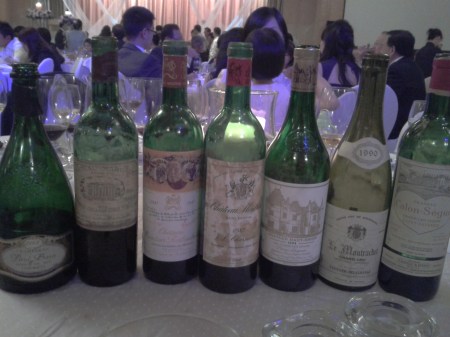
1990: Cos Labory, Clos de L’Oratoire, Sociando Mallet & Les Ormes de Pez
I returned to Table At 7 (run jointly by Eugenia and Karl, the partnership that also runs private dining at Au Petit Salut) on 11 Aug 2011, barely a week after my first visit there. Hiok had arranged dinner that was to be sponsored by F. As a matter of principle, I never turn down any offer of a free meal and, by pure coincidence, most of us had brought along a 1990 Bordeaux each.
We began with a 1983 Ch Grand-Puy-Lacoste (courtesy KP). Popped and poured. Dusty red. There were fears that this wine would exhaust itself in no time, but it gave a gutsy display of sweet rosy fragrance and lovely mature red fruits, grippy and strong on glycerin but rather four-square, finishing short with biting tannins. Suitably complex but still has unresolved fruit. 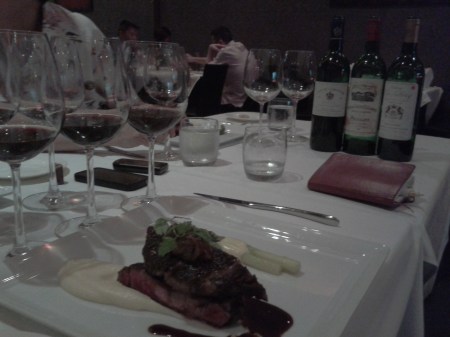 The initial exuberance settled down after about 45 minutes when it began fading on the nose, but it remained soft and seamless right till the end of dinner, still well and alive.
We drank the next pair together. The 1990 Ch Clos de L’Oratoire (courtesy Chris), aired in bottle, was dark dusky red, producing powerful sweet medicinal aromas not unlike Chinese cough mixture, complete with a sense of thickness, difficult for other flavours to penetrate through. For sure, it was dense, almost unctuous and hedonistic, most unlike a Bordeaux even for a modern-day Saint-Emilion and I don’t think it’ll turn out to be anything else even with further cellaring. Next to this, the 1990 Ch Cos Labory, also aired in bottle, was still remarkably fresh and youthful, open, soft and harmonious with a dark citrusy trail and a glow of orange peel and kumquat, although somewhat reticent and austere at the corners. Fully mature and elegant without possessing outright power, eventually developing great concentration and grip at the end of dinner with mouth-puckering intensity. This was the most evolved of the three St Estephe wines, and showing better than a recent tasting in June this year (see post). Excellent value at SGD115, a recent purchase from Crystal Wines.
As good as the above wines were, the next pair actually raised the bar further. F produced a 1990 Ch Les Ormes de Pez, most appropriately, as my introduction to fine claret had begun with a half-bottle of the same wine at Saint-Pierre, also courtesy of F, back in 2003. This wine was simply quite gorgeous, dark in color, exuding a superb bouquet of rich ripe fruit, medium-bodied, excellent in concentration with grippy velvety tannins, ending in a long lasting finish.  Still seemingly youthful in character, becoming more full over time yet retaining great transparency. Quite astonishing from this cru bourgeois estate. To match this outstanding red was the equally outstanding 1990 Ch Sociando Mallet (courtesy Hiok) that had been decanted from home and brought to the restaurant. The waiter, unfortunately, accidentally knocked a hole in Hiok’s decanter, spilling some of the precious wine but we managed to rescue most of it. It displayed a deep luxuriant red, throwing off an attractive powerful earthy pungency with other subtle tertiary characters, very opulent, lush and open with a touch of green and a hint of gravel, not gaining in intensity, just simply holding ship throughout the whole course of dinner.
This tasting goes to show that you don’t need to bust the bank for a memorable 1990. My thanks to all for their generosity.
1999 Ch Angelus
My second bottle in 3 months, from the case of half-dozen imported from Bordeaux Index London, over dinner at Moomba, 10 Sep 2011. Decanted on site. 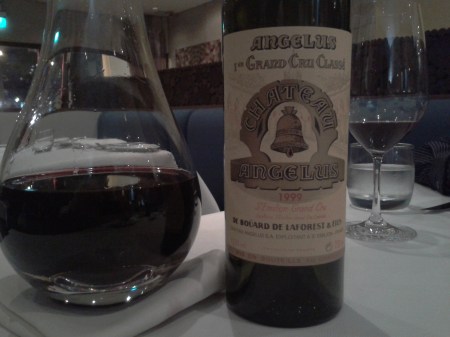 Deep red with a bouquet of blueberries, other darker fruits and a note of soy. In spite of what was, supposedly, a wet vintage, the fruit is remarkably fresh and ripe, just missing in charm and outright opulence after the initial pour, rather stern in demeanour. After 20 minutes, it took on greater intensity with some biting tannins before settling into a smooth harmonious wine that was in no way hollow, though without much sparkle. But after an hour, it transformed into a wine of great concentration, becoming a lot weightier, opening up to reveal more layering in the mid-body, lingering in its finish, performing better than my previous note (July 2011). Although I admit to having a soft spot for any 1999 (a significant year for myself), this is an excellent wine by any standard.
Notes from Salzburg
I just returned from a whirlwind trip to Salzburg, primarily to attend its famous summer Festival. To me, it seemed most people were there to be seen rather than knowing anything substantial about the music. The champagne served at the Festival Halls (there are three, all housed within a single complex) is the Möet & Chandon NV at €13 per glass, pale with dominant notes of citrus, lime and floral fragrance underscored with brazen minerality and cutting acidity at the edges. Lacks the balance of a Bollinger.
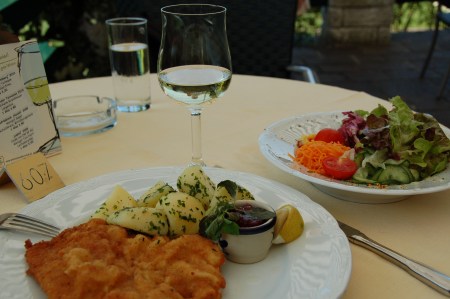
I made a day trip to Steinbach-am-Attersee in search of Gustav Mahler’s composing hut by the lake, where he had written his Second and Third symphonies. For sure it’s there, extremely well-conserved within the grounds of the Hotel Fottinger where he had stayed between 1893-6. I had lunch there, washed down with a glass of 2010 Weingut Wilhelm Brundlmayer Riesling “Kamptaler Terrassen”, possessing substantial notes of melons, green apples and citrus supported by understated sweetness without any hollowness, slightly minty towards the finish. A lovely counterpoint to the heat of summer.
Singapore Airlines Business Class (Aug 2011)
I was pleasantly surprised at being upgraded to Business Class (first time I’ve had such a privilege) when I flew to Munich on 23 Aug 2011, so another chance to sample its offerings.
The Bollinger NV Special Cuvee remained available, a staple nowadays for SQ Business Class, it seems. Fairly complex on the nose and palate – nutty, toast with a bit of burnt and almonds with excellent minerality without being acerbic. Very good body and balance. Probably the best tasting note for Bollinger on board.
Next, I tried the 2008 Joseph Drouhin Chablis Reserve de Vaudon which, for me, was too one-dimensional, stuffed with loads of limey citrus and sharp minerality, almost bruising my palate. It settled down after some food, but it still came across as rather bland, lacking in real depth. Perhaps its a wine that needs plenty of time to aerate.
The ubiquitous Dr Loosen (2008) was available, but I chose instead to try the 2009 Balthasar Ress Haltenheimer Schutzenhaus kabinett riesling which impressed immediately with its highly attractive, perfumed bouquet – dense, smoky with plenty of petroleum character.  But unfortunately, the wine carried less weight on the palate than suggested, some hollowness evident in the mid-body, remaining unremarkable all the way to its finish.
There was a choice of Bordeaux for the reds, both of which I tried. The 2007 Ch Paloumey had been favourably mentioned in a previous note in June 2011, and it remained the better of the two on this occasion as well. A lovely ruby red with lifted, almost scented, notes of red fruits, vanilla and oak, slightly dry in character which suited the wine well. Undeniably attractive. An astute choice by the airline. In contrast, the 2007 Ch La Garde was dark and muted. Soft at the edges with quality fruit that was apparent after some coaxing, albeit with a touch of greenness, leaving behind a slight alcoholic trail. Ultimately lacking in real charm and concentration. A pity, as I had held out high hopes for the Pessac-Leognan.
 Ric's Wine Journal