Notes in brief (Jan 2012): 1982 Pape Clement, 2002 Penfolds St Henri, 2002 Cos D’Estournel, 2004 Rockford Black Shiraz…
1982 Ch Pape Clement (courtesy KP), at Hiok’s residence, 2 Jan 2012. Distinctly brownish in color and unmistakably aged, revealing notes of earth and old leather that gave off a musty “old” feel, slightly plummy on the palate, appropriately dry with other notes of herbs and mushrooms. Gained weight over time but I’d expected it to be bigger, though. Still drinking well, but won’t get any better.
2009 Kanonkop Pinotage (courtesy Hiok), at his residence, 2 Jan 2012. Hand-carried from South Africa. Very deep purple, weighty and dense, almost port-like given its high level of intensity with a trace of sweetness. It did open up a little over time, becoming smoother and sweeter but still retaining its big, bold forward character. Admittedly quite attractive though difficult to place if tasted blind.
2004 Rockford Black Shiraz, at Hiok’s residence, 2 Jan 2012. One of 6 bottles I’d hand-carried back from Adelaide sometime in in 2007. Deep, complex and layered with excellent depth, almost velvety with medicinal overtones of liquer and linctus, whilst the bubbles remained gentle and unobtrusive. Became more distilled and intense over time, the liquer component gaining in prominence. Excellent.
2007 Les Carmes Haut Brion, a half-bottle over lunch at Gourmet Plus, 2 Jan 2012. Popped and poured. Distinctly austere, earthy and dry, with fruit that seemed to be thinning out. But it gained weight after 30-45 minutes, developing more grip and bite although it remained unsmiling. Don’t think I’ll miss it.
 2004 Glaetzer Godolphin, decanted on-site at Etoile, 6 Jan 2012. Deep purple. From the looks, one would normally have expected a bruising Aussie blockbuster and, indeed, its bouquet of powerful spice, earth and anise seemed to promise all these and more. On the palate, however, this was anything but a Barossa shiraz. There’s not a hint of the usual licorice nor pluminess, just an open wine, remarkably smooth and layered, filled with a mixture of ripe red and dark berries caressing the palate with velvety finely-knit tannins with a touch of orange peel. Sophisticated and expertly crafted. I would’ve bought more if I’d known it’d be this good. My only bottle.
2010 Albert Ponnelle Reserve de la Chevre Noire Bourgogne, popped and poured at Porta Porta, a small charming family-run restaurant at Stanley St, 7 Jan 2012. Notes of green melons, apples and grassy overtones dominate, by no means effusive but neither hollow as well. In fact, it fleshed out over time, gaining in body and limey minerality, even managing to produce a bit of layering. Not bad at all.
Guerrieri Rizzardi Prosecco NV, at SGD65 off the wine list of Gattopardo at Fort Canning Hotel, 9 Jan 2012, with my Residents. An enticing nose filled with musty smoky incense married to the perfumed fragrance of white flowers, melons and pears, medium-bodied and well-balanced with soft bubbles. Very enjoyable.
2004 Poggio Il Castellare Brunello di Montalcino, double-decanted for an hour before airing further in bottle at Gattopardo, Fort Canning Hotel, 9 Jan 2012, with my Residents. Served in a Burgundy glass, and rather appropriate too for its Burgundian semblance. A light tinge of red with aromas of cherries and strawberries instead of dark fruits, medium-bodied and open on the palate, almost pure, smooth and seamless without the power and depth of the best brunello, but this is a wine caught at almost its peak, and will probably hold for several more years.
2004 Domaine de Chevalier at Prive, 13 Jan 2012, decanted on-site. Deep purplish red with an early hint of development. Very lovely on the nose with classic earthy barnyard aromas of Pessac-Leognan amidst notes of ripe dark berries, laced with a tinge of sweetness. Medium-full on the palate, the mid-body opening up after 30 minutes to reveal a softer core of red and dark fruits, well-integrated with excellent depth and layering, framed by velvety tannins, finishing with a touch of ferrous minerality. Expertly crafted and sophisticated, yet retaining enough of its rustic charm and identity, which is why I love this estate. This is showing so much better than a previous tasting some 2 years ago where it was still a tannic monolith. Excellent.
2002 Penfolds St Henri shiraz, at the new Italian restaurant Pepenero along Stanley St, 14 Jan 2012. Decanted on-site. Still showing a deep purple, absolutely unevolved in color.  Medium-full initially on the palate, slightly dense with notes of blackberries, bramble, musty forest floor with a faint hint of licorice and medicinal aromas without the usual plumminess of Aussie shiraz. It softened considerably within minutes, decidedly medium-bodied and rounded, opening up to reveal fruit that is gloriously ripe but cool without any alcoholic trace, framed by finely-grained tannins, eventually developing excellent depth and layering with a trace of sweetness, rather lively at the finish. It reminded me of a Rhone syrah, betrayed only by the firmness and density. This wine is approaching its peak, compared to a previous tasting some 4 years ago. But I suggest you refrain from popping another till at least 5 years later.
2004 Ch Gloria, at the Chinese New Year reunion dinner, 22 Jan 2012. Aired in bottle for an hour plus. Unimpressive at first, the wine too big and forward for its own good, savoury and rustic, almost New World-like. It eventually settled down after another hour, opening up to reveal more of cedar, cinnamon and raisins, slightly austere towards the finish, resembling quite closely a previous tasting in Nov 2011. However, I don’t think I’ll miss it.
2009 Joseph Drouhin Laforet Bourgogne chardonnay, drunk at home over dinner on the first day of the Lunar New Year, 23 Jan 2012. Aired in bottle for 90 min. Pale yellow-tint. More of green apples, citrus and lime than any firm chalky minerality despite the creamy bouquet. A simple chardonnay; quite agreeable, nonetheless.
2002 Ch Cos D’Estournel, drunk at home over dinner on the first day of the Lunar New Year, 23 Jan 2012. Aired in bottle for 90 min. A dark-toned wine with initial notes of wood and dusty tannins dominate, perhaps as a result of it being drunk too cold. It opened up to reveal more of blackcurrants and dark cherries, but there was precious little in the way of secondary development, still rather one-dimensional and lacking in layering, missing in charm and elegance as well. Certainly it’s still very dark in color, so I doubt it has fallen off the cliff. It’s probably still wrapped up, yet to approach its drinking window.
2002 Clonakilla shiraz-viognier, at Gourmet Plus, 27 Jan 2012. Popped and poured. Dark cherry core with an evolved rim, producing powerful aromas of plums, brandied cherries with more than a trailing dash of orangey citrus, no doubt the contribution by the fraction of viognier. On the palate, however, the fruit is hopelessly overwhelmed by the dense alcohol content, and neither further aeration, food nor any form coaxing could do any good. I’d harbored high hopes for this wine, given the quality of the 2004, but I certainly didn’t like what’s happening here, contrary to what those Aussies will tell you.
2007 Dog Point Section 94 sauvignon blanc, at a Chinese New Year dinner at Roland restaurant, 28 Jan 2012. Aired in bottle for 45 minutes. Compared to an earlier tasting more than 1 year ago, this seemed to have lost some of its vivacity, tasting more like a straight sauvignon blanc with plenty of fresh citrus and pomelo amidst creamy minerality, crisp and well-defined at the edges, tapering towards a complex but slightly steely finish. It’s good stuff but I can’t take too much of this…gimme my red!
Ric’s Most Memorable Wines of 2011
Here goes Ric’s choices, based on my tasting experiences in 2011…
Best Unaffordable Red: 1985 Ch Lafite Rothschild. Only someone like David could afford this (thanks!!). Quite simply, a quintessential Lafite that still packs persuasive power and elegance effortlessly. Memorable as well because it came about as a result of a wager I’d won, and for being part of an expensive Palmer vertical.
Best Affordable Red: 1982 Ch Montrose. Affordable only because KP managed to source a case at a ridiculously low price. Surpassed a ’87 Mouton Rothschild and ’94 Haut Brion at the same dinner.
Most Memorable Red: 1989 Ch Beaucastel, brought by a Frenchman at Hinoki. I’ve never had a properly aged CdP, and this showed beautifully, having shed all its heavy dark outer layers to reveal a very lovely glow of predominantly red fruits and currants, still very much alive, supported by a deeper phenolic vein of dark cherries and a kaleidoscopic display of tertiary nuances. 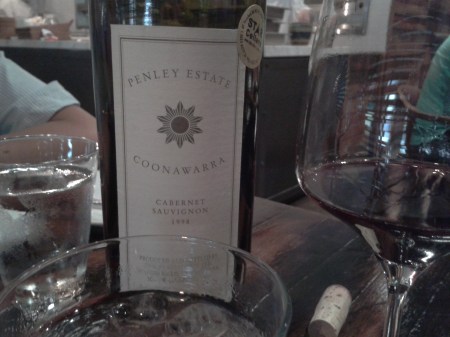 The 1998 Penley Estate Reserve cabernet sauvignon is a close second, pairing an outstanding vintage and winemaker from Coonawarra.
Best Value Red: 2000 L’Hospitalet de Gazin. A nicely-matured and confident second wine of Gazin that easily commands twice the price of SGD42 that I bought.
Most Disappointing Red: 1970 Ch Margaux, at Daniel’s wedding. Absolutely past its prime. As they say, there’re only great bottles, no great wines.
Worst Red: 2006 Ch de Pressac. Not worth wasting your hepatocytes (and money) on.
Best Unaffordable White: I don’t think I had any wihite in 2011 that, to me, justified its stratospheric price.
Best Affordable White: 2005 Pahlmeyer chardonnay. Grows in stature. Utterly convincing.
Most Memorable White: I’ll opt for a dessert wine here, the 2006 Kracher No.8 Traminer trockenbeerenauslese. At PS’s farewell dinner.
Best Value White: A tie between 2009 Estancia (Monterey County) chardonnay and 2008 Wilderness chardonnay. Try searching hard for these.
Most Disappointing White: None, really.
Worst White: None, really.
I must thank all friends and contributors who had so unselfishly made available these wines for tasting. Bon vin et merci beaucoup!
1997: Chateaux Figeac & Pichon Lalande 1998 Domaine de Chevalier
An evening again at Hinoki on 5 Jan 2012, probably the first time I’ve eaten there where Lawrence was absent and, perhaps, for the better as Gary gave us extra cuts of toro, sashimi and foie gras sushi. We began the evening with a 2009 Joh Jos Prum Wehlenur Sonnenuhr spatlese (courtesy Hiok). It seems there can be no such thing as a bad JJ Prum, for the 2009 was, again, generous in its offering of peaches, melons, white flowers and ripe tropical fruit, all very refreshing with excellent mouthfeel, though perhaps not as intense as the 2007. Nevertheless, this is still very lovely, remarkable for its balance and depth, a wine that you could keep on drinking the entire evening. Excellent.
Next came a pair of Bordeaux from 1997, both having been double-decanted by Hiok prior. The Figeac (courtesy KP) displayed a fully evolved color with a touch of kumquat and dried citrus, more tellingly on the palate where it was soft and well-integrated, the fruit not quite drying out but definitely lighter in weight, slightly weedy without much character, eventually thinning out over the course of dinner, becoming extremely dry. 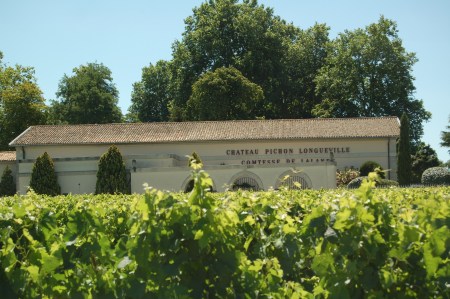 Past its prime, for sure. In contrast, the Ch Pichon Longueville Comtesse de Lalande (courtesy Hiok), whilst displaying a similarly evolved color, came across as a weightier wine with better density and concentration of fruit, although the initial impression wasn’t encouraging given the prominent barnyard aromas amidst green woody notes, soft and light-weight on the palate, lacking in layering, rather linear and straightforward, short at the finish. However, its redemption came late, the dry Pauillac character surfacing only after an hour, the fruit beginning to emerge, eventually fleshing out into a fuller wine, staying that way right till the end. Not bad at all, considering the weak vintage, but we were unanimous that the Ch Pichon Longueville Baron across the road is a better bet for 1997.
The best was left for last, a Domaine de Chevalier from 1998, a vintage favouring Graves, which I’d double decanted for well over an hour, and aired further in bottle. Much weightier than any of the preceding wines but with a quiet intensity, for this estate is never showy, preferring to really let the vintage and terroir communicate with the drinker. A lovely effusive glow of ripe plummy fruit on the nose is matched by a soft and rounded wine of excellent concentration and delineation, with notes of ferrous minerality and dried mushrooms, very earthy in character, opening up further to reveal soft sweet velvety tannins. Truly beautiful. A connoiseur’s red. Don’t miss out on this.
Notes in brief (Dec 2011): 1999 Parker First Growth, 1998 Penley Reserve cabernet, 2000 Sociando Mallet…
Ca Del Bosco NV, at Ming Kee Live Seafood, 2 Dec 2011. I must say this sparkling wine is really good, smooth with an even spread of bubbles, neither too dry nor brazen, very lovely in body and presence on the palate. My last bottle.
2007 Moss Wood Chardonnay, over a meal of chilli crab at Long Beach Seafood, 3 Dec 2011. The usual notes of vanilla and cream dominate, though by no mans effusive, with more than a touch of green citrus, slightly hollow in the mid-body initially. This became less noticeable as dinner wore on, but the expected layering and depth didn’t really materialise as well, much to my disappointment. In short, a rather nondescript chardonnay. You’re better off with a generic bourgogne from, say, Leflaive or Louis Jadot.
2010 Corner Stone Wines Classic French White, at the Silver Kris lounge of Singapore Airlines, Hong Kong International Airport, 16 Dec 2011. I thought SIA would at least serve something that’s more presentable. Nevertheless, this was surprisingly agreeable – lean limey citrus with grassy overtones, crispy at the edges, full enough on the palate, ending on a mild spicy note of white pepper.
2010 Corner Stone Wines merlot, at the Silver Kris lounge of Singapore Airlines, Hong Kong International Airport, 16 Dec 2011. Again, normally, I wouldn’t come near this wine with a 10-foot pole but, surprisingly enough, this was quite full without any discernible hollowness, earthy with notes of raisins and toast, grippy on the palate.
2003 Cullen Diana Madeline, paired with wagyu beef cheek at Gourmet Plus, 17 Dec 2011. Double-decanted for an hour. Deep red with notes of dark berries that ran deep, accompanied by a bit of burnt and sappy medicinal aromas, rounded off by a significant degree of ferrous minerality. It seemed a tad disjointed but things improved with further aeration and food, the wine finally gelling together with more plummy flavours appearing. Compared to a previous tasting note more than a year ago, the impression here is a wine that’s still yet to peak, but I’ve moved away from this kind of style. My last bottle, I think.
2009 Ch Barit, a Bordeaux Superieur from the Bordeaux sub-region of Entre-Deux-Mers that’s selling for SGD14 nett at all Esso petrol kiosk minimarts these couple of months. Not to be confused with Ch Baret of Pessac-Leognan. I was interested to know the performance level of a quaffer in an outstanding vintage. Popped and poured at Imperial Treasure T3 on 18 Dec 2011. Rather purplish and light on the palate initially with forward notes of sultanas and blueberries, but it rapidly gained weight after some aeration, adding some bite and grip, more fleshy at the finish than before although a tad austere on the whole. Not bad, but not compeling.
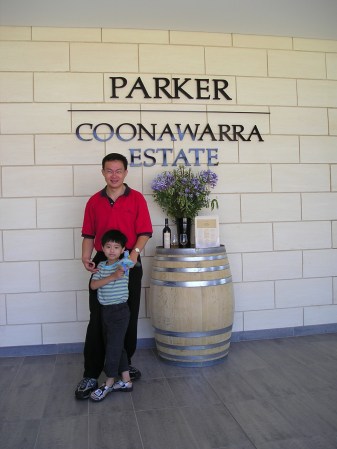 1999 Parker Estate First Growth Terra Rossa, a blend of cabernet sauvignon and merlot with a dash of malbec, at Jade Palace, 24 Dec 2011. Decanted on site. Still remarkably youthful in spite of all its twelve years, full-bodied with forward notes of ripe fruit layered with burnt toast, orange citrus, plums, earth, finishing in exuberant style which, no doubt, came from the malbec. Hasn’t quite gelled together, still displaying a rather sharp attack on the mid-palate, replete with some astringency towards the finish. I’m not sure if the wine will mellow over time, or gain even greater concentration. I’m a bit disappointed, to be honest.
2003 Steingruber Wolfoerger Grand Gru, a gewurztraminer from Alsace (courtesy LW at her party), 30 Dec 2011. Pale yellow. Resembles very much a German riesling with notes of ripe green melons, perfumed aromas and a touch of nectar and honey, imparting a significant degree of sweetness, though without the complexity and layering of a true riesling.
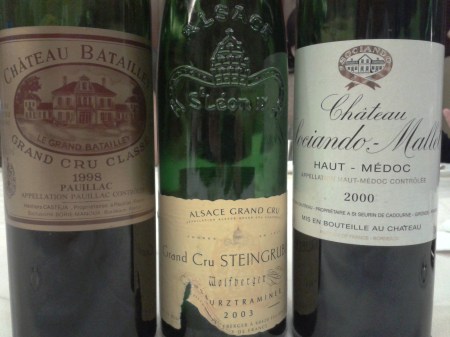 1998 Ch Batailley (courtesy LW at her party), 30 Dec 2011. Popped and poured. Marred by significant cork taint on the nose, unfortunately, although it’s clean on the palate, where the dry Pauillac character is very much evident but there’s barely enough fruit to cover the framework, and whatever that’s remaining has thinned out. Not recommended.
2000 Ch Sociando Mallet (courtesy LW at her party), 30 Dec 2011. The top-notch quality was plainly evident, even though the bottle was simply popped and poured. Most remarkable for its lovely balance. There’s plenty of top drawer fruit, mostly of darker tones with just a nudge of secondary characters coming on, but this is still a very youthful wine with plenty of potential, judging from the layering, relative opulence and superb cohesiveness, but still rather tight even after eleven years. There’s nothing excessive about this wine, where everything is kept beautifully in proportion. I think it’ll need at least another decade of cellaring before attempting a re-visit. A clone of the 1990, but even better. Great stuff.
1998 Penley Estate Reserve cabernet sauvignon, over lunch at Bedrock Bar & Grill, 31 Dec 2011. Double-decanted for over an hour at home, and aired further in bottle at the restaurant. Compared to a previous tasting more than 2 years ago where it seemed to be evolving rapidly, this bottle still seemed remarkably fresh and youthful, yet to hit its peak drinking period, but this is a great time to catch this wine. Dark red, initially austere and brooding with notes of blackberries, dark cherries and bitter chocolate. Two hours later, it began opening up, transforming into a top drop that would have been difficult to tell apart from a modern-day St-Emilion in a blind tasting, such was the opulence, concentration, lushness and quiet intensity, emitting a lovely complex glow on the nose, big but beautifully proportioned, finishing with velvety tannins and notes of dried herbs and mushrooms and snuff. Really wonderful, and little wonder that 1998 is such a hallowed vintage for South Australia. Only one more bottle remaining, I fear.
Leflaive at Santi: 2001-2009 Meursault 1er Cru Sous le Dos d’Âne & 2006 Clavoillon & 2006 Batard-Montrachet
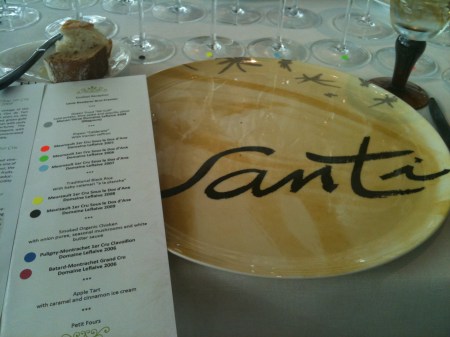 Only SGD168 nett for lunch at Santi, Marina Bay Sands Singapore (the very venue where the poor maestro Santamaria himself collapsed in his kitchen earlier this year and died), paired with a world’s first vertical of Domaine Leflaive’s Meursault 1er Cru Sous le Dos d’Ane and a Les Clavoillon and a Batard-Montrachet, with the manager of Domaine Leflaive and his negociant distributor in attendance, sounds too good to be true but it really did happen on 4 Dec 2011, thanks to Grand Vin Pte Ltd. In spite of the Singapore marathon that was taking place at Marina Bay that same day, the select group of 15 diners managed to arrive on time, starting the day’s proceedings with liberal pours of the Louis Roederer Premier Brut NV, a champagne that impressed with abundant notes of fig and perfumed white flowers, beautifully balanced in a lovely glow, utterly smooth on the palate with excellent body, layering and complexity, getting us all to a wonderful start.
The first white of Domaine Leflaive was the 2009 Macon-Verze, poured from magnum, displaying plenty of green apples, limey citrus and a bit of vanilla on the nose, distinctly medium-bodied on the palate. I found it remarkable for its beautiful proportion and balance, growing in intensity over time, developing notes of buttered minerality and green melons. Very good indeed. This was followed by the first of two flights of the Domaine Leflaive Meursault 1er Cru Sous le Dos d’Ane, comprising the 2001, 2006 and 2007, paired with prawn “Calderata” with Iranian saffron. Not surprisingly, the 2001 was much deeper in tone, color and weight compared to the rest, notably more complex with a lovely mix of tropical fruits and creamy minerality, totally seamless and persistent. 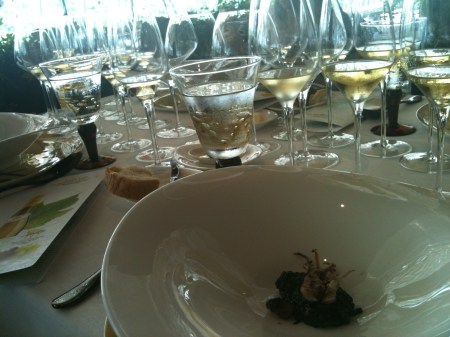 The 2006 contained more than a trace of cork taint on the nose (Fatty concurred…yes, he was there at a separate table with the Dean) that obscured the rich minerality beneath, although it was untarnished on the palate, drinking very well at this stage, creamy, smooth and seamless, much like a younger version of the 2001. The surprise for me was the 2007. Although widely acknowledged as a weak growing season, the 2007 packed a lovely pungency, punchy on the palate with plenty of lively acidity and verve, rather full with excellent intensity and concentration, almost sexy, finishing with an aromatic lift.
The 2008 followed on in the second flight, but coming after the vivacious 2007, the latter seemed curiously quiet and nondescript, lively but straightforward. The final Meursault, from the outstanding vintage of 2009, was precocious, already laden with heavenly notes of caramel and scorched creme, encapsulating the lovely balance and complexity between the ripe citrus and the rich minerality. Clearly plenty of potential here, poised to achieve much much more.
 The penultimate wine came in the form of the 2006 Domaine Leflaive Puligny-Montrachet Clavoillon 1er Cru, a big wine with biscuity and nutty overtones, rounded, smooth and creamy with concentrated lifted aromatics, beginning to reveal some complexity beneath all that gloss even at this stage. In contrast, true to its Grand Cru status, the 2006 Domaine Leflaive Batard-Montrachet, weighty and displaying the obligatory nutty and biscuity notes topped with a dash of cream within a large round body, seemed more reticent at this stage, neither opulent nor lush although the potential is enormous, perhaps in the process of shutting down, bringing the whole tasting line-up to a bit of an anti-climax. This tasting confirms the view that the whites of 2006 are excellent, perhaps even developing a bit faster than anticipated, and that the 2009s are a no-brainer with top-notch fruit that’s beautifully balanced.
1996 Ch Calon Segur
I raved quite a bit about Brawn Steakhouse last month, but I’m afraid I have to take back my words, for my return trip on 10 December 2011 for my birthday dinner proved to be disappointing. For a full cost dinner that’ll set each diner back by SGD100-150, exclusive of corkage at SGD40++, my steak had better be excellent, the service and ambience worthy of mention, and, in particular, the wine service immaculate. Sadly, Brawn doesn’t seem to know how to position itself. The interior decor is clearly modern chic (veering towards some degree of vulgarity with its liberal use of mirrors and rows of bright bulbs) but the music, a selection of Top 40 hits, is way too loud, the wait staff (especially the manager, of all people) neither speak nor articulate well, the wine service consistently inattentive (even though only two other tables were occupied then) where my glass was allowed to go empty more than once and I had to reach for the decanter myself, and the ribeye decidedly unremarkable and overdone.
Luckily, the 1996 Ch Calon Segur, decanted on site, turned out to be the sole saving grace for the evening. Dull purplish red, but it exuded the unmistakable characteristics of a mature claret – a hallowed glow of warm plummy fruit with notes of cedar, briar, wild berries, leather, cinnamon and forest floor, supported by the slightly salty tone of St-Estephe clay. The fruit came to life with further aeration, beautifully integrated with the soft-grained tannins, with nuances of mushrooms, herbs and cigar box that only time can produce, soft and fleshy, imparting a very lovely finish that persisted.
Notes in brief (Nov 2011): 2003 Lagrange, 2007 Smith Haut Lafitte, 1995 Figeac, 2000 Chasse-Spleen, 2004 Gloria…
2004 Ch Gloria, SGD180 off the restaurant list of Salt Grill, 55th floor of ION Orchard, on 4 Nov 2011. Decanted on site. Deep crimson with a hint of evolution at the rim. Attractive notes of dark berries, bramble, forest floor and earth. Medium-bodied, soft at the edges and fleshy with a mild salty note, turning more ferrous and austere towards the finish, consistent with its St-Julien origin. It became more homogenous over time although a good deal of rusticity remained, not a bad thing at all as it added more to the wine’s identity. A good drop.
1995 Ch Figeac, over dinner with the wifey at Novus, 5 Nov 2011. Decanted for around 75 minutes at the restaurant. Dull purple with a powerful earthy aroma amidst other notes of dark berries and blackcurrants with a mild musty overtone. Soft and medium-bodied on the palate, notable for its salty minerality with a hint of soy and receding acidity that was, nonetheless, still quite adequate, leading to a minty, spicy finish. It opened up to reveal more layering as dinner wore on, the fruit still surprising full, the tannins supple yet grippy. Compared to two previous tasting some 3 years ago (at Kome & Les Artistes Bistrot) , the current impression has more character and heft. Quite excellent, and I’d probably leave my last bottle alone till 2015 or beyond.
2004 Mitolo G.A.M., over a buffet dinner at the Holiday Inn Atrium. 6 Nov 2011. Deep inky red, exuding intense aromas of plummy ripe McLaren Vale shiraz, blackcurrants and licorice, saturating the palate with powerful medicinal overtones before dissipating in a warm alcoholic trail, not developing any further even after two hours. Well crafted, but I can’t imagine how else it’ll develop even with further cellaring other than becoming even more concentrated and dense.
2007 Ch Les Carmes Haut Brion, a half bottle over an excellent lunch at Bedrock Bar & Grill, 7 Nov 2011. Decanted on site. Very good concentration of dark berries, wild flowers and a bit of dried leaves, slightly plummy though there wasn’t much of earthy tones of Pessac-Leognan, opening up quite nicely after some time. Enjoyable, albeit rather four-square in character.
2006 Ch Corbin, my final half-bottle from a half-dozen, at Foo House, 10 Nov 2011. As expected, simple and straightforward with good concentration of red and dark berries, probably split down the middle between cabernet and merlot, smooth and supple with decent balance. But I don’t think I’ll miss it.
 2007 Ch Smith Haut Lafitte, over 220g tenderloin steak at Brawn, Marina Bay Link Mall, 11 Nov 2011. The number of superb and classy steakhouses in Singapore is growing exponentially, and this new establishment far eclipses Bedrock and Salt Grill to be almost on par with Morton’s, but considerably friendlier on your wallet. Popped and poured. After an initial whiff of an exuberant lovely fragrance, the nose seemed to shut down quite quickly, although it hits all the right notes on the palate – medium-full and fleshy with excellent concentration of ripe berries and tame tannins, expertly crafted with sophistication as one would expect from this estate, so much so that I thought it’d lost its Pessac-Leognan identity, becoming too “international”. Already accessible and drinking well at this stage. At SGD75, it will please every palate over a meal, as long as you don’t get too cerebral over it.
2003 Ch Sociando-Mallet, a half-bottle brought to Imperial Treasure T3 for dinner, 13 Nov 2011. Dark inky red with an excellent bouquet promising fresh dark cherries amidst a very inviting deep glow of blackcurrants and blueberries. Medium-full and firm on the palate, softening considerably over time although the ferrous minerality underlying the mid-body persisted throughout, leading to well-integrated but stern tannins, ensuring that the wine remained austere and tight. Expertly crafted without any hint of burnt, consistent, I suppose, with the excellent quality of its neighbouring estates in St-Estephe that year. Think I’ll refrain from tasting again till 2018, at least.
2000 Ch Chasse-Spleen, SGD180 off the restaurant list of Gunther’s, 16 Nov 2011. Popped and poured, already showing an evolved bright vermillion shade with a darker purplish core. Highly attractive aromas of ripe berries, redcurrants and plum of great concentration, giving off an intense glow suffused with secondary nuances of mushroom, leather and toast, very open and inviting. It quickly gelled into a seamless, soft and fleshy wine with the dryish character of Bordeaux emerging after about 30 minutes. Really excellent. We had to finish our meal within an hour, but I can imagine it would be truly wonderful if given another 3 hours of aeration. Superb.
2010 Drouet Freres Privilege chardonnay, on board Singapore Airlines economy class, 17 Nov 2011. Decent aromas of mild vanilla, citrus and stony minerality with just enough fruit on the palate to match the acidity, slightly hollow towards the finish. A decent effort, still, and better than the airline’s previous Paul Mas offering.
 2006 St Hallett Old Block, off the restaurant list of Xu Lounge at Ho Chi Minh City, Vietnam, 18 Nov 2011, where it was a rip-off at VND3.3 million (SGD203). Decanted on site and drunk over the next 90 minutes. As expected, the wine was deep dark inky red, saturated with warm ripe Barossa fruit displaying characters of forest floor, earth and a particularly strong herbal note peppered with spicy notes leading to a hot finish, still primal without any sign of secondary change. Almost a blockbuster, unlike its neighbour across the main road – the Rockford Basket Press – of the same vintage which has a lot more layering and subtlety beneath its bold front.
2003 Ch Lagrange, decanted at Moomba on 23 Nov 2011. Lovely deep ruby with aromas of ripe blueberries and blackcurrants. This wine has changed significantly since a previous tasting some 2 years back, much softer and more open, even thinning out a little initially, having lost its woody vanilla cloak. It fleshed out better after some time, decidedly medium-bodied with lowish acidity, decent in concentration and depth without any hint of the hot growing season, hence rather unremarkable in its overall demeanour. Drinking well. Will be interesting to see how it develops further. Another 10 more bottles.
2004 Ch Sociando Mallet, double decanted for an hour before pairing it with an excellent wagyu beef steak at Gourmet Plus, 29 Nov 2011. Translucent purple with a dominant glow of medium-bodied plummy fruit framed by limey citrus with a faint streak of darker berries in the background, not unlike a sangiovese or nebbiolo. On the palate, this wine has lost its angular sharpness compared to a previous tasting 3 years ago, considerably softer, more feminine and fleshy with reasonable depth although it hasn’t quite completely gelled together. Very good.
1999 Ch Haut Brion
This is my penultimate bottle of the 1999 Ch Haut Brion, specially chosen and double-decanted for an hour before being brought to La Barca, 24 Nov 2011, for a celebratory dinner where it proved to be the perfect accompaniment to maestro Sorrentino’s 1.2 kg T-bone steak. 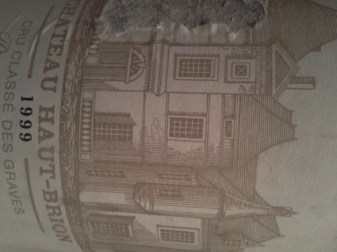 Compared to two previous tastings – Dec 2009 at Saint Pierre and May 2011 at Les Amis – this is, by far, the best experience I’ve had with this wine. A highly complex bouquet of heated gravel and high-toned earthy minerality compete against equally engaging aromas of dry citrus, grapefruit and raspberries with background notes of briar, cedar and wild berries, traversing the palate with excellent linearity and presence at just the right degree of concentration, remarkable for its ability to remain so beautifully proportioned and elegant without drawing attention to itself. As dinner wore on, a greater predominance of red fruits and sweet cherries came to the fore, the fruit remarkably fresh, more rounded and full with a bit more fat in the mid-body, becoming almost Burgundy-like, holding on in this manner till the last drop. It seemed to have the legs to last another 10 years, easily, just missing the final ounce of opulence and hedonism of the finest vintages. Nevertheless, this is a top drop by any standard.
Apart from catching a couple of football matches at Manchester and White Hart Lane, as well as concerts at the Wigmore Hall, Royal Festival Hall and the Royal Opera, Covent Garden, my recent trip to London included a couple of dining experiences at Zafferano, Knightsbridge, and The Ledbury, Notting Hill. There wasn’t much of a palpable difference between these one- and two-Michelin star establishments, respectively, though I thought I fancied the former slightly more.
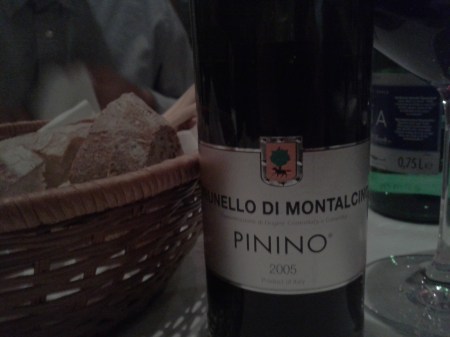 2006 Pinino Brunello di Montalcino, a half bottle from the restaurant list over dinner at Zafferano, 19 Oct 2011, for GBP52. Rather full-bodied and one-dimensional initially, almost overwhelming with a mix of red and darker berries, although one appreciates the excellent concentration and balance without any jarring edges in spite of its relative youth. The alcoholic trace receded over time and food, the red fruits becoming more dominant, the wine opening up to reveal more layering, supported by darker fruits beneath whilst the subtle plumminess of sangiovese became more noticeable. Very good, really. I find that Tuscan reds offer some of the best value in restaurant lists and this is no exception.
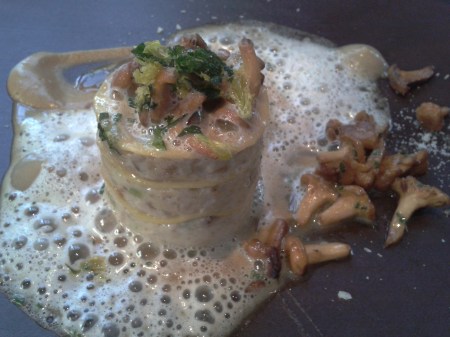 2006 Domaine Dujac Morey St-Denis 1er Cru, a half-bottle from the restaurant list over lunch at The Ledbury, 21 Oct 2011, for GBP54. A shade heavy in color for pinot, but arresting in its exuberant bouquet of sweet strawberries, cherries and other red fruits right from the first pour, matched by an intensity that held the palate in a firm grip. It opened up quite quickly over time, revealing layers of brambly fruits and cedar, the tannins more relaxed and supple, eventually transforming into a soft fleshy wine true to its Burgundian spirit with excellent balance and depth. Highly rewarding, but needs time.
Notes in brief (Oct 2011): 1998 Clos Fourtet, 2002 Faiveley Gevrey-Chambertin 1er Cru, 2006 Dead Arm, 1988 Rieussec
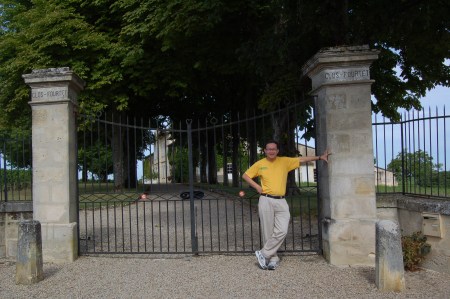 1998 Ch Clos Fourtet, over dinner at Pete’s Place, Grand Hyatt Singapore, 1 Oct 2011. In spite of having been decanted for 3 hours prior, this wine was still, surprisingly, bold and unyielding, extracted in a more modern style of St-Emilion with a salty tone in the mid-body, obviously generous in red fruits and darker berries but still rather unsettled, weighing in with hefty tannins that grew in stature over time instead of receding away.
2005 Winemaker’s Collection Episode One, at Etoile on 4 Oct 2011. Decanted on site. Deep purple with a slightly evolved tint. This is the last bottle from my first case of twelve that I started drinking since 2008, and it’s showing the best. Highly expressive on the nose with notes of ripe red and dark berries and a bit of plum, grippy and generous on the palate, excellent in concentration, fleshy and layered with raisins and cinnamon, the predominant softer merlot component all adding up to a highly inviting proposition. This is one instance where Michel Rolland’s preference for longer fruit hang and greater extraction has worked wonders on an otherwise so-so terroir.
2009 Ch Bernardotte, popped and poured from a magnum at Azur, Crowne Plaza Hotel, 6 Oct 2011. Deep purple, primarily fruit forward with notes of ripe blackcurrant and blueberries, supported by mild vanilla oak. Pretty simple and straightforward. Only time will tell whether it will gain further weight and complexity with time. At only SGD75 for a magnum, no one’s complaining.
2006 Ch de Pressac (courtesy Gerard) at Azur, Crowne Plaza Hotel, 6 Oct 2011. Popped and poured. I must say this wine was rather enticing on the nose, a healthy dollop of ripe red and dark berries that ran fairly deep with more than a hint of complex minerality. On the palate, however, it was utterly disappointing – thin, green, stern and austere at the finish witha rusty ferrous quality, a total disconnect from its bouquet.
2005 Domaine Michelot Mersault 1er Cru “les Genevrieres”, from the restaurant list at Absinthe where we were seated right inside its cellar, 7 October 2011. Absolutely lovely on the nose with exuberant creamy minerality and notes of butter, a hint of vanilla and white flowers against a soft citrusy tone. Rounded and smooth, displaying very good depth and concentration. Yet to develop further complexity but I can imagine it’ll be really excellent when that time comes.
2002 Domaine Faiveley Gevrey-Chambertin 1er Cru “Champonnet“, at Absinthe, 7 October 2011. Decanted on-site for an hour. A lovely red for pinot, soft and supple, rather feminine in character with good purity and concentration of red cherries and strawberries, medium-bodied with a light touch, elegant and beautifully balanced, totally devoid of excesses. However, it is clearly not in the same league as Clos St-Jacques. Nevertheless, it was the perfect accompaniment for lunch.
2005 Domaine Leflaive bourgogne (courtesy LW), at Tunn’s housewarming party, 26 Oct 2011. Popped and poured. Medium-bodied, relatively generous with notes of cream and vanilla, well-balanced against the moderate minerality, neither too citrusy nor crispy. Didn’t develop much further in spite of food and further aeration. Definitely well worth cellaring and re-visiting 5 years later.
2005 Wyndham Estate Black Cluster shiraz (courtesy LW) at Tunn’s housewarming party, 26 Oct 2011. Popped and poured. Dark red, typical in character with flavours of warm medicinal and herbal aromas of ripe shiraz, laced with an attractive sweetness and a trace of liquer at the finish, spicy and peppery but well-balanced, consistent with its Hunter Valley origin. Definitely not over-the-top.
2006 D’Arenberg Dead Arm shiraz, at Tunn’s housewarming party, 26 Oct 2011. Decanted for about an hour. As expected, very deep impenetrable red with aromas of ripe shiraz, dark-fruited with briar and blueberries and a touch of licorice, full-bodied and rich, excellent in concentration without being over-saturated, a lot more sophisticated than the preceding Wyndham Estate above. 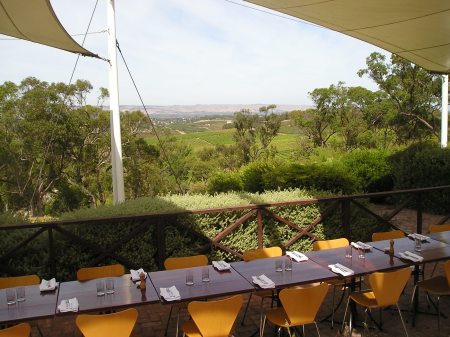 Over time, it opened up to reveal layers of dark chocolate, toffee, earth and that inevitable bit of spice that accompanies all Aussie shiraz without any alcoholic trail, always a good sign. I’d say the aging potential is excellent, and I’d leave my remaining bottles untouched for another 5-7 years, at least.
1988 Ch Rieussec, a half-bottle at Tunn’s housewarming party, 26 Oct 2011. Deeper in color than usual for a Sauternes, showing its age with low levels of acidity that doesn’t quite support the remaining fruit, imparting a rather dull lustre to the notes of peach, orangey citrus and apricot, missing much of the nectar and honey that would have added a much needed lift to the perfumed aromatics.

