Notes in brief (February 2011): 2008 Lady May
2005 Ch La Motte, a gift from a colleague, drunk at home during dinner on the first day of Chinese New Year, 3 Feb. Aired in bottle for 3 hours prior. Dark inky red. Notes of plum and licorice, laced with some sweetness. Quite well-crafted as there was no trace of heat from the 14.5% alcohol. Rather saturated on the palate, although it managed to avoid being overtly fruity, striking a good balance. I don’t usually fancy South African reds but this is actually very decent. Went well with the Chinese dishes.
2003 Ch Cissac, a half-bottle bought from Enoteca (at Takashimaya Shopping Centre, Singapore, basement 2), popped and drunk rather quickly over 45 minutes with a Monster Burger at Foo House, 6 Feb. Dark red. The initial impression was a soft wine of moderate concentration and intensity with notes of bitter chocolate and a mild herbal undertone of bramble and bush, still bearing a relatively tannic spine, slightly oaky. It got better with time, more open with better concentration and more of the ripe fruit coming through, developing into a bigger wine. We drunk it too quickly, of course, but I daresay it has plenty of potential. At only SGD28, I’m getting half a dozen more.
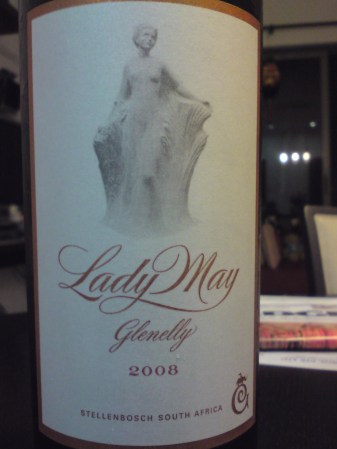 2008 Lady May Glenelly, over a lo-hei lunch at Imperial Treasure T3. Any wine made on foreign soil by an established Bordelais is bound to raise comparisons between Old and New World, and I suppose we can’t run away here. This is a new label, a straight cabernet sauvignon from the region of Stellenbosch, South Africa, made by May de Lencquesaing of Ch Pichon Lalande, aged in French oak, of course. Popped and poured. Beautful dark red, lightening towards the rim. One senses something different from the first whiff – the nose fairly open with a mix of dark and red berries, not overtly forward. More interestingly, the classic cabernet character of dried leaves, tobacco and pencil shavings are all there. In spite of its relative intensity and concentration, the medium-full wine is surprisingly gentle on the entry, broadening on the palate with a rush of fruit laced with fresh glycerin mid-way through but receding just as quickly, giving way to a tight tannic spine that’s beautifuly controlled. There’s absolutely none of that woody, plummy, spicy licorice note of New World cabernet, nor any hint of its 14.5% alcohol. One admires the expert craftsmanship. Almost feminine, befitting its assocition with Comtesse de Lalande. Does this mean it truly resembles an Old World? In many ways it does, but it does justice to the local terroir too, which is probably the best compliment one can pay. This wine can easily sell for twice the price. But it’s only SGD60, from Bob Rees of WEA. Excellent!
2003 Ch Pibran, a magnum bought from Vinum for SGD140, drunk over a final Chinese New Year dinner at Hua Ting restaurant, Orchard Hotel, Singapore. Decanted for an hour. This Pauillac estate, with vineyards close to Mouton Rothschild, usually produces stern robust oaky reds during good vintages, whilst difficult years may result in weedy wines lacking adequate stuffing. The hot uneven 2003 vintage tends to favour the Left Bank, and it shows. There is a very decent mix of blueberries and dark fruits with good density and concentration and a bit of layering as well. It became more plummy and intense after some time, developing a tannic finish. Not bad at all. Something you can use as a starting red to slosh the non-drinkers.
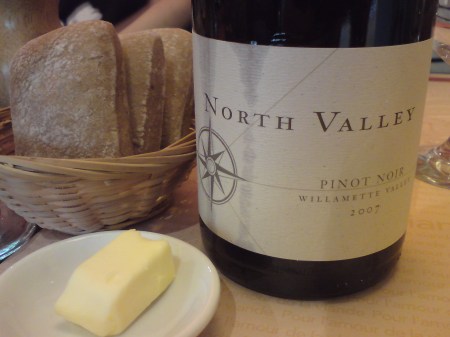 2007 North Valley Pinot Noir, from the region of Willamette in Oregon. Bought off the restaurant list of Hippopotamus restaurant at Marina Square for SGD68. Popped and poured, served in decidedly sub-optimal glasses. A dull shade of pinot. Somewhat thin and alcoholic (13.6%) at the beginning, but this dissipated quickly, allowing the fruit, admittedly quite lovely, to emerge. Usual red fruits and cherries dominate, appropriately dense on the mid-palate with a trace of licorice and raspberries, good concentration, tapering to a sharp accent on the finish. This is a very decent effort.
2005 Ch Villars de Fontaine, a white bourgogne from the Hautes Cotes de Nuits, over a yusheng dinner at Roland restaurant on 5 Feb. This is my third bottle from a half dozen purchased from Le Benaton some 3 years ago. Aired briefly in bottle before being served. Dull golden. Grassy overtones dominate initially, the wine seemingly shut and bereft of character. Things got a lot better after an hour, with some caramel, cream and almonds appearing on the nose while a wall of stony minerality developed on the palate, slightly sharp but well-defined, admittedly. The grassy notes receded somewhat but still dominated at the finish. This wine could do with more layering, depth and concentration. Difficult to tell how it would all turn out.
1998 Louis Jadot Beaune “Clos des Ursules” 1er Cru, over dinner at Uluru steakhouse. Dull light purple tint. Popped and poured. Subdued initially on the nose, but it opened up after some airing to reveal abundant red fruits, strawberries and cherries. Medium-bodied and homogenous, somewhat thick in the middle with a salty accent, leading to a moderate finish. Lacking in real depth and layering, perhaps symptomatic of the reds south of the Cote des Nuits.
2008 Neudorf sauvignon blanc, from the region of Nelson, New Zealand, on a hot afternoon, 6 Feb, at the residence of the former Honorary Consul to Cyprus. Straw-colored. Bitter citrus and pomelo predominate, along with steely minerality that led to a stern, austere finish. I can’t say I enjoyed it.
2006 Ch Martet, a magnum ordered off the restaurant list of Le Bistrot du Sommelier in Singapore on the last day of February, courtesy of FJP. This is a 100% merlot grown in the region of Graves. Decanted in the restaurant. Deep garnet core with a dark purple rim. A bit muted on the nose initially, but it gradually opened up with notes of dark berries, blueberries and violets. Soft and accessible on the palate without the cabernet structure but the fruit is nicely ripe and long-flavoured, adding to the supple tannin along its spine. Lacking in real depth and layering, and rather pricey at SGD220 for what is, after all, an unclassified growth but it went well with the 1.6 kg of cote de boeuf.
2004 Col D’Orcia Brunello di Montalcino
With a heavy thud, followed immediately by the sickening sound of splintering glass, I stared in utter disbelief as my bottle of 1994 Ch L’Evangile, meant for Valentine dinner at Gattopardo this evening, lay bleeding profusely at the entrance of Hotel Fort Canning, Singapore.  It’d dropped from the car the moment I’d opened the car door, just as the valet was about to takeover the wheel. It was terminal. I tried to laugh it off nonchalantly, but I knew one of the stars of 1994 had been extinguished, prematurely.
The only option was to purchase a bottle from the restaurant list, which comprised entirely of Italian wines (no Bordeaux, no Burgundy). After some perusal, and making sure that I’d impressed upon the sommelier that SGD400 for a bottle of Guado al Tasso was simply outrageous, I settled for a 2004 Col D’Orcia Brunello di Montalcino for SGD160. Decanted on-site, displaying a lovely ruby glow that could easily pass off as a pinot noir, just a shade heavier. Quite restrained on the nose initially, the 14% alcohol making itself felt even if it wasn’t assertive. Notes of red fruits became more dominant with time as the alcohol began to dissipate, the bouquet increasingly more perfumed as well whilst a concentrated, balanced mix of red and dark berries lay siege on the palate with a firm grip of reasonable complexity, leading to a mild tannic spine and a lasting minty finish. Rounded, without any jarring edges. It kept developing further with notes of cinnamon and even a hint of smoke, such that I was reluctant to finish the last drop two hours into dinner. Excellent.
Chambolle-Musigny 1er Cru
The Burgundian group gathered on 20 January 2011, once again at Jade Palace upon the occasion of another of YW’s visits back home. KG masterminded yet another lofty theme, the premier cru of Chambolle-Musigny which number 24 in total.
I arrived late to find that the group was already almost done with a bottle of 2002 Dom Perignon (courtesy of KG). Light-golden and rather reticent on the nose. Yet its illustrious pedigree is unmistakable, for in spite of its brazen minerality, this full-bodied wine was remarkably well-balanced, the alcohol, acidity and wood perfectly offset by the ripe fruit. Tightly coiled, of course, but the sense of depth was already quite apparent. Excellent now, but will be great in 2031.
The first red was a 2005 Domaine Faiveley Chambolle-Musigny “Les Fuees” 1er Cru (courtesy of Yap Seng), decanted on-site. Deep ruby. Restrained and tight, consistent with its youth, with a petroleum note on the nose that was quite alluring. However, it is not as rich on the palate as suggested by its color, medium-bodied with dscernible new oak but well-balanced and silky smooth without any harsh edges, thinning out towards the finish initially. 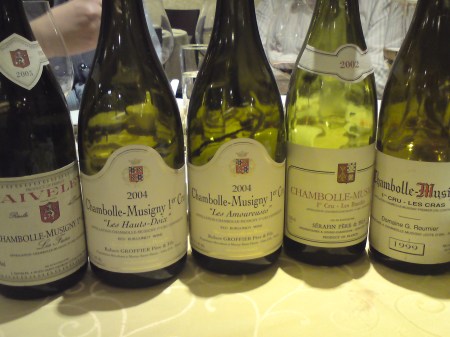 It began opening up after some time with a deeper vein of red fruits. It’s good to see Faiveley on form in this great vintage.
Next was a pair of Robert Groffier Pere et Fils Chambolle-Musigny 1er Cru, drunk side-by-side. The 2004 “Les Haut Doix” (courtesy of See Lim), displaying a classic pinot tint, exuded a powerful bouquet that was highly perfumed, rather feminine. Very lovely. Rich on the palate, containing substantial fullness in the mid-body with excellent definition and delineation, tapering to a gentle finish. Quite complete. Excellent as that was, the 2004 “Les Amoureuses” (courtesy of KG) – from the same producer – was darker in color and appreciably superior by a significant margin, being much more layered, imbued with wonderful purity and an enticing richness in the middle, superbly balanced, displaying great definition and linearity all the way to its lively finish. There’s a bit of an orange peel note amidst all the complexity, contributing to the wonderful spine of lasting flavours. Has the layering that’s missing from the Haut Doix. Very, very lovely. Definitely belonging to the Grand Cru class.
The 2002 Serafin Pere et Fils Chambolle-Musigny “Les Baudes” 1er Cru that followed was just as deep in color, but the similarity ended there. This was a huge wine, absolutely full-bodied and dense, rich in red fruits with a dash of spice. Still very primal. Unfortunately, there’s a good deal of extraction going on, which was a pity as the glorious fruit that’s evident from such a stellar vintage would have benefitted infinitely from more delicate handling. In that sense, it was disappointing. It opened up a little with time, but this isn’t ready at all. Will it ever? In contrast, the final wine, a 1999 George Roumier Chambolle-Musigny “Les Cras” 1er Cru (courtesy of JJ), managed to avoid the excesses of an outstanding vintage. Rather dark in color and dense, but it managed to maintain a good balance with the purity of the fruit coming through. The finish was somewhat short, but it was a wine worthy of rounding up the excellent evening. My sincere thanks to all for their kind generosity.
Mouton Rothschild: 1983, ’86, ’87, ’95 & ’99
Looking through my diary, I discovered that the ultra-snob wine circle – Bacchus – had met only once in 2010 (see Final Blowout at Iggy’s, Aug 2010), which was all too infrequent. To make amends, we wasted no time organising a dinner that took place on 19 January 2011, paired with a First Growth theme, a vertical of Ch Mouton Rothschild, no less. For some reason, people tend to avoid this l’enfant terrible when pulling out Firsts from their cellars, probably because of its lack of consistency, and so we thought this would be a great theme. The location was Novus, an impressive establishment located right within the National Museum serving modern European cuisine (but none of that molecular crap, thank goodness), helmed by a chef who had previously worked at Fat Duck, London. 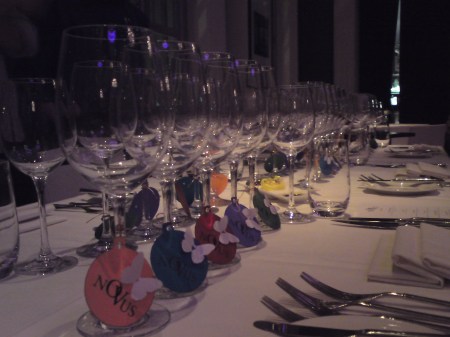 We arrived to find that we had the entire restaurant to ourselves, the table already laden with glasses, each polished to high gleam and labeled. Truly impressive. We’d all declared what we’re bringing – for sure there’d be a 1983 (courtesy of Vic), 1986 (LF), 1987 (Hiok), 1995 (Kieron) and 1999 – but, nevertheless, the wines were served blind, the order left to the maitre’d to organise. The 1987 and 1999 were double-decanted in advance and aired again in decanter on site, while the rest were decanted only at the restaurant.
As usual, we began with a white, a 1996 Louis Latour Chevalier-Montrachet Grand Cru (courtesy of Danny). Dull golden. Too cold initially, but its bouquet was most alluring with notes of peaches and tropical fruits which opened up further to reveal dense oily aromas of apricot, almost honeyed, very lovely. However, to my surprise, there was a major de-sync between bouquet and palate, which was lighter in texture but steely and stern, almost bitter, layered with mild grassy overtones that’s a signature of Louis Latour. So, extremely lovely on the nose, but I can’t quite say the same for the palate.
We dived straight into Red#1, dusty dark red with some browning towards the rim. There was a prominent barnyard aroma that blew off to reveal a most lovely bouquet of cassis and dried herbs, rather deep. On the palate, the wine was medium-bodied, very homogenous and seamless with lots of finesse and elegance, with a finish of sweet meats. Clearly a well-aged wine but the fruit is still holding on. Far from being on its last legs. One is struck by its impeccable balance. Judging by its color, I thought this was likely to be the 1983.
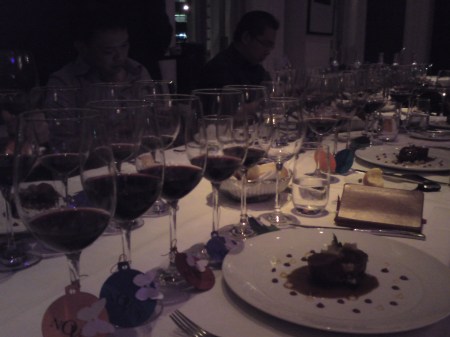 Red #2 that followed was darker in color but compared to the first red, this was very muted on the nose, highly reticent, and whatever that came through had a suggestion of dryness, although some sweetness was detectable. The wine was similarly unsmiling on the palate, medium-bodied and rather stern, almost austere. The fruit was definitely drying out, leaving behind mainly a framework of alcohol and tannin. It managed to put on some weight, but was still lacking in density, eventually beginning to fade as dinner ended. Must be the 1987, surely, a forgotten vintage that has almost disappeared from the face of the earth.
Red #3 seemed to be a younger wine, judging from its deeper, more luxuriant ruby red. Some thought it lost out to the first red on the nose, but as dinner wore on, this wine simply kept developing in character and complexity, so much so that by the end of dinner, this was one of only two wines that merit serious consideration as to the possibility of it being the 1986. I thought it was already quite open from the first pour, still rather primal on the nose, of course, with a high-toned minerality and some early secondary characteristics. Gentle on the entry, revealing excellent depth and concentration, quite opulent and rounded with a lovely fruity glow, taking its time to unfold. Highly cerebral. A wine that’s clearly yet to peak. Can it be the 1986, still so youthful after all these years? Most of us thought so.
Red #4 displayed a very impressive red, obviously still rather young but it was, surprisingly, less open on the nose. Fairly big on the palate, hitting the right cabernet notes of tobacco, smoke, herbs and mushrooms with a touch of spice, fairly long, yet to develop its secondary nuances. But coming after the preceding red, this was clearly less opulent and lacking in charm. Ultimately underwhelming. Put simply, it doesn’t taste like a First Growth. We deduced that this must be the 1999, a watered-down vintage.
Finally, Red #5 which had the deepest red of all. Unassuming at first, like a nondescript bystander, but it went quietly from strength to strength, taking its time to develop, such that it was some time before we realised we were drinking something great. This had power, great stuffing and superb integration in spite of it being seemingly very youthful and backward. It became massive by the end of dinner but one senses there’s still plenty of unrealised potential.  Tightly coiled, yet to unfurl its full colors. Could it be the 1986? However, judging by its color, most of us felt it more likely to be the 1995.
Actually…the order drunk was: 1987, 1983, 1999, 1995 and 1986. How did we end up being so screwed up??!! It’s like being privy to a set of leaked exam questions, and yet still writing the wrong answers! The 1987 and the 1995 defy all expectations, at polar extremes. The same could be said about the 1999, almost rivaling the 1986. Could it be because of double-decanting that the 1987 and the 1999, both dark horses, surpassed all expectations? But we were tuly at a loss to explain the disappointing 1995…an off bottle? Or still shut down? It certainly merits re-consideration. And about the 1986…one of the reasons I had difficulty identifying it was because all the while, I was recalling the tasting experience I had three years back (where there was plenty of layering) but I didn’t seem to find it at this present tasting. By the time it began to develop, I was open to too many doubts and re-doubts about the whole lineup. I guess the lessons learnt are: i) possessing prior knowledge, or being open to the power of suggestion, really tips the bias and affects one’s judgment, for the worse; ii) Mouton is truly inconsistent.
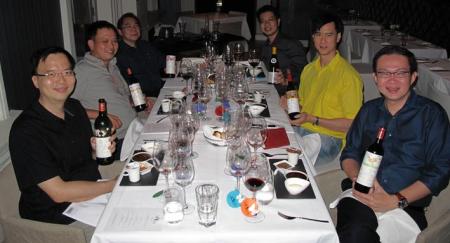
Thanks again to all for this great experience but next time, we need to do a theme that’s friendlier to the wallet, but we’ll be back at Novus, for sure.
1998 Krug
Aired briefly in bottle for about 30 minutes before being served at Golden Peony, Conrad International Singapore, this evening on the occasion of Mom’s 80th birthday and drunk over the next two-and-a-half hours. Clear golden. The initial whiff only yielded some toasty oak and roasted almonds that was met on the palate by a high-toned crystalline minerality from the medium to full-bodied wine. Gradually, as it sat in the glass, further notes of white flowers, walnuts and malt crept in, developing more depth at the same time, the fizz settling down onto a more even spread, allowing one to appreciate the fine balance between the lively acidity, alcohol and fruit, the yeasty hallmark of Krug making an appearance as well. 1998 is the last vintage of that decade for Krug (after 1990, 1995 & 1996) and I must say the 1998 doesn’t lose much ground at all next to the 1996. This has the trappings of a generous wine that’s still obviously very youthful. I shall leave my remaining bottles alone to flesh out over this decade whilst accumulating more. At SGD288 (airport duty-free), it’s almost a steal.
2000 Ch La Dominique
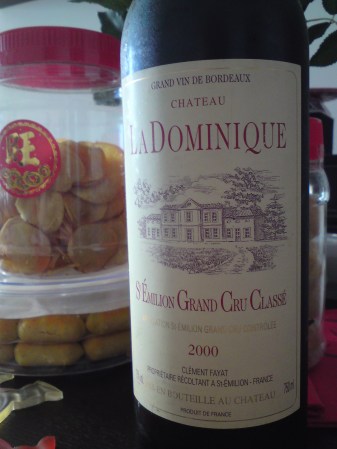 A bottle that had been immaculately stored in my cellar for the past 5 years, drunk this evening with the broader family at our Chinese New Year Eve reunion dinner. Dusty dark red. There was a whiff of musty oak when I decanted it at 3.30PM. By the time I poured it at 7.00PM, the oakiness had disappeared but the wine was hardly impressive, the fruit seemingly reticent save for a predominance of licorice and mint against a background of musty forest undergrowth, somewhat disjointed although in no way jarring. Its true colors only emerged another hour later when the ripe fruit, a mixture of red and dark berries, began emerging to the fore with an easy grip on the palate, generously flavoured and long with excellent concentration and intensity, soft at the edges yet rather youthful in character, hardly developing any secondary nuances but maintaining a lovely balance. Quite fine, I must say, although it sure took a long time to develop, probably a trait of this outstanding vintage. Best to refrain from popping any for the next 5 years.
2004 Ch Belle-Vue (courtesy of Dr CJ Ooi), at Xin Cuisine on 6 Jan 2011. This used to be one of my favourite restaurants, and it’s good to see that its wine service is impeccable. Popped and poured. I’ve not heard of this estate and the simple label didn’t appear promising, but to my surprise, the bouquet was fairly deep right off the blocks, with loads of mulberries and dark cherries and that bit of forest floor character that’s unmistakably Medoc. Just a tad thin on the mid-palate initially, but this corrected nicely as the wine gained weight rapidly, fleshing out with a fair degree of complexity amidst notes of plum, graphite and intense minerality, rounded at the edges, drinking well. Very good.
2001 Ch Sociando-Mallet, my second bottle in as many weeks, but this bottle (only SGD79!!) came from a fresh supply collected from Crystal Wines, drunk concurrently with the 2004 Ch Belle-Vue above. Popped and poured. Noticeably darker, deeper, weightier and more complex than the Belle-Vue. There’s plenty of dark berries and intense minerality on the nose, but the wine was initially very smooth and seamless on the palate, drinking like a mature Bordeaux. Its true colors emerged after 20 minutes – revealing superb concentration and depth that held rich layers of fruit amidst emerging secondary notes of dark chocolate, toffee and minerals framed by velvety tannins that puts this wine firmly within the classified growths. Long-flavoured, not quite the epitome of elegance and finesse yet, although there’s no doubt it is headed there. I daresay it sits comfortably within Deuxieme Cru at this stage. Will it knock on the doors of Premier Cru in 2020? I suggest you snap up as many as you can.
2005 Les Hauts de Smith, at Imperial Treasure T3. Still drinking through a half-case purchased back in 2009. Compared to previous tastings, this wine has become more seamless and integrated with an easy grip on the palate, the minerality more recessed into the background. Elegant, if not exactly exciting. I maintain that this is an excellent second wine, provided the price is right.
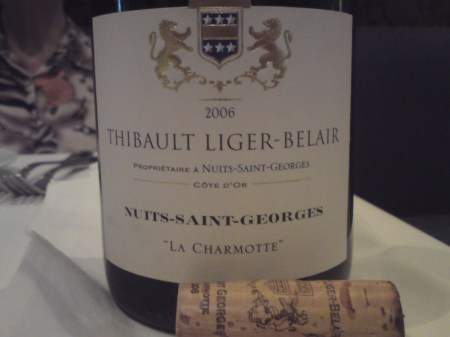 2006 Domaine Thibault Liger-Belair Nuits Saint-Georges La Charmotte, over dinner at Moomba, 15 Jan, with the family. For reasons unclear, we had the entire restaurant to ourselves. Popped and poured, showing a rather heavy pinot tint, laden on the nose with notes of red cherries, raspberries and rose cordial. Surprisingly soft and silky smooth on the palate, developing some spicy tannins at the finish with further aeration, but it lacked real depth and complexity. Very agreeable, nevertheless.
2004 Ch Monbousquet, over dinner with a couple of Residents at Broth. Decanted briefly at the restaurant. Purplish-red, with quite an attractive fragrance of red fruits and cherries. Soft, surprisingly accessible without the usual density of a modern St-Emilion. In fact, it took on more of a Burgundy character with time, as more notes of rose cordial and raspberries appear. Doesn’t say much about terroir but with the pricing of Monbousquet remaining realistic even in stellar vintages, I doubt anyone would mind.
1994 Ch Montrose
 Popped and poured over dinner with the family at Imperial Treasure T3 this evening. Still a deep impenetrable red at the core, lightening up towards the rim. Rather attractive on the nose with a lovely mix of red and dark berries as well as firm minerality (you can really smell that), but the wine was rather thin on the palate initially, devoid of much of the promised fruit, leaving just a structure of drying tannins and alcohol. After 45 minutes, the minerality on the nose grew in intensity, the fruit more forward as well, the wine fleshing out quite beautifully in bold strokes, becoming weightier with greater density and concentration, long-flavoured with notes of soy and rounded at the edges although I must say I didn’t quite get a sense of the St-Estephe terroir. More like a modern St-Emilion. Still, it’s rather fine.
This fastidious grower is quite a household name for flinty Mersault whites, but he has plots of red as well (belonging to his wife’s family, I believe), notably in Corton and Savigny-les-Beaune. 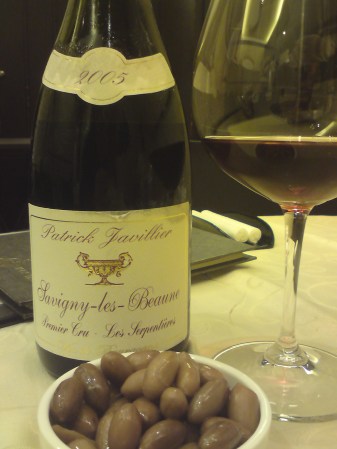 I cracked open one of three bottles of 2005 Domaine Patrick Javillier Savigny-les-Beaune Les Serpentieres 1er Cru, bought about 3 years ago from Le Benaton for only SGD53 each, over dinner with the wifey at Jade Palace last night as I was curious to get an impression of this wine. Popped and poured, showing a classic pinot tint, slightly dull. A generous bouquet of red cherries wafted across that was reinforced on the palate, though initially a tad heavy for pinot noir without any secondary development. Things became interesting an hour later as the wine really opened up to reveal notes of other red fruits and raspberries, fresh and bright, more remarkable for its excellent balance and concentration than outright opulence or depth, with plenty of spine and flavour but rather lean in the mid-body, missing the oily texture of great Burgundy. This is really quite fine and enjoyable, but I’m not touching my remaining two bottles for another 5 years, at least.
Ric’s Most Memorable Wines of 2010
Here goes Ric’s choices, based on the 55 new posts in 2010…
Best Unaffordable Red: 1995 Domaine de la Romanee-Conti Richebourg Grand Cru. Like I said last year, a great burgundy beats everything hands-down. Thanks, Danny.
Best Affordable Red: 1990 Ch Chasse-Spleen (thanks, Hiok). Who would have thought that a Moulis en Medoc can resemble a Haut-Brion? Another deserving winner would be the 1985 Dominus proprietary red…if you can find it. Thanks, PS.
Most Memorable Red: 1998 Ch Ausone and 2003 Pingus, for the wrong reasons: they are the two most expensive bottles that I’ve ever purchased just for the express purpose of drinking; we drank them far too young; they are bloody over-priced.
Best Value Red: 2005 Ch D’Aurilhac, followed closely by the 2005 Ch D’Escurac, both at similar price points of only SGD27, but drinking like classified growths.
Most Disappointing Red: 2001 Beringer Private Reserve cabernet sauvignon. I think Dominus is the best bet for California reds. Period.
Worst Red: 2007 Fontant de France cabernet. Not acceptable to be served on board Singapore Airlines. The 2000 Ch Mouton (not Rothschild!) and the 2005 Domaine Louis Latour Beaune Vignes Franches 1er Cru come close as well in mediocrity.
Best Unaffordable White: None. I don’t have deep pockets, but I don’t think I drank any that I’d consider unaffordable.
Best Affordable White: 2002 Leeuwin Estate Art Series chardonnay (if you can find it…thanks, K), proving that this wine is really a match for the best chardonnays. Close behind is the 2007 Peter Michael Mon Plaisir chardonnay.
Most Memorable White: I’ll opt for a bubbly here, the 1990 Dom Perignon, at the final blowout at Iggy’s, sharing the stage with Ausone and Pingus. Thanks again, Danny boy.
Best Value White: 2007 Dog Point Section 94 sauvignon blanc, that just pipped the 2009 Grosset Polish Hill riesling, both similarly priced at SGD46.
Most Disappointing White: 2007 Heritiers du Comte Lafon Macon-Milly-Lamartine. Worse, it’s over-priced.
Worst White: None, really.
I must thank all friends and contributors who had so unselfishly made available these wines for tasting. Bon vin et merci beaucoup!
 Ric's Wine Journal